


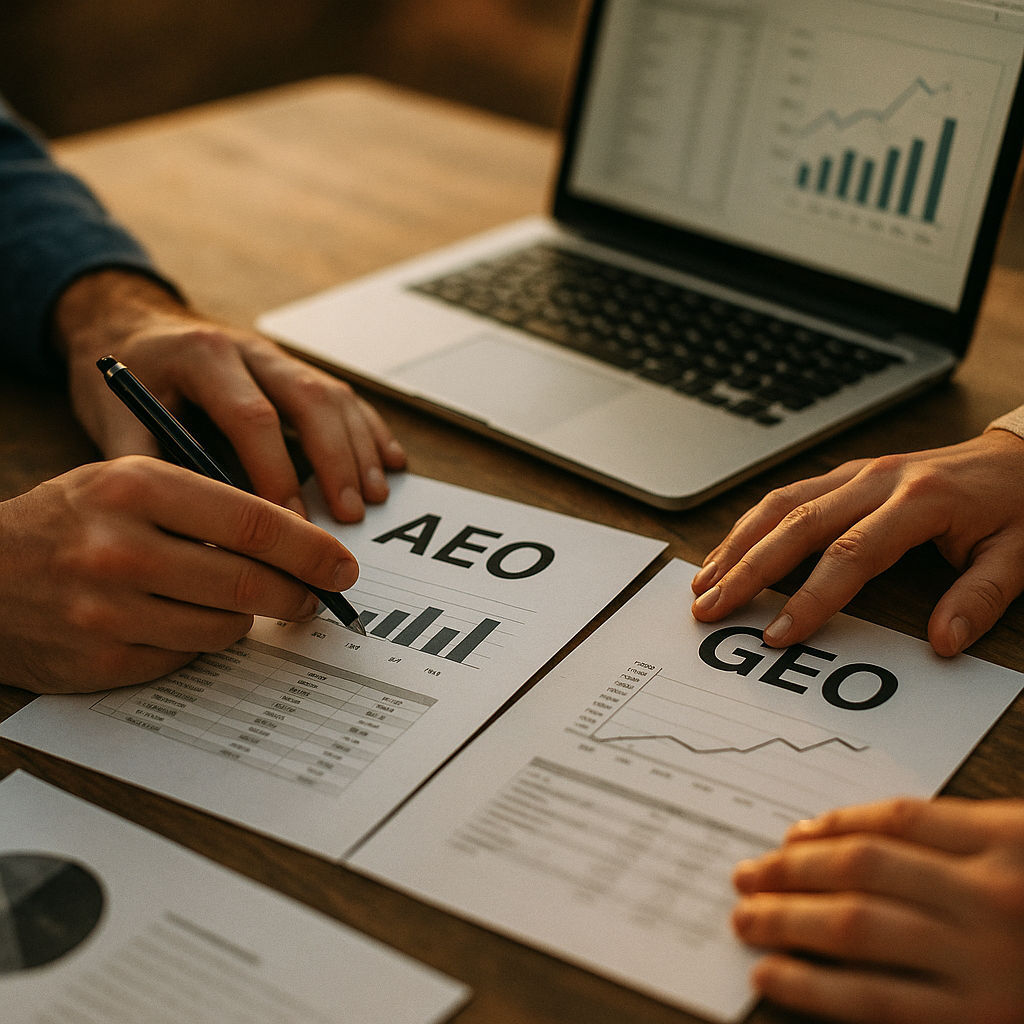
Roughly 60% of Google searches now end without a click, and the number climbs higher every time Google or OpenAI ships a new answer feature. So when a vendor pitches you on “Answer Engine Optimization vs Generative Engine Optimization,” the real question isn’t which acronym wins. It’s whether your brand shows up at all when the answer engine has already made up its mind. Let’s separate the two disciplines properly, because conflating them is costing brands visibility budget they can’t get back.
Two Different Problems Wearing Similar Names
Answer Engine Optimization (AEO) is about structuring content so it gets pulled into direct-answer surfaces: featured snippets, voice assistant replies, Google’s “People Also Ask” boxes, and increasingly, AI Overviews. It’s fundamentally an information-architecture discipline. You’re optimizing for extraction — making your content the cleanest, most citable chunk available for a specific query.
Generative Engine Optimization (GEO) is broader and messier. It’s about influencing how large language models represent your brand across an entire generative response, not just a single answer box. Think ChatGPT summarizing “best CRM platforms for mid-market teams,” or Perplexity synthesizing a multi-source answer about influencer marketing agencies. GEO cares about brand mentions, sentiment, and share of voice inside a generated narrative — not just whether you got the snippet.
AEO optimizes for a slot. GEO optimizes for a story the AI tells about your category — and your brand’s place in it.
That distinction matters more than most agencies admit. A brand can dominate AEO — owning every relevant snippet — and still be invisible in GEO if the LLM’s training data and retrieval layer never surface it as a credible source when generating a broader recommendation.
Why Late-Stage 2026 Changes the Math
Search behavior has shifted structurally, not incrementally. Google’s AI Mode is no longer a beta experiment; it’s a default entry point for a growing share of commercial queries, and it’s increasingly executing actions on its own rather than just summarizing. We’ve already covered how AI Mode now executes ads autonomously, which tells you Google isn’t just answering questions anymore — it’s closing loops. That changes what “visibility” even means.
Meanwhile, generative platforms like ChatGPT, Perplexity, and Claude have their own retrieval and citation logic, largely decoupled from traditional search rank. A page that ranks #1 on Google can be entirely absent from a Perplexity answer if its retrieval-augmented generation (RAG) pipeline weights different signals — freshness, structured data, third-party corroboration, or domain authority scored differently than PageRank ever did.
This is why brands need to stop treating “AI search optimization” as one line item. It’s at least two disciplines, sometimes three if you count traditional SEO as a separate legacy layer still driving real traffic.
The Technical Stack Underneath Each Approach
AEO leans hard on structured data. Schema markup (FAQPage, HowTo, Product, Article), clear H2/H3 hierarchies, concise definitional answers in the first 40-60 words of a section, and semantic HTML that search crawlers parse cleanly. It’s an extension of technical SEO, just tuned for extraction rather than ranking.
GEO relies on a different signal stack:
- Corroboration density — how many independent, credible sources mention your brand in similar context. LLMs weight consensus heavily.
- Entity clarity — whether your brand is unambiguously defined as an entity (via Wikipedia, Wikidata, Crunchbase, structured knowledge graphs) rather than just a keyword.
- Retrieval freshness — RAG-based tools like Perplexity and Google’s AI Mode pull live or recently indexed content, so stale authority doesn’t carry the same weight it did in classic SEO.
- Citation-worthy phrasing — content written in extractable, quotable sentences that an LLM can lift with attribution intact.
We’ve written before about how structured data fixes AI citation gaps, and that piece is still the most practical technical starting point for GEO work specifically — it’s less about ranking, more about being a trustworthy node in the AI’s retrieval graph.
Where Brands Get the Comparison Wrong
Most marketing teams treat AEO and GEO as a single “AI SEO” budget line, then wonder why results are inconsistent. Here’s the practical failure mode: a brand invests in schema markup and FAQ-formatted content (good AEO hygiene), sees a lift in featured snippets, and assumes their generative visibility improved too. It didn’t. Snippet visibility and LLM citation frequency are correlated, not causal.
According to eMarketer research on evolving search behavior, a meaningful and growing share of consumers now use AI chat tools as a first-stop research destination for purchase decisions, bypassing traditional search entirely for certain categories. That’s a GEO problem, not an AEO one. If your content strategy stops at snippet optimization, you’re solving for a shrinking slice of the discovery journey.
Snippet share and LLM citation share are different KPIs, tracked by different tools, moved by different levers. Budgeting for one doesn’t buy the other.
The inverse mistake happens too. Some teams chase GEO exclusively — chasing ChatGPT mentions, running “AI visibility audits,” obsessing over Perplexity citations — while ignoring that Google’s AI Overviews still draw heavily from traditional ranking signals and structured markup. You can’t skip the AEO foundation and expect GEO gains to compound on nothing.
A Practical Framework: Which One Gets Budget First?
If your category has high commercial intent and clear factual questions (pricing, comparisons, “how to” queries), prioritize AEO first. It’s cheaper, faster to implement, and the tooling is mature — most technical SEO platforms already support schema validation and snippet tracking.
If your category is narrative-driven or reputation-sensitive (B2B software, professional services, anything where “best X for Y” recommendations matter), GEO deserves earlier investment. You’re not fighting for a snippet; you’re fighting to be one of the three brands an LLM decides to name in a synthesized answer.
Realistically, most brands need both, sequenced:
- Audit your current data foundation — you can’t optimize either discipline on messy, contradictory, or duplicated content. This is the same diagnostic work covered in auditing your AI data foundation, and it applies directly to AI search visibility, not just campaign AI.
- Fix structured data and entity clarity — schema, knowledge graph presence, consistent NAP (name/address/phone) and brand descriptors across the web.
- Layer in citation-focused content — comparison pages, original research, quotable stats — the kind of content LLMs actually lift.
- Measure separately — track snippet share (AEO) and brand mention frequency across AI platforms (GEO) as distinct KPIs, not one blended “AI visibility score.”
On the measurement point specifically, tooling has matured fast. If you’re evaluating vendors, the tiering breakdown in our AI visibility audit buyer’s guide is a useful starting filter — free tools mostly track snippet-adjacent metrics, while enterprise platforms are starting to offer genuine cross-model citation tracking.
The Compliance Angle Nobody’s Pricing In Yet
Here’s something legal and brand safety teams should be flagging: when an LLM generates a claim about your product, pricing, or performance, and gets it wrong, who owns that error? Traditional SEO never had this problem — a wrong snippet was your content’s fault. A hallucinated GEO citation might be the model’s fault, but it’s your brand’s reputational risk.
This connects directly to the hallucination governance conversation happening across enterprise AI right now. If you haven’t reviewed a RAG vendor comparison for hallucinated claims, it’s worth doing before you scale GEO content investment, because the same retrieval mechanics that make GEO possible are the ones that can misattribute claims to your brand.
There’s also a broader AI governance thread here worth connecting: brands running AI agent governance checklists for media buying should extend the same override-and-monitor discipline to AI search visibility. If an AI agent starts making purchase recommendations that cite your brand incorrectly, you want a documented process for correction requests, not a scramble.
What This Means for Budget Allocation, Concretely
Stop asking “how much should we spend on AI SEO.” Ask two separate questions: how much should we spend making our existing content extractable (AEO), and how much should we spend building the kind of authoritative, corroborated, entity-clear presence that gets us named in generative answers (GEO)?
For most mid-to-senior marketing teams, a workable split for the next planning cycle looks like 40% AEO (technical fixes, schema, snippet-targeted content refreshes) and 60% GEO (original research, PR-driven corroboration, structured entity building, citation-format content). That ratio shifts based on category, but the split itself — treating them as separate budget lines with separate KPIs — is the actual unlock.
Industry benchmarking data from Statista on AI-assisted search adoption continues to show upward momentum across both consumer and B2B research behavior, which is the strongest signal yet that this isn’t a passing trend to deprioritize until “things settle down.” They’re not settling down.
Next step: Run a two-track audit this quarter — one measuring snippet and featured-answer share (AEO), one measuring brand mention frequency and sentiment across ChatGPT, Perplexity, and Google AI Overviews (GEO). Treat the gap between them as your actual roadmap, not a rounding error.
FAQs
Is Generative Engine Optimization just a rebrand of SEO?
No. GEO targets how large language models synthesize and cite brand information across generated answers, which relies on retrieval mechanics, entity recognition, and corroboration signals that differ substantially from classic ranking factors.
Can a brand do AEO without GEO, or vice versa?
Technically yes, but it’s inefficient. AEO without GEO leaves you invisible in chat-based research tools growing fastest among B2B buyers. GEO without AEO ignores the structured data foundation that also feeds Google’s AI Overviews.
How do you measure GEO performance separately from traditional SEO?
Track brand mention frequency, citation accuracy, and sentiment across specific AI platforms like ChatGPT, Perplexity, and Google AI Mode, using dedicated AI visibility tools rather than traditional rank trackers.
What’s the biggest technical risk with GEO right now?
Hallucinated or misattributed claims. Because GEO content gets pulled into generative summaries, an LLM can misrepresent pricing, features, or claims in ways traditional search snippets never did, creating brand safety exposure.
Should smaller brands prioritize AEO or GEO first?
Smaller brands with limited budgets typically get faster ROI from AEO — schema markup and snippet-targeted content are cheaper to implement and show measurable results sooner than building the corroboration density GEO requires.
Top Influencer Marketing Agencies
The leading agencies shaping influencer marketing in 2026
Agencies ranked by campaign performance, client diversity, platform expertise, proven ROI, industry recognition, and client satisfaction. Assessed through verified case studies, reviews, and industry consultations.
Moburst

-
2

The Shelf
Boutique Beauty & Lifestyle Influencer AgencyA data-driven boutique agency specializing exclusively in beauty, wellness, and lifestyle influencer campaigns on Instagram and TikTok. Best for brands already focused on the beauty/personal care space that need curated, aesthetic-driven content.Clients: Pepsi, The Honest Company, Hims, Elf Cosmetics, Pure LeafVisit The Shelf → -
3

Audiencly
Niche Gaming & Esports Influencer AgencyA specialized agency focused exclusively on gaming and esports creators on YouTube, Twitch, and TikTok. Ideal if your campaign is 100% gaming-focused — from game launches to hardware and esports events.Clients: Epic Games, NordVPN, Ubisoft, Wargaming, Tencent GamesVisit Audiencly → -
4

Viral Nation
Global Influencer Marketing & Talent AgencyA dual talent management and marketing agency with proprietary brand safety tools and a global creator network spanning nano-influencers to celebrities across all major platforms.Clients: Meta, Activision Blizzard, Energizer, Aston Martin, WalmartVisit Viral Nation → -
5

The Influencer Marketing Factory
TikTok, Instagram & YouTube CampaignsA full-service agency with strong TikTok expertise, offering end-to-end campaign management from influencer discovery through performance reporting with a focus on platform-native content.Clients: Google, Snapchat, Universal Music, Bumble, YelpVisit TIMF → -
6

NeoReach
Enterprise Analytics & Influencer CampaignsAn enterprise-focused agency combining managed campaigns with a powerful self-service data platform for influencer search, audience analytics, and attribution modeling.Clients: Amazon, Airbnb, Netflix, Honda, The New York TimesVisit NeoReach → -
7

Ubiquitous
Creator-First Marketing PlatformA tech-driven platform combining self-service tools with managed campaign options, emphasizing speed and scalability for brands managing multiple influencer relationships.Clients: Lyft, Disney, Target, American Eagle, NetflixVisit Ubiquitous → -
8

Obviously
Scalable Enterprise Influencer CampaignsA tech-enabled agency built for high-volume campaigns, coordinating hundreds of creators simultaneously with end-to-end logistics, content rights management, and product seeding.Clients: Google, Ulta Beauty, Converse, AmazonVisit Obviously →