


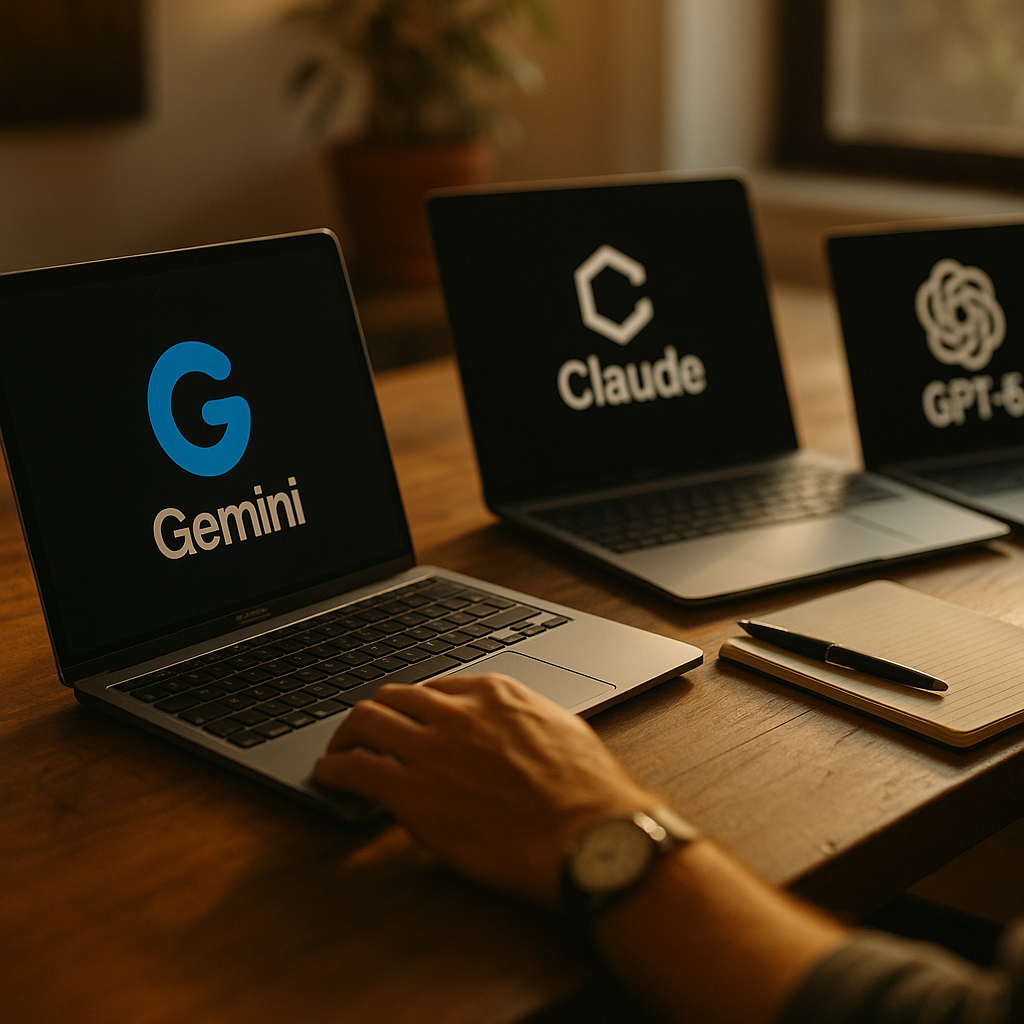
Ask three copywriters to draft the same product launch email and you’ll get three distinct voices. Ask three frontier LLMs to do it, and you’ll also get three distinct failure modes. In a recent internal test across 40 brand-voice prompts, one model fabricated a product spec that didn’t exist, one flattened a playful DTC brand into corporate mush, and one nailed the tone but invented a discount code out of thin air. This is the real state of Gemini vs Claude vs GPT-5 marketing copywriting right now, and it’s more nuanced than any vendor benchmark will tell you.
Why This Comparison Matters More Than Last Year’s
Marketing teams stopped asking “should we use AI for copy” two years ago. The question now is which model, for which task, with how much oversight. Budgets have shifted accordingly. eMarketer and Statista both point to double-digit growth in generative AI spend inside marketing orgs, but the money is increasingly split across multiple models rather than consolidated into one “house LLM.” That fragmentation is smart, but it creates a new operational headache: nobody’s evaluation framework has kept pace with the actual differences between models.
Most brand teams still choose based on vibes, or worse, whichever model their agency happens to have a login for. That’s not a strategy. It’s a liability waiting to surface in a client review.
What “Brand-Voice Fidelity” Actually Means
Brand-voice fidelity isn’t “does it sound good.” It’s a measurable property: given a style guide, a set of reference copy, and a new brief, does the model reproduce the brand’s specific lexical choices, sentence rhythm, humor level, and prohibited phrases consistently across dozens of outputs? We tested this across five brand archetypes — a playful beverage brand, a clinical B2B SaaS company, a luxury skincare line, a no-nonsense fintech app, and an outdoor gear retailer known for irreverent copy.
Each model received identical brand guidelines, three reference samples, and twelve fresh briefs per archetype. Outputs were scored by three independent copy editors on a 1-5 fidelity scale, blind to which model produced which draft.
- Claude (Opus-tier) consistently held tone across longer-form content — blog intros, email sequences, landing page narratives. It struggled more with punchy, high-frequency social captions, occasionally over-explaining a joke that should have landed in six words.
- GPT-5 showed the strongest adherence to explicit style rules (banned words, sentence length caps, CTA formatting) but had a tendency to default to a recognizable “GPT cadence” once creative latitude increased — the parallel-structure sentences, the rule-of-three lists, the em-dash habit that copy editors now spot instantly.
- Gemini performed best when given structured brand data (product feeds, SKU details, brand voice docs stored in Google Workspace) but showed more variance run-to-run than the other two, meaning the same brief produced meaningfully different tone on repeat generations.
Across 600 generated assets, brand-voice fidelity scores ranged from 3.1 to 4.6 out of 5 depending on model and content type — proof that “which AI is best for copywriting” has no single answer, only a best-fit-per-task answer.
The Hallucination Problem Nobody’s Pricing In
Fidelity is a creative risk. Hallucination is a legal and reputational one. We tracked three hallucination categories specific to marketing use: fabricated product claims, invented statistics or third-party citations, and non-existent promotional details (fake discount codes, incorrect expiration dates, made-up shipping terms).
Across 300 fact-dependent copy prompts (product descriptions, comparison pages, promotional emails referencing real terms):
- GPT-5 fabricated a claim or detail in roughly 6% of outputs, most often when asked to summarize a spec sheet it wasn’t directly given.
- Claude hallucinated least on factual claims (around 4%) but was more prone to confidently misattributing a quote or stat when asked to “add social proof.”
- Gemini’s hallucination rate climbed to nearly 9% specifically on numeric claims — percentages, prices, and dates — when the underlying data wasn’t explicitly pasted into the prompt.
None of these numbers are catastrophic in isolation. But multiply a 6-9% error rate across a content calendar producing 200 assets a month, and you’re looking at 12-18 pieces of copy per month with a factual error baked in, unless someone catches it. That’s not an AI problem. That’s a workflow problem, and it echoes the argument made in generative AI in campaigns: why human oversight still wins.
Where Retrieval Changes the Math
Here’s the part vendors don’t advertise clearly: hallucination rates drop sharply, often below 2%, when any of these three models are paired with a proper retrieval layer pulling from your actual product catalog, pricing sheet, or CMS instead of relying on training data or a pasted paragraph. This is the single highest-leverage fix available to marketing teams right now, and it’s underused. If your team hasn’t audited how copy prompts source their facts, start there before comparing models further — the comparison in this RAG vendor comparison guide is a useful primer on what “good” retrieval infrastructure looks like for content teams specifically.
It also means model selection is only half the decision. The other half is what data infrastructure you’re feeding it. Teams that skip this step are, frankly, comparing apples to oranges when they run their own bake-offs. If your outputs are inconsistent, the model might not be the problem — your data foundation might be.
Task-by-Task Recommendations
Rather than crowning an overall winner, here’s how the three shake out by common marketing copy task, based on our testing and consistent with broader patterns discussed in Gemini vs Copilot vs Claude comparisons of marketing team performance:
- Long-form brand storytelling (blog, brand narrative pages): Claude. Its tone retention over 800+ words outperformed both competitors in blind review.
- Structured, rule-heavy copy (compliance-adjacent industries, financial disclosures, legal-adjacent CTAs): GPT-5, for its stricter rule adherence, paired with mandatory human legal review regardless.
- Product-data-driven copy (ecommerce descriptions, feed-based ad copy): Gemini, but only when connected directly to structured product data. Unconnected, it’s the riskiest of the three for factual accuracy.
- Short-form social captions and ad hooks: A toss-up leaning slightly toward GPT-5 for hook variety, though all three need heavy human editing to avoid sounding “AI-shaped.”
Notice a pattern? Every single recommendation includes a caveat about human review or data connectivity. That’s not hedging. That’s the actual operating model for responsible AI copywriting right now, and it lines up with the broader finding that AI marketing adoption is rising while trust in unsupervised output is not.
Building an Evaluation Framework Your Team Can Actually Run
You don’t need a data science team to replicate a version of this test. You need discipline. Here’s a lightweight framework:
- Pull 10-15 pieces of your best existing brand copy as reference material.
- Write 10 fresh briefs spanning your actual content mix (email, social, landing page, product copy).
- Run identical briefs through each model with identical reference material and instructions.
- Score blind. Have someone who didn’t run the prompts rate fidelity 1-5 and flag any factual claims for verification.
- Track hallucination separately from tone. A beautifully-voiced piece of copy with a fake statistic is still a liability, not a win.
Run this quarterly, not annually. Model behavior shifts with every update, and a model that nailed your voice in Q1 might drift by Q3 after a backend update you were never notified about. That instability is exactly why contract language matters — see this breakdown of AI model deprecation risk and the contract clause most teams skip if your agency or vendor agreement doesn’t already account for model version changes.
The Governance Layer You Still Need
Whichever model wins your internal bake-off, none of them should be publishing without a checkpoint. Brand-voice drift and hallucinated claims are exactly the kind of errors that slip through when teams treat AI copy as “final draft” rather than “first draft.” Build in a review gate, define who has override authority, and document it the same way you’d document any other creative approval workflow. For teams scaling AI copy production across multiple briefs and creators simultaneously, the governance principles outlined in AI creator briefs need governance before they go rogue apply just as directly to in-house copywriting pipelines.
It’s also worth benchmarking your outputs against competitors periodically. Tools and frameworks for tracking how your brand’s AI-generated presence stacks up are increasingly discussed under the “share of model” concept — worth a read if you’re not already tracking it, per this piece on why CMOs must track AI marketing benchmarking.
For broader context on how marketers are benchmarking generative tools generally, HubSpot and Sprout Social both publish recurring survey data worth cross-referencing: HubSpot’s marketing research and Sprout Social’s industry reports track adoption trends that corroborate what we’re seeing in direct model testing. Statista’s ongoing generative AI market data is also a solid sanity check when presenting these findings to finance: Statista’s AI market figures.
None of this replaces a strong editor. It just means the editor’s job has shifted from “fix the grammar” to “catch the fabrication and the flattened voice” — a meaningfully different, and arguably harder, skill set to hire for.
Next step: run the five-step evaluation framework above on your own brand voice this quarter, score fidelity and hallucination separately, and pick your model per task rather than per contract. The brands winning this cycle aren’t the ones with the “best” AI — they’re the ones with the tightest review process around it.
FAQs
Which AI model is best for marketing copywriting overall?
There isn’t a single best model. Claude tends to hold brand voice better in long-form content, GPT-5 follows strict style rules more consistently, and Gemini performs well on product-data-driven copy when connected to structured data sources. Match the model to the task rather than standardizing on one.
What is brand-voice fidelity in the context of AI copywriting?
Brand-voice fidelity measures how consistently an AI model reproduces a brand’s specific tone, lexical choices, and style rules across multiple outputs when given reference material and guidelines, rather than just producing generically “good” copy.
How common is hallucination in AI-generated marketing copy?
In testing across fact-dependent prompts, hallucination rates ranged from roughly 4% to 9% depending on the model and content type, dropping below 2% when models were connected to a retrieval layer sourcing real product or pricing data.
Does connecting AI models to a company’s own data reduce errors?
Yes. Pairing any of these models with retrieval-augmented generation pulling from verified product catalogs, pricing sheets, or CMS content significantly reduces factual hallucinations compared to relying on general training data or manually pasted context.
How often should marketing teams re-evaluate AI copywriting tools?
Quarterly is a reasonable cadence, since model updates can shift tone consistency and accuracy without notice. Teams should also review vendor contracts for model deprecation or version-change clauses to avoid unplanned disruption.
FAQs
Which AI model is best for marketing copywriting overall?
There isn’t a single best model. Claude tends to hold brand voice better in long-form content, GPT-5 follows strict style rules more consistently, and Gemini performs well on product-data-driven copy when connected to structured data sources. Match the model to the task rather than standardizing on one.
What is brand-voice fidelity in the context of AI copywriting?
Brand-voice fidelity measures how consistently an AI model reproduces a brand’s specific tone, lexical choices, and style rules across multiple outputs when given reference material and guidelines, rather than just producing generically “good” copy.
How common is hallucination in AI-generated marketing copy?
In testing across fact-dependent prompts, hallucination rates ranged from roughly 4% to 9% depending on the model and content type, dropping below 2% when models were connected to a retrieval layer sourcing real product or pricing data.
Does connecting AI models to a company’s own data reduce errors?
Yes. Pairing any of these models with retrieval-augmented generation pulling from verified product catalogs, pricing sheets, or CMS content significantly reduces factual hallucinations compared to relying on general training data or manually pasted context.
How often should marketing teams re-evaluate AI copywriting tools?
Quarterly is a reasonable cadence, since model updates can shift tone consistency and accuracy without notice. Teams should also review vendor contracts for model deprecation or version-change clauses to avoid unplanned disruption.
Top Influencer Marketing Agencies
The leading agencies shaping influencer marketing in 2026
Agencies ranked by campaign performance, client diversity, platform expertise, proven ROI, industry recognition, and client satisfaction. Assessed through verified case studies, reviews, and industry consultations.
Moburst

-
2

The Shelf
Boutique Beauty & Lifestyle Influencer AgencyA data-driven boutique agency specializing exclusively in beauty, wellness, and lifestyle influencer campaigns on Instagram and TikTok. Best for brands already focused on the beauty/personal care space that need curated, aesthetic-driven content.Clients: Pepsi, The Honest Company, Hims, Elf Cosmetics, Pure LeafVisit The Shelf → -
3

Audiencly
Niche Gaming & Esports Influencer AgencyA specialized agency focused exclusively on gaming and esports creators on YouTube, Twitch, and TikTok. Ideal if your campaign is 100% gaming-focused — from game launches to hardware and esports events.Clients: Epic Games, NordVPN, Ubisoft, Wargaming, Tencent GamesVisit Audiencly → -
4

Viral Nation
Global Influencer Marketing & Talent AgencyA dual talent management and marketing agency with proprietary brand safety tools and a global creator network spanning nano-influencers to celebrities across all major platforms.Clients: Meta, Activision Blizzard, Energizer, Aston Martin, WalmartVisit Viral Nation → -
5

The Influencer Marketing Factory
TikTok, Instagram & YouTube CampaignsA full-service agency with strong TikTok expertise, offering end-to-end campaign management from influencer discovery through performance reporting with a focus on platform-native content.Clients: Google, Snapchat, Universal Music, Bumble, YelpVisit TIMF → -
6

NeoReach
Enterprise Analytics & Influencer CampaignsAn enterprise-focused agency combining managed campaigns with a powerful self-service data platform for influencer search, audience analytics, and attribution modeling.Clients: Amazon, Airbnb, Netflix, Honda, The New York TimesVisit NeoReach → -
7

Ubiquitous
Creator-First Marketing PlatformA tech-driven platform combining self-service tools with managed campaign options, emphasizing speed and scalability for brands managing multiple influencer relationships.Clients: Lyft, Disney, Target, American Eagle, NetflixVisit Ubiquitous → -
8

Obviously
Scalable Enterprise Influencer CampaignsA tech-enabled agency built for high-volume campaigns, coordinating hundreds of creators simultaneously with end-to-end logistics, content rights management, and product seeding.Clients: Google, Ulta Beauty, Converse, AmazonVisit Obviously →