


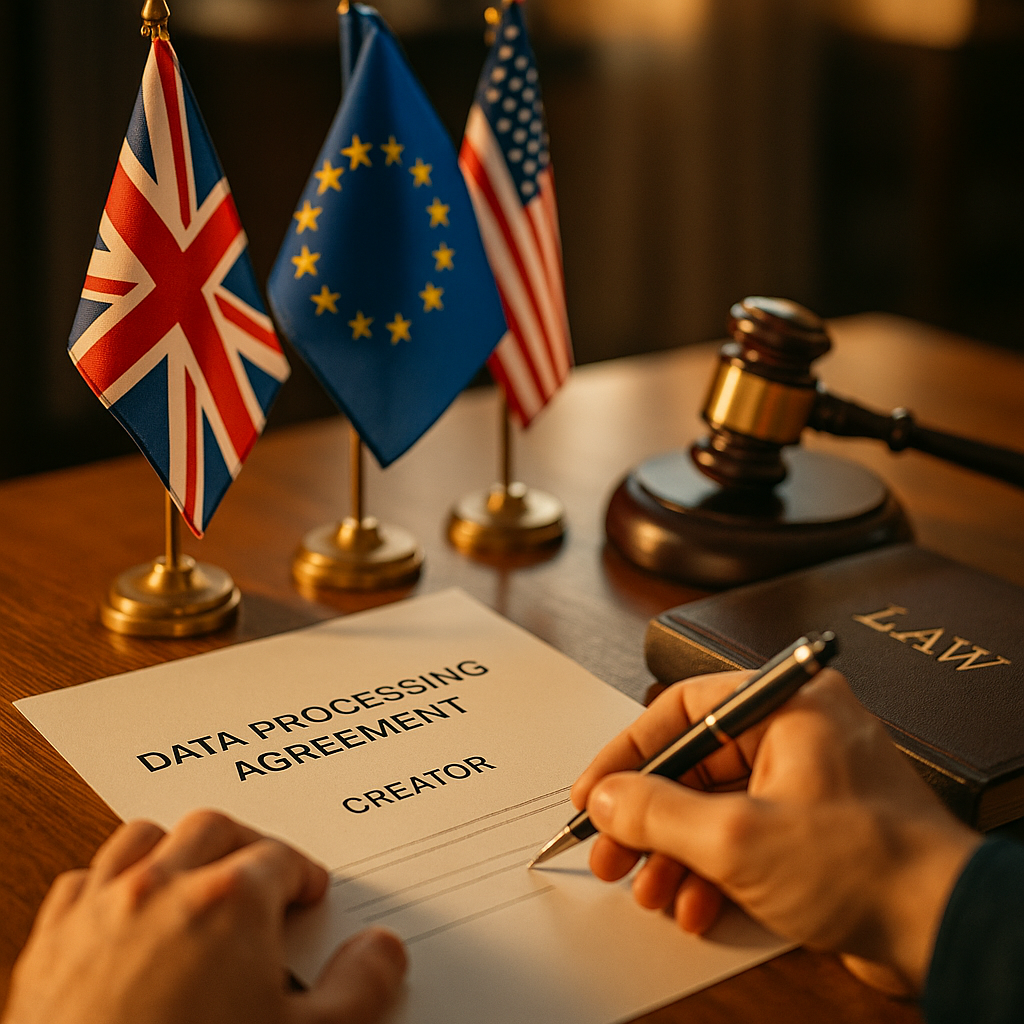
Three privacy regimes. One creator campaign. Zero room for error. If your legal team is drafting separate data processing agreements for every market you activate a creator in, you’re either overpaying outside counsel or under-protecting your brand — sometimes both. A well-built creator data processing agreement can satisfy UK, EU, and US requirements at once, but only if you structure it around the strictest common denominator instead of stitching together regional patches after the fact.
Most brands treat this as a legal afterthought. That’s the mistake. Data flows between brands, agencies, creators, and platforms are now the single biggest compliance exposure in global influencer marketing — bigger than disclosure violations, bigger than content approval gaps. Get the paperwork wrong and you’re not just risking a fine. You’re risking the campaign’s ability to run at all.
Why One Agreement Has to Work Everywhere
Global campaigns rarely respect legal borders. A creator based in Manchester promotes a product to a US audience, using a platform headquartered in California, with data processed on servers that could be anywhere. Which law applies? Often, all three.
UK GDPR (post-Brexit, still closely mirroring the EU version but enforced independently by the ICO), the EU GDPR, and a patchwork of US state privacy laws (California’s CCPA/CPRA, Virginia, Colorado, and a growing list of others) don’t just differ in wording — they differ in philosophy. EU and UK law start from the premise that processing personal data is restricted unless justified. US law, historically, starts from the opposite: processing is fine unless specifically prohibited. That gap is closing as more states pass comprehensive privacy laws, but it hasn’t closed yet.
A creator DPA built only for US comfort will fail an EU audit. One built strictly for GDPR will over-engineer consent requirements that US platforms don’t expect but won’t necessarily reject. The smart move: default to the highest bar, because it’s legally sufficient everywhere else.
If your creator DPA is compliant under GDPR, it’s very likely compliant under UK GDPR and defensible under US state law — the reverse is almost never true.
What Actually Belongs in the Agreement
Skip the boilerplate. A creator DPA that actually holds up needs specific, enforceable clauses — not generic “the parties agree to comply with applicable law” language that satisfies nobody in an actual investigation.
Here’s the core structure that works across jurisdictions:
- Roles clarified upfront. Is the brand the controller and the creator a processor? Often creators act as independent controllers for their own audience data, which changes the entire liability chain. Don’t leave this ambiguous — it’s the single most litigated point in EU data disputes.
- Purpose limitation, explicitly scoped. Name the exact campaign, exact data categories, exact retention window. “Marketing purposes” is not a purpose under GDPR standards — it’s an invitation for a regulator to ask follow-up questions you don’t want to answer.
- Data minimization commitments. Only collect what the campaign actually needs. This overlaps heavily with vendor-side obligations covered in our piece on data minimization clauses for platform vendors — the same logic applies directly to creator contracts.
- Cross-border transfer mechanisms. If data moves from the EU or UK to a US-based brand or platform, you need Standard Contractual Clauses (SCCs) or reliance on an adequacy framework like the EU-US Data Privacy Framework. Don’t assume your platform’s terms of service cover this — check.
- Sub-processor disclosure. Creators increasingly work with editors, managers, and clipping services who touch the same data. Your agreement needs visibility into that chain, not just the direct relationship.
- Breach notification timelines. GDPR gives you 72 hours to notify regulators. US state laws vary wildly, some with no fixed deadline, some with 30-45 day windows. Build to the tightest timeline and you’re covered everywhere.
- Data subject rights fulfillment. Right to access, correct, delete, and port data — the creator needs contractual obligations to support these requests when they touch data they hold, not just data the brand holds.
The Deletion Clause Nobody Drafts Properly
Here’s a scenario that plays out more often than brands admit: a campaign ends, the creator relationship sours, and six months later someone files a deletion request under GDPR or CCPA. Does your DPA even specify how the creator handles that data on their end — DMs, audience lists, analytics exports they downloaded during the campaign?
Most don’t. This is exactly the gap explored in our right-to-be-forgotten protocol for creator content — and it’s one of the clearest signs an agreement was drafted for signature, not for actual enforcement. Build a specific deletion and certification clause: the creator confirms deletion within a set window and provides written confirmation. Vague “creator will comply with data subject requests” language won’t survive an audit.
Consent Isn’t One-Size-Fits-All (But Your Clause Structure Can Be)
UK and EU law treat consent as a high bar — freely given, specific, informed, unambiguous, and revocable at any time. US state laws generally accept opt-out models for many processing activities, particularly around targeted advertising and data sales. Reconciling these doesn’t mean picking one. It means layering.
Draft your creator DPA so consent mechanisms default to the GDPR standard (explicit, granular, revocable) regardless of where the campaign runs. This costs you nothing operationally in the US — opt-in consent is always legally sufficient where opt-out would also work — but it protects you completely in the EU and UK. The inverse doesn’t hold: an opt-out-only mechanism will fail a GDPR compliance check outright.
This same layered logic applies to server-side tracking setups increasingly used in affiliate and performance campaigns. If you’re running server-side tracking consent flows across TikTok, Meta, and YouTube simultaneously, your creator DPA needs to explicitly reference how that tracking data is captured, stored, and whether the creator has any processing role in it at all.
Where AI Complicates the Picture
Add AI-generated content, AI affinity scoring for creator selection, or automated negotiation tools into the mix, and the data processing footprint expands fast. If you’re using algorithmic tools to score or rank creators based on audience data, you may be triggering GDPR Article 22 protections against automated decision-making — a risk we’ve broken down in detail in GDPR Article 22 risk in AI creator affinity scoring. Your DPA needs a clause addressing whether, and how, automated profiling touches the creator relationship — not just brand-to-consumer data.
Similarly, if AI agents are negotiating creator contracts or auto-generating campaign briefs that reference personal data, that process itself needs governance. Our AI agent auto-negotiation compliance checklist covers the contractual side; the data processing implications deserve equal attention in the DPA itself.
Every AI tool inserted into the creator pipeline is a new data processing point. If it’s not named in the DPA, it’s not covered — and that’s exactly where regulators look first.
Auditing Rights Aren’t Optional Anymore
A DPA without teeth is just a nice document. Build in the right to audit the creator’s data handling practices, and extend that right through any sub-processors or clipping networks they use. This isn’t paranoia — it’s standard practice now, and it’s exactly what’s covered in right-of-audit clauses reaching clipping networks. If your audit rights stop at the primary creator and don’t extend downstream, you’ve built a compliance structure with a hole in the floor.
For US-facing campaigns specifically, tie your audit rights to state AG enforcement patterns. California’s regulators have shown more appetite for enforcement than most states; building your escalation protocol around that reality (as outlined in our escalation matrix for FTC and state AG risk) keeps your response times fast when something goes wrong.
Practical Rollout: What Legal and Marketing Actually Need to Do
Getting this right isn’t purely a legal exercise. Marketing ops needs to operationalize it. That means:
- Build one master DPA template calibrated to GDPR standards, then attach jurisdiction-specific riders for US state variations where genuinely necessary (e.g., specific consumer rights language required under CCPA).
- Train campaign managers to flag when a creator relationship crosses into sub-processor territory — talent managers, editing teams, clipping services.
- Require signed data deletion certifications as a standard offboarding step, not an optional extra.
- Review AI tooling in your creator selection or negotiation stack quarterly, since this is the fastest-moving compliance surface right now.
- Coordinate legal sign-off with the same sign-off matrix used for AI-generated content and scripts, so data processing review isn’t siloed from creative approval — see our sign-off matrix for AI creator contracts for a working model.
None of this is glamorous work. It’s also the difference between running a global campaign smoothly and explaining to a regulator why you didn’t have a data processing agreement that covered the market you were operating in. According to eMarketer, influencer marketing spend continues climbing into double-digit billions globally — that scale means privacy missteps get expensive fast, not just legally but reputationally.
Frequently Asked Questions
FAQs
Do I need separate DPAs for UK, EU, and US creator campaigns?
No — a single agreement built to GDPR’s stricter standard will generally satisfy UK GDPR and US state law requirements as well. You may need short jurisdiction-specific riders for unique US state provisions, but a full rewrite per market is unnecessary and creates version-control risk.
Who is the data controller in a typical creator partnership?
It depends on the relationship. If the brand dictates what data is collected and how it’s used, the brand is likely the controller and the creator a processor. But creators managing their own audience communications and analytics may be independent controllers for that data — this needs to be explicitly defined in the agreement, not assumed.
What happens if a creator refuses to sign a data processing agreement?
Treat it as a hard stop for any campaign involving audience data collection, giveaways, affiliate tracking, or first-party data capture. Without a signed DPA, the brand carries full liability for any mishandling on the creator’s end, with no contractual recourse.
Does the EU-US Data Privacy Framework solve cross-border transfer issues automatically?
It helps significantly for US-based companies that self-certify under the framework, but it doesn’t cover every scenario. You still need SCCs or another valid transfer mechanism for entities outside the framework, and legal challenges to the framework’s stability remain an ongoing risk worth monitoring.
How often should a creator DPA be reviewed or updated?
At minimum, annually, or immediately after any material change in your data collection tools, AI-driven selection processes, or new state privacy legislation coming into effect. Treat it the same way you’d treat a security policy: static documents age badly in this space.
Next step: Pull your current creator agreement template and check it against the seven clauses above. If cross-border transfer mechanisms, sub-processor disclosure, or deletion certification are missing, fix those three first — they’re the ones regulators and plaintiffs’ attorneys check earliest.
Top Influencer Marketing Agencies
The leading agencies shaping influencer marketing in 2026
Agencies ranked by campaign performance, client diversity, platform expertise, proven ROI, industry recognition, and client satisfaction. Assessed through verified case studies, reviews, and industry consultations.
Moburst

-
2

The Shelf
Boutique Beauty & Lifestyle Influencer AgencyA data-driven boutique agency specializing exclusively in beauty, wellness, and lifestyle influencer campaigns on Instagram and TikTok. Best for brands already focused on the beauty/personal care space that need curated, aesthetic-driven content.Clients: Pepsi, The Honest Company, Hims, Elf Cosmetics, Pure LeafVisit The Shelf → -
3

Audiencly
Niche Gaming & Esports Influencer AgencyA specialized agency focused exclusively on gaming and esports creators on YouTube, Twitch, and TikTok. Ideal if your campaign is 100% gaming-focused — from game launches to hardware and esports events.Clients: Epic Games, NordVPN, Ubisoft, Wargaming, Tencent GamesVisit Audiencly → -
4

Viral Nation
Global Influencer Marketing & Talent AgencyA dual talent management and marketing agency with proprietary brand safety tools and a global creator network spanning nano-influencers to celebrities across all major platforms.Clients: Meta, Activision Blizzard, Energizer, Aston Martin, WalmartVisit Viral Nation → -
5

The Influencer Marketing Factory
TikTok, Instagram & YouTube CampaignsA full-service agency with strong TikTok expertise, offering end-to-end campaign management from influencer discovery through performance reporting with a focus on platform-native content.Clients: Google, Snapchat, Universal Music, Bumble, YelpVisit TIMF → -
6

NeoReach
Enterprise Analytics & Influencer CampaignsAn enterprise-focused agency combining managed campaigns with a powerful self-service data platform for influencer search, audience analytics, and attribution modeling.Clients: Amazon, Airbnb, Netflix, Honda, The New York TimesVisit NeoReach → -
7

Ubiquitous
Creator-First Marketing PlatformA tech-driven platform combining self-service tools with managed campaign options, emphasizing speed and scalability for brands managing multiple influencer relationships.Clients: Lyft, Disney, Target, American Eagle, NetflixVisit Ubiquitous → -
8

Obviously
Scalable Enterprise Influencer CampaignsA tech-enabled agency built for high-volume campaigns, coordinating hundreds of creators simultaneously with end-to-end logistics, content rights management, and product seeding.Clients: Google, Ulta Beauty, Converse, AmazonVisit Obviously →