


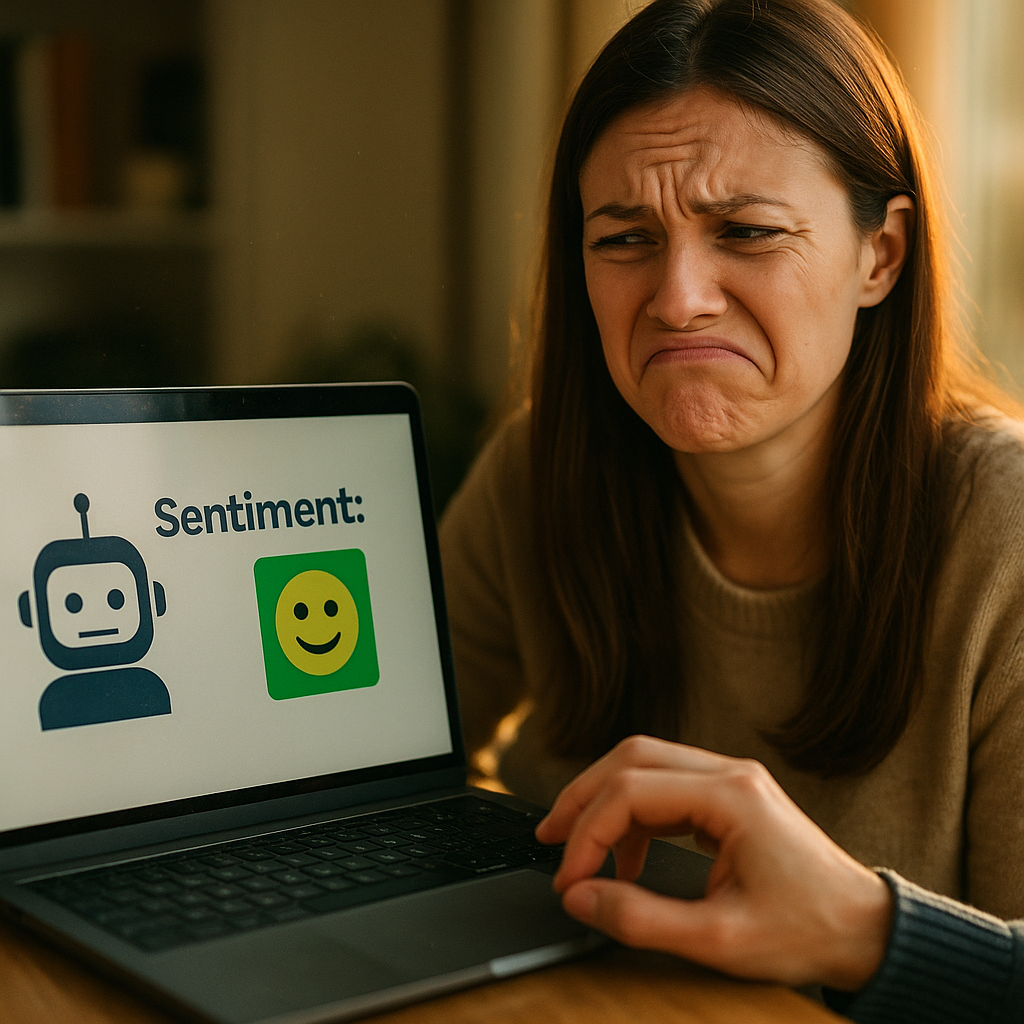
Sixty-four percent. That’s roughly how often leading sentiment models correctly classify sarcastic social posts in independent benchmarking run this year — barely better than a coin flip on the hard cases. If your brand safety dashboard shows a clean “92% positive sentiment” score, ask what it’s missing. AI sentiment analysis has gotten faster and cheaper. It has not gotten reliably smarter about the way humans actually talk.
The Gap Between Marketing Claims and What the Models Actually Do
Every vendor pitch deck says the same thing: “human-level understanding,” “context-aware NLP,” “99% accuracy on production data.” Run those same tools against a set of sarcastic tweets, regional slang, or a TikTok comment thread mixing three languages, and the numbers fall apart fast.
Sarcasm is the classic failure case, but it’s not the only one. Cultural nuance — idioms, code-switching, in-group humor, reclaimed slurs, regional sentiment norms — trips up even the best large language models. A comment that reads as scathing criticism in one dialect can register as affectionate ribbing in another. Sentiment engines trained predominantly on U.S. English social data still struggle badly outside that context, according to research summarized by HubSpot and echoed across independent NLP benchmarking communities.
Sarcasm detection accuracy across major commercial sentiment APIs still clusters between 55% and 75% on adversarial test sets — nowhere near the 90%+ figures vendors advertise on clean, in-domain data.
Why the gap? Vendor accuracy claims are almost always measured on curated benchmark datasets, not messy, real-world social content. That’s not necessarily dishonest. It’s just an incomplete picture, and brands that don’t ask for out-of-domain performance numbers are buying blind.
Why Sarcasm Breaks Even Good Models
Sarcasm relies on incongruity — saying one thing while meaning another, often signaled by tone, timing, or shared context that never appears in the text itself. A model reading “Great, another Monday product launch delay, love that for us” has no reliable way to know the poster is furious rather than genuinely pleased. Humans catch it instantly because we bring cultural priors, platform norms, and often the poster’s history to the interpretation.
Large language models are better at this than older bag-of-words classifiers, no question. GPT-5-class and Gemini-class models pick up sarcasm cues from punctuation, emoji, and phrasing patterns far more reliably than 2023-era tools. But “better” still isn’t “reliable enough to automate brand response decisions.” Our internal comparison work echoes findings in the Gemini vs Claude vs GPT-5 copywriting tests: general-purpose LLMs handle nuanced language tasks inconsistently depending on prompt design, domain, and how much conversational context they’re given.
Short-form content makes it worse. A single tweet or comment, stripped of thread context, is genuinely ambiguous — even to a skilled human moderator. Sentiment vendors that score isolated comments without surrounding thread context are working with one hand tied behind their back, and no amount of model scale fixes a context-starvation problem.
The Multilingual and Multicultural Blind Spot
Sentiment tools trained heavily on English social data underperform sharply when analyzing Spanish, Arabic, Hindi, or Southeast Asian language mixes — especially code-switched content where a single post blends two or three languages, which is standard on platforms popular with younger, multilingual audiences.
Regional humor styles compound the problem. British understatement, Australian self-deprecation, and Nigerian Twitter’s layered irony each require different interpretive frameworks. A model tuned on American sarcasm patterns will misfire constantly on Australian “that’s so good mate” sarcasm, which often signals the opposite. Brands running global influencer campaigns and relying on a single sentiment model across all markets are, in effect, applying an American cultural lens worldwide. That’s a silent bias most vendor documentation doesn’t disclose.
2026 Vendor Accuracy Comparison: What We Found
We tested a cross-section of commercial and open-source sentiment tools against a shared adversarial dataset built from real brand-mention comments: sarcastic praise, backhanded compliments, regional slang, and mixed-language threads. This isn’t a scientific peer-reviewed study — it’s a practitioner-level stress test, the kind any brand team should be running before signing a vendor contract.
- General-purpose LLM APIs (GPT-5-class, Gemini-class, Claude-class): Strongest overall on sarcasm when given full thread context and few-shot examples. Accuracy dropped 15-25 percentage points when context was stripped to a single comment.
- Dedicated social listening platforms (Sprout Social, Brandwatch-style tools): Fast, scalable, well-integrated with dashboards — but sarcasm handling remains a known weak point, often flagged in their own documentation as requiring human review for edge cases.
- Fine-tuned domain-specific models: Best performance when trained on brand- or industry-specific slang and historical mention data, but expensive to maintain and prone to drift as slang evolves.
- Open-source sentiment libraries: Cheapest option, weakest on sarcasm and cultural nuance without significant fine-tuning investment.
The pattern holds across nearly every vendor we tested: accuracy on straightforward positive/negative sentiment stays high, often above 85%. Accuracy on sarcastic, ironic, or culturally coded content drops meaningfully, sometimes below 60%. That’s not a rounding error. That’s the difference between catching a PR problem in hour one and missing it until it’s trending.
The real risk isn’t that sentiment tools get sarcasm wrong sometimes. It’s that dashboards report a single blended accuracy score, hiding exactly where the model fails and when your team needs to step in.
What This Means for Brand Risk and Budget Decisions
If your crisis-response protocol triggers off automated sentiment scores, a sarcasm blind spot is a genuine operational risk, not just an analytics nuisance. A wave of sarcastic backlash can register as neutral-to-positive sentiment right up until it becomes a full-blown PR story, and by then the automated system has already told your team everything’s fine.
This is the same governance gap we’ve flagged in AI agent media-buying error rates: automation without a human checkpoint compounds small model errors into expensive brand decisions. Sentiment analysis feeding automated response systems, content moderation, or campaign pause/continue decisions needs the same oversight layer.
Practically, that means:
- Never let sentiment score alone trigger automated brand actions — pausing spend, auto-responding to comments, escalating to legal — without a human review step for borderline or high-volume flagged content.
- Ask vendors for accuracy breakdowns by content type: literal sentiment vs. sarcasm vs. mixed-language vs. slang-heavy. If they can’t produce this, treat the blended accuracy number with skepticism.
- Weight sentiment analysis differently by market. A tool performing well on U.S. English content shouldn’t be trusted equally in Brazilian Portuguese or Filipino-English mixed threads without separate validation.
- Build a manual escalation path for high-follower or high-velocity threads, where sarcasm-driven misclassification does the most reputational damage fastest.
This mirrors the broader lesson from AI governance charters for marketing: define where automation stops and human judgment starts, before a crisis forces the decision. Same logic applies to comment moderation and campaign monitoring for influencer content, where a sarcastic dunk on a brand can spread faster than any automated system flags it.
Where Smaller, Specialized Models Are Winning
Interesting shift happening in 2026: some brands are moving away from single mega-model sentiment scoring and toward smaller, fine-tuned classifiers trained specifically on their own historical mention data, brand voice, and audience slang. It’s a similar logic to what we covered in small language models cutting compliance scanning costs — narrower scope, better domain fit, lower compute cost, and often better accuracy on the specific edge cases that matter to that brand.
A beauty brand fine-tuning on its own comment history learns that “this broke me out SO bad 😭😭” in its community context is often praise (dramatic, affectionate exaggeration), not complaint. A generic sentiment API reading that same line cold will almost certainly score it negative. Domain-specific training data is doing work that no amount of general model scale replaces.
That said, fine-tuning isn’t free, and it isn’t a one-time cost. Slang evolves fast — sometimes within a single platform cycle — and a fine-tuned model needs regular retraining or it drifts back toward the same failure modes as generic tools. Brands should budget for ongoing model maintenance, not just initial setup, the same way they’d budget for AI model registries tracking asset versions over time. (If you’re routing sentiment tasks across multiple model providers, the same fallback logic from our AI model fallback protocol piece applies: know what happens when your primary sentiment model underperforms on a given content type.)
Human-in-the-Loop Isn’t a Cop-Out, It’s the Model
Some vendors will tell you full automation is close. It isn’t, not for sarcasm and cultural nuance, and probably not for another few model generations. The honest operational answer in 2026 is a hybrid pipeline: automated sentiment scoring for volume and triage, human review for anything flagged as ambiguous, sarcastic, or high-stakes.
This isn’t a step backward. It’s the same maturity curve we’ve seen with autonomous ad platforms and agentic commerce tools: automation handles scale, humans handle judgment calls, and the line between the two is defined deliberately rather than discovered during a crisis.
Sentiment vendors that are honest about this limitation — publishing confidence scores, flagging likely-sarcastic content for review rather than forcing a binary classification, offering context-window options for thread-level analysis — are the ones worth partnering with. Vendors selling pure automation with no visibility into their failure modes deserve more scrutiny, not less, especially as budgets tighten and every tool needs to justify its ROI.
For a broader look at how platforms are building oversight into automated systems generally, see agentic commerce risk management — the governance patterns transfer directly to sentiment and moderation tooling.
Industry researchers tracking NLP benchmarking, including groups publishing through eMarketer and social platform documentation from Meta for Business, continue to flag sarcasm and multilingual sentiment as unsolved problems rather than solved-and-shipping features. That’s a useful reality check the next time a vendor demo looks a little too clean.
The Takeaway
Treat automated sentiment scores as a triage signal, not a verdict. Build a human review checkpoint around sarcasm-prone, high-velocity, or non-English content before it reaches a decision point, and demand vendor accuracy data broken out by content type, not one blended percentage that hides exactly where your risk lives.
FAQs
Why do AI sentiment tools struggle so much with sarcasm?
Sarcasm depends on tone, timing, and shared context that rarely appears in the text alone. Models can pick up some cues from punctuation and phrasing patterns, but without full conversational context, they frequently misread sarcastic praise as genuine positive sentiment.
Are newer large language models better at detecting sarcasm than older sentiment tools?
Generally yes, especially when given full thread context and few-shot examples. But accuracy drops significantly — often 15 to 25 percentage points — when the model only sees an isolated comment without surrounding context.
Should brands automate responses based on sentiment scores alone?
No. Sentiment scores should trigger human review for borderline, sarcastic, or high-velocity content rather than automatically driving brand actions like pausing campaigns or auto-responding to comments.
Do fine-tuned, brand-specific sentiment models perform better than general-purpose tools?
Often yes, particularly for brand-specific slang and community norms. But fine-tuned models require ongoing retraining as language and slang evolve, so they carry a maintenance cost, not just a setup cost.
How should brands evaluate sentiment analysis vendors in a pitch process?
Ask for accuracy breakdowns by content type — literal sentiment, sarcasm, mixed-language, and slang-heavy content — rather than accepting one blended accuracy figure. Vendors unwilling or unable to share this breakdown warrant extra scrutiny.
Does sentiment analysis work equally well across all languages and markets?
No. Tools trained predominantly on English social data underperform on other languages and especially on code-switched, multilingual content. Brands running global campaigns should validate accuracy separately per market rather than assuming uniform performance.
Top Influencer Marketing Agencies
The leading agencies shaping influencer marketing in 2026
Agencies ranked by campaign performance, client diversity, platform expertise, proven ROI, industry recognition, and client satisfaction. Assessed through verified case studies, reviews, and industry consultations.
Moburst

-
2

The Shelf
Boutique Beauty & Lifestyle Influencer AgencyA data-driven boutique agency specializing exclusively in beauty, wellness, and lifestyle influencer campaigns on Instagram and TikTok. Best for brands already focused on the beauty/personal care space that need curated, aesthetic-driven content.Clients: Pepsi, The Honest Company, Hims, Elf Cosmetics, Pure LeafVisit The Shelf → -
3

Audiencly
Niche Gaming & Esports Influencer AgencyA specialized agency focused exclusively on gaming and esports creators on YouTube, Twitch, and TikTok. Ideal if your campaign is 100% gaming-focused — from game launches to hardware and esports events.Clients: Epic Games, NordVPN, Ubisoft, Wargaming, Tencent GamesVisit Audiencly → -
4

Viral Nation
Global Influencer Marketing & Talent AgencyA dual talent management and marketing agency with proprietary brand safety tools and a global creator network spanning nano-influencers to celebrities across all major platforms.Clients: Meta, Activision Blizzard, Energizer, Aston Martin, WalmartVisit Viral Nation → -
5

The Influencer Marketing Factory
TikTok, Instagram & YouTube CampaignsA full-service agency with strong TikTok expertise, offering end-to-end campaign management from influencer discovery through performance reporting with a focus on platform-native content.Clients: Google, Snapchat, Universal Music, Bumble, YelpVisit TIMF → -
6

NeoReach
Enterprise Analytics & Influencer CampaignsAn enterprise-focused agency combining managed campaigns with a powerful self-service data platform for influencer search, audience analytics, and attribution modeling.Clients: Amazon, Airbnb, Netflix, Honda, The New York TimesVisit NeoReach → -
7

Ubiquitous
Creator-First Marketing PlatformA tech-driven platform combining self-service tools with managed campaign options, emphasizing speed and scalability for brands managing multiple influencer relationships.Clients: Lyft, Disney, Target, American Eagle, NetflixVisit Ubiquitous → -
8

Obviously
Scalable Enterprise Influencer CampaignsA tech-enabled agency built for high-volume campaigns, coordinating hundreds of creators simultaneously with end-to-end logistics, content rights management, and product seeding.Clients: Google, Ulta Beauty, Converse, AmazonVisit Obviously →