


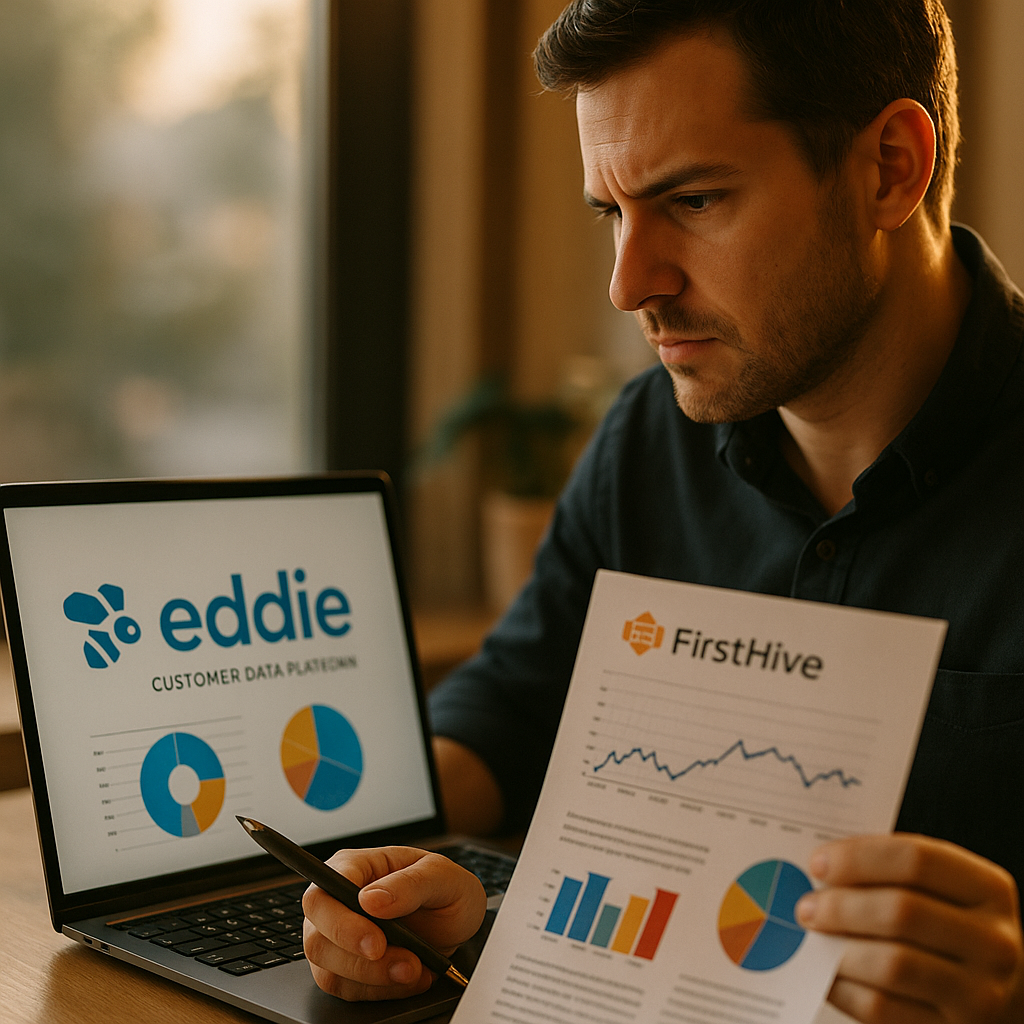
Most mid-market CDPs still make marketers do the thinking: pull the segment, guess the offer, hope the timing works. FirstHive’s Eddie Autonomous Decision Engine claims to skip that step entirely, resolving identity and scoring next-best-action in real time. Bold claim. Does it hold up under actual campaign pressure?
What Eddie Actually Is
Eddie isn’t a bolt-on feature. It’s positioned as the decision layer sitting on top of FirstHive’s core CDP, the part that used to require a data science team and three weeks of model tuning. FirstHive markets it as “autonomous,” meaning it ingests identity signals, resolves them into a unified profile, then scores the next-best-action without a human building the rule tree first.
For context: FirstHive has spent years in the identity resolution and customer data space, mostly serving BFSI, retail, and healthcare clients in APAC and increasingly in North America. Eddie is their answer to a market question that’s gotten louder every quarter — can mid-market brands get enterprise-grade personalization without an enterprise-grade data science budget?
Identity Resolution: The Part That Actually Matters
Everyone claims identity resolution now. The differentiator is match rate quality under real-world messiness — multiple devices, guest checkouts, third-party data decay. Eddie’s approach leans on deterministic matching first (email, phone, CRM ID) and probabilistic matching second, stitching behavioral signals when deterministic keys run out.
That’s not novel architecture. What’s notable is how FirstHive claims to feed resolved identities directly into the decision engine without a separate export/import cycle. In practice, that shaves the latency most mid-market teams complain about when their CDP and their activation layer are different vendors talking through nightly batch files.
If your identity graph updates hourly but your decisioning engine only reads it once a day, you’re not doing real-time personalization — you’re doing yesterday’s personalization with a nicer dashboard.
We’ve covered this problem before in our identity resolution vendor shootout, where match rate claims consistently outpaced what teams could reproduce in QBRs. Eddie doesn’t escape that scrutiny just because it’s newer. Ask FirstHive for match rate benchmarks segmented by industry and channel, not a blended average across their whole client base.
Where It Beats Legacy Stitching
- Single-pass resolution feeding directly into scoring, no export lag
- CRM-first matching that plays well with existing Salesforce or HubSpot instances
- Configurable confidence thresholds, so risk-averse teams can require tighter matches before triggering an action
That last point matters more than vendors let on. A loose probabilistic match triggering the wrong next-best-action isn’t a minor annoyance — it’s a brand trust problem. Send the wrong offer to the wrong resolved identity enough times, and customers stop trusting personalization altogether.
Next-Best-Action Scoring: Autonomous or Just Automated?
Here’s where “autonomous” gets tested. Eddie’s scoring model ranks potential actions — email, SMS push, retarget ad, sales alert — based on propensity signals and historical response data, then executes without a marketer manually approving each decision. FirstHive frames this as removing human bottlenecks.
Fair enough, but autonomy without guardrails is how brands end up in compliance trouble. Does Eddie let you set suppression rules for regulated categories? Can you cap frequency so “next-best-action” doesn’t become “next five actions in one day”? These are the questions procurement teams should be asking in the demo, not after signing.
To FirstHive’s credit, the platform does allow rule-based overrides layered on top of the ML scoring, which is a reasonable middle ground. It’s autonomous in execution, but not unsupervised in design, assuming your team actually configures the guardrails rather than accepting defaults.
The ROI Question Nobody Answers Cleanly
Vendors love to cite lift percentages. FirstHive’s own materials reference conversion lift in the 15-20% range for clients using Eddie versus static segmentation, but as with most vendor-supplied stats, ask for the methodology. Was that lift measured against a true control group, or against a previous quarter with different seasonality?
According to eMarketer, personalization-driven engagement gains have been trending upward across CDP-enabled brands broadly, but attribution to any single decisioning engine is notoriously hard to isolate. Treat any single-vendor lift claim as a hypothesis to test, not a guarantee to budget against.
Mid-Market Fit: Why This Matters More Than Feature Lists
Enterprise CDPs like Salesforce CDP or Adobe Real-Time CDP have decisioning capabilities too, but they typically require dedicated data science resourcing to configure well. That’s the gap Eddie is trying to fill: decisioning power without the six-figure implementation team.
Is that gap real? For teams with 50,000 to 2 million customer records, unified profile requirements, and no in-house ML engineer, yes — it’s a legitimate underserved segment. We touched on this dynamic in our CRM attribution buyers guide: mid-market teams keep getting pitched enterprise tools priced and staffed for enterprise teams, then wonder why adoption stalls after month three.
Compare that to how Salesforce Marketing Cloud stacks against HubSpot on attribution — both strong platforms, but both assume a level of internal technical maturity that a lot of mid-market marketing teams simply don’t have yet. Eddie’s pitch is lowering that maturity bar. Whether it actually does, versus just repackaging the complexity into a different UI, depends heavily on onboarding quality, which FirstHive’s own case studies don’t fully address.
Compliance and Risk: The Part That Gets Skipped in Demos
Autonomous decisioning touching customer PII raises the obvious questions: where’s the data processed, how is consent tracked across resolved identities, and what happens when a customer exercises a deletion request under GDPR or CCPA? FirstHive states compliance with major frameworks, but “compliant platform” and “compliant implementation” are different things. Your team still owns the configuration.
This is a good moment to revisit the broader shift happening in identity infrastructure. Our piece on how identity resolution vendors are rebuilding for the agent-driven web covers why autonomous decisioning tools are under more regulatory scrutiny than static segmentation ever was — the moment a machine executes a customer-facing action without human review, liability questions get murkier. Check the FTC’s guidance on automated decision-making and, if you operate in the UK or EU, the ICO’s position on profiling before you greenlight full autonomy on customer-facing actions.
Autonomous doesn’t mean unaccountable. Someone on your team still has to answer for every action Eddie takes on your brand’s behalf — make sure that person is in the room during implementation, not just procurement.
Server-side data handling is also worth interrogating directly. If Eddie’s scoring pulls from cookie-based signals anywhere in its stack, you’ll want the same rigor we recommended in our server-side tracking compliance guide — ask vendors for their data flow diagrams, not just their marketing one-pagers.
Where Eddie Falls Short
No platform is without gaps, and Eddie has a few worth flagging before you sign anything:
- Documentation depth — public technical documentation is thinner than competitors like Salesforce or Adobe, meaning more reliance on FirstHive’s implementation team during rollout
- Third-party integration breadth — strong on CRM connectivity, less proven on newer commerce and creator-attribution stacks
- Explainability — ask specifically how Eddie surfaces why a given next-best-action was scored highest; “black box” scoring is a real adoption blocker for marketing teams that need to defend decisions internally
That explainability gap is the one I’d push hardest on in a vendor call. A next-best-action engine that can’t show its work is asking your team to trust a black box with customer relationships. Good vendors show reasoning. Great ones let you audit it.
Should You Shortlist It?
If you’re a mid-market brand drowning in disconnected identity data and manually built segment rules, Eddie is worth a serious pilot. If you already have mature decisioning infrastructure or need deep integrations with a specific commerce stack, run a side-by-side comparison first — the kind of rigorous testing we’ve applied to other AI-driven platforms in adjacent categories, where vendor claims and pilot results didn’t always match.
Next step: before any contract, request a 90-day pilot with your own historical data, a defined control group, and explicit sign-off on suppression rules — then measure lift against that baseline, not FirstHive’s published averages.
Frequently Asked Questions
What is FirstHive’s Eddie Autonomous Decision Engine?
Eddie is a decisioning layer built into FirstHive’s customer data platform that resolves customer identity across channels and automatically scores the next-best-action for each profile, without requiring manual rule-building or a dedicated data science team.
How does Eddie’s identity resolution compare to other CDPs?
Eddie uses deterministic matching (email, phone, CRM ID) first, then probabilistic matching for gaps, feeding resolved profiles directly into its scoring engine. The single-pass architecture reduces latency compared to CDPs that rely on batch exports between identity resolution and activation tools.
Is Eddie suitable for mid-market marketing teams?
Yes, with caveats. It’s designed for teams with meaningful customer data volume but no in-house ML engineering resources. Teams should still budget for implementation support given thinner public documentation compared to enterprise platforms.
What compliance risks come with autonomous decisioning tools like Eddie?
Autonomous execution of customer-facing actions raises questions around consent tracking, data deletion requests, and accountability for automated decisions. Brands should confirm suppression rule configuration, data processing locations, and audit trails before enabling full autonomy.
How is next-best-action ROI typically measured?
Reliable measurement requires a true control group and a defined baseline period, not just before-and-after comparisons that can be skewed by seasonality. Ask vendors for methodology behind any published lift statistics before budgeting against them.
Top Influencer Marketing Agencies
The leading agencies shaping influencer marketing in 2026
Agencies ranked by campaign performance, client diversity, platform expertise, proven ROI, industry recognition, and client satisfaction. Assessed through verified case studies, reviews, and industry consultations.
Moburst

-
2

The Shelf
Boutique Beauty & Lifestyle Influencer AgencyA data-driven boutique agency specializing exclusively in beauty, wellness, and lifestyle influencer campaigns on Instagram and TikTok. Best for brands already focused on the beauty/personal care space that need curated, aesthetic-driven content.Clients: Pepsi, The Honest Company, Hims, Elf Cosmetics, Pure LeafVisit The Shelf → -
3

Audiencly
Niche Gaming & Esports Influencer AgencyA specialized agency focused exclusively on gaming and esports creators on YouTube, Twitch, and TikTok. Ideal if your campaign is 100% gaming-focused — from game launches to hardware and esports events.Clients: Epic Games, NordVPN, Ubisoft, Wargaming, Tencent GamesVisit Audiencly → -
4

Viral Nation
Global Influencer Marketing & Talent AgencyA dual talent management and marketing agency with proprietary brand safety tools and a global creator network spanning nano-influencers to celebrities across all major platforms.Clients: Meta, Activision Blizzard, Energizer, Aston Martin, WalmartVisit Viral Nation → -
5

The Influencer Marketing Factory
TikTok, Instagram & YouTube CampaignsA full-service agency with strong TikTok expertise, offering end-to-end campaign management from influencer discovery through performance reporting with a focus on platform-native content.Clients: Google, Snapchat, Universal Music, Bumble, YelpVisit TIMF → -
6

NeoReach
Enterprise Analytics & Influencer CampaignsAn enterprise-focused agency combining managed campaigns with a powerful self-service data platform for influencer search, audience analytics, and attribution modeling.Clients: Amazon, Airbnb, Netflix, Honda, The New York TimesVisit NeoReach → -
7

Ubiquitous
Creator-First Marketing PlatformA tech-driven platform combining self-service tools with managed campaign options, emphasizing speed and scalability for brands managing multiple influencer relationships.Clients: Lyft, Disney, Target, American Eagle, NetflixVisit Ubiquitous → -
8

Obviously
Scalable Enterprise Influencer CampaignsA tech-enabled agency built for high-volume campaigns, coordinating hundreds of creators simultaneously with end-to-end logistics, content rights management, and product seeding.Clients: Google, Ulta Beauty, Converse, AmazonVisit Obviously →