


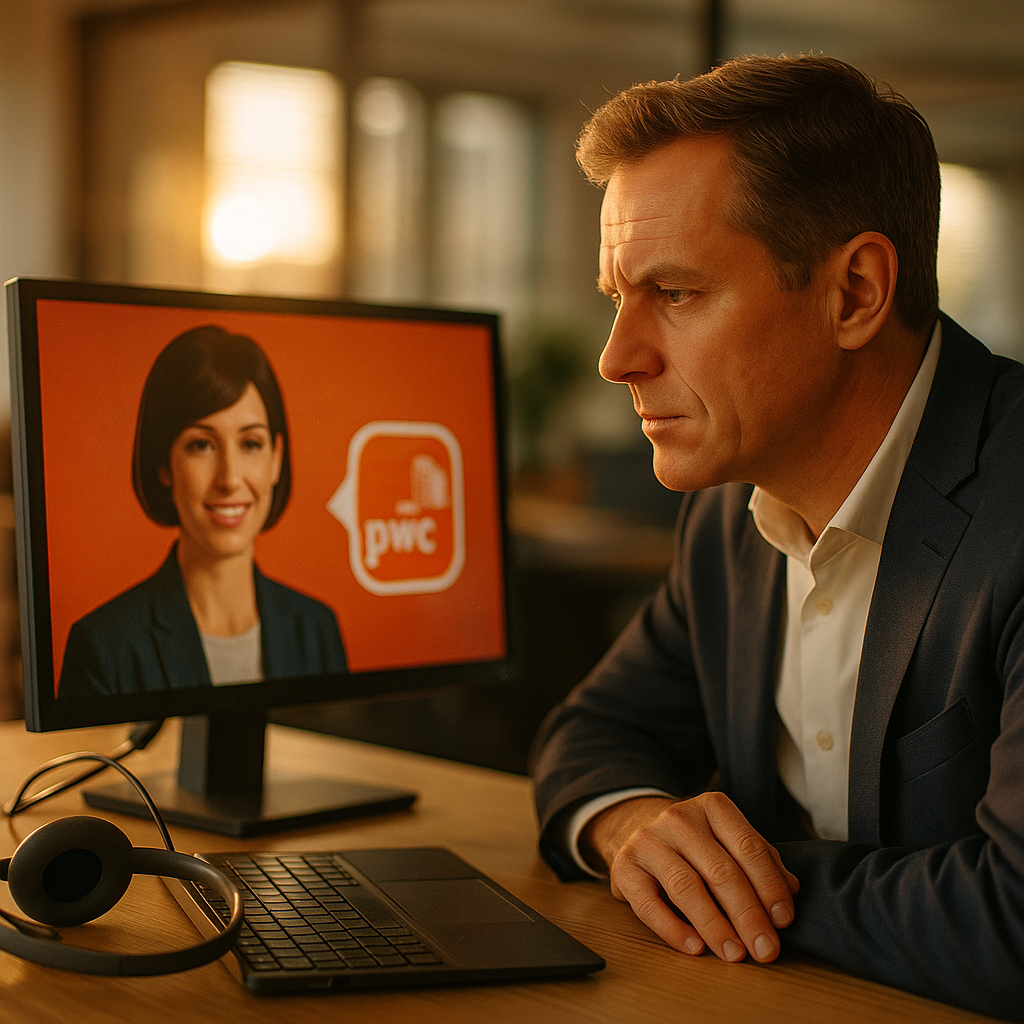
When PwC announced it was embedding OpenAI’s models directly into customer-service workflows, most headlines focused on cost savings. That’s the boring part. The real story: brand attribution just got a lot messier, because the “last touch” before a purchase might now be an AI agent that never mentions the creator, campaign, or channel that actually built the desire to buy.
Here’s the uncomfortable question every CMO should be asking right now: if a customer discovers your product through a TikTok creator, then converts three days later after chatting with an embedded LLM agent about shipping and sizing, who gets credit? Right now, the honest answer is nobody knows. And that gap is about to become a very expensive blind spot.
What PwC and OpenAI Actually Built
PwC’s rollout isn’t a chatbot bolted onto a help center. It’s a full-stack customer-engagement layer, using OpenAI’s models to handle service tickets, product recommendations, order modifications, and increasingly, pre-purchase conversations that used to belong to marketing. Think of it as a service agent with a sales rep’s instincts, deployed at the scale of a Fortune 500 support desk.
This matters for brand strategists because the line between “service” and “marketing touchpoint” is dissolving. A customer who messages support asking “does this work for sensitive skin?” is having a conversion conversation, not a support conversation. The agent that answers is now part of the influence chain, whether your attribution model accounts for it or not.
PwC framed the build around efficiency: faster resolution times, lower headcount costs, higher CSAT. Fair enough. But embedded LLM agents don’t just resolve tickets. They increasingly recommend products, upsell alternatives, and settle purchase hesitation, functions that traditionally lived inside the marketing funnel and got measured accordingly.
The moment a service agent starts influencing purchase decisions, it becomes a marketing channel, whether or not anyone updated the attribution model to reflect that.
The Attribution Loop Problem, Explained Simply
Attribution loops work on a simple premise: track the touchpoints, weight them, credit the channels. Multi-touch attribution already struggles with dark social and creator content that gets screenshotted, reposted, and shared outside trackable links. Embedded service agents add a new wrinkle entirely.
When an OpenAI-powered agent handles a pre-purchase question, it typically pulls from internal knowledge bases, not campaign data. It doesn’t know the customer saw an unboxing video from a creator last week. It doesn’t tag its own conversation as an influence event in your analytics stack. It just closes the loop and logs a resolved ticket.
- Influence gets buried: Creator-driven discovery happens upstream, but the agent conversation downstream often gets coded as “support,” not “conversion assist.”
- Credit shifts to the last human-adjacent touch: Many models still default to last-click or last-interaction logic, and an AI service chat frequently is the last interaction.
- Creator ROI gets underreported: If the agent quietly closes sales that creators originally sparked, influencer program budgets look weaker than they actually perform.
This isn’t hypothetical. Brands already struggle to prove creator lift because of dark social and cross-device behavior. Embedded LLM agents just added another opaque layer between discovery and purchase. If your team is still leaning on standard attribution windows built for web-only journeys, this is the moment to revisit them.
Why This Isn’t Just PwC’s Problem
PwC and OpenAI are the visible test case, but every enterprise using conversational AI in service workflows faces the same exposure. Salesforce, Zendesk, Intercom, and a dozen CX platforms are racing to embed similar agent capabilities. eMarketer has tracked accelerating enterprise AI adoption in customer service functions, and the trend line only points one direction.
Brands running influencer programs at any real scale, meaning six figures or more in annual creator spend, need to treat this as an operational risk, not a curiosity. If your finance team is measuring influencer ROI against a funnel that ends at “website visit” or “add to cart,” and the actual purchase decision gets finalized in a service chat two days later, you’re systematically undercounting creator impact. That undercounting shows renewal budgets. Programs that actually work get cut because the data says they didn’t.
This is the same structural issue explored in marketing-mix modeling for influencer spend: single-touch models were always going to break under AI-mediated customer journeys. PwC’s build just accelerated the timeline.
Fixing the Loop: What Brands Can Actually Do
You can’t stop enterprises from embedding LLM agents into service workflows. You also probably shouldn’t try, since faster resolution and better CX genuinely help retention. What you can do is redesign how you track influence so the agent layer doesn’t swallow credit that belongs upstream.
Instrument the handoff, not just the click
Work with your CX and data teams to tag service-agent conversations that reference product discovery, comparison, or purchase hesitation. Even a rough classifier that flags “pre-purchase intent” conversations gives you a proxy for influence assists that pure last-click data misses entirely.
Push for cross-functional attribution ownership
Attribution can’t live solely inside marketing anymore. If service agents are making recommendations, the CX org needs to share attribution data back to marketing in near real time. This sounds obvious. Most enterprises still run marketing analytics and CX analytics in completely separate stacks that never talk to each other.
Lean on incrementality testing, not just touch-weighting
Multi-touch attribution assumes you can identify every touch. You increasingly can’t. Incrementality testing, holdout groups, geo-lift studies, matched market comparisons, sidesteps the identification problem by measuring lift directly. It’s more expensive to run but far more resilient to AI-mediated journeys where the touchpoint trail goes dark.
If you can’t see every touchpoint, stop trying to weight them. Measure lift instead, and let incrementality testing catch what attribution models miss.
Brands already grappling with pipeline gaps in AI-driven marketing should look at the diagnostic approach in why AI agents underperform, because the root cause is usually the same: data pipelines built for a pre-agent world.
The Compliance Angle Nobody’s Talking About
There’s a quieter risk here too. If an embedded LLM agent recommends a product and references (even loosely) something a creator said in sponsored content, who’s responsible for the accuracy of that claim? The FTC has been explicit about disclosure and substantiation requirements for endorsements, and regulators are watching AI-generated commercial speech closely.
If PwC’s agent tells a customer “this product is great for sensitive skin” based on a hallucinated summary of creator content or outdated product data, that’s a liability question, not just an attribution one. Brands should check the FTC’s guidance on endorsements and make sure their AI vendor contracts specify who’s accountable when an agent makes an unsubstantiated product claim.
This connects directly to a problem Influencers Time has flagged before: AI systems confidently stating things that aren’t true. The same fix applies here. Tools like the one covered in FactCheck Agent catches AI hallucinations exist precisely because embedded agents will say things about your brand that nobody approved, and increasingly, those statements happen inside a sales-adjacent conversation, not a chatbot sandbox.
What This Means for Creator Program Design
Here’s the strategic pivot: if service agents are absorbing more of the bottom-funnel conversation, creator content needs to work harder at the top and middle of the funnel, where it can still be cleanly attributed. That means investing more in creator content built for discovery and consideration, and less in content chasing last-click conversion metrics that are about to get noisier anyway.
It also means brand safety and messaging consistency matter more, not less. If an LLM agent is going to synthesize product information from multiple sources including creator content, brand guidelines, and support docs, inconsistent creator messaging becomes a bigger operational risk. A creator who overstates a claim isn’t just a compliance headache anymore; they’re potentially training the language your AI agent uses with every customer who chats in afterward.
Brands serious about this should audit how consistent their brand voice is across creator content and owned channels, similar to the comparative work in enterprise brand voice consistency. Consistency isn’t a nice-to-have anymore. It’s an input into how your customers experience AI-mediated service.
None of this means panic. It means updating the mental model. The funnel used to end at checkout. Now it might end three exchanges deep in a service chat, powered by a model that has no idea a creator started the whole thing.
Next Step
Audit one service workflow this quarter: pull transcripts where the embedded agent handled a pre-purchase question, and cross-reference those customers against your creator campaign touchpoints. If you find overlap you weren’t tracking, that’s your attribution gap, and your case for fixing it before the next budget cycle.
Frequently Asked Questions
What does PwC’s OpenAI customer-engagement build actually do?
It embeds OpenAI’s language models directly into PwC’s customer-service workflows, handling ticket resolution, product recommendations, and pre-purchase questions at scale, functions that increasingly overlap with marketing’s traditional funnel.
Why does this affect brand attribution?
Because embedded LLM agents often become the last interaction before a purchase, even when a creator or campaign originally drove discovery. Standard attribution models tend to credit that last interaction, undercounting the upstream influence that actually created buying intent.
How can brands measure influencer impact if AI agents are absorbing the final touchpoint?
Incrementality testing, such as holdout groups and geo-lift studies, measures actual lift rather than relying on touchpoint tracking. This approach is more resilient when parts of the customer journey, like AI service chats, aren’t visible in standard attribution tools.
Is there a compliance risk if an AI service agent references creator claims?
Yes. If an embedded agent repeats or synthesizes an unsubstantiated product claim originally made by a creator, the brand can face regulatory exposure under FTC endorsement guidelines. Vendor contracts should clarify accountability for AI-generated commercial statements.
Should brands shift creator content strategy in response to this trend?
Many are shifting investment toward top- and mid-funnel creator content, where attribution remains cleaner, while tightening brand voice consistency so AI agents synthesizing information from multiple sources don’t amplify inconsistent or inaccurate messaging.
Top Influencer Marketing Agencies
The leading agencies shaping influencer marketing in 2026
Agencies ranked by campaign performance, client diversity, platform expertise, proven ROI, industry recognition, and client satisfaction. Assessed through verified case studies, reviews, and industry consultations.
Moburst

-
2

The Shelf
Boutique Beauty & Lifestyle Influencer AgencyA data-driven boutique agency specializing exclusively in beauty, wellness, and lifestyle influencer campaigns on Instagram and TikTok. Best for brands already focused on the beauty/personal care space that need curated, aesthetic-driven content.Clients: Pepsi, The Honest Company, Hims, Elf Cosmetics, Pure LeafVisit The Shelf → -
3

Audiencly
Niche Gaming & Esports Influencer AgencyA specialized agency focused exclusively on gaming and esports creators on YouTube, Twitch, and TikTok. Ideal if your campaign is 100% gaming-focused — from game launches to hardware and esports events.Clients: Epic Games, NordVPN, Ubisoft, Wargaming, Tencent GamesVisit Audiencly → -
4

Viral Nation
Global Influencer Marketing & Talent AgencyA dual talent management and marketing agency with proprietary brand safety tools and a global creator network spanning nano-influencers to celebrities across all major platforms.Clients: Meta, Activision Blizzard, Energizer, Aston Martin, WalmartVisit Viral Nation → -
5

The Influencer Marketing Factory
TikTok, Instagram & YouTube CampaignsA full-service agency with strong TikTok expertise, offering end-to-end campaign management from influencer discovery through performance reporting with a focus on platform-native content.Clients: Google, Snapchat, Universal Music, Bumble, YelpVisit TIMF → -
6

NeoReach
Enterprise Analytics & Influencer CampaignsAn enterprise-focused agency combining managed campaigns with a powerful self-service data platform for influencer search, audience analytics, and attribution modeling.Clients: Amazon, Airbnb, Netflix, Honda, The New York TimesVisit NeoReach → -
7

Ubiquitous
Creator-First Marketing PlatformA tech-driven platform combining self-service tools with managed campaign options, emphasizing speed and scalability for brands managing multiple influencer relationships.Clients: Lyft, Disney, Target, American Eagle, NetflixVisit Ubiquitous → -
8

Obviously
Scalable Enterprise Influencer CampaignsA tech-enabled agency built for high-volume campaigns, coordinating hundreds of creators simultaneously with end-to-end logistics, content rights management, and product seeding.Clients: Google, Ulta Beauty, Converse, AmazonVisit Obviously →