


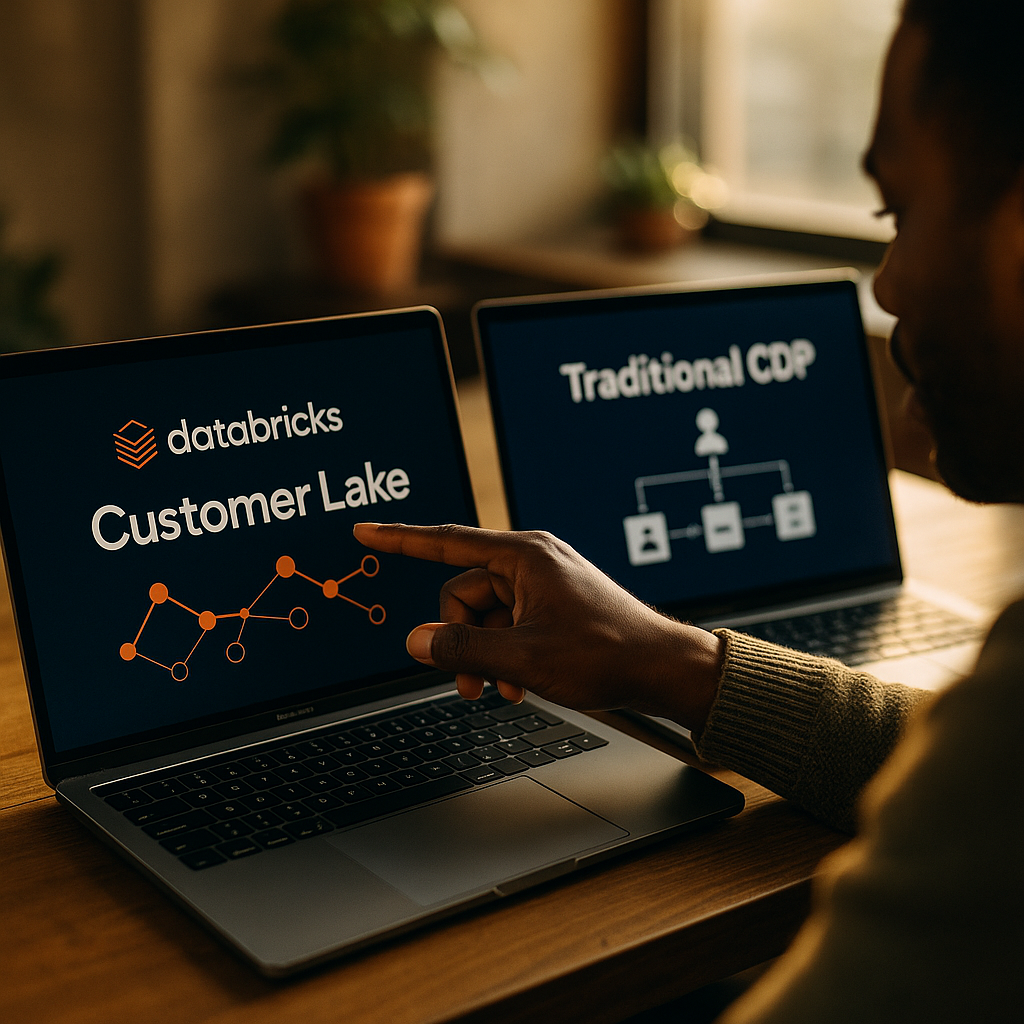
Gartner says 80% of CDP implementations underdeliver on their original business case. So why are brands still buying platforms built for 2019-era rules engines when AI agents now need to query, reason over, and act on audience data in real time? Databricks CustomerLake just entered the conversation as a genuine architectural alternative to traditional customer data platforms — and marketing leaders evaluating agentic AI need to understand what actually changes under the hood.
This isn’t a feature comparison. It’s a buying decision that touches your data warehouse strategy, your compliance posture, and how fast your team can operationalize an AI agent that decides, in milliseconds, whether a creator’s audience segment matches a campaign brief.
What Databricks CustomerLake actually is
CustomerLake isn’t a CDP wearing a lakehouse costume. It’s Databricks extending its existing Unity Catalog and Delta Lake infrastructure with purpose-built identity resolution, audience segmentation, and activation tooling — all sitting directly on top of the data you already have in your lakehouse, rather than requiring a separate copy.
That distinction matters more than it sounds. Traditional CDPs like Segment, Tealium, or mid-market players such as those covered in our martech consolidation breakdown require you to pipe data out of your warehouse, into their proprietary store, then back out again for activation. Every hop adds latency, cost, and a governance blind spot. CustomerLake’s pitch is simple: keep the data where it lives, run segmentation and AI agent queries against it directly, and skip the duplication tax entirely.
The core architectural bet is this: agentic AI doesn’t have time for a three-day data sync. If your agent needs fresh audience context to make a real-time creator-matching or bid decision, a zero-copy lakehouse model beats a traditional CDP’s batch-and-sync cycle almost every time.
Why “agentic-ready” is the phrase that matters now
Every vendor is slapping “AI-powered” on their pitch deck. Fewer can support actual agentic workflows — autonomous systems that query data, make a decision, and take action without a human clicking “approve” at each step. Our earlier look at autonomous decisioning in CDPs flagged this shift months ago: the platforms winning budget now are the ones that let an agent reason over live audience data, not a stale nightly export.
Here’s the practical test. Can your platform let an AI agent ask, “which of our retained customers overlap with this creator’s engaged audience, and what’s the propensity to convert if we activate a UGC campaign this week?” — and get an answer in seconds, using governed, permissioned data? Traditional CDPs generally can’t, because their segmentation logic runs against a copied, often stale dataset that was never designed for open-ended querying.
CustomerLake, by running natively on Databricks’ Mosaic AI and Unity Catalog governance layer, lets you build and deploy agents that query the same governed tables your data science team already uses for attribution modeling. No separate export. No shadow copy drifting out of sync with your source of truth.
The technical comparison brand teams actually need
Strip away the marketing language and the differences come down to five things: data residency, identity resolution method, activation latency, governance model, and cost structure.
- Data residency: Traditional CDPs copy data into their own store. CustomerLake operates in-place on your lakehouse, meaning one copy of truth, not three.
- Identity resolution: Legacy CDPs rely on deterministic and probabilistic matching within their own walled dataset. CustomerLake can join identity graphs against your full warehouse — CRM, transaction history, ad platform exports, creator campaign data — without a separate ETL job.
- Activation latency: Segment builds in most CDPs refresh hourly or daily. CustomerLake, running on Delta Lake’s streaming architecture, can support near-real-time segment updates, which matters enormously for time-sensitive influencer or flash-sale activations.
- Governance: Unity Catalog gives you column-level and row-level access controls natively. Most CDPs bolt governance on as an afterthought, which becomes a real liability under GDPR or CCPA audits.
- Cost structure: CDPs charge per profile, per monthly tracked user, or per activation. Databricks charges compute-based consumption, which can be cheaper at scale but punishes inefficient queries if your data engineering team isn’t disciplined.
That last point trips up a lot of buyers. A traditional CDP’s per-profile pricing is predictable but expensive at scale. CustomerLake’s consumption model rewards teams with strong data engineering discipline and penalizes teams that don’t have one. If your marketing ops function still relies on spreadsheet exports and manual segment building, you’ll burn compute credits fast and won’t see the savings Databricks promises.
Where traditional CDPs still win
Let’s not pretend this is a clean sweep. Traditional CDPs still have real advantages, especially for mid-market teams without a mature data engineering function.
First, time to value. Platforms like Klaviyo or the ones benchmarked in our predictive AI engagement comparison ship with pre-built connectors, templated journeys, and marketer-friendly UI that a campaign manager can operate without an engineering ticket. CustomerLake, by contrast, assumes you already have a lakehouse, a data engineering team, and someone fluent in SQL or PySpark who can build segmentation logic. That’s a real barrier for smaller brand teams.
Second, ecosystem maturity. Traditional CDPs have years of pre-built integrations with ad platforms, email tools, and CRM systems like the ones compared in our CRM admin-time comparison. CustomerLake’s activation layer is newer and still building out its partner integrations, which means more custom API work for now.
Third: vendor lock-in cuts both ways. Yes, CustomerLake avoids the CDP’s proprietary data silo. But you’re now locked into Databricks’ compute pricing and Unity Catalog architecture. Swap that dependency for a different one — just make sure it’s the one you actually want.
The compliance angle nobody’s talking about enough
Here’s where this gets interesting for anyone managing influencer or creator data alongside first-party customer data. Regulators are increasingly scrutinizing how brands combine customer PII with third-party social and creator engagement data for targeting purposes. The FTC has signaled continued interest in data broker practices, and the UK ICO has published guidance specifically on AI-driven profiling and automated decisioning.
A unified governance layer like Unity Catalog gives you a defensible audit trail: who queried what data, when, and for what purpose. That’s not a nice-to-have anymore. If your agentic AI system is autonomously deciding which customer segments to target with which creator campaign, you need to be able to explain that decision to a regulator, or at minimum, to your own legal team.
Traditional CDPs generally offer consent management and suppression lists, but the audit trail for AI-driven decisioning is often thinner, because the segmentation logic and the activation logic live in different systems with different logs.
If you can’t produce a query-level audit trail showing why an AI agent selected a specific audience segment, you’re not agentic-ready — you’re exposed. Governance isn’t a checkbox here, it’s the difference between a defensible AI program and a headline you don’t want.
A practical evaluation framework
Before you sign anything, run this checklist internally:
- Do you already have a lakehouse? If your data lives in Databricks or Snowflake already, CustomerLake’s zero-copy model is a genuine efficiency win. If you’re still warehouse-agnostic, a traditional CDP is faster to deploy.
- Who builds your segments? Marketers who need drag-and-drop segment builders will struggle with CustomerLake’s SQL-first approach. Data teams comfortable in notebooks will find it liberating.
- What’s your activation latency requirement? Flash promotions, real-time creator matching, and dynamic bid adjustments favor CustomerLake’s streaming model, similar to the logic behind dashboards that flag nano-to-micro spend shifts in real time.
- How mature is your governance function? If you don’t have a data governance lead, Unity Catalog’s granular controls will go unused, and you’ll lose the compliance advantage entirely.
- What’s the real total cost of ownership? Model out compute costs against per-profile CDP pricing at your actual scale, not the vendor’s demo scenario.
Run the numbers honestly. According to eMarketer, marketing data infrastructure spend continues climbing as brands consolidate martech stacks, and the CDP-versus-lakehouse decision is increasingly a multi-year architectural bet, not a quarterly tooling swap.
Next step
Don’t evaluate CustomerLake against your current CDP on feature parity. Evaluate it against your actual agentic AI roadmap for the next 18 months, then pick the architecture that supports where your audience segmentation strategy is headed, not where it’s been.
Frequently Asked Questions
Is Databricks CustomerLake a replacement for a traditional CDP?
For brands already running on a Databricks or compatible lakehouse, CustomerLake can replace most traditional CDP functions. For teams without existing data engineering infrastructure, a traditional CDP is often still the faster, lower-risk path.
What makes a platform “agentic-ready” for audience segmentation?
An agentic-ready platform lets AI agents query live, governed data and act on it autonomously, without waiting on batch syncs or manual approval steps at every stage of the decision.
Does CustomerLake cost less than a traditional CDP?
It depends entirely on scale and data engineering discipline. Consumption-based pricing can be cheaper at high volume but more expensive than per-profile CDP pricing if queries and pipelines aren’t optimized.
How does governance differ between CustomerLake and traditional CDPs?
CustomerLake inherits Unity Catalog’s column- and row-level access controls natively, giving a built-in audit trail. Traditional CDPs typically manage consent and suppression separately from segmentation logic, which weakens auditability for AI-driven decisions.
Do marketers need SQL skills to use CustomerLake?
Largely yes, or access to a data team that does. Unlike drag-and-drop CDP segment builders, CustomerLake’s core segmentation workflows assume comfort with SQL or notebook-based tools.
FAQs (Structured Data)
Top Influencer Marketing Agencies
The leading agencies shaping influencer marketing in 2026
Agencies ranked by campaign performance, client diversity, platform expertise, proven ROI, industry recognition, and client satisfaction. Assessed through verified case studies, reviews, and industry consultations.
Moburst

-
2

The Shelf
Boutique Beauty & Lifestyle Influencer AgencyA data-driven boutique agency specializing exclusively in beauty, wellness, and lifestyle influencer campaigns on Instagram and TikTok. Best for brands already focused on the beauty/personal care space that need curated, aesthetic-driven content.Clients: Pepsi, The Honest Company, Hims, Elf Cosmetics, Pure LeafVisit The Shelf → -
3

Audiencly
Niche Gaming & Esports Influencer AgencyA specialized agency focused exclusively on gaming and esports creators on YouTube, Twitch, and TikTok. Ideal if your campaign is 100% gaming-focused — from game launches to hardware and esports events.Clients: Epic Games, NordVPN, Ubisoft, Wargaming, Tencent GamesVisit Audiencly → -
4

Viral Nation
Global Influencer Marketing & Talent AgencyA dual talent management and marketing agency with proprietary brand safety tools and a global creator network spanning nano-influencers to celebrities across all major platforms.Clients: Meta, Activision Blizzard, Energizer, Aston Martin, WalmartVisit Viral Nation → -
5

The Influencer Marketing Factory
TikTok, Instagram & YouTube CampaignsA full-service agency with strong TikTok expertise, offering end-to-end campaign management from influencer discovery through performance reporting with a focus on platform-native content.Clients: Google, Snapchat, Universal Music, Bumble, YelpVisit TIMF → -
6

NeoReach
Enterprise Analytics & Influencer CampaignsAn enterprise-focused agency combining managed campaigns with a powerful self-service data platform for influencer search, audience analytics, and attribution modeling.Clients: Amazon, Airbnb, Netflix, Honda, The New York TimesVisit NeoReach → -
7

Ubiquitous
Creator-First Marketing PlatformA tech-driven platform combining self-service tools with managed campaign options, emphasizing speed and scalability for brands managing multiple influencer relationships.Clients: Lyft, Disney, Target, American Eagle, NetflixVisit Ubiquitous → -
8

Obviously
Scalable Enterprise Influencer CampaignsA tech-enabled agency built for high-volume campaigns, coordinating hundreds of creators simultaneously with end-to-end logistics, content rights management, and product seeding.Clients: Google, Ulta Beauty, Converse, AmazonVisit Obviously →