


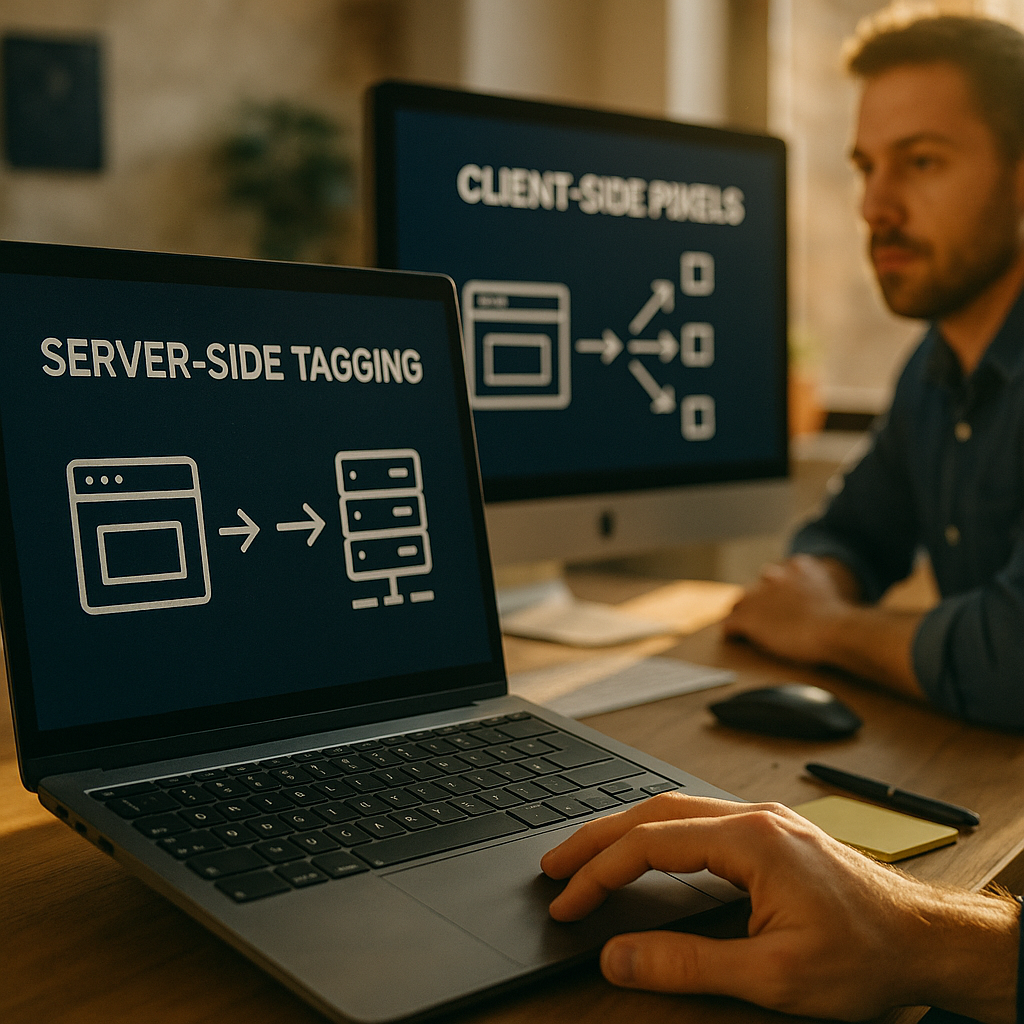
Third-party cookie deprecation has been “coming soon” for so long that some marketing ops teams stopped taking it seriously. Big mistake. Server-side tagging adoption jumped sharply as Chrome’s Privacy Sandbox rollout, iOS tracking restrictions, and ad blocker penetration (now over 40% in some markets, per Statista) quietly gutted client-side pixel accuracy. If your attribution still leans on a Meta Pixel and a prayer, you’re already losing data you can’t see.
Why This Debate Isn’t Optional Anymore
Client-side pixels fire from the user’s browser. That’s the whole problem. Ad blockers, Intelligent Tracking Prevention, and browser extensions like uBlock Origin intercept those calls before they ever reach your ad platform’s server. Some estimates put client-side event loss at 15-30% depending on the industry and audience skew toward privacy-conscious browsers like Firefox or Brave.
Server-side tagging routes that same event data through a server you (or your vendor) control, then forwards it to Meta, TikTok, Google, or wherever it needs to go. The browser never talks directly to the ad platform. Ad blockers can’t intercept what they can’t see.
Marketing ops teams still running pixel-only setups are effectively optimizing campaigns on a data sample that skews toward users who don’t block trackers — which is not a neutral sample.
The Technical Difference, Without the Jargon
Client-side tracking works like this: a snippet of JavaScript sits on your site, watches for events (page view, add-to-cart, purchase), and sends that data directly from the browser to the ad platform’s endpoint. Fast to deploy. Cheap to maintain. Also fragile, because it depends entirely on the browser cooperating.
Server-side tagging, most commonly implemented through Google Tag Manager’s server container, works differently. The browser sends event data to a first-party endpoint, typically a subdomain you own. That server then processes, enriches, and forwards the data to your ad platforms via their conversion APIs — Meta’s Conversions API, TikTok’s Events API, Google’s Enhanced Conversions.
- Data ownership: you control what gets sent, when, and to whom.
- Latency: slightly higher, since there’s an extra hop, but negligible in practice.
- Resilience: immune to most browser-level blocking, since the traffic looks like standard first-party requests.
- Complexity: requires cloud infrastructure (usually Google Cloud Run or AWS), ongoing maintenance, and someone who understands server logs, not just tag configurations.
Where Client-Side Pixels Still Make Sense
Let’s not pretend server-side is right for everyone. If you’re a small DTC brand running a single Shopify store with modest ad spend, standing up a server container might be overkill. The engineering cost and ongoing maintenance can outweigh the data recovery benefit if your monthly ad spend is under $10k.
Client-side pixels are also faster to test. Want to try a new pixel event for a flash sale? You can deploy it in an afternoon. Server-side changes typically go through a more deliberate release process, because you’re touching infrastructure, not just a tag manager container.
What Server-Side Tagging Actually Fixes
Three things, mainly: data loss, latency-sensitive personalization, and compliance exposure. Let’s take them one at a time.
Data loss. Recovering blocked or degraded events is the headline benefit. Brands moving to Meta’s Conversions API alongside server-side infrastructure commonly report conversion match rate improvements, though the exact lift depends heavily on implementation quality and existing pixel health. This directly affects how confident you can be in creator attribution dashboards that rely on pixel-fired conversion events to credit influencer-driven sales.
Compliance control. Server-side setups let you filter, hash, or strip PII before it ever leaves your infrastructure. That’s a meaningfully different risk posture than hoping your client-side pixel doesn’t accidentally leak an email address in the URL parameters. Regulators are paying attention — the FTC and the ICO have both signaled increased scrutiny of ad tech data flows, and having a server-side layer gives you an auditable checkpoint.
Speed and reliability. First-party server endpoints load faster than third-party scripts, which can shave milliseconds off page load and, in aggregate, improve Core Web Vitals scores. Google has said page experience factors into search ranking, so this isn’t purely an ad-tech concern.
The Attribution Angle Marketing Ops Can’t Ignore
Here’s the part that should worry anyone running influencer or affiliate programs: if your pixel is dropping 20% of conversion events, your attribution model is working with a distorted dataset. That skews which creators look like they’re driving ROI and which ones look like duds. You might be cutting a high-performing creator because their audience happens to over-index on Safari users with ITP enabled.
This is exactly the kind of blind spot addressed in identity resolution approaches to attribution, and it’s why hybrid measurement models are gaining traction. If you’re still relying purely on rule-based attribution fed by client-side data, server-side tagging isn’t a nice-to-have. It’s a prerequisite for trustworthy numbers.
A pixel that’s silently dropping 20% of conversions doesn’t just cost you data — it costs you the ability to trust which creators are actually driving revenue.
What Migration Actually Costs (Time, Money, Headcount)
Nobody wants to hear this, but server-side tagging isn’t a weekend project. Realistic timelines for a mid-market brand:
- Setup: 2-6 weeks, depending on how many platforms you’re integrating (Meta CAPI, TikTok Events API, Google Ads Enhanced Conversions, plus any CDP connections).
- Cloud hosting costs: typically $50-300/month on Google Cloud Run for mid-traffic sites, scaling with event volume.
- Engineering time: expect a developer or ops engineer to own this, not a marketer clicking through a tag manager UI. This is infrastructure, and it needs someone who can debug server logs.
- Ongoing maintenance: API versions change. Meta updates CAPI parameters periodically. Someone needs to own that upkeep, or event matching quality degrades silently over time.
For teams already juggling a fragmented martech stack, this can feel like one more system to babysit. That’s a fair concern, and it’s part of why some organizations are consolidating attribution infrastructure into a centralized data lake rather than managing point-to-point integrations for every ad platform separately.
Vendor-Managed vs. In-House: Which Fits Your Team?
You don’t have to build this from scratch. Platforms like Stape, Elevar (built specifically for Shopify), and Segment’s server-side connections offer managed server-tagging infrastructure. This trades some control for significantly faster deployment and less ongoing engineering burden.
For brands without dedicated dev resources, a managed solution is almost always the right call. Building your own Google Cloud Run container from scratch makes sense only if you have specific customization needs, unusual data volume, or an internal platform team that already owns similar infrastructure. Evaluating this decision looks a lot like the broader build-vs-buy tradeoffs marketing ops teams face across the martech stack — the tooling question is rarely just about features, it’s about who owns maintenance six months from now.
A Practical Decision Framework
Rather than treating this as binary, most mature marketing ops teams run a hybrid: client-side pixels for low-stakes, exploratory tracking, and server-side infrastructure for revenue-critical conversion events feeding attribution and ad platform optimization.
- Audit your current match rate. Check Meta Events Manager or your platform’s diagnostics to see how much event data is already getting lost.
- Prioritize by revenue impact. Purchase and lead-gen events deserve server-side treatment first. Page views and low-value engagement events can stay client-side.
- Decide build vs. managed. If you don’t have a developer who can own this quarterly, go managed.
- Connect it to attribution, not just ad platforms. Server-side data should feed your broader measurement stack, not just improve Meta’s optimization algorithm in isolation.
This is also where identity resolution and clean data pipelines matter more than the tagging method itself. Server-side tagging fixes data capture. It doesn’t fix stitching that data across devices and sessions, which is a separate (and arguably harder) problem tackled by tools built around cross-channel data pipelines.
If you take one action after reading this: pull your current pixel match rate this week, compare it against your server-side potential using Meta’s Conversions API diagnostics, and use that gap as the business case for prioritizing migration before next year’s budget cycle locks in.
Frequently Asked Questions
Is server-side tagging replacing client-side pixels entirely?
No. Most brands run both in a hybrid model, using server-side for revenue-critical events and client-side for lower-stakes tracking where speed of deployment matters more than data completeness.
How much does server-side tagging typically cost to implement?
Cloud hosting runs roughly $50-300 per month for mid-traffic sites, plus setup time of two to six weeks depending on how many ad platforms you’re integrating. Managed vendors like Stape or Elevar reduce upfront engineering cost significantly.
Does server-side tagging solve cookie deprecation entirely?
Not entirely. It improves first-party data capture and event delivery reliability, but it doesn’t replace the need for consent management, identity resolution, or first-party data collection strategies elsewhere in your stack.
Which ad platforms support server-side conversion APIs?
Meta’s Conversions API, TikTok’s Events API, and Google’s Enhanced Conversions are the most widely adopted. Most major ad platforms now offer some form of server-to-server event ingestion.
Do small businesses need server-side tagging?
Not always. If monthly ad spend is modest and the team lacks engineering resources, a managed client-side setup with strong consent management may be sufficient until scale justifies the migration.
Top Influencer Marketing Agencies
The leading agencies shaping influencer marketing in 2026
Agencies ranked by campaign performance, client diversity, platform expertise, proven ROI, industry recognition, and client satisfaction. Assessed through verified case studies, reviews, and industry consultations.
Moburst

-
2

The Shelf
Boutique Beauty & Lifestyle Influencer AgencyA data-driven boutique agency specializing exclusively in beauty, wellness, and lifestyle influencer campaigns on Instagram and TikTok. Best for brands already focused on the beauty/personal care space that need curated, aesthetic-driven content.Clients: Pepsi, The Honest Company, Hims, Elf Cosmetics, Pure LeafVisit The Shelf → -
3

Audiencly
Niche Gaming & Esports Influencer AgencyA specialized agency focused exclusively on gaming and esports creators on YouTube, Twitch, and TikTok. Ideal if your campaign is 100% gaming-focused — from game launches to hardware and esports events.Clients: Epic Games, NordVPN, Ubisoft, Wargaming, Tencent GamesVisit Audiencly → -
4

Viral Nation
Global Influencer Marketing & Talent AgencyA dual talent management and marketing agency with proprietary brand safety tools and a global creator network spanning nano-influencers to celebrities across all major platforms.Clients: Meta, Activision Blizzard, Energizer, Aston Martin, WalmartVisit Viral Nation → -
5

The Influencer Marketing Factory
TikTok, Instagram & YouTube CampaignsA full-service agency with strong TikTok expertise, offering end-to-end campaign management from influencer discovery through performance reporting with a focus on platform-native content.Clients: Google, Snapchat, Universal Music, Bumble, YelpVisit TIMF → -
6

NeoReach
Enterprise Analytics & Influencer CampaignsAn enterprise-focused agency combining managed campaigns with a powerful self-service data platform for influencer search, audience analytics, and attribution modeling.Clients: Amazon, Airbnb, Netflix, Honda, The New York TimesVisit NeoReach → -
7

Ubiquitous
Creator-First Marketing PlatformA tech-driven platform combining self-service tools with managed campaign options, emphasizing speed and scalability for brands managing multiple influencer relationships.Clients: Lyft, Disney, Target, American Eagle, NetflixVisit Ubiquitous → -
8

Obviously
Scalable Enterprise Influencer CampaignsA tech-enabled agency built for high-volume campaigns, coordinating hundreds of creators simultaneously with end-to-end logistics, content rights management, and product seeding.Clients: Google, Ulta Beauty, Converse, AmazonVisit Obviously →