


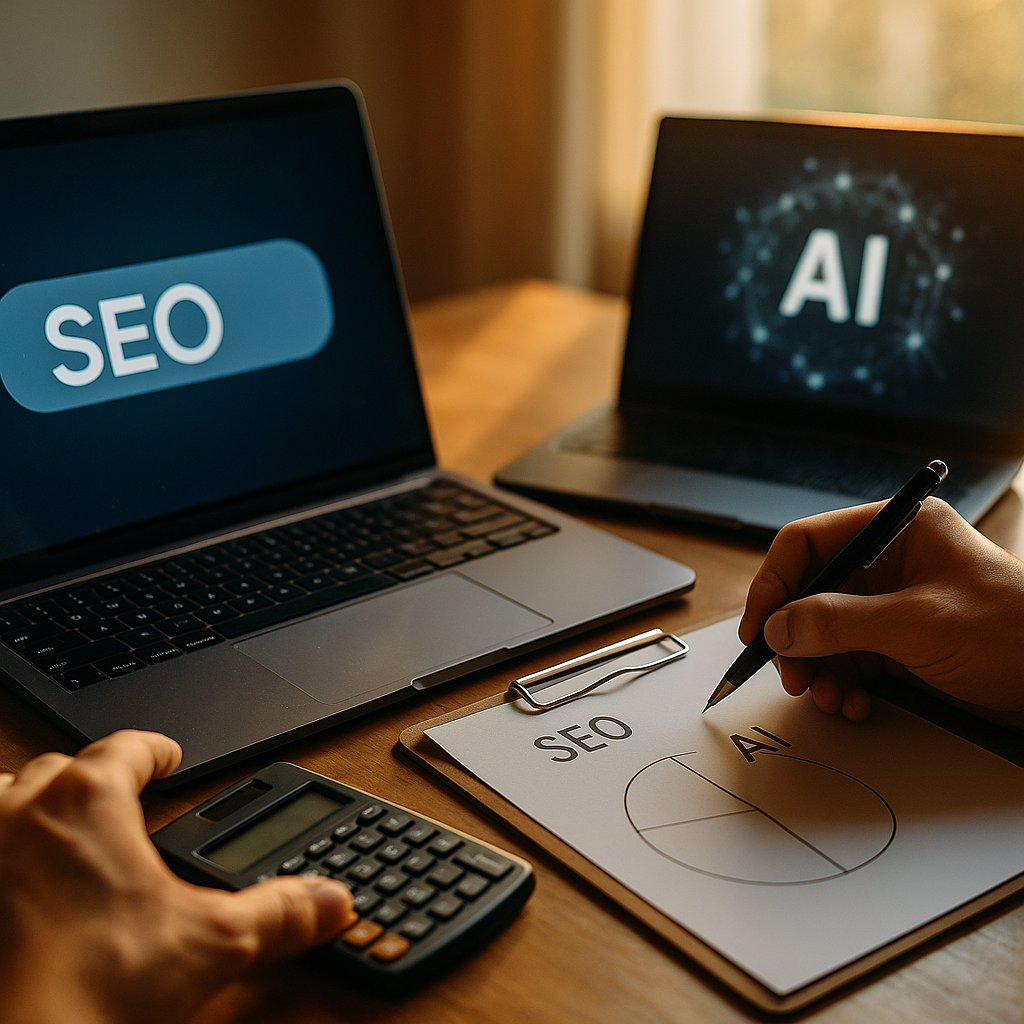
Sixty-eight percent of searches now end without a click. That’s not a typo — it’s the new baseline for organic discovery, and it’s forcing CMOs to answer a question nobody budgeted for two years ago: how much do we spend optimizing for AI answers versus traditional search? Welcome to the generative answer economy, where Google’s blue links are losing ground to synthesized responses, and your content strategy either adapts or disappears into the training data nobody credits.
The Split Nobody Planned For
Marketing budgets don’t reallocate cleanly. They fracture, get renegotiated in quarterly reviews, and usually lag behind the behavior shift that triggered them in the first place. That’s exactly what’s happening with search spend right now.
Traditional SEO — the discipline built around ranking pages, earning backlinks, and optimizing for click-through — still commands the majority of most brands’ organic budgets. But a growing slice is migrating toward what industry analysts are calling AI answer optimization, or AAO: the practice of structuring content so large language models cite, summarize, or recommend your brand when someone asks ChatGPT, Perplexity, or Google’s AI Overviews a question.
The two disciplines overlap, but they’re not the same job. Traditional SEO optimizes for a ranking algorithm that rewards authority signals humans can audit. AI answer optimization optimizes for a probabilistic model that decides, in milliseconds, which sources deserve a citation — and that model doesn’t care about your domain authority score the way Google’s classic algorithm did.
Zero-click search has already hit 68 percent of all queries, meaning the majority of searches now resolve without a single visit to a publisher or brand site — a shift that’s rewriting the ROI math on content investment entirely.
We covered the mechanics of this shift in detail in our breakdown of zero-click search trends, but the budget implication deserves its own conversation. If discovery no longer drives traffic, what exactly are you buying with your SEO dollars?
Why AI Answer Optimization Isn’t Just “SEO for Chatbots”
Here’s the mistake a lot of marketing teams are making: treating generative engine optimization as a rebrand of SEO, then handing it to the same team with the same tools and calling it done.
It’s not the same job. Traditional SEO ranks pages. AI answer optimization earns citations inside a synthesized response — and the mechanics of earning that citation are different enough to require a distinct playbook.
- Structured, extractable content beats keyword density. LLMs favor clear, well-organized answers with explicit claims and sourcing over pages stuffed with long-tail keyword variants.
- Third-party validation matters more than backlinks. Being mentioned favorably on Reddit, G2, or industry publications now carries weight because models train on and retrieve from that content.
- Freshness and specificity win. Vague evergreen content underperforms against pages with precise stats, dates, and named sources — models reward specificity because it’s easier to extract and attribute.
- Brand mentions without links still count. Unlike classic SEO, where a citation without a backlink was nearly worthless, AI models can surface your brand name in an answer even when there’s no clickable link back to you.
That last point unsettles a lot of SEO veterans. For twenty years, the backlink was the currency. Now brand visibility inside an AI-generated answer can happen with zero referral traffic and zero attribution data in Google Analytics. It’s marketing in the dark, and it’s exactly why budget allocation is so contentious right now — nobody’s entirely sure how to measure the return.
Where the Money Is Actually Going
According to eMarketer tracking of digital ad and content spend, brands are still allocating the bulk of organic content budgets to traditional SEO infrastructure: technical audits, link-building programs, and content refreshes tied to ranking signals. But the growth line belongs to AI optimization.
A useful way to think about the split: traditional SEO is defending existing equity, AI answer optimization is building new equity in a channel with far less competition right now. Early movers who structure content for LLM retrieval are seeing outsized citation share simply because most competitors haven’t shown up yet.
This mirrors a pattern we’ve tracked across other parts of the marketing stack. The AI martech market’s rapid growth shows the same dynamic: budget consolidating around fewer, more capable platforms rather than spreading thin across point solutions. Search optimization is following the same arc — brands are less interested in bolting on a new “AEO tool” and more interested in vendors who can manage both traditional and generative discovery from one dashboard.
That consolidation instinct isn’t limited to search tooling, either. We’ve seen marketing teams broadly retreat from fragmented point solutions in favor of unified platforms, a trend we detailed in our piece on AI stack consolidation. Search budgets are simply the latest line item to get swept into that logic.
The Measurement Problem Is the Real Budget Blocker
Ask a CMO why they haven’t shifted more budget toward AI answer optimization and you’ll usually get the same answer: they can’t prove it works yet.
Google Search Console tells you almost nothing about whether ChatGPT cited your page in a response to a user you’ll never identify. There’s no referral URL, no session, no conversion path most attribution models can parse. A handful of vendors — Profound, Rankscale, and a few emerging entrants — are building tracking layers that simulate thousands of AI queries and monitor citation frequency, but this category is still maturing, and the data is directional rather than definitive.
This is where the parallel to influencer marketing measurement gets useful. The industry spent years chasing reach and impressions before realizing trust and attribution mattered more. Our coverage of trust-based buying behavior found that the majority of purchase decisions hinge on credibility signals, not audience size. AI answer optimization is walking the same path — brands are learning that being cited by an LLM only matters if it correlates with something the business cares about: pipeline, direct traffic, brand search volume.
Smart teams are triangulating instead of waiting for perfect attribution. They’re tracking branded search lift, monitoring direct traffic spikes after known model updates, and running qualitative brand awareness surveys asking “how did you hear about us” with an explicit AI assistant option. Imperfect, but directionally useful — and far better than doing nothing while competitors experiment.
What a Split Budget Actually Looks Like
So what’s a defensible allocation right now? There’s no universal number, but a pattern is emerging among brands further along the curve.
- Protect the base with traditional SEO. Technical health, core page rankings, and existing link equity still drive real traffic. Don’t gut this to fund experimentation.
- Carve out 15-25% for AI-specific content structuring. This includes rewriting cornerstone pages for extractability, building FAQ schema (like the one at the bottom of this article), and publishing original data that models can cite with attribution.
- Invest in earned media and third-party mentions. Since LLMs weight independent validation heavily, PR and digital PR functions are becoming AI optimization functions almost by accident.
- Fund measurement infrastructure before scaling spend further. A modest investment in AI citation tracking tools pays for itself by telling you which content types are actually earning visibility.
Notice what’s missing from that list: nobody is recommending brands abandon traditional SEO. The channels are complementary, not competitive, at least for now. But the marginal dollar is increasingly flowing toward AI-native tactics, and that trend line only steepens as tools like Google’s AI Overviews expand coverage across more query types.
A Talent Gap Is Slowing Everyone Down
There’s an uncomfortable truth underneath all of this: most marketing teams don’t have anyone who genuinely understands how LLMs retrieve and rank content. SEO specialists know PageRank logic. Content teams know brand voice. Almost nobody on staff has spent real time reverse-engineering how Perplexity decides which three sources to cite out of ten thousand candidates.
This is the same skills shortfall we flagged in our analysis of the agentic AI talent gap facing marketing organizations broadly. Search optimization is just one more function where the tooling has outpaced the workforce’s understanding of how to use it.
Agencies are stepping into the gap, but buyer beware: plenty of vendors are rebranding old SEO service packages as “AI optimization” without changing the underlying methodology. Ask specifically how they measure citation frequency, what tools they use to track LLM visibility, and whether they can show before-and-after data from a comparable client. If the answer is vague, the service probably is too.
Where This Is Headed
The generative answer economy isn’t a temporary disruption that resolves once Google “fixes” AI Overviews or users get tired of chatbot search. It’s a structural shift in how information gets discovered, and it’s compounding. HubSpot’s ongoing research into buyer behavior shows younger B2B buyers increasingly starting research inside AI tools rather than search engines — a pattern that only strengthens as those buyers age into bigger budgets.
Brands that treat AI answer optimization as a side experiment funded by leftover SEO budget will fall behind brands treating it as its own discipline with its own KPIs, its own headcount, and its own measurement stack. The split isn’t a temporary budgeting headache. It’s the new shape of organic marketing.
Frequently Asked Questions
FAQs
What is AI answer optimization and how is it different from SEO?
AI answer optimization (also called generative engine optimization or AEO) is the practice of structuring content so AI tools like ChatGPT, Perplexity, and Google’s AI Overviews cite or recommend your brand in a synthesized response. Traditional SEO optimizes for ranking algorithms and click-through; AI answer optimization optimizes for citation and mention inside an AI-generated answer, often without any click at all.
Should brands cut traditional SEO budget to fund AI optimization?
Most practitioners recommend against cutting traditional SEO significantly. Traditional search still drives measurable traffic and revenue for most brands. The more common approach is incremental reallocation — carving out 15-25% of organic budget for AI-specific content structuring and measurement while maintaining core SEO investment.
How do brands measure ROI on AI answer optimization?
Measurement is still immature. Brands are triangulating using branded search volume lift, direct traffic spikes correlated with model updates, AI citation tracking tools, and survey data asking customers how they discovered the brand. There’s no direct equivalent to Google Analytics referral tracking yet.
Which content formats perform best for AI citation?
Structured, specific content performs best: clear headings, explicit data points, FAQ sections with schema markup, and original research with named sources. Vague evergreen content tends to underperform compared to pages with precise stats and clear sourcing that models can easily extract and attribute.
Does brand mention in an AI answer matter if there’s no link?
Yes, according to most practitioners tracking this space. Brand visibility inside an AI-generated answer can influence awareness and consideration even without a clickable link, similar to how offline or unlinked media mentions have always contributed to brand equity — just harder to attribute directly.
Next step: Audit your last two quarters of organic content for extractability — clear claims, named data, structured FAQs — before adding a single dollar to your AI optimization line item. The content you already have is probably underperforming in AI answers for fixable, structural reasons.
Frequently Asked Questions
What is AI answer optimization and how is it different from SEO?
AI answer optimization (also called generative engine optimization or AEO) is the practice of structuring content so AI tools like ChatGPT, Perplexity, and Google’s AI Overviews cite or recommend your brand in a synthesized response. Traditional SEO optimizes for ranking algorithms and click-through; AI answer optimization optimizes for citation and mention inside an AI-generated answer, often without any click at all.
Should brands cut traditional SEO budget to fund AI optimization?
Most practitioners recommend against cutting traditional SEO significantly. Traditional search still drives measurable traffic and revenue for most brands. The more common approach is incremental reallocation — carving out 15-25% of organic budget for AI-specific content structuring and measurement while maintaining core SEO investment.
How do brands measure ROI on AI answer optimization?
Measurement is still immature. Brands are triangulating using branded search volume lift, direct traffic spikes correlated with model updates, AI citation tracking tools, and survey data asking customers how they discovered the brand. There’s no direct equivalent to Google Analytics referral tracking yet.
Which content formats perform best for AI citation?
Structured, specific content performs best: clear headings, explicit data points, FAQ sections with schema markup, and original research with named sources. Vague evergreen content tends to underperform compared to pages with precise stats and clear sourcing that models can easily extract and attribute.
Does brand mention in an AI answer matter if there’s no link?
Yes, according to most practitioners tracking this space. Brand visibility inside an AI-generated answer can influence awareness and consideration even without a clickable link, similar to how offline or unlinked media mentions have always contributed to brand equity — just harder to attribute directly.
Top Influencer Marketing Agencies
The leading agencies shaping influencer marketing in 2026
Agencies ranked by campaign performance, client diversity, platform expertise, proven ROI, industry recognition, and client satisfaction. Assessed through verified case studies, reviews, and industry consultations.
Moburst

-
2

The Shelf
Boutique Beauty & Lifestyle Influencer AgencyA data-driven boutique agency specializing exclusively in beauty, wellness, and lifestyle influencer campaigns on Instagram and TikTok. Best for brands already focused on the beauty/personal care space that need curated, aesthetic-driven content.Clients: Pepsi, The Honest Company, Hims, Elf Cosmetics, Pure LeafVisit The Shelf → -
3

Audiencly
Niche Gaming & Esports Influencer AgencyA specialized agency focused exclusively on gaming and esports creators on YouTube, Twitch, and TikTok. Ideal if your campaign is 100% gaming-focused — from game launches to hardware and esports events.Clients: Epic Games, NordVPN, Ubisoft, Wargaming, Tencent GamesVisit Audiencly → -
4

Viral Nation
Global Influencer Marketing & Talent AgencyA dual talent management and marketing agency with proprietary brand safety tools and a global creator network spanning nano-influencers to celebrities across all major platforms.Clients: Meta, Activision Blizzard, Energizer, Aston Martin, WalmartVisit Viral Nation → -
5

The Influencer Marketing Factory
TikTok, Instagram & YouTube CampaignsA full-service agency with strong TikTok expertise, offering end-to-end campaign management from influencer discovery through performance reporting with a focus on platform-native content.Clients: Google, Snapchat, Universal Music, Bumble, YelpVisit TIMF → -
6

NeoReach
Enterprise Analytics & Influencer CampaignsAn enterprise-focused agency combining managed campaigns with a powerful self-service data platform for influencer search, audience analytics, and attribution modeling.Clients: Amazon, Airbnb, Netflix, Honda, The New York TimesVisit NeoReach → -
7

Ubiquitous
Creator-First Marketing PlatformA tech-driven platform combining self-service tools with managed campaign options, emphasizing speed and scalability for brands managing multiple influencer relationships.Clients: Lyft, Disney, Target, American Eagle, NetflixVisit Ubiquitous → -
8

Obviously
Scalable Enterprise Influencer CampaignsA tech-enabled agency built for high-volume campaigns, coordinating hundreds of creators simultaneously with end-to-end logistics, content rights management, and product seeding.Clients: Google, Ulta Beauty, Converse, AmazonVisit Obviously →