


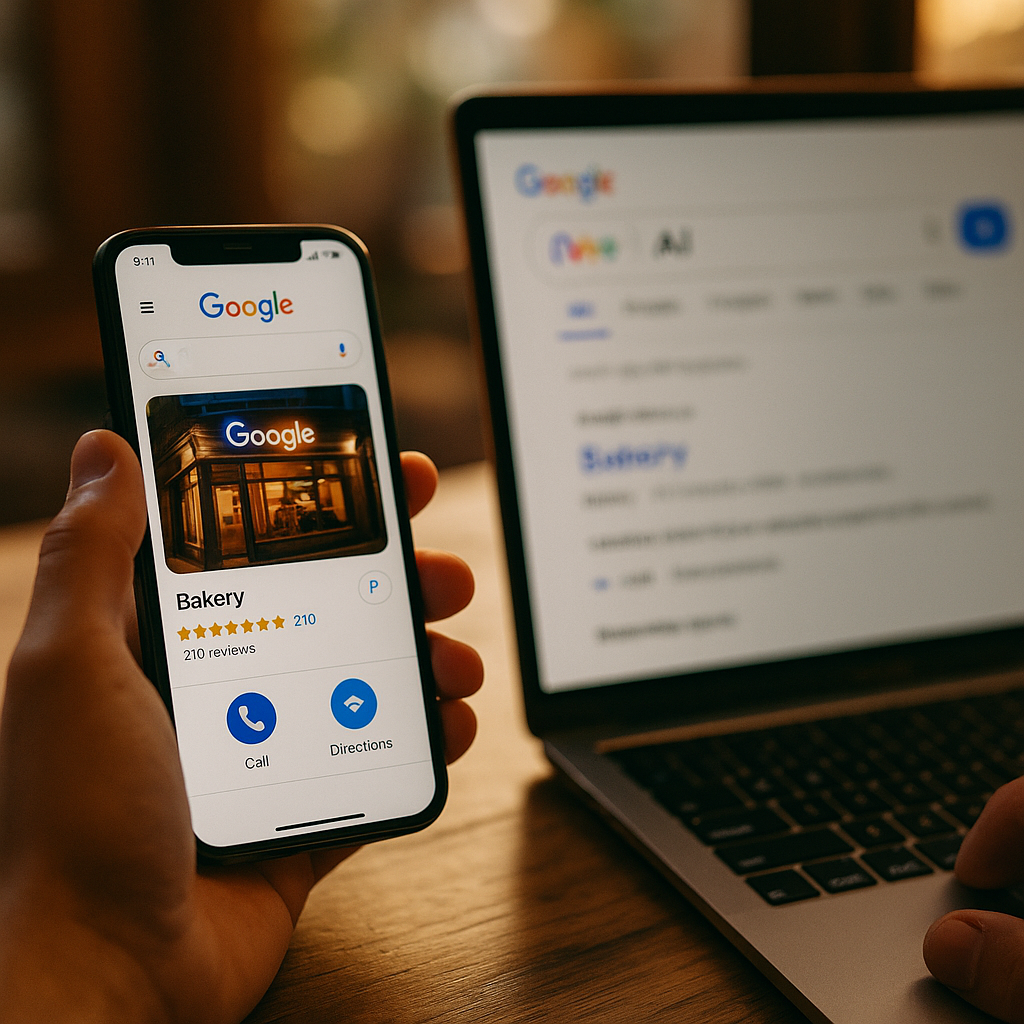
Ask ChatGPT or Google’s AI Overviews where to find “the best plumber near me,” and it won’t crawl your website first. It’ll pull from your Google Business Profile, cross-check your listing against a dozen directories, and penalize you silently if your phone number doesn’t match across all of them. Website traffic used to be the trophy metric. In local AI search, it’s now a lagging indicator.
The Ranking Signal Nobody Budgeted For
Here’s the uncomfortable part for brands that spent years optimizing on-site content: large language models don’t browse the way Googlebot does. They query structured data sources, and Google Business Profile (GBP) sits at the center of that graph for anything with local intent. When Gemini-powered AI Overviews or a Perplexity local query needs to answer “is this business open now” or “where’s the nearest location,” it reaches for the profile, not the homepage.
That shift matters because most brand SEO stacks were built around the website as the source of truth. NAP data (Name, Address, Phone) got typed into a GBP listing once, in 2019, and never touched again. Meanwhile the website footer says “Suite 200,” the Yelp listing says “Ste 200,” and the Facebook page still has the old area code. Humans skimmed past those discrepancies. AI models don’t skim, they parse.
Local AI search doesn’t reward the business with the best website copy. It rewards the business whose identity data resolves cleanly across every platform an AI model checks.
Why NAP Consistency Became a Trust Signal, Not a Housekeeping Task
NAP consistency has been an SEO talking point since the days of Moz’s local ranking factor studies. What’s changed is the stakes. In classic search, an inconsistent phone number might cost you a few ranking positions. In AI-generated answers, an inconsistent phone number can get your business dropped from the answer entirely, because the model can’t confidently resolve which listing is authoritative.
Think of it as identity resolution, the same concept marketers already wrestle with in customer data platforms. AI search engines are trying to resolve “which entity is this business” the same way a CDP tries to resolve “which person is this customer.” Conflicting signals break the match. Our team covered this exact mechanic in depth in our identity resolution framework for AI search, and the pattern holds: the more directories that agree on your NAP data, the more confidently an LLM cites you.
What “Outranking Website Traffic” Actually Means
Let’s be precise, because this claim gets thrown around loosely. Nobody’s saying website traffic is irrelevant. What’s happening is a re-weighting: for queries with clear local intent — “near me,” “hours,” “open Sunday,” “closest location” — AI search systems increasingly treat GBP and directory data as the primary source, with the website acting as a secondary verification layer.
Google’s own documentation on Business Profile management has quietly shifted emphasis toward structured attributes: service areas, categories, attributes like “wheelchair accessible” or “appointment required.” These are machine-readable in a way that a paragraph of website copy simply isn’t. A blog post that says “we’ve proudly served the Denver metro for 20 years” is meaningless to a model looking for a service-area boundary. A correctly configured GBP service-area field is not.
Data from BrightLocal’s ongoing local search studies has shown for years that GBP is the primary driver of local pack visibility. What’s new is that this same profile data is now feeding AI Overviews, Gemini’s local answers, and increasingly Perplexity’s location-aware responses. One optimization now serves three surfaces.
The Directory Sprawl Problem
Most mid-size and enterprise brands have NAP data scattered across more listings than anyone on the marketing team can name off the top of their head. Google Business Profile, Bing Places, Apple Maps, Yelp, Facebook, Yellow Pages, industry-specific directories, chamber of commerce sites, data aggregators like Neustar Localeze and Data Axle. Each one is a potential citation an AI model might pull from to verify or contradict your primary listing.
- Primary platforms: Google Business Profile, Bing Places, Apple Business Connect
- Review platforms: Yelp, TripAdvisor, industry-specific review sites
- Data aggregators: Data Axle, Neustar Localeze, Foursquare
- Social platforms: Facebook, Instagram, LinkedIn company pages
- Niche/vertical directories: healthcare, legal, home services, hospitality-specific listings
The problem compounds for multi-location brands and franchises. A 50-location retail chain isn’t managing 50 NAP records, it’s managing 50 records times 8-10 directories, which is 400-500 individual data points, any one of which can drift out of sync after a rebrand, a phone system migration, or a suite renumbering.
A Technical Audit Framework for NAP Consistency
Fixing this isn’t glamorous work, but it’s tractable if you treat it like a data hygiene project rather than a content project. Here’s the sequence that actually moves the needle:
- Establish one canonical NAP record. Pick the exact string format for your name, address, and phone number, down to abbreviations (St. vs Street, Suite vs Ste). Document it in a shared source of truth, not someone’s memory.
- Audit every existing listing against that canonical record. Tools like Moz Local, Yext, or BrightLocal can pull a consolidated view, but for anything under 20 locations, a manual spreadsheet audit is faster and cheaper.
- Fix primary platforms first. Google Business Profile, Bing Places, Apple Business Connect. These feed the most AI surfaces directly.
- Clean data aggregators next. Aggregators like Data Axle push listings out to dozens of smaller directories automatically. Fixing the aggregator record fixes downstream listings without touching them individually.
- Reconcile social and niche directories last. Lower AI-citation weight, but still worth closing the loop for consistency.
- Set a recurring audit cadence. Quarterly, minimum. Address changes, new phone systems, and rebrands break consistency fast.
If your organization already runs structured AI visibility audits for organic answer engines, this NAP work should slot into the same cadence. The AI search visibility audit framework we published earlier this year applies the same logic to ChatGPT and Perplexity citations, and local NAP hygiene is really a specialized subset of that broader discipline.
Structured Data Still Matters, Just Differently
Schema markup hasn’t gone away, it’s just been reassigned a role. LocalBusiness schema on your website won’t outrank a well-maintained GBP listing, but it acts as a corroborating signal. When an AI model finds matching NAP data in your GBP listing, your site’s schema markup, and three major directories, that redundancy builds confidence. When it finds four different phone numbers across five sources, confidence collapses and the model either hedges its answer or omits your business entirely.
Consistency across five sources beats perfection on one. AI models are built to distrust outliers, and a single mismatched listing is an outlier.
This is also where budget conversations get real. Marketing leaders who’ve been splitting spend between traditional SEO and generative engine optimization already understand the tradeoff; our piece on splitting budgets between SEO and AI search is a useful reference point if you’re trying to justify headcount or tooling spend for directory management specifically. NAP cleanup is cheap relative to content production, but it requires discipline, not creativity, and that makes it easy to deprioritize until it shows up as a ranking problem.
What This Means for Multi-Location and Franchise Brands
Franchise marketing teams have the hardest version of this problem. Corporate controls brand voice and creative, but individual franchisees often manage their own GBP listings, and local owners don’t always know a rebrand happened at HQ. The result: a national campaign launches with new messaging while forty franchise locations still show the old logo, old hours, or a defunct phone number in their profiles.
The fix isn’t more oversight meetings. It’s centralizing GBP and directory management under a platform that pushes updates downstream automatically, paired with a lightweight approval workflow for local exceptions (a location with genuinely different hours, for instance). Franchise brands that treat local listings as a shared marketing asset, not a franchisee’s individual responsibility, are the ones showing up cleanly in AI-generated local answers today.
Industry data from eMarketer continues to show local and “near me” search intent growing as a share of total search volume, and Statista’s local search tracking shows similar momentum. That growth is exactly the segment AI Overviews and voice assistants are optimizing to serve first. If your NAP data is inconsistent, you’re not just losing a ranking position, you’re losing eligibility for an increasingly large slice of search volume altogether.
Getting Started This Quarter
Pull your GBP insights, run a directory audit across your top ten citation sources, and fix the primary platforms before touching anything else. That single pass will resolve the majority of AI-search visibility gaps most brands are currently losing without realizing it.
Frequently Asked Questions
Why does Google Business Profile matter more than website content for local AI search?
AI search systems pull structured, verifiable data first because it’s faster and more reliable to parse than unstructured website copy. GBP fields like address, hours, and service area are machine-readable and cross-checkable against other directories, which makes them a stronger trust signal for local queries than a paragraph of marketing text.
What counts as a NAP inconsistency?
Any mismatch in your business name, address, or phone number across platforms — including formatting differences like “St.” versus “Street,” an outdated suite number, or a legacy phone number still live on an old directory listing. Even small formatting mismatches can reduce an AI model’s confidence in your listing.
How often should businesses audit their NAP consistency?
Quarterly at minimum, and immediately after any address change, phone system migration, or rebrand. Multi-location brands should audit more frequently given the higher volume of listings and franchisee-managed profiles.
Do data aggregators still matter for local SEO and AI search?
Yes. Aggregators like Data Axle and Neustar Localeze distribute your NAP data to dozens of smaller directories automatically. Fixing your record at the aggregator level is more efficient than correcting each downstream directory individually.
Can schema markup fix NAP inconsistency on its own?
No. Schema markup corroborates your GBP data but doesn’t override conflicting information found elsewhere. It works best as a supporting signal alongside a consistent GBP listing and clean directory data, not as a standalone fix.
Top Influencer Marketing Agencies
The leading agencies shaping influencer marketing in 2026
Agencies ranked by campaign performance, client diversity, platform expertise, proven ROI, industry recognition, and client satisfaction. Assessed through verified case studies, reviews, and industry consultations.
Moburst

-
2

The Shelf
Boutique Beauty & Lifestyle Influencer AgencyA data-driven boutique agency specializing exclusively in beauty, wellness, and lifestyle influencer campaigns on Instagram and TikTok. Best for brands already focused on the beauty/personal care space that need curated, aesthetic-driven content.Clients: Pepsi, The Honest Company, Hims, Elf Cosmetics, Pure LeafVisit The Shelf → -
3

Audiencly
Niche Gaming & Esports Influencer AgencyA specialized agency focused exclusively on gaming and esports creators on YouTube, Twitch, and TikTok. Ideal if your campaign is 100% gaming-focused — from game launches to hardware and esports events.Clients: Epic Games, NordVPN, Ubisoft, Wargaming, Tencent GamesVisit Audiencly → -
4

Viral Nation
Global Influencer Marketing & Talent AgencyA dual talent management and marketing agency with proprietary brand safety tools and a global creator network spanning nano-influencers to celebrities across all major platforms.Clients: Meta, Activision Blizzard, Energizer, Aston Martin, WalmartVisit Viral Nation → -
5

The Influencer Marketing Factory
TikTok, Instagram & YouTube CampaignsA full-service agency with strong TikTok expertise, offering end-to-end campaign management from influencer discovery through performance reporting with a focus on platform-native content.Clients: Google, Snapchat, Universal Music, Bumble, YelpVisit TIMF → -
6

NeoReach
Enterprise Analytics & Influencer CampaignsAn enterprise-focused agency combining managed campaigns with a powerful self-service data platform for influencer search, audience analytics, and attribution modeling.Clients: Amazon, Airbnb, Netflix, Honda, The New York TimesVisit NeoReach → -
7

Ubiquitous
Creator-First Marketing PlatformA tech-driven platform combining self-service tools with managed campaign options, emphasizing speed and scalability for brands managing multiple influencer relationships.Clients: Lyft, Disney, Target, American Eagle, NetflixVisit Ubiquitous → -
8

Obviously
Scalable Enterprise Influencer CampaignsA tech-enabled agency built for high-volume campaigns, coordinating hundreds of creators simultaneously with end-to-end logistics, content rights management, and product seeding.Clients: Google, Ulta Beauty, Converse, AmazonVisit Obviously →