


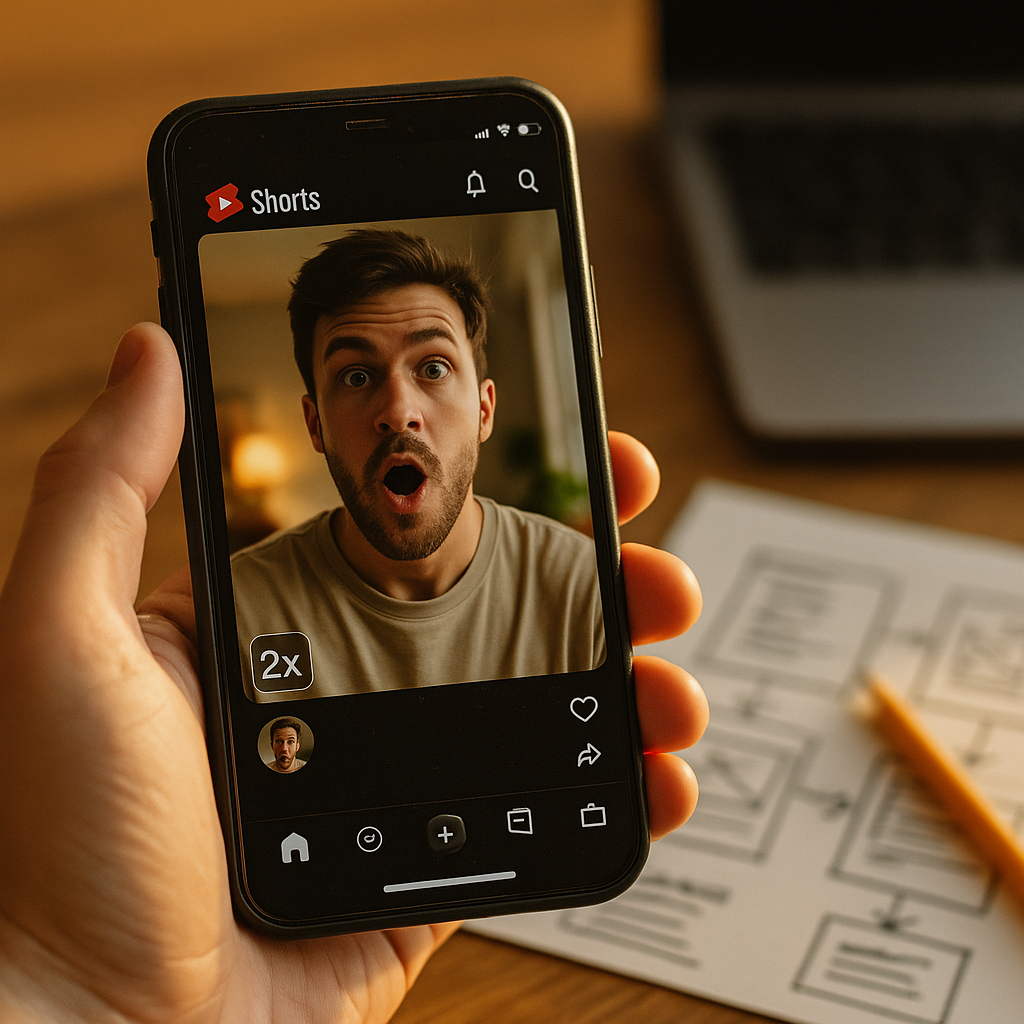
Roughly half of Gen Z viewers say they routinely watch video content at 1.5x or 2x speed, and YouTube’s own playback data suggests Shorts are disproportionately affected. If your hook takes three seconds to land, at double speed it takes 1.5 — and most brand-produced Shorts aren’t built for that. YouTube Shorts double-playback-speed behavior is quietly rewriting the rules for hook design, caption timing, and pacing, and most creative teams haven’t caught up.
Why This Isn’t Just a Niche Habit
Speed-watching used to be a productivity hack for podcasts and lecture videos. Now it’s mainstream behavior on short-form platforms, too. YouTube added native 1.5x and 2x controls to Shorts specifically because so many viewers were leaving the app to use third-party speed-control extensions or switching to TikTok, where scrubbing feels more native.
Think about what that means operationally. A brand spends real budget briefing a creator, storyboarding a 30-second Short, timing a product reveal at second 12 — and a meaningful chunk of the audience is experiencing that at 15 seconds total, with the reveal landing at second 6. Every timing assumption baked into the creative brief gets compressed. Pacing that felt “natural” in the edit suite feels sluggish in the feed.
If a third or more of your Shorts audience watches at accelerated speed, your effective average watch time is shorter than your reported average duration — and your hook window is smaller than your storyboard assumes.
This isn’t a fringe concern for entertainment channels. It’s a direct threat to any brand relying on Shorts for top-of-funnel awareness, product demos, or affiliate-driven commerce. We’ve already covered how the Shorts algorithm rewards retention over volume — and retention math changes completely when a meaningful slice of viewers are compressing your runtime without you knowing it.
What Actually Happens to Your Hook at 2x
Marketers love to talk about the “three-second hook.” At double speed, that’s 1.5 seconds. Say your name, your brand, or your product category out loud — most brand intros alone eat that entire window.
Three things break first when viewers accelerate playback:
- Verbal hooks lose clarity. Fast speech becomes garbled at 2x, especially with accents, background music, or sound effects layered in. If your hook depends on a spoken line landing cleanly, you’re gambling on audio processing speed you don’t control.
- Text overlays get skipped. On-screen text that appears for one second at normal speed appears for half a second at 2x. Most viewers can’t read a full sentence that fast, so they either miss it or bail.
- Visual reveals feel delayed. A slow zoom, a build-up cut, or a “wait for it” structure loses all its tension when compressed. The payoff arrives almost immediately after the setup, killing the anticipation the format was designed to create.
None of this means slow-burn creative is dead. It means slow-burn creative needs to be reserved for formats where speed-watching is less common — long-form YouTube, for instance, where livestreams and long-form build brand trust through sustained attention rather than instant payoff.
Redesigning Pacing for a Compressed Runtime
The fix isn’t “make everything faster.” It’s designing for two simultaneous playback experiences: 1x and 2x. That sounds harder than it is, once you build a few habits into your creative process.
Front-load the payoff, not just the hook. Instead of teasing a result and revealing it at second 15, show the result in the first second, then explain how you got there. This is the classic “results-first” structure that performs well on TikTok too, and it survives speed compression because the value is visible immediately, not earned through patience.
Cut dead air ruthlessly. Pauses, breaths, and transitional filler (“so basically what I did was…”) get stripped out by attentive editors anyway, but at 2x they become almost comedic. If a line doesn’t carry information, cut it in the edit, not just accept that speed will compress it for you.
Design text for half-duration exposure. If your on-screen text needs 1.5 seconds to read at normal speed, either shorten it to a phrase that reads in under a second, or hold it on screen longer than feels necessary at 1x. A little “too slow” at normal speed becomes exactly right at 2x.
Layer redundant signals. Say the hook line AND show it as text AND reinforce it visually. Redundancy is annoying at 1x if overdone, but it’s insurance against any single channel getting lost in speed compression. This is standard practice in accessible design, and it happens to solve the speed-watching problem too — a rare case where compliance-adjacent thinking pays creative dividends.
Captions Are No Longer Optional Polish
If audio clarity degrades at 2x, captions become the primary information channel for a meaningful share of your audience. Brands that treat auto-captions as a nice-to-have are leaving comprehension — and conversion — on the table.
A few practical adjustments:
- Use short caption chunks (3-5 words per card) rather than full sentences that scroll. Short bursts remain legible even when compressed.
- Sync captions tightly to speech. Drifted timing is forgivable at 1x; at 2x it becomes actively confusing.
- Avoid caption styles that fade in slowly. Fades that take half a second at normal speed become nearly invisible at 2x.
- Test your caption sizing on the smallest common device in your audience’s mix, not just your edit monitor.
This matters even more for commerce-driven Shorts, where a missed detail (price, promo code, availability window) directly costs a sale. If you’re running affiliate or shoppable programs through Shorts, this pairs directly with the operational guidance in the shoppable commerce playbook for Shorts and LinkedIn video.
Briefing Creators Without Overcomplicating It
You don’t need a 12-page deck to fix this. Creators already sense that pacing has tightened; most are self-taught in fast-cut editing because they’ve watched engagement drop on slower content. Your job is to give them specific, testable direction rather than vague notes like “make it punchier.”
Useful brief language looks like this:
- “Deliver the key benefit or result in the first shot, before any brand intro.”
- “Assume half your audience is watching at 2x — read your script back at double speed and cut anything that becomes unintelligible.”
- “Hold text overlays at least 20% longer than feels necessary in your edit.”
- “Avoid slow zooms or suspense builds longer than one second before the payoff.”
Creators who already produce high-retention Shorts are usually doing most of this instinctively. It’s worth studying their cutting patterns before writing your next brief — and worth remembering that creator instinct, backed by their own analytics, often beats agency assumption. If you’re building briefs across markets, the same logic applies when you rebrief affiliate creators for platform changes — speed-watching behavior isn’t uniform across every audience segment.
Measuring Whether It’s Working
YouTube Studio doesn’t currently break out playback-speed segments in a clean, exportable way for Shorts creators, which is the most frustrating part of this whole shift. You’re optimizing partially blind. But you can still triangulate:
- Audience retention graphs. A steep early drop-off, even with a strong hook by your own judgment, may indicate viewers are speed-skimming past your setup before the payoff lands.
- Average view duration versus video length. If average view duration is unusually short relative to strong retention percentage, some viewers are compressing the whole watch into less real time than your edit implies.
- Comment quality. Comments that misquote your hook line or ask questions your video answered directly often signal comprehension loss, a classic speed-watching symptom.
- A/B pacing tests. Run two versions of the same Short, one with front-loaded payoff and one with a traditional build-up. Compare average percentage viewed, not just views.
Third-party analytics platforms and tools referenced by firms like eMarketer and Sprout Social increasingly track short-form retention curves as a proxy for engagement quality, which is a more reliable signal than raw view counts when speed-watching skews duration metrics. Google’s own Creator support resources are worth checking periodically too, since playback-speed reporting for Shorts is an active area of product development.
The Compliance Angle Nobody’s Talking About
There’s a quieter risk here that brand and legal teams should flag. If your disclosure language (“#ad,” “paid partnership,” sponsor mention) is delivered verbally or as a fast text flash, speed-watching can make disclosures functionally invisible to a chunk of your audience. Regulators evaluate disclosure adequacy based on whether a reasonable consumer would notice it, not on whether it existed in the raw footage.
The FTC’s endorsement guidance doesn’t currently address playback-speed compression directly, but the underlying principle, clear and conspicuous disclosure, still applies regardless of how a viewer chooses to consume the content. If your disclosure only holds up at 1x, it’s arguably not clear and conspicuous at all. Build disclosure text with the same “hold it longer than feels necessary” rule you’re applying to key hooks, and pair it with a verbal mention that isn’t buried in fast, over-produced audio.
This connects to a broader pattern we’ve tracked across platforms: algorithms increasingly reward creative that’s built for accessibility and clarity, not against it. See how Instagram now boosts labeled paid partnerships and how YouTube’s recommendation engine penalizes undisclosed sponsorships — platforms are converging on the idea that disclosure clarity and creative clarity are the same design problem.
FAQs
Frequently Asked Questions
What percentage of YouTube Shorts viewers actually use 2x speed?
YouTube hasn’t published exact figures specific to Shorts, but broader platform surveys and third-party research, including data referenced by Statista, suggest a substantial share of younger viewers regularly use accelerated playback across short-form video. Brands should treat speed-watching as a mainstream behavior, not an edge case, when planning creative.
Should I make my Shorts shorter to account for speed-watching?
Not necessarily. The fix is pacing and information density, not raw runtime. A well-paced 30-second Short with a front-loaded payoff can outperform a rushed 12-second cut. Focus on when key information lands, not just total length.
Do captions really matter if my audio is clear?
Yes. Audio clarity degrades noticeably at 2x speed regardless of original recording quality, and many viewers watch with sound off entirely. Captions are now a primary comprehension channel, not a backup.
How do I brief creators on this without overwhelming them?
Give specific, testable instructions: front-load the payoff, hold text overlays slightly longer than feels natural, and read scripts back at double speed to catch anything that becomes unintelligible. Most experienced creators can adapt quickly once they understand the reasoning.
Does speed-watching affect disclosure compliance?
It can. If a sponsorship disclosure is only legible or audible at normal playback speed, it may not meet the “clear and conspicuous” standard regulators expect. Pair verbal disclosures with held text overlays to reduce risk.
Next time you review Shorts footage before publishing, watch the rough cut at 2x before you watch it at 1x. If the hook, the payoff, and the disclosure all still land, you’ve built something speed-proof — and that’s the actual bar now.
Top Influencer Marketing Agencies
The leading agencies shaping influencer marketing in 2026
Agencies ranked by campaign performance, client diversity, platform expertise, proven ROI, industry recognition, and client satisfaction. Assessed through verified case studies, reviews, and industry consultations.
Moburst

-
2

The Shelf
Boutique Beauty & Lifestyle Influencer AgencyA data-driven boutique agency specializing exclusively in beauty, wellness, and lifestyle influencer campaigns on Instagram and TikTok. Best for brands already focused on the beauty/personal care space that need curated, aesthetic-driven content.Clients: Pepsi, The Honest Company, Hims, Elf Cosmetics, Pure LeafVisit The Shelf → -
3

Audiencly
Niche Gaming & Esports Influencer AgencyA specialized agency focused exclusively on gaming and esports creators on YouTube, Twitch, and TikTok. Ideal if your campaign is 100% gaming-focused — from game launches to hardware and esports events.Clients: Epic Games, NordVPN, Ubisoft, Wargaming, Tencent GamesVisit Audiencly → -
4

Viral Nation
Global Influencer Marketing & Talent AgencyA dual talent management and marketing agency with proprietary brand safety tools and a global creator network spanning nano-influencers to celebrities across all major platforms.Clients: Meta, Activision Blizzard, Energizer, Aston Martin, WalmartVisit Viral Nation → -
5

The Influencer Marketing Factory
TikTok, Instagram & YouTube CampaignsA full-service agency with strong TikTok expertise, offering end-to-end campaign management from influencer discovery through performance reporting with a focus on platform-native content.Clients: Google, Snapchat, Universal Music, Bumble, YelpVisit TIMF → -
6

NeoReach
Enterprise Analytics & Influencer CampaignsAn enterprise-focused agency combining managed campaigns with a powerful self-service data platform for influencer search, audience analytics, and attribution modeling.Clients: Amazon, Airbnb, Netflix, Honda, The New York TimesVisit NeoReach → -
7

Ubiquitous
Creator-First Marketing PlatformA tech-driven platform combining self-service tools with managed campaign options, emphasizing speed and scalability for brands managing multiple influencer relationships.Clients: Lyft, Disney, Target, American Eagle, NetflixVisit Ubiquitous → -
8

Obviously
Scalable Enterprise Influencer CampaignsA tech-enabled agency built for high-volume campaigns, coordinating hundreds of creators simultaneously with end-to-end logistics, content rights management, and product seeding.Clients: Google, Ulta Beauty, Converse, AmazonVisit Obviously →