


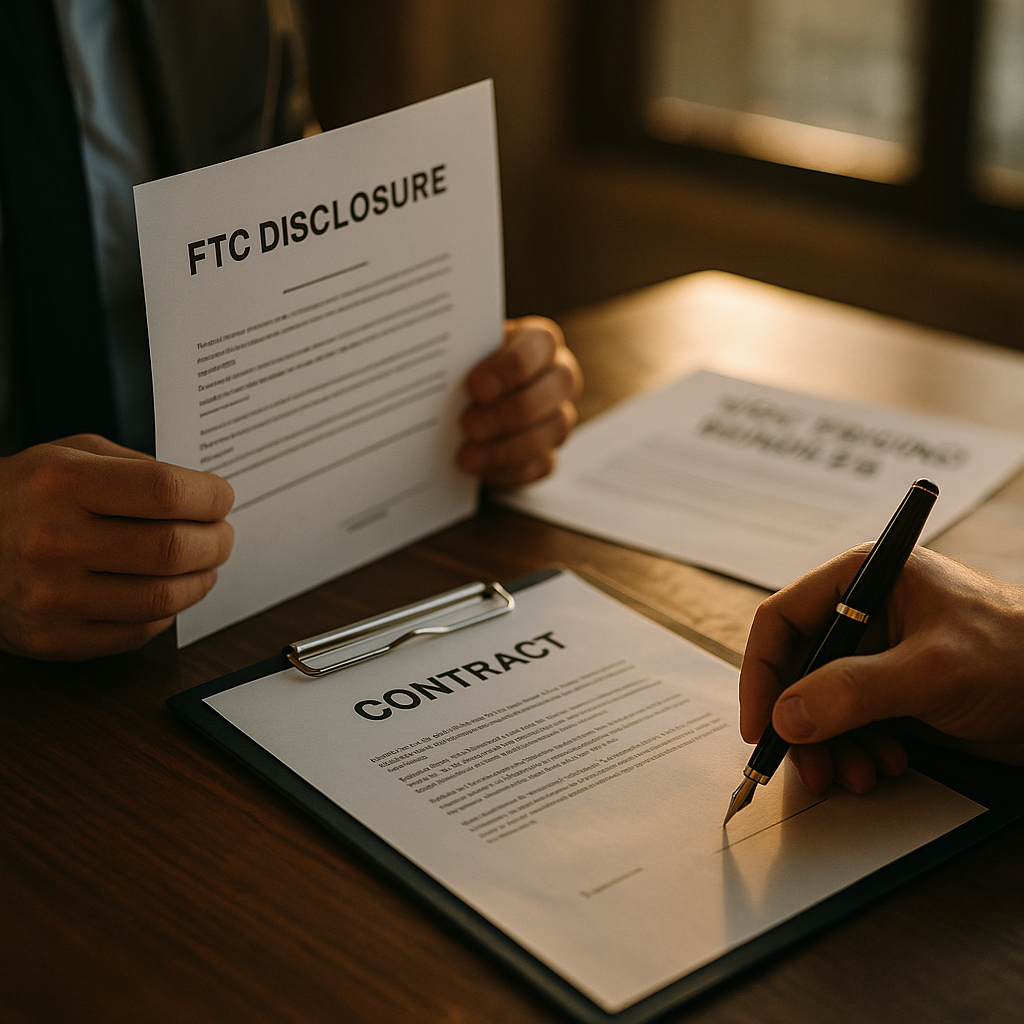
Sixty-one percent of brands now buy UGC in itemized bundles — base fee, raw footage license, multilingual versioning — rather than flat packages. So why are most FTC disclosure notices still written as if the deal is one simple sponsorship? Get the FTC disclosure language wrong across a segmented UGC contract, and you don’t just risk one violation. You risk one per line item, per market, per cut.
That’s the uncomfortable math brand legal teams are waking up to in 2026.
Why Bundled Pricing Breaks Simple Disclosure Templates
The old influencer contract was easy to disclose: creator gets paid, creator says “#ad,” everyone moves on. Bundled UGC packages don’t work that way anymore. A single creator engagement might now include a base production fee, a separate raw footage licensing charge, and an add-on fee for dubbing or subtitling into three languages. Each of those is a distinct commercial transaction with the brand. Each one is, in the FTC’s eyes, a separate material connection that could require its own disclosure treatment depending on where and how the resulting asset gets published.
Here’s the problem: most brands write one disclosure line and slap it on every deliverable, regardless of which pricing tier produced it. That’s a shortcut, not a strategy. If the raw footage gets re-edited by an agency and republished without the original creator’s disclosure context, or if a French-language cut runs on a regional page with a translated caption that drops the sponsorship language entirely, the brand — not just the creator — owns that gap.
Segmented pricing creates segmented liability. If you’re paying separately for base content, footage rights, and language versions, your disclosure documentation needs to mirror that structure — not flatten it.
Map Disclosure Obligations to Each Fee Line, Not Just the Contract Total
Think of your UGC invoice as a liability map. Every line item on it corresponds to a distinct use case, and each use case carries its own disclosure requirement under FTC guidance. Breaking this down:
- Base fee (original content creation): Standard disclosure applies. The creator discloses in the original post, first line or first few seconds, per platform-native tools. This is the easy part — most brands already handle it reasonably well.
- Raw footage licensing: This is where things get messy. Once a brand owns raw footage outright, it can cut, re-edit, and repurpose that content across ads, landing pages, and other creator’s channels. The original disclosure often doesn’t travel with the edited clip. Brands need contract language that obligates them to append a new disclosure any time raw footage is repackaged into a new placement — not just rely on the creator’s original caption.
- Multilingual add-ons: Translation isn’t just linguistic, it’s legal. A disclosure that reads clearly in English can get lost, softened, or dropped entirely in translation. If you’re paying a creator or agency an add-on fee to localize content into Spanish, Portuguese, or Tagalog, that fee needs to explicitly include the deliverable of a compliant, locally-appropriate disclosure — not just a translated caption.
This is precisely the gap covered in our usage-rights clauses for multi-language UGC breakdown: brands assume translation vendors handle compliance, but most translation shops are optimizing for fluency, not FTC adequacy.
The Raw Footage Trap Nobody Contracts For
Raw footage deals are the fastest-growing line item in UGC budgets, according to multiple agency sourcing reports tracked by eMarketer. Brands like buying raw footage because it’s cheaper per-use and gives editorial control. But raw footage strips context. The disclosure that lived in the creator’s original TikTok caption doesn’t exist anymore once your internal team cuts a 6-second clip for a paid social ad.
The FTC doesn’t care that you paid for the footage separately from the original post. It cares whether the final placement discloses the material connection clearly and conspicuously, in that specific placement. That means your raw footage contract needs a clause requiring the brand (or its agency) to insert fresh disclosure language wherever the footage resurfaces — website, paid ad, retail partner channel, whatever. Our raw footage licensing fixes piece goes deeper on how to structure that liability clause so it doesn’t fall on the creator after the fact.
Multilingual Add-Ons: Where Translation Meets Legal Exposure
Quick gut check: does your localization vendor know what “clear and conspicuous” means in Portuguese? In Korean? Probably not, because that’s not their job. It’s yours.
When brands price multilingual versioning as an add-on, they’re usually thinking about dubbing costs, subtitle timing, and cultural adaptation of the script. Disclosure compliance rarely makes the creative brief. That’s the mistake. A disclosure that says “Ad” in a tiny corner overlay might pass in the U.S. but fail basic conspicuousness standards once translated and re-timed for a different market’s typical viewing pattern.
Structure your multilingual add-on contracts with three explicit requirements:
- Disclosure text must be translated by someone reviewing for legal adequacy, not just linguistic accuracy. This might mean a second review pass, separate from the creative localization vendor.
- Placement and timing of the disclosure must be re-verified per language version, since dubbing can shift the video’s pacing and push a spoken disclosure later than the “first few seconds” standard.
- Each language version gets logged separately in your compliance audit trail, with a timestamp and reviewer sign-off, so you can prove diligence if a regulator or platform trust team asks.
This lines up with the compliance audit template for multi-language UGC campaigns we published last quarter — worth pairing with any bundled UGC contract rewrite.
Writing the Actual Disclosure Clause: A Practical Template
Enough theory. Here’s how to actually structure the language inside your master services agreement or SOW when pricing is itemized.
Start with a definitions section that separates “Base Content,” “Licensed Raw Footage,” and “Localized Derivative Content” as distinct deliverables, each with its own disclosure obligation clause attached. Don’t bury disclosure language in a single boilerplate paragraph at the end of the contract. Attach it to each pricing line, the way you’d attach usage rights or turnaround time.
A workable clause structure looks like this:
- For Base Content: “Creator shall include a disclosure compliant with FTC Endorsement Guides in the first line of on-screen text or within the first three seconds of spoken audio, using platform-native disclosure tools where available.”
- For Licensed Raw Footage: “Brand agrees that any repurposing, re-editing, or republishing of Licensed Raw Footage in a new placement shall include a newly-appended disclosure appropriate to that placement, regardless of disclosure present in the original creator post.”
- For Localized Derivative Content: “Any Localized Derivative Content shall include a disclosure translated and reviewed for legal adequacy in the target language and market, verified separately from creative or linguistic localization review, prior to publication.”
Notice what this does: it moves disclosure obligation from a single point-in-time creator responsibility to an ongoing brand responsibility that travels with the asset. That’s the mental shift most legal and marketing ops teams still haven’t made.
Documentation Is the Difference Between a Fine and a Warning
Regulators and platforms both reward brands that can show their work. If the FTC comes knocking, or if a platform’s trust and safety team flags a piece of sponsored content, the brand that can produce a documented chain — original disclosure, footage licensing terms, per-language compliance review, timestamped sign-offs — is in a categorically different position than the brand that shrugs and says “the creator handled it.”
This is the same logic behind building an FTC-proof documentation trail for AI-assisted creator scripts. The tools differ, the principle doesn’t: itemized services require itemized proof of compliance.
A one-line disclosure clause covering a three-line-item invoice isn’t a compliance strategy. It’s a liability waiting for a discovery request.
Build a simple internal tracker, even a shared spreadsheet, that logs each UGC asset against its pricing components: base fee paid, footage licensed, languages produced, disclosure verified for each. It’s not glamorous work. It’s the work that keeps a six-figure campaign out of a regulatory filing.
What This Means for Vendor and Agency Contracts
If you’re routing UGC production through an agency rather than contracting creators directly, push this same itemized disclosure logic into your master services agreement with that agency. Too many brands assume the agency “handles compliance” as a blanket service, without specifying deliverables per pricing tier. Ask your agency directly: does your rate card for raw footage licensing include a disclosure-reinsertion service for repurposed cuts? Does your multilingual production package include legal-adequacy review of translated disclosures, or just linguistic QA?
If they can’t answer clearly, that’s your answer. Related reading on how disclosure obligations shift when content moves across channels: FTC disclosure rules for repurposed UGC covers the channel-hopping risk in more detail, and pairs well with a bundled-pricing contract audit.
Bottom line: rewrite your UGC contract template this quarter so disclosure obligations are itemized against pricing components, not bundled into one generic clause. That single change closes most of the gap between how brands buy UGC today and how FTC enforcement actually evaluates it.
Frequently Asked Questions
Does each pricing component in a UGC deal need its own disclosure clause?
Yes. Base content, raw footage licensing, and multilingual add-ons each represent distinct uses of paid content, and each can trigger separate disclosure obligations depending on where and how the resulting asset is published.
Who is liable if a translated version of sponsored content drops the disclosure?
The brand carries primary liability in most enforcement scenarios, since the FTC evaluates the final placement’s clarity regardless of whether a translation vendor or agency handled the localization work.
Does raw footage licensing require a new disclosure every time it’s reused?
Generally yes. If raw footage is re-edited or republished in a new placement, the original creator’s disclosure typically doesn’t carry over, so a fresh, placement-appropriate disclosure should be added.
Can one master disclosure clause cover a fully bundled UGC package?
It’s risky. A single generic clause tends to overlook the different disclosure needs of base content, licensed footage, and localized versions, leaving gaps that only surface during an audit or complaint.
What documentation should brands keep to prove compliance?
A timestamped log showing disclosure review for each deliverable — original post, repurposed footage, and each language version — along with reviewer sign-off, gives brands a defensible audit trail if questioned.
Frequently Asked Questions
Does each pricing component in a UGC deal need its own disclosure clause?
Yes. Base content, raw footage licensing, and multilingual add-ons each represent distinct uses of paid content, and each can trigger separate disclosure obligations depending on where and how the resulting asset is published.
Who is liable if a translated version of sponsored content drops the disclosure?
The brand carries primary liability in most enforcement scenarios, since the FTC evaluates the final placement’s clarity regardless of whether a translation vendor or agency handled the localization work.
Does raw footage licensing require a new disclosure every time it’s reused?
Generally yes. If raw footage is re-edited or republished in a new placement, the original creator’s disclosure typically doesn’t carry over, so a fresh, placement-appropriate disclosure should be added.
Can one master disclosure clause cover a fully bundled UGC package?
It’s risky. A single generic clause tends to overlook the different disclosure needs of base content, licensed footage, and localized versions, leaving gaps that only surface during an audit or complaint.
What documentation should brands keep to prove compliance?
A timestamped log showing disclosure review for each deliverable — original post, repurposed footage, and each language version — along with reviewer sign-off, gives brands a defensible audit trail if questioned.
Top Influencer Marketing Agencies
The leading agencies shaping influencer marketing in 2026
Agencies ranked by campaign performance, client diversity, platform expertise, proven ROI, industry recognition, and client satisfaction. Assessed through verified case studies, reviews, and industry consultations.
Moburst

-
2

The Shelf
Boutique Beauty & Lifestyle Influencer AgencyA data-driven boutique agency specializing exclusively in beauty, wellness, and lifestyle influencer campaigns on Instagram and TikTok. Best for brands already focused on the beauty/personal care space that need curated, aesthetic-driven content.Clients: Pepsi, The Honest Company, Hims, Elf Cosmetics, Pure LeafVisit The Shelf → -
3

Audiencly
Niche Gaming & Esports Influencer AgencyA specialized agency focused exclusively on gaming and esports creators on YouTube, Twitch, and TikTok. Ideal if your campaign is 100% gaming-focused — from game launches to hardware and esports events.Clients: Epic Games, NordVPN, Ubisoft, Wargaming, Tencent GamesVisit Audiencly → -
4

Viral Nation
Global Influencer Marketing & Talent AgencyA dual talent management and marketing agency with proprietary brand safety tools and a global creator network spanning nano-influencers to celebrities across all major platforms.Clients: Meta, Activision Blizzard, Energizer, Aston Martin, WalmartVisit Viral Nation → -
5

The Influencer Marketing Factory
TikTok, Instagram & YouTube CampaignsA full-service agency with strong TikTok expertise, offering end-to-end campaign management from influencer discovery through performance reporting with a focus on platform-native content.Clients: Google, Snapchat, Universal Music, Bumble, YelpVisit TIMF → -
6

NeoReach
Enterprise Analytics & Influencer CampaignsAn enterprise-focused agency combining managed campaigns with a powerful self-service data platform for influencer search, audience analytics, and attribution modeling.Clients: Amazon, Airbnb, Netflix, Honda, The New York TimesVisit NeoReach → -
7

Ubiquitous
Creator-First Marketing PlatformA tech-driven platform combining self-service tools with managed campaign options, emphasizing speed and scalability for brands managing multiple influencer relationships.Clients: Lyft, Disney, Target, American Eagle, NetflixVisit Ubiquitous → -
8

Obviously
Scalable Enterprise Influencer CampaignsA tech-enabled agency built for high-volume campaigns, coordinating hundreds of creators simultaneously with end-to-end logistics, content rights management, and product seeding.Clients: Google, Ulta Beauty, Converse, AmazonVisit Obviously →