


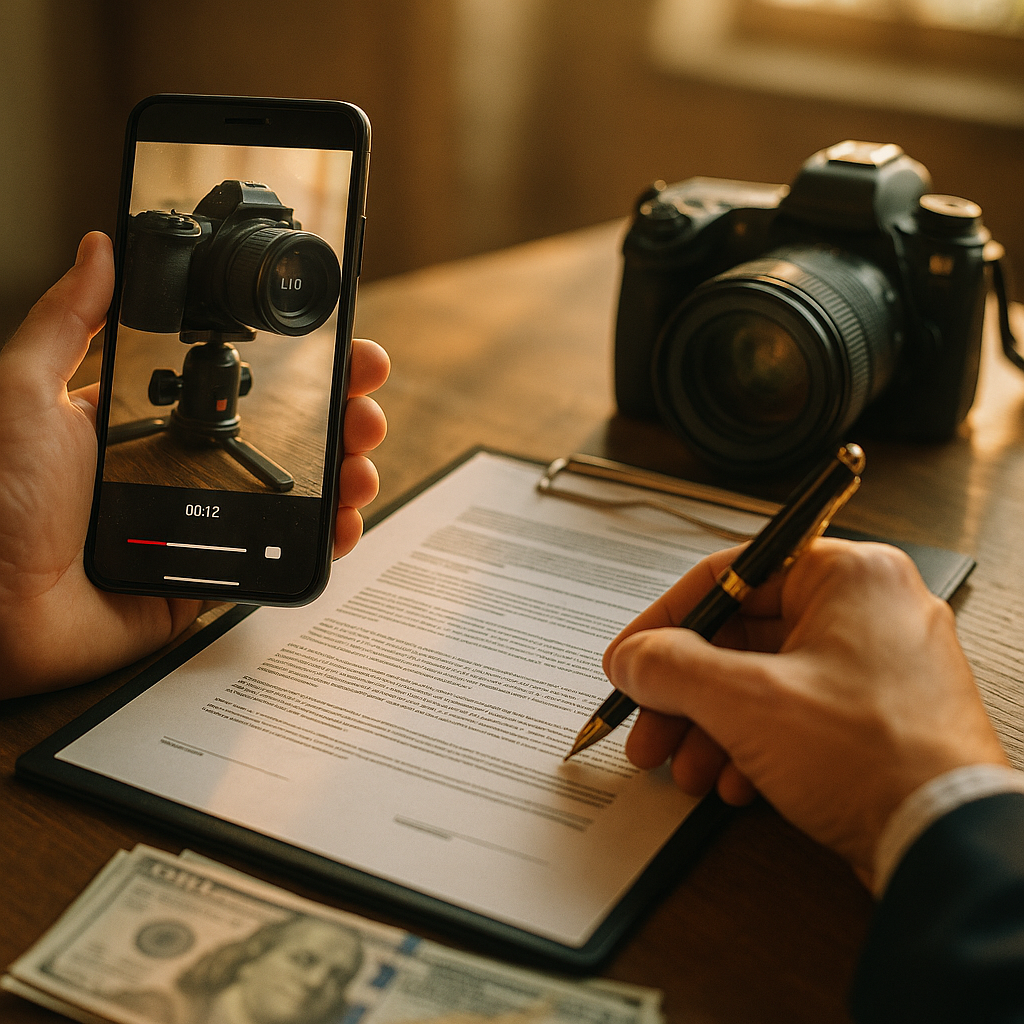
One clause is quietly costing brands millions in unplanned usage disputes: the failure to separate raw-footage licensing fees from base production fees. If your contracts bundle both into a single line item, you don’t actually own what you think you own — and neither does your legal team’s peace of mind. Raw-footage licensing is the piece almost every brand gets wrong, and it’s the piece that determines whether a repurposed clip becomes a case study or a lawsuit.
This isn’t a niche billing quirk. It’s a structural fix that touches usage rights, indemnification, and how much leverage a creator retains after the invoice clears.
Why Bundled Fees Create a Liability Blind Spot
Most UGC agreements still treat production and licensing as one transaction. The brand pays a flat fee, the creator delivers final edited assets, and everyone assumes the brand now “owns” the content. Except ownership and licensing are not the same thing, and courts don’t treat them that way either.
When a single fee covers everything, the scope of what’s actually licensed becomes ambiguous. Did the payment cover the final cut only? Or does it extend to the raw B-roll, alternate takes, and unused footage sitting on the creator’s hard drive? If a dispute lands in front of a judge, ambiguous contract language typically gets interpreted against the party that drafted it — usually the brand’s agency or marketing team.
That ambiguity is exactly where liability exposure lives.
A single bundled fee doesn’t just complicate accounting — it creates a legal gray zone where neither party can prove what was actually purchased.
Brands that repurpose creator content across paid social, retail media, or connected TV increasingly need raw footage: different aspect ratios, alternate hooks, B-roll for editing flexibility. If the original contract never explicitly priced and licensed that raw material, you’re relying on goodwill, not a contract. Goodwill doesn’t hold up in arbitration.
The Legal Distinction Between Production Fees and Licensing Fees
Production fees compensate the creator for labor: filming, editing, styling, talent time. Licensing fees compensate for the rights to use the resulting IP — where, for how long, and in what form. These are legally distinct considerations under copyright law, and conflating them creates two problems.
- Scope creep: Without a separate licensing fee, brands often assume broader usage rights than were actually granted, leading to unauthorized use claims.
- Valuation disputes: If a creator later claims the flat fee only covered production, brands have no documented basis for the usage rights they assumed they’d secured.
This is the same underlying tension covered in our breakdown of usage-rights clauses for multi-language campaigns, where scope ambiguity created downstream translation and re-licensing headaches. Raw footage is arguably higher-risk because it’s unedited, unbranded, and more easily repurposed in ways the creator never anticipated or approved.
Separating the fees forces both parties to define, in writing, exactly what’s being licensed. That documentation is your liability shield.
What “Raw Footage” Actually Means in a Contract
Vague definitions are the enemy here. “Raw footage” should be contractually defined to include unedited camera files, alternate takes, B-roll, outtakes, and any behind-the-scenes capture generated during the shoot. If your contract just says “all footage” without defining the term, you’re inviting a dispute over what counts.
Some agencies now specify frame-accurate delivery requirements — timecoded raw files, delivered via a specific format and platform — precisely so there’s no room for interpretation later.
Building the Two-Fee Structure
Here’s the practical model gaining traction among brand legal teams and agencies handling high-volume UGC programs:
- Base production fee: Covers the creator’s labor to shoot and deliver a finished, edited asset for an agreed initial use case (e.g., one paid social placement, 90-day term).
- Raw-footage licensing fee: A separate, itemized fee that grants the brand rights to the underlying unedited footage, scoped by duration, channel, and derivative-use permissions.
Pricing raw footage separately also gives brands optionality. If you don’t need the raw files upfront, don’t pay for them upfront. License them later, on a per-project basis, when a specific repurposing need arises. This keeps initial production costs lean and avoids paying for rights you may never use.
It also gives creators a fairer deal — they’re compensated proportionally to how extensively their content and likeness get reused, which reduces the odds of a creator disputing usage later on reputational or compensation grounds.
Treating raw footage as a distinct licensable asset — not a bonus included in the production fee — is the single clearest way to reduce unauthorized-use exposure.
Duration, Renewal, and the Renewal-Fee Trap
Raw-footage licenses should carry their own term limits, separate from the finished-asset license. Brands that follow a 90-day content license standard for edited assets often make the mistake of assuming the same window applies to raw files. It shouldn’t, by default — raw footage licensing terms need to be negotiated explicitly, because the potential use cases (new edits, new campaigns, AI-generated derivative content) are broader and harder to predict.
Failing to set renewal terms here is how brands end up back where our piece on stopping renewal fees started: paying repeated, escalating fees because the original license never anticipated long-term reuse.
A practical structure:
- Initial raw-footage license: 6-12 months, scoped to specific derivative use cases (paid social variants, retail media, CTV cutdowns).
- Automatic renewal at a pre-agreed rate, not a renegotiated one, to avoid holdout pricing.
- A defined “archive” clause specifying what happens to unused raw footage after the license expires — deletion, return, or extended licensing at a flat renewal fee.
Indemnification Gets Cleaner When Fees Are Separated
Here’s an angle brand counsel doesn’t discuss enough: separating fees clarifies who’s liable for what. If a piece of raw footage inadvertently captures a third party, a copyrighted song, or an unapproved product placement, the licensing fee — not the production fee — becomes the anchor point for indemnification language.
Why does that matter? Because insurers and legal teams can price risk more accurately when the licensing transaction is isolated. A production fee dispute is a labor/contract issue. A licensing fee dispute is an IP issue, and IP issues carry different remedies, different statutes of limitations, and often different insurance coverage triggers.
This same logic shows up in the FTC’s approach to material connection disclosures — where script approval depth and liability are treated as distinct issues from creative production. Regulators increasingly expect brands to document exactly where control and rights sit in the creator relationship, not lump everything into one vague “collaboration fee.”
What This Means for AI Repurposing
Raw footage is increasingly the raw material for AI-driven ad variation tools — think dynamic creative optimization platforms that generate dozens of cutdowns from a single shoot. If your raw-footage license doesn’t explicitly address AI-assisted derivative use, you may be technically infringing every time an algorithm remixes unlicensed clips. Brands running programmatic creative testing should treat AI-derivative rights as a distinct licensing line item, not an assumed extension of the base license.
According to eMarketer, brands are scaling creative output volume faster than their legal review processes can keep pace, which is precisely the gap that unclear raw-footage licensing exploits.
A Quick Compliance Checklist
- Does the contract define “raw footage” explicitly, separate from “final deliverables”?
- Is there a distinct line-item fee for raw-footage licensing, with its own scope and term?
- Does the license address AI-assisted or algorithmic derivative use?
- Is there a renewal mechanism with pre-agreed rates?
- Does indemnification language attach to the licensing fee, not the production fee?
Brands managing high-volume creator programs should also cross-reference this against broader content licensing duration standards to keep raw-footage terms consistent with finished-asset terms across the portfolio. Consistency here isn’t cosmetic — it’s what makes the contract defensible at scale, especially when legal teams are reviewing hundreds of creator agreements a quarter.
For general guidance on endorsement and disclosure obligations that intersect with licensing structure, the FTC’s endorsement guidance remains the baseline reference point, even though it doesn’t directly regulate fee structuring.
None of this requires reinventing your contract templates from scratch. It requires adding one clean, itemized clause and pricing it honestly. That’s a far smaller lift than litigating usage rights after the fact.
Next step: Pull your last five UGC contracts and check whether raw footage has its own fee line. If it doesn’t, you’re one dispute away from finding out the hard way what “included in production” actually meant.
FAQs
What’s the difference between a production fee and a licensing fee in UGC contracts?
A production fee compensates the creator’s labor — filming, editing, and delivering the finished asset. A licensing fee compensates for the rights to use that content (and any raw footage) across specific channels, durations, and formats. Bundling them together obscures what usage rights were actually purchased.
Why does separating these fees reduce brand liability?
Separation creates a documented, itemized record of what was licensed, for how long, and under what terms. This reduces ambiguity in disputes, clarifies indemnification responsibility, and gives brands a defensible paper trail if a creator or third party challenges unauthorized use.
Should raw-footage licenses have the same term length as finished-asset licenses?
Not necessarily. Raw footage often supports broader and less predictable use cases — new edits, AI-generated variants, future campaigns — so many brands negotiate separate, often longer or renewable, terms rather than defaulting to the finished-asset license window.
Does this apply to AI-generated ad variations built from raw footage?
Yes. If a license doesn’t explicitly cover AI-assisted or algorithmic derivative use, repurposing raw footage through creative automation tools may exceed the granted rights. Brands should add a specific clause addressing AI-derivative use.
What happens if a contract never separated these fees in the first place?
Existing contracts can be amended with a licensing addendum that retroactively defines and prices raw-footage rights. Brands should prioritize this for high-visibility or frequently repurposed creator content first.
FAQs
Top Influencer Marketing Agencies
The leading agencies shaping influencer marketing in 2026
Agencies ranked by campaign performance, client diversity, platform expertise, proven ROI, industry recognition, and client satisfaction. Assessed through verified case studies, reviews, and industry consultations.
Moburst

-
2

The Shelf
Boutique Beauty & Lifestyle Influencer AgencyA data-driven boutique agency specializing exclusively in beauty, wellness, and lifestyle influencer campaigns on Instagram and TikTok. Best for brands already focused on the beauty/personal care space that need curated, aesthetic-driven content.Clients: Pepsi, The Honest Company, Hims, Elf Cosmetics, Pure LeafVisit The Shelf → -
3

Audiencly
Niche Gaming & Esports Influencer AgencyA specialized agency focused exclusively on gaming and esports creators on YouTube, Twitch, and TikTok. Ideal if your campaign is 100% gaming-focused — from game launches to hardware and esports events.Clients: Epic Games, NordVPN, Ubisoft, Wargaming, Tencent GamesVisit Audiencly → -
4

Viral Nation
Global Influencer Marketing & Talent AgencyA dual talent management and marketing agency with proprietary brand safety tools and a global creator network spanning nano-influencers to celebrities across all major platforms.Clients: Meta, Activision Blizzard, Energizer, Aston Martin, WalmartVisit Viral Nation → -
5

The Influencer Marketing Factory
TikTok, Instagram & YouTube CampaignsA full-service agency with strong TikTok expertise, offering end-to-end campaign management from influencer discovery through performance reporting with a focus on platform-native content.Clients: Google, Snapchat, Universal Music, Bumble, YelpVisit TIMF → -
6

NeoReach
Enterprise Analytics & Influencer CampaignsAn enterprise-focused agency combining managed campaigns with a powerful self-service data platform for influencer search, audience analytics, and attribution modeling.Clients: Amazon, Airbnb, Netflix, Honda, The New York TimesVisit NeoReach → -
7

Ubiquitous
Creator-First Marketing PlatformA tech-driven platform combining self-service tools with managed campaign options, emphasizing speed and scalability for brands managing multiple influencer relationships.Clients: Lyft, Disney, Target, American Eagle, NetflixVisit Ubiquitous → -
8

Obviously
Scalable Enterprise Influencer CampaignsA tech-enabled agency built for high-volume campaigns, coordinating hundreds of creators simultaneously with end-to-end logistics, content rights management, and product seeding.Clients: Google, Ulta Beauty, Converse, AmazonVisit Obviously →