


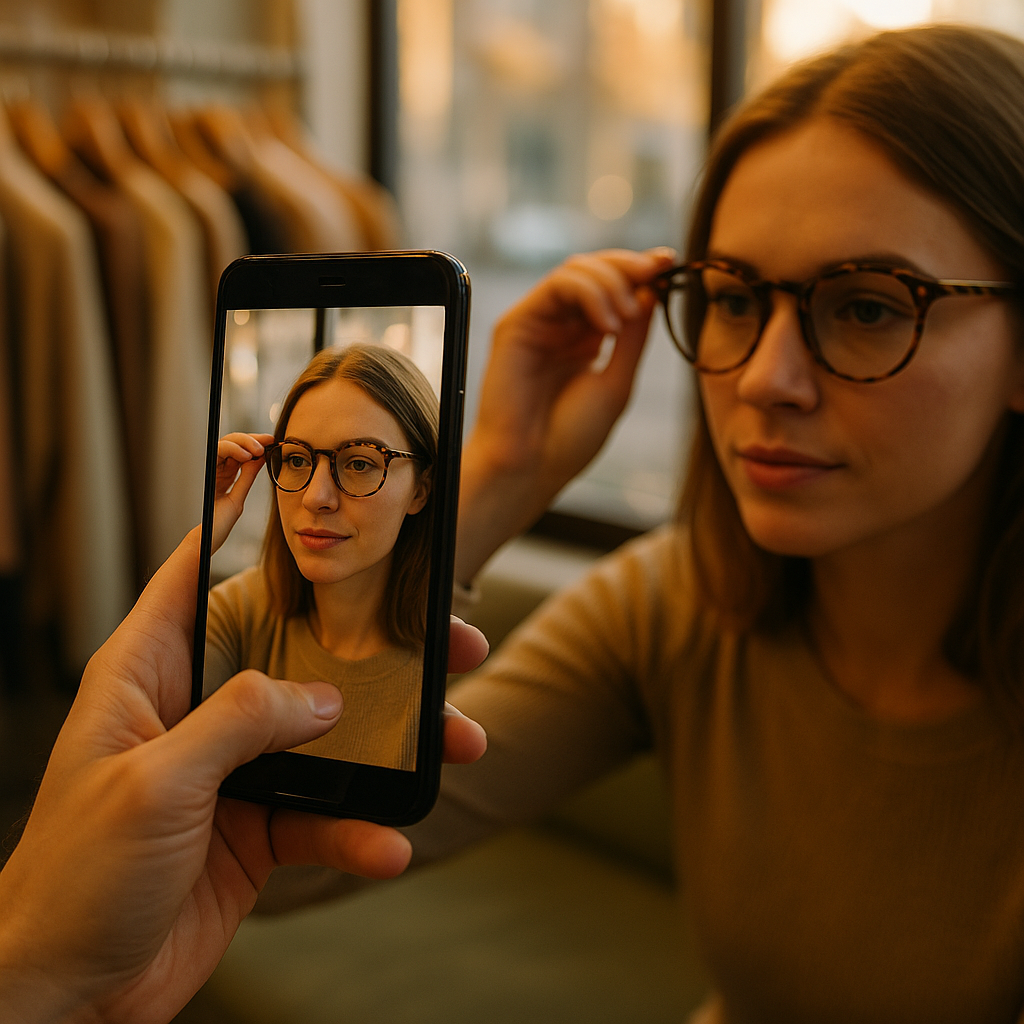
Nearly 70% of returned apparel gets sent back because the item “looked different” than expected. Now flip that stat around: what if shoppers could see the product on themselves before they ever clicked buy? That is the promise behind the interactive AR try on filter, and brands that ignore it are leaving conversion on the table.
This is not a novelty filter category anymore. AR try on tools have moved from Snapchat lens gimmicks to core commerce infrastructure, sitting inside product detail pages, TikTok shops, and Instagram Reels. For brand teams weighing where to put next quarter’s content budget, this format deserves a hard look.
What Exactly Is an AR Try On Filter?
An AR try on filter uses a phone camera and computer vision to overlay a product, makeup, glasses, sneakers, jewelry, even furniture, onto a live image of the user or their space. The shopper moves, the product moves with them. No app download required in most cases, since the tech now lives natively inside TikTok, Instagram, Snapchat, and Pinterest.
What separates this from a static filter or a lookbook photo is interactivity. The user controls the angle, the lighting, sometimes the color or size. That agency is the whole point. It replaces the guesswork of a size chart with a live preview, and it does it inside the same scroll where the discovery happened.
The brands winning with AR try on filters treat them as a conversion tool first and a content format second. The engagement is a byproduct, not the goal.
Why Social Commerce Brands Are Paying Attention Now
Three forces converged to make this the moment for AR try on. First, camera hardware on mid-range phones finally handles real-time rendering without lag. Second, platforms built the infrastructure themselves, so brands no longer need a custom app or a six-figure dev budget. Third, and most important, return rates are crushing margins across fashion and beauty categories.
Meta’s business tools now support AR shopping ads directly inside Instagram and Facebook, letting a beauty brand run a “try this shade” filter as a paid unit rather than an organic experiment. Meta’s advertising platform has quietly built AR try on into its ad manager, which tells you where the platform sees this heading. TikTok has followed with its own effects platform, and Snapchat, arguably the category’s original home, still commands strong engagement numbers on branded AR lenses according to reporting from eMarketer.
The ROI case is straightforward when you break it down. A Warby Parker style virtual glasses try on or a Sephora shade matcher does not just entertain, it pre-qualifies the purchase. The shopper who spends 45 seconds rotating a pair of virtual sunglasses on their own face has already mentally tried the product. That is a warmer lead than someone who scrolled past a static product shot.
The Return Rate Angle Nobody Talks About Enough
Retail return rates for e-commerce sit stubbornly high, and apparel and beauty carry some of the worst numbers, per data tracked by Statista. Every returned item costs the brand shipping both ways, restocking labor, and often a markdown when the item goes back to inventory damaged or out of season. AR try on directly attacks the two biggest drivers of returns: wrong fit and wrong color perception under different lighting.
This is where the format earns its place in a performance marketing plan, not just a brand awareness one. If a virtual try on experience cuts return rate by even a few points on a high volume SKU, the math pays for the production cost inside the first month.
Building the Filter: What Actually Goes Into Production
Brand teams tend to assume AR filter production requires an in-house dev team. It usually does not. Most mid-market brands work with a specialized AR studio or use platform-native tools like Meta Spark, TikTok’s Effect House, or Snap’s Lens Studio. The heavier lift is not the code, it is the asset preparation.
- 3D or texture mapping of the product: shoes, glasses, and accessories need clean 3D scans; makeup and apparel often rely on 2D texture overlays that are cheaper and faster to produce.
- Skin tone and face shape calibration: beauty filters especially need testing across a wide range of tones and features to avoid embarrassing (and reputationally damaging) misfires.
- Platform-specific export: a filter built for Instagram does not automatically work on TikTok or Snap. Budget for at least light rework per platform.
- Creator hand off: once the filter exists, creators need a brief on how to demo it authentically, not just apply it once and move on.
That last point matters more than most brands expect. A filter without a creator strategy behind it just sits in a discovery feed collecting dust. Pair the AR asset with a creator brief the way you would for any product reel format, giving creators a reason to show the try on process rather than just the result.
Where the Format Fits in Your Content Calendar
AR try on filters work best as a layer on top of existing content infrastructure, not a replacement for it. Think of it as the interactive cousin of your spec comparison reel, giving shoppers a hands on way to evaluate a product decision instead of just watching someone else make it.
Brands running livestream commerce have particularly strong pairing potential here. A host can direct viewers to “try it yourself” via a filter link mid-stream, turning a passive shoppable livestream moment into an active one. Beauty brands especially benefit, since shade matching is exactly the kind of decision viewers hesitate on without seeing it on their own skin.
For UGC-heavy brands, the filter itself becomes raw material. Creators who use a branded AR effect naturally produce content that doubles as social proof, similar to how unboxing content generates saves and shares without heavy production spend. The difference is the AR layer gives that content a functional hook: viewers do not just watch, they tap to try it themselves.
Risk and Compliance: The Part Legal Will Ask About
AR filters that alter appearance, especially beauty filters that smooth skin or reshape features, sit in a gray zone that regulators are increasingly watching. The FTC has signaled concern over filters that create misleading impressions of product performance, particularly in beauty and skincare where “results” can be exaggerated by the filter itself rather than the product.
The UK’s Information Commissioner’s Office has also flagged biometric data handling in AR try on tools, since facial mapping technically processes biometric information even when it feels like a harmless filter. Brand and legal teams should confirm data retention policies with whatever platform or vendor builds the filter, and disclose clearly when a filter simulates rather than guarantees a real world result.
If your AR filter makes skin look clearer or a product look more flattering than reality, disclose it. Regulators are treating filtered “results” claims the same way they treat doctored before-and-afters.
Rights management also gets trickier once creators start generating content using your branded filter. If a creator’s face or likeness appears in filter demo content that you want to reuse in paid ads, you need clear usage rights up front. This is exactly the kind of gap a UGC rights workflow is built to close, and it applies just as much to AR demo clips as it does to standard UGC video.
Measuring What Actually Matters
Vanity metrics like filter opens feel good in a slide deck but do not tell you if the format is earning its budget. The metrics that matter for a social commerce brand:
- Try on to cart rate: what percentage of filter sessions lead to an add to cart within the same session or within 24 hours?
- Return rate delta: compare return rates on SKUs promoted with AR try on against SKUs without it.
- Session duration: longer interaction time generally correlates with higher purchase intent, but watch for filters that are just fun to play with and not driving decisions.
- Share and reuse rate: how often do users share their try on result or repost creator content using the filter?
Most platforms now surface at least basic funnel data inside their ad managers. HubSpot and similar marketing platforms can help stitch that data back to CRM records if you are running the filter as part of a broader retargeting sequence, which is where the real revenue attribution shows up.
A Format That Rewards Patience
Do not expect a single filter launch to move the needle overnight. The brands seeing the best results treat AR try on as an ongoing content stream, refreshing filters seasonally the way they’d refresh a drop shop reveal series, rather than a one-off campaign asset. Novelty fades fast on social platforms. A filter tied to new product drops keeps the format feeling current instead of stale.
The teams getting the most value are also the ones testing across platforms rather than betting everything on one. A filter that performs on Snapchat’s younger audience may need a completely different creative approach to land on TikTok, where discovery behavior and attention spans differ meaningfully, something Sprout Social’s platform benchmarks consistently show across demographics.
Next step: pick one high-return SKU, brief an AR studio or platform tool for a single try on filter, and track the try on to cart rate against your current baseline for 30 days before scaling the format further.
FAQs
Do AR try on filters actually reduce product returns?
Early data from beauty and eyewear brands suggests meaningful reductions in size and color related returns, since shoppers get a clearer preview before purchase. Results vary by category, with apparel showing smaller gains than accessories and beauty due to fit complexity.
Which platforms support AR try on filters natively?
Instagram and Facebook support AR shopping ads through Meta’s Spark AR tools, TikTok offers Effect House for brand-built filters, and Snapchat remains a strong option through Lens Studio, particularly for younger audience targeting.
Is building an AR filter expensive?
Cost depends heavily on asset complexity. A 2D texture-based beauty filter can be produced relatively cheaply, while a fully rigged 3D product like footwear or furniture requires more upfront modeling investment. Most mid-market brands work with third-party AR studios rather than building in-house.
What compliance risks should brands watch for?
Regulators are scrutinizing filters that exaggerate product performance or alter appearance in misleading ways, especially in beauty. Brands should also confirm biometric data handling policies with their AR vendor and secure clear usage rights for any creator content generated using the filter.
How do brands measure AR filter performance beyond engagement?
Track try on to cart conversion rate, return rate differences on promoted SKUs, and session duration, then tie that data back into CRM or retargeting systems to connect filter interaction with actual revenue.
FAQs
Do AR try on filters actually reduce product returns?
Early data from beauty and eyewear brands suggests meaningful reductions in size and color related returns, since shoppers get a clearer preview before purchase. Results vary by category, with apparel showing smaller gains than accessories and beauty due to fit complexity.
Which platforms support AR try on filters natively?
Instagram and Facebook support AR shopping ads through Meta’s Spark AR tools, TikTok offers Effect House for brand-built filters, and Snapchat remains a strong option through Lens Studio, particularly for younger audience targeting.
Is building an AR filter expensive?
Cost depends heavily on asset complexity. A 2D texture-based beauty filter can be produced relatively cheaply, while a fully rigged 3D product like footwear or furniture requires more upfront modeling investment. Most mid-market brands work with third-party AR studios rather than building in-house.
What compliance risks should brands watch for?
Regulators are scrutinizing filters that exaggerate product performance or alter appearance in misleading ways, especially in beauty. Brands should also confirm biometric data handling policies with their AR vendor and secure clear usage rights for any creator content generated using the filter.
How do brands measure AR filter performance beyond engagement?
Track try on to cart conversion rate, return rate differences on promoted SKUs, and session duration, then tie that data back into CRM or retargeting systems to connect filter interaction with actual revenue.
Top Influencer Marketing Agencies
The leading agencies shaping influencer marketing in 2026
Agencies ranked by campaign performance, client diversity, platform expertise, proven ROI, industry recognition, and client satisfaction. Assessed through verified case studies, reviews, and industry consultations.
Moburst

-
2

The Shelf
Boutique Beauty & Lifestyle Influencer AgencyA data-driven boutique agency specializing exclusively in beauty, wellness, and lifestyle influencer campaigns on Instagram and TikTok. Best for brands already focused on the beauty/personal care space that need curated, aesthetic-driven content.Clients: Pepsi, The Honest Company, Hims, Elf Cosmetics, Pure LeafVisit The Shelf → -
3

Audiencly
Niche Gaming & Esports Influencer AgencyA specialized agency focused exclusively on gaming and esports creators on YouTube, Twitch, and TikTok. Ideal if your campaign is 100% gaming-focused — from game launches to hardware and esports events.Clients: Epic Games, NordVPN, Ubisoft, Wargaming, Tencent GamesVisit Audiencly → -
4

Viral Nation
Global Influencer Marketing & Talent AgencyA dual talent management and marketing agency with proprietary brand safety tools and a global creator network spanning nano-influencers to celebrities across all major platforms.Clients: Meta, Activision Blizzard, Energizer, Aston Martin, WalmartVisit Viral Nation → -
5

The Influencer Marketing Factory
TikTok, Instagram & YouTube CampaignsA full-service agency with strong TikTok expertise, offering end-to-end campaign management from influencer discovery through performance reporting with a focus on platform-native content.Clients: Google, Snapchat, Universal Music, Bumble, YelpVisit TIMF → -
6

NeoReach
Enterprise Analytics & Influencer CampaignsAn enterprise-focused agency combining managed campaigns with a powerful self-service data platform for influencer search, audience analytics, and attribution modeling.Clients: Amazon, Airbnb, Netflix, Honda, The New York TimesVisit NeoReach → -
7

Ubiquitous
Creator-First Marketing PlatformA tech-driven platform combining self-service tools with managed campaign options, emphasizing speed and scalability for brands managing multiple influencer relationships.Clients: Lyft, Disney, Target, American Eagle, NetflixVisit Ubiquitous → -
8

Obviously
Scalable Enterprise Influencer CampaignsA tech-enabled agency built for high-volume campaigns, coordinating hundreds of creators simultaneously with end-to-end logistics, content rights management, and product seeding.Clients: Google, Ulta Beauty, Converse, AmazonVisit Obviously →