


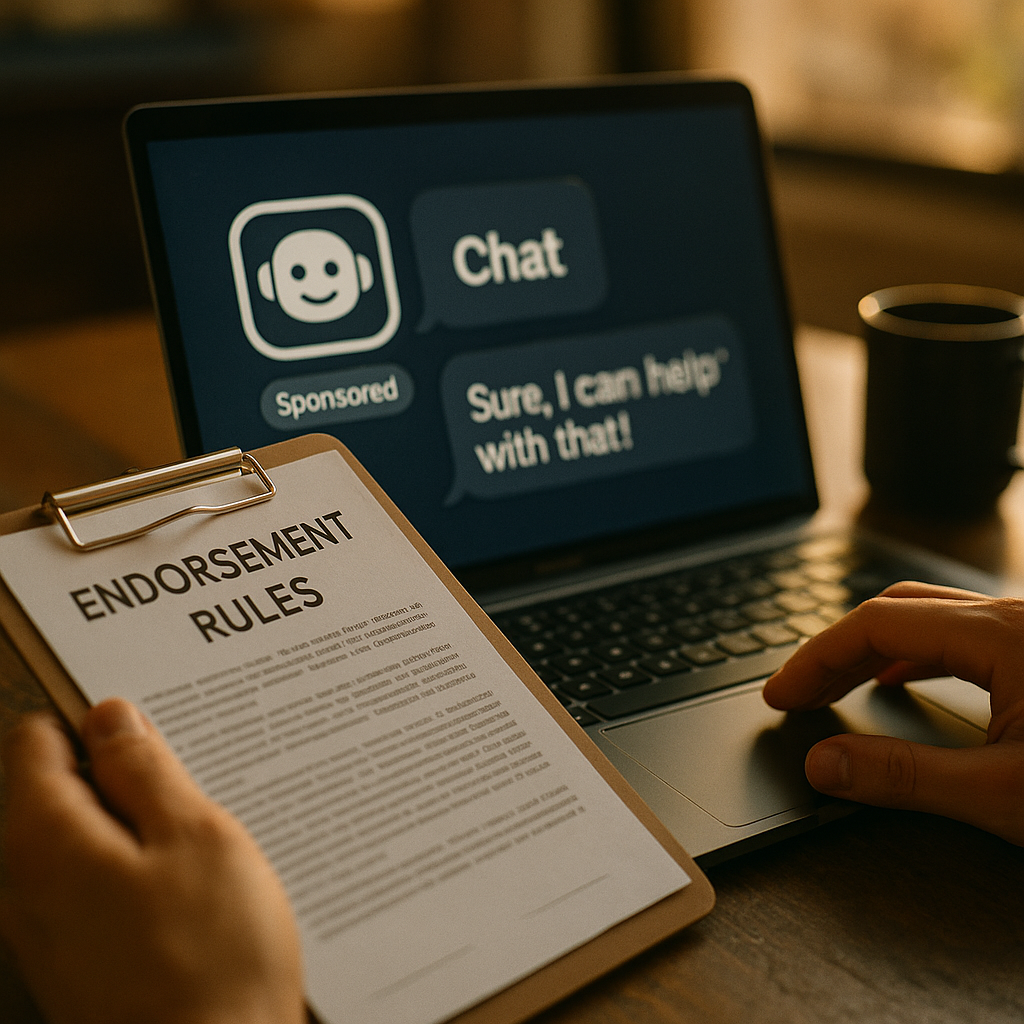
Ask ChatGPT for a skincare recommendation. Ask Perplexity what running shoes to buy. Increasingly, the answer includes a product that a creator got paid to promote, filtered through an AI layer with zero disclosure in sight. The FTC endorsement rules were written for humans posting on Instagram, not for chatbots synthesizing sponsored content into “neutral” advice. That gap is now a live liability for every brand running influencer programs in the AI era.
The Compliance Blind Spot Nobody Budgeted For
Here’s the uncomfortable truth: your creator content doesn’t stay on the platform where you posted it. TikTok videos get scraped, transcribed, and indexed. Blog posts feed training data. Product reviews become source material for AI chatbots answering “what’s the best X” queries. When a chatbot surfaces a sponsored recommendation without flagging the material connection, the disclosure trail your legal team worked so hard to build effectively disappears.
This isn’t hypothetical anymore. Shopping-focused AI agents from OpenAI, Perplexity, and Google are actively citing product reviews and creator recommendations in their answers. Some of that content was disclosed properly at the source. Once it’s remixed into a conversational answer, the disclosure often doesn’t travel with it.
If an AI chatbot recommends your product based on sponsored creator content and never mentions the payment, the FTC doesn’t care whose fault it was — the brand is still on the hook.
What the FTC Actually Requires (Refresher)
The FTC’s Endorsement Guides haven’t changed their core principle in decades: any “material connection” between a brand and an endorser must be disclosed clearly and conspicuously, and that disclosure has to be understandable in the context where the consumer encounters it. The FTC’s own guidance makes clear this applies regardless of platform or format. Chat interfaces are not exempt.
The tricky part is “context where the consumer encounters it.” A disclosure buried in a TikTok caption doesn’t travel to a chatbot’s summarized answer. If the AI tool strips out the #ad tag while pulling the substance of the recommendation, you’ve got an endorsement with no visible disclosure — which is exactly what the rules prohibit.
Three things matter most for brands right now:
- Disclosures must be clear and conspicuous in every surface where the endorsement appears, including AI-generated summaries.
- Brands are liable for creator non-compliance if they had reason to know about it or failed to monitor.
- “Reasonable monitoring” is becoming the standard the FTC expects — and AI surfacing didn’t exist as a monitoring category two years ago.
For a deeper breakdown of how these rules apply specifically to AI shopping assistants, our brand compliance guide for AI shopping agents walks through agent-specific scenarios in more detail.
Why Chatbot Recommendations Are a Different Animal Than Search Results
Search results, at least, link out. Users can click through and see the original post, sponsorship disclosure included. Chatbot answers are often synthesized text with no visible source, or a small citation link most users never click. That’s a meaningfully higher-risk surface.
Think about how a chatbot response actually reads: “For sensitive skin, dermatologists and beauty creators frequently recommend [Brand] because of its fragrance-free formula.” No mention that three of those “beauty creators” were paid $3,000 each for a sponsored post. The consumer reading that has no way of knowing a material connection exists — which is precisely the harm the endorsement guides were designed to prevent.
Compare this to the ongoing debate around TikTok’s built-in disclosure tools. We’ve already established that the branded content toggle alone isn’t sufficient compliance on-platform. Once that same content gets pulled into an AI answer with the toggle metadata stripped entirely, the risk compounds.
Where Brand Liability Actually Sits
Marketers often assume the platform or AI company absorbs this risk. They don’t — at least not primarily. The FTC’s enforcement pattern consistently targets the brand paying for the endorsement, alongside the creator. Platforms get scrutiny too, but “the AI did it” isn’t a defense that’s held up in prior enforcement actions around algorithmic amplification of undisclosed ads.
Your exposure comes from three directions:
- Contractual gaps. If your creator agreements don’t require disclosure language that survives republishing or summarization, you have no contractual leverage when it disappears downstream.
- Monitoring failures. Regulators expect brands to have a process for checking how sponsored content appears across surfaces, not just the original post.
- Training data exposure. If your sponsored content was used to train a model without consent language addressing disclosure preservation, you’ve got a separate — and growing — legal problem.
On that last point, this is exactly why AI training-data consent clauses have become standard in serious creator contracts. If you’re not addressing this in your paperwork yet, you’re behind.
Building an Actual Compliance Process
Enough diagnosis. Here’s what a workable process looks like for brands that want to get ahead of this instead of reacting to an FTC letter.
1. Audit your creator contracts for disclosure survivability. Standard disclosure clauses were written assuming the content stays put. You need language that requires disclosure to persist regardless of downstream summarization, syndication, or AI ingestion. This overlaps heavily with the work covered in our creator contract audit framework for script control risk — the same audit discipline applies here.
2. Run quarterly AI-surface checks. Pick your top 20-30 products by sponsored content volume. Query the major chatbots (ChatGPT, Gemini, Perplexity, Copilot) with the kinds of questions consumers actually ask — “best moisturizer for rosacea,” “top wireless earbuds under $100” — and document whether sponsored recommendations appear without disclosure. This is tedious. It’s also the closest thing to “reasonable monitoring” that currently exists for this channel.
3. Escalate documented gaps internally with a paper trail. If you find undisclosed sponsored content surfacing in AI answers, you need a documented response: outreach to the creator, request for platform correction, and internal sign-off that the issue was addressed. This is the same discipline outlined in our piece on building an FTC compliance paper trail for AI testimonials — the principle transfers directly.
Reasonable monitoring doesn’t mean catching everything. It means being able to show the FTC you have a repeatable process, and that you acted when problems surfaced.
4. Add AI-surfacing language to vendor and matching-tool contracts. If you’re using AI-powered creator-matching or content-syndication tools, those vendor agreements need explicit terms about disclosure preservation and data handling. Our legal guide to data-sharing riders for AI creator-matching tools covers the specific clauses worth negotiating.
5. Treat this as a cross-functional problem. Legal, marketing, and data teams all touch this issue and rarely talk to each other about it. Marketing picks the creators. Legal drafts the contracts. Data/analytics teams often own the AI tool integrations. None of them alone can close this gap — it requires a shared workflow.
What About Synthetic and AI-Generated Endorsers?
A related wrinkle: some brands are now using AI-generated “creators” or synthetic personas to produce sponsored-style content, which then gets surfaced by chatbots as if it were organic advice. This intersects with the growing patchwork of state-level synthetic performer laws. If you operate across multiple states, our framework for synthetic performer laws across states is worth reviewing alongside your AI chatbot exposure, since the two risks increasingly overlap in enforcement discussions.
International brands have it worse. The EU’s DSA and the UK’s ASA rules layer additional disclosure obligations on top of FTC requirements, and none of the three regulatory frameworks were built with AI synthesis in mind. If you run global campaigns, the cross-border disclosure matrix for FTC, ASA, and DSA rules is the fastest way to see where your obligations diverge by market.
The ROI Argument for Getting This Right
Compliance teams rarely get budget for “proactive monitoring of hypothetical AI risk.” Here’s the pitch that actually lands with finance: FTC enforcement actions carry penalties that dwarf the cost of a quarterly audit process, and reputational damage from a public enforcement case travels faster than any campaign ever will. Industry data on influencer marketing spend shows brands are pouring more budget into creator programs every year — which means the surface area for this exact risk is expanding in parallel.
There’s also a simpler efficiency argument. Brands that build disclosure-survivability into contracts and monitoring from the start spend less fixing problems later. Retrofitting compliance after an AI tool has already surfaced a thousand undisclosed recommendations is expensive, slow, and reputationally messy. Prevention is cheaper. It always is.
FAQs
Do FTC endorsement rules apply to AI chatbot recommendations?
Yes. The FTC’s Endorsement Guides apply regardless of the platform or format where a sponsored recommendation appears, including AI-generated chat responses. If a chatbot surfaces content with an undisclosed material connection, the underlying disclosure obligation still applies.
Who is liable if an AI chatbot strips disclosure from sponsored content?
Primarily the brand that paid for the endorsement, along with the creator. The FTC has consistently held brands responsible for monitoring how sponsored content appears downstream, not just at the point of original publication.
How can brands monitor whether AI tools are surfacing undisclosed sponsored content?
Run periodic queries against major chatbots using realistic consumer questions related to your top products, and document whether sponsored recommendations appear without disclosure. Treat this as a recurring compliance task, similar to social listening.
Should creator contracts specifically address AI surfacing?
Yes. Contracts should require disclosure language that persists regardless of how content is summarized, syndicated, or ingested by AI tools, and should include consent terms covering AI training-data use.
Is using an AI shopping agent different from a general chatbot for compliance purposes?
Not fundamentally. Both surface product recommendations to consumers, and both are subject to the same disclosure principles. Shopping-specific agents may carry higher scrutiny since their entire purpose is purchase influence.
Next Step
Start with a one-time audit: query the top AI chatbots with your five best-selling products this week and see what surfaces. If undisclosed sponsored content shows up, that’s your business case for building a quarterly monitoring process before the FTC builds it for you.
Top Influencer Marketing Agencies
The leading agencies shaping influencer marketing in 2026
Agencies ranked by campaign performance, client diversity, platform expertise, proven ROI, industry recognition, and client satisfaction. Assessed through verified case studies, reviews, and industry consultations.
Moburst

-
2

The Shelf
Boutique Beauty & Lifestyle Influencer AgencyA data-driven boutique agency specializing exclusively in beauty, wellness, and lifestyle influencer campaigns on Instagram and TikTok. Best for brands already focused on the beauty/personal care space that need curated, aesthetic-driven content.Clients: Pepsi, The Honest Company, Hims, Elf Cosmetics, Pure LeafVisit The Shelf → -
3

Audiencly
Niche Gaming & Esports Influencer AgencyA specialized agency focused exclusively on gaming and esports creators on YouTube, Twitch, and TikTok. Ideal if your campaign is 100% gaming-focused — from game launches to hardware and esports events.Clients: Epic Games, NordVPN, Ubisoft, Wargaming, Tencent GamesVisit Audiencly → -
4

Viral Nation
Global Influencer Marketing & Talent AgencyA dual talent management and marketing agency with proprietary brand safety tools and a global creator network spanning nano-influencers to celebrities across all major platforms.Clients: Meta, Activision Blizzard, Energizer, Aston Martin, WalmartVisit Viral Nation → -
5

The Influencer Marketing Factory
TikTok, Instagram & YouTube CampaignsA full-service agency with strong TikTok expertise, offering end-to-end campaign management from influencer discovery through performance reporting with a focus on platform-native content.Clients: Google, Snapchat, Universal Music, Bumble, YelpVisit TIMF → -
6

NeoReach
Enterprise Analytics & Influencer CampaignsAn enterprise-focused agency combining managed campaigns with a powerful self-service data platform for influencer search, audience analytics, and attribution modeling.Clients: Amazon, Airbnb, Netflix, Honda, The New York TimesVisit NeoReach → -
7

Ubiquitous
Creator-First Marketing PlatformA tech-driven platform combining self-service tools with managed campaign options, emphasizing speed and scalability for brands managing multiple influencer relationships.Clients: Lyft, Disney, Target, American Eagle, NetflixVisit Ubiquitous → -
8

Obviously
Scalable Enterprise Influencer CampaignsA tech-enabled agency built for high-volume campaigns, coordinating hundreds of creators simultaneously with end-to-end logistics, content rights management, and product seeding.Clients: Google, Ulta Beauty, Converse, AmazonVisit Obviously →