


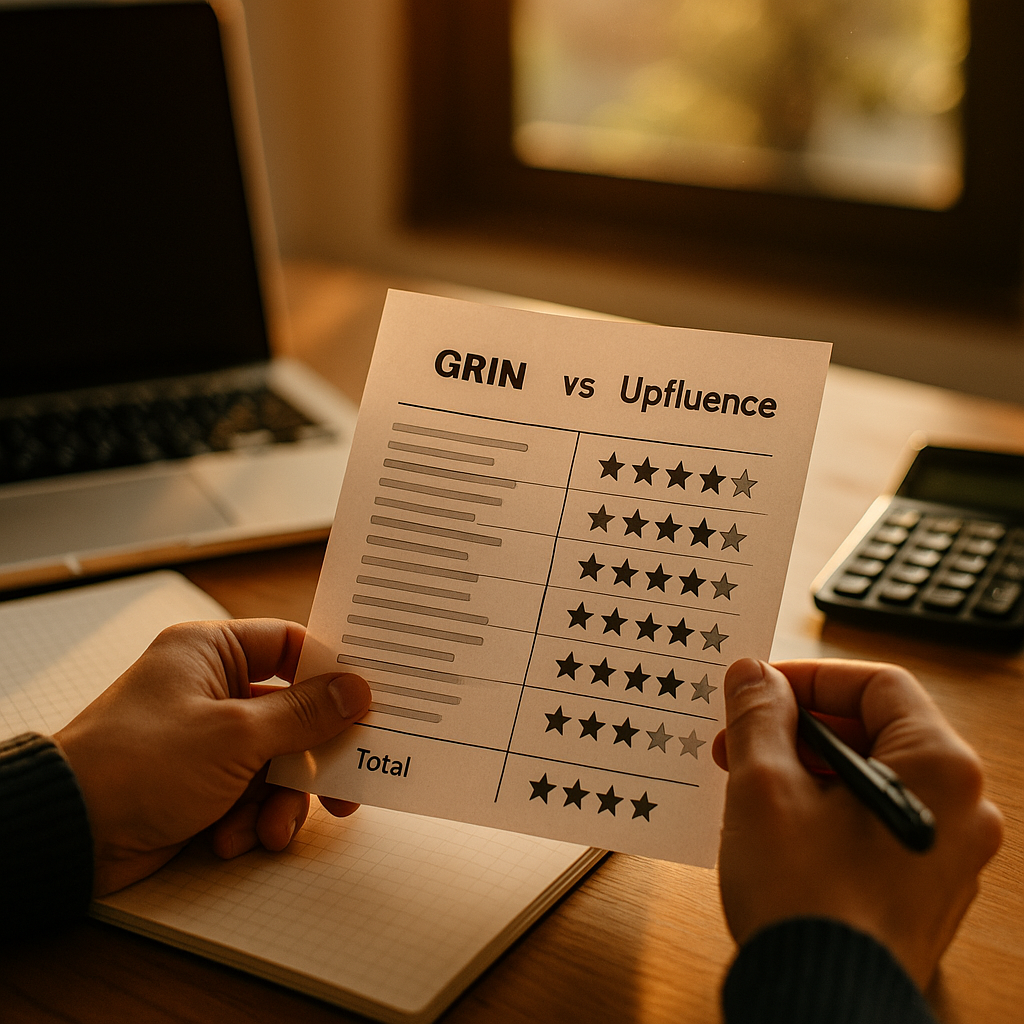
Sixty-three percent of marketing leaders say their last influencer platform purchase underdelivered against the demo. That’s not a vendor problem. That’s a scoring problem. If you’re weighing GRIN vs Upfluence right now, the difference between a good decision and a costly mistake usually comes down to whether you built a real vendor scorecard or just took notes during a sales call.
Procurement teams love a checklist. Marketing teams love a demo. Neither approach catches what actually breaks six months into a contract: AI recommendations that miss your niche, contract workflows that still require manual chasing, and reports that look great in a sales deck but can’t answer “what did this campaign actually return?”
Why a Scorecard Beats a Gut-Check Demo
Demos are theater. Sales engineers cherry-pick the creator database, pre-load the campaign templates, and show you the reporting dashboard with sample data that’s been groomed for weeks. You need a structured way to compare vendors under conditions that mimic your actual workflow, not their showcase environment.
A vendor scorecard forces discipline. It makes you define what “good” looks like before you’re seduced by a slick UI. And it gives you a paper trail for when finance asks why you picked the pricier option, or when the platform underperforms and you need to justify a renewal decision (or a switch).
The platforms that win RFPs today aren’t necessarily the ones with the flashiest AI. They’re the ones whose contract and payment workflows survive contact with a real finance team.
This matters more than ever because GRIN and Upfluence have converged on features. Both platforms pitch AI-assisted discovery, both automate contracts to some degree, both offer robust reporting. The differences live in the details, and details are exactly what a scorecard is built to surface.
Pillar One: AI Recommendation Quality
Start here because it’s the most oversold capability in the category. Every platform claims “AI-powered matching.” Few define what that means operationally.
Your scorecard should test AI recommendation quality against three sub-criteria:
- Relevance precision: Feed the platform a real brief from a past campaign. Count how many of the top 20 recommended creators would have actually passed your internal vetting. Anything below 50% relevance is a red flag.
- Niche depth: Broad categories (fitness, beauty, tech) are easy for any AI model to nail. Test niche verticals specific to your brand, regional dialects, or micro-communities. This is where matching engines diverge sharply.
- Fraud and quality signal integration: Does the AI recommendation engine factor in audience authenticity, or does it purely optimize for follower count and engagement rate? Platforms that bundle fraud detection into the matching layer tend to produce cleaner shortlists. If you want a deeper look at how bundled detection performs against standalone tools, bundled fraud detection accuracy is worth reviewing before you weight this criterion.
Third-party testing has already shown meaningful gaps between platforms on raw matching accuracy. A recent independent comparison found measurable variance in creator-fit precision between GRIN, Upfluence, and CreatorIQ when run against identical briefs, with some platforms surfacing significantly more irrelevant profiles in their top recommendations. If you haven’t seen that data, the AI matching accuracy comparison is a useful baseline to import directly into your scorecard weighting.
Score each platform 1-5 on precision, niche depth, and fraud integration. Weight precision heaviest if you run high-volume campaigns; weight niche depth heaviest if you operate in a specialized category like B2B, finance, or regulated health products.
Pillar Two: Contract Automation, Where the Real Time Savings Live
Contract automation sounds boring next to AI matching. It shouldn’t. It’s where operational teams either save twenty hours a week or lose their minds chasing signatures.
Break this pillar into concrete, testable components rather than vague “does it have e-signature” checkboxes:
- Template intelligence: Can the platform auto-populate contract terms (usage rights, exclusivity windows, deliverable counts) based on the campaign brief, or does every contract start from a blank template?
- Conditional workflows: Does the system trigger different approval chains for different contract values or creator tiers? A $500 micro-influencer agreement shouldn’t require the same legal review as a $50,000 ambassador deal.
- Rights and usage tracking: Post-signature, does the platform flag when usage rights are expiring, or does that fall to a spreadsheet somewhere?
- Integration with payment triggers: This is the piece most scorecards miss. Contract completion should trigger payment automation, not sit in a separate silo. If your platform requires a manual handoff between signed contract and payment release, you’ve just reintroduced the bottleneck the automation was supposed to remove.
Recent comparisons of GRIN and Upfluence specifically on this front found that payment workflow maturity, not contract signing speed, is now the deciding factor for procurement teams. Worth reading the full breakdown in why payment workflows now win RFPs before you finalize your weighting here. It reinforces a broader shift: payment operations now win platform RFPs more often than discovery features do, which should tell you something about where to allocate scorecard points.
Also test reconciliation. Ask each vendor to walk through how a disputed payment, a partial deliverable, or a mid-campaign contract amendment gets handled. The demo will show you the happy path. Your scorecard needs the unhappy path. The payment reconciliation buyers guide has a solid checklist of edge cases to probe during vendor calls.
Pillar Three: Reporting Depth (Not Just Dashboards)
Every platform has dashboards. Dashboards are not reporting depth. Reporting depth is the ability to answer a CFO’s follow-up question without exporting to Excel and building a pivot table yourself.
Test reporting depth against these questions:
- Can the platform attribute revenue to individual creators across multiple touchpoints, or only last-click?
- Does it support custom ROI formulas that match your internal finance definitions, or only the platform’s default calculation?
- Can you export raw campaign data in a format your BI team can actually use, without needing an API developer?
- Does the reporting layer flag anomalies (sudden engagement spikes, suspicious click patterns) automatically, or do you have to go looking?
Reporting depth is also where fraud detection and payment automation intersect. A platform that can’t tie payment records to performance data cleanly will always produce reports with gaps. If you’re evaluating how fraud detection and payment automation work together in practice, fraud detection meets payment automation is a good companion read, especially if your brand runs affiliate or performance-based creator deals where fraudulent activity directly hits your P&L.
If your reporting tool can’t survive a CFO’s second question, it’s not reporting. It’s a screenshot generator.
Building the Actual Scorecard
Here’s a practical structure you can adapt. Use a weighted scoring model, not a simple checklist, because not every criterion matters equally to every brand.
- Column 1: Criterion (e.g., “AI matching precision,” “conditional contract workflows,” “multi-touch attribution”)
- Column 2: Weight (percentage of total score, should sum to 100% across all criteria in a pillar)
- Column 3: GRIN score (1-5)
- Column 4: Upfluence score (1-5)
- Column 5: Evidence notes (screenshot, test result, reference call quote)
Run this with at least two evaluators independently, then reconcile scores. Solo scoring introduces bias, especially if one person sat through a persuasive demo and the other didn’t.
Total cost of ownership deserves its own line item, separate from feature scoring. A platform that scores higher on AI matching but requires three additional integrations to hit feature parity on reporting might cost more in the long run than a slightly less flashy all-in-one suite. The TCO framework for marketing suites vs point solutions is directly applicable here if you’re also weighing whether to bolt on separate fraud detection or attribution tools rather than relying on native platform features.
Don’t Skip Reference Calls
Scorecards built purely from demos and sales collateral are incomplete. Call two or three current customers in your industry vertical and ask specifically about the three pillars above. Ask what broke. Ask what took longer to implement than promised. Ask whether support tickets on contract or reporting issues get resolved in days or weeks.
Marketing technology purchases increasingly hinge on operational reliability rather than feature novelty, a trend reflected broadly across martech buying research from firms like Gartner and eMarketer. Influencer platforms are not exempt. The creator economy has matured past the point where “we have AI” is a differentiator; buyers now expect proof under real operating conditions, similar to how HubSpot and other CRM vendors get evaluated on data portability and integration depth, not just headline features.
Compliance and data handling should get a line item too, particularly if your campaigns involve creator payment data or EU-based talent. Review how each platform handles data subject requests and payment data retention against guidance from bodies like the FTC and the ICO, especially if your legal team hasn’t already vetted the vendor’s compliance documentation.
What This Looks Like in Practice
A mid-size DTC brand running quarterly influencer campaigns across three regions doesn’t need the same scorecard weighting as a B2B SaaS company running always-on ambassador programs. Adjust weights to match your operating model, not a generic template pulled from a vendor comparison blog.
If your program is contract-heavy with hundreds of micro-influencer agreements per quarter, weight contract automation at 40% or more. If you’re running a smaller number of high-value partnerships where attribution accuracy determines renewal budgets, weight reporting depth heaviest. There’s no universal right answer, only the right answer for your operating reality.
Next Step
Build the scorecard before your next renewal or RFP cycle, run it against live campaign data rather than vendor-supplied samples, and require both platforms to demonstrate the unhappy-path workflows, not just the polished demo. That single change will tell you more about GRIN vs Upfluence than any sales deck ever will.
FAQs
How long should a vendor scorecard evaluation take?
Plan for two to four weeks if you’re including reference calls and live data testing. Rushing the AI matching and contract stress-tests is the most common reason teams pick the wrong platform.
Should pricing be part of the scorecard or evaluated separately?
Evaluate pricing separately as total cost of ownership, including integration costs and implementation time, rather than folding it into feature scores. Combining them muddies which platform actually performs better on capability.
What’s the biggest blind spot teams have when comparing GRIN and Upfluence?
Assuming AI matching quality is roughly equivalent across platforms. Independent testing shows measurable gaps in niche-category precision, which matters far more for specialized brands than for broad lifestyle campaigns.
Do I need IT or engineering involved in the scorecard process?
Yes, at least for the reporting and integration criteria. Marketing teams often underestimate how much custom reporting or API access requires engineering support post-purchase.
How often should we re-run this scorecard after choosing a vendor?
Annually at minimum, ideally ahead of every contract renewal. Platforms update AI models and reporting features frequently enough that a scorecard from eighteen months ago may no longer reflect current capability.
FAQs
How long should a vendor scorecard evaluation take?
Plan for two to four weeks if you’re including reference calls and live data testing. Rushing the AI matching and contract stress-tests is the most common reason teams pick the wrong platform.
Should pricing be part of the scorecard or evaluated separately?
Evaluate pricing separately as total cost of ownership, including integration costs and implementation time, rather than folding it into feature scores. Combining them muddies which platform actually performs better on capability.
What’s the biggest blind spot teams have when comparing GRIN and Upfluence?
Assuming AI matching quality is roughly equivalent across platforms. Independent testing shows measurable gaps in niche-category precision, which matters far more for specialized brands than for broad lifestyle campaigns.
Do I need IT or engineering involved in the scorecard process?
Yes, at least for the reporting and integration criteria. Marketing teams often underestimate how much custom reporting or API access requires engineering support post-purchase.
How often should we re-run this scorecard after choosing a vendor?
Annually at minimum, ideally ahead of every contract renewal. Platforms update AI models and reporting features frequently enough that a scorecard from eighteen months ago may no longer reflect current capability.
Top Influencer Marketing Agencies
The leading agencies shaping influencer marketing in 2026
Agencies ranked by campaign performance, client diversity, platform expertise, proven ROI, industry recognition, and client satisfaction. Assessed through verified case studies, reviews, and industry consultations.
Moburst

-
2

The Shelf
Boutique Beauty & Lifestyle Influencer AgencyA data-driven boutique agency specializing exclusively in beauty, wellness, and lifestyle influencer campaigns on Instagram and TikTok. Best for brands already focused on the beauty/personal care space that need curated, aesthetic-driven content.Clients: Pepsi, The Honest Company, Hims, Elf Cosmetics, Pure LeafVisit The Shelf → -
3

Audiencly
Niche Gaming & Esports Influencer AgencyA specialized agency focused exclusively on gaming and esports creators on YouTube, Twitch, and TikTok. Ideal if your campaign is 100% gaming-focused — from game launches to hardware and esports events.Clients: Epic Games, NordVPN, Ubisoft, Wargaming, Tencent GamesVisit Audiencly → -
4

Viral Nation
Global Influencer Marketing & Talent AgencyA dual talent management and marketing agency with proprietary brand safety tools and a global creator network spanning nano-influencers to celebrities across all major platforms.Clients: Meta, Activision Blizzard, Energizer, Aston Martin, WalmartVisit Viral Nation → -
5

The Influencer Marketing Factory
TikTok, Instagram & YouTube CampaignsA full-service agency with strong TikTok expertise, offering end-to-end campaign management from influencer discovery through performance reporting with a focus on platform-native content.Clients: Google, Snapchat, Universal Music, Bumble, YelpVisit TIMF → -
6

NeoReach
Enterprise Analytics & Influencer CampaignsAn enterprise-focused agency combining managed campaigns with a powerful self-service data platform for influencer search, audience analytics, and attribution modeling.Clients: Amazon, Airbnb, Netflix, Honda, The New York TimesVisit NeoReach → -
7

Ubiquitous
Creator-First Marketing PlatformA tech-driven platform combining self-service tools with managed campaign options, emphasizing speed and scalability for brands managing multiple influencer relationships.Clients: Lyft, Disney, Target, American Eagle, NetflixVisit Ubiquitous → -
8

Obviously
Scalable Enterprise Influencer CampaignsA tech-enabled agency built for high-volume campaigns, coordinating hundreds of creators simultaneously with end-to-end logistics, content rights management, and product seeding.Clients: Google, Ulta Beauty, Converse, AmazonVisit Obviously →