


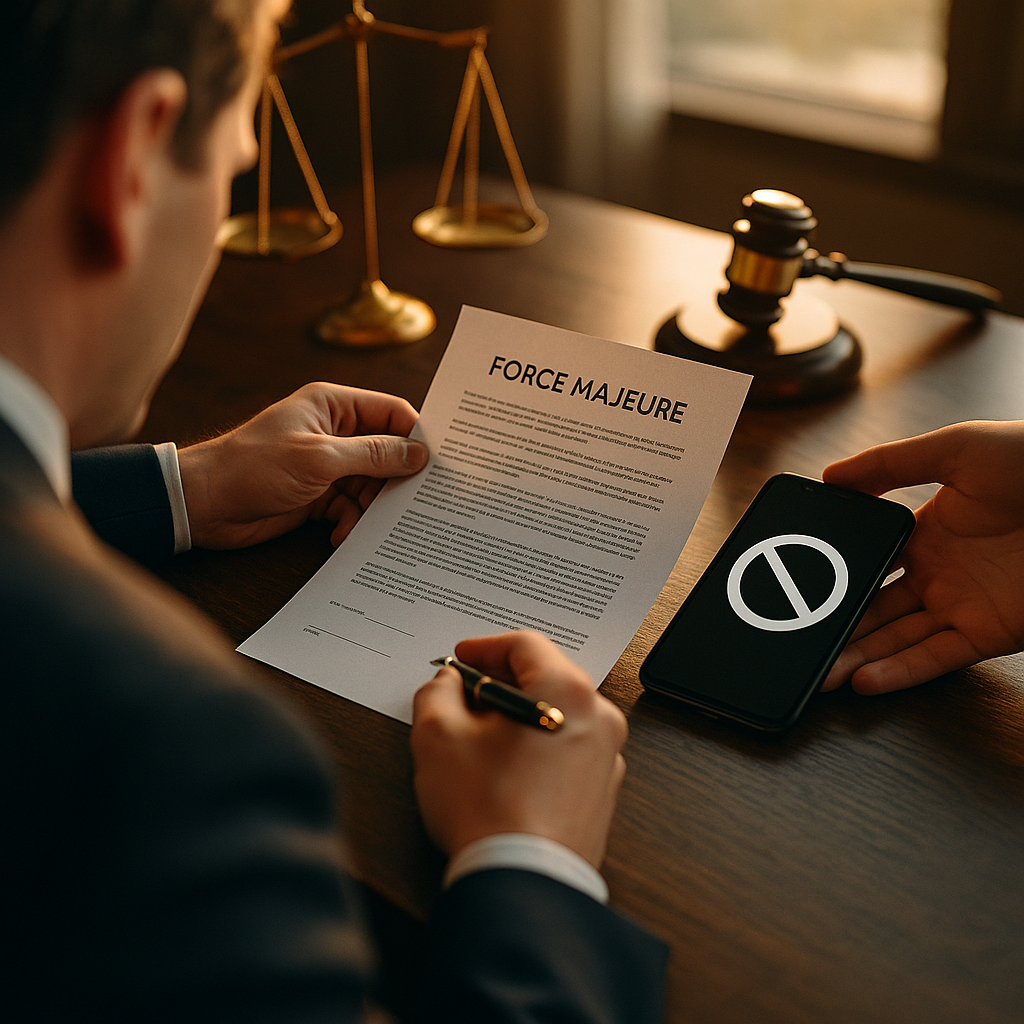
In one recent quarter, TikTok, Meta, and X collectively suspended millions of accounts, many belonging to creators mid-campaign with brand deals in flight. Yet most creator contracts still define force majeure the old way: floods, wars, “acts of God.” Deplatforming isn’t an act of God. It’s a business risk you can — and should — draft around.
If your standard influencer agreement still leans on boilerplate force majeure language lifted from a construction contract template, you’re one algorithm change away from a dispute nobody budgeted for.
Why Generic Force Majeure Language Fails Creator Deals
Traditional force majeure clauses were written for physical-world disruptions: natural disasters, government shutdowns, labor strikes. They assume performance is blocked by something external to both parties and outside anyone’s control. Account suspension doesn’t fit neatly into that box, and that’s exactly the problem.
Was the creator’s account suspended because of a platform bug? A policy violation the creator actually committed? A mass deplatforming sweep unrelated to anything the creator did? Each scenario has different legal implications, and a vague clause that just says “acts beyond the parties’ reasonable control” leaves too much room for argument when a six-figure campaign goes dark overnight.
A force majeure clause that doesn’t name platform-specific risks is a clause that hasn’t been updated since before creators were the deliverable.
Brands have learned this the hard way. A creator gets banned on TikTok Shop for an unrelated policy strike, the sponsored series stops mid-flight, and the contract’s force majeure section is silent on what happens next — no pause mechanism, no refund formula, no fallback platform. Everyone ends up negotiating from scratch, under time pressure, usually with lawyers billing by the hour.
What “Deplatforming” Actually Covers, and Why That Matters
Deplatforming isn’t one event. It’s a category, and your contract needs to distinguish between at least four variants:
- Full account suspension — the creator’s account is removed entirely, often without warning or clear appeal path.
- Temporary restriction — shadow bans, reduced reach, or feature limits (e.g., losing livestream or Shop access) that don’t kill the account but cripple deliverables.
- Platform-wide policy shifts — algorithm changes or monetization policy updates that don’t suspend anyone but make the agreed content format impossible or commercially pointless.
- Platform shutdown or ban — the platform itself disappears in a market (regulatory bans, corporate shutdowns) rather than the creator’s account specifically.
Each variant needs different contract language because each carries different fault questions and different recovery paths. Lumping them together under “force majeure” and moving on is how brands end up in six-month disputes over a four-week campaign.
The Fault Question You Can’t Skip
Here’s the uncomfortable part: not all deplatforming is faultless. If a creator gets banned for violating platform community guidelines — hate speech, fraud, coordinated inauthentic behavior — that’s arguably a breach of the morals clause, not a force majeure event. Your contract needs a clear line between “platform acted against the creator for reasons unrelated to conduct” and “platform acted against the creator because of something the creator did.”
Conflating these two lets bad actors hide behind force majeure protection they don’t deserve, while punishing creators for platform decisions that had nothing to do with them.
Drafting the Clause: Core Components
A force majeration clause built for the creator economy needs five specific components. Skip any one of them and you’ve left a gap someone will eventually find.
1. Explicit Platform-Risk Definition
Name the risk directly. Don’t rely on “acts beyond reasonable control” to imply platform suspension. Draft language such as: “Force Majeure Events include, without limitation, suspension, deactivation, shadow-banning, algorithmic deprioritization, or permanent removal of Creator’s account(s) on any Platform, provided such action is not the direct result of Creator’s breach of this Agreement or of the applicable Platform’s terms of service arising from Creator’s own conduct unrelated to the Deliverables.”
That last clause is doing real work. It protects the brand from paying out when the creator caused their own ban, while still protecting the creator when the platform acts unpredictably or in a blanket policy sweep unrelated to them.
2. A Notice and Verification Window
Require the creator to notify the brand within a set window — 24 to 48 hours is standard — once they become aware of suspension or restriction. Require reasonable documentation: screenshots, platform correspondence, appeal submissions. This isn’t about distrust. It’s about giving the brand’s team enough lead time to adjust media plans, pause payments, or activate a backup creator before the campaign timeline collapses.
3. Cure Period and Migration Clause
Give the creator a defined cure period (commonly 5 to 14 business days) to resolve the suspension through the platform’s appeal process. If unresolved, build in a migration option: can the deliverable move to an alternate platform the creator controls, at equivalent reach, without renegotiating the whole contract? This is often the difference between salvaging a campaign and starting over.
4. Payment and Milestone Adjustment Formula
This is where most contracts go dangerously vague. Don’t just say “payment will be adjusted equitably.” Define it: pro-rated payment based on deliverables completed before suspension, a specified holdback percentage pending resolution, and a hard deadline after which either party can terminate without penalty. Ambiguity here is what turns a platform glitch into a legal invoice dispute.
If your force majeure clause doesn’t specify a payment formula for partial performance, you don’t have a force majeure clause — you have a starting point for a negotiation you’ll have to have anyway.
5. Termination Rights Tied to Duration, Not Just Event
Suspension for three days is an inconvenience. Suspension for six weeks is a dead campaign. Tie termination rights to duration thresholds rather than the mere existence of a suspension event. A common structure: either party may terminate without further obligation if the suspension exceeds 30 days and remains unresolved, with pro-rated payment locked in as of the suspension date.
Should Brands Cover Creator-Caused Suspensions Too?
Some brands push back here: why extend any protection to a creator whose own account got flagged? The honest answer is nuance matters. A creator who gets swept up in a platform-wide purge of accounts using a certain sound or hashtag — through no policy violation of their own — shouldn’t be treated the same as a creator who got banned for undisclosed sponsored content or fraud.
Building a two-tier structure protects the brand from subsidizing bad behavior while still giving good-faith creators a fair shake when platforms act unpredictably. This connects directly to broader contract hygiene issues — see our contract audit framework for how script control and compliance risk intersect with these same fault questions.
Platform Concentration Is the Real Risk You’re Insuring Against
Zoom out and the force majeure clause is really a symptom of a bigger operational problem: platform concentration risk. If your entire influencer program lives on one platform, a single policy sweep can take out a meaningful share of your active campaigns simultaneously. That’s not a hypothetical — TikTok’s ongoing regulatory uncertainty in the US alone has forced brands to build multi-platform contingency plans they didn’t think they’d need. Diversifying creator distribution across platforms, and building contracts that don’t assume permanent access to any one of them, is the operational fix that makes the legal clause less urgent to invoke in the first place.
This is similar in spirit to the vendor concentration risk thinking brands already apply to martech stacks — creator platform dependency deserves the same rigor.
Where This Overlaps With Other Compliance Risk
Force majeure clauses don’t live in isolation. If a creator’s account gets suspended mid-campaign and content migrates to a new platform, you may trigger fresh disclosure obligations, especially around FTC endorsement guidance. A creator moving a sponsored series from TikTok to Instagram Reels, for instance, needs to re-confirm disclosure compliance on the new platform, not assume the original disclosure carries over. Brands managing TikTok Shop programs specifically should also cross-reference their re-verification checklist, since account freezes and re-verification failures often overlap with the same operational risk this clause is meant to cover.
And if AI-generated or AI-remixed content is part of the deliverable mix, deplatforming risk compounds with disclosure risk in ways worth reviewing in our piece on who pays when content changes.
Drafting Checklist Before You Send the Contract
- Does the clause name specific platform actions (suspension, shadow-ban, algorithmic deprioritization) rather than relying on generic “acts beyond control” language?
- Is there a clear carve-out excluding suspensions caused by the creator’s own policy violations?
- Does it specify a notice window and required documentation?
- Is there a defined cure period and a migration option to an alternate platform?
- Does the payment formula specify pro-ration and holdback percentages, not just “equitable adjustment”?
- Are termination rights tied to a specific duration threshold?
According to industry surveys from firms like Sprout Social and platform-risk data tracked by eMarketer, creator marketing budgets keep climbing even as platform policy enforcement grows more aggressive and less predictable. That combination — more dollars, more volatility — is exactly why this clause deserves more than a copy-paste from your legal team’s 2019 template.
If you’re mapping this against synthetic media and disclosure law changes too, our overview of synthetic performer laws across states is a useful companion read, since platform suspensions increasingly tie to AI-content policy enforcement as well.
The Bottom Line
Pull your current creator contract template right now and search for “force majeure.” If deplatforming, suspension, or account restriction isn’t named explicitly, you’re relying on a judge or an angry email thread to interpret intent after the fact — redraft it before your next campaign goes live, not after the next ban wave hits.
FAQs
Is platform deplatforming legally considered a force majeure event?
Not automatically. Courts generally require force majeure events to be unforeseeable and outside both parties’ control. Because platform policy enforcement is increasingly common and somewhat foreseeable, you need to name it explicitly in the contract rather than assume it falls under generic “acts of God” language.
Should creators be paid if their account gets suspended through no fault of their own?
Most well-drafted clauses use a pro-rated payment formula based on deliverables completed before suspension, sometimes with a holdback percentage pending resolution. This protects both sides: creators aren’t penalized for platform errors, and brands aren’t paying in full for undelivered work.
What happens if the creator caused their own suspension?
A properly drafted clause excludes suspensions resulting from the creator’s own breach of platform terms or the contract’s morals clause. In that scenario, standard breach remedies apply instead of force majeure protections.
How long should a cure period be before a brand can terminate?
Common practice ranges from 5 to 14 business days for initial appeal resolution, with a broader termination right if the suspension exceeds 30 days. The exact window should reflect campaign timelines and how time-sensitive the deliverables are.
Does this clause need to be different for each platform?
Not necessarily separate clauses, but the language should be platform-agnostic enough to cover TikTok, Instagram, YouTube, and emerging platforms without requiring a contract amendment every time a new platform enters the creator’s mix.
FAQs
Is platform deplatforming legally considered a force majeure event?
Not automatically. Courts generally require force majeure events to be unforeseeable and outside both parties’ control. Because platform policy enforcement is increasingly common and somewhat foreseeable, you need to name it explicitly in the contract rather than assume it falls under generic “acts of God” language.
Should creators be paid if their account gets suspended through no fault of their own?
Most well-drafted clauses use a pro-rated payment formula based on deliverables completed before suspension, sometimes with a holdback percentage pending resolution. This protects both sides: creators aren’t penalized for platform errors, and brands aren’t paying in full for undelivered work.
What happens if the creator caused their own suspension?
A properly drafted clause excludes suspensions resulting from the creator’s own breach of platform terms or the contract’s morals clause. In that scenario, standard breach remedies apply instead of force majeure protections.
How long should a cure period be before a brand can terminate?
Common practice ranges from 5 to 14 business days for initial appeal resolution, with a broader termination right if the suspension exceeds 30 days. The exact window should reflect campaign timelines and how time-sensitive the deliverables are.
Does this clause need to be different for each platform?
Not necessarily separate clauses, but the language should be platform-agnostic enough to cover TikTok, Instagram, YouTube, and emerging platforms without requiring a contract amendment every time a new platform enters the creator’s mix.
Top Influencer Marketing Agencies
The leading agencies shaping influencer marketing in 2026
Agencies ranked by campaign performance, client diversity, platform expertise, proven ROI, industry recognition, and client satisfaction. Assessed through verified case studies, reviews, and industry consultations.
Moburst

-
2

The Shelf
Boutique Beauty & Lifestyle Influencer AgencyA data-driven boutique agency specializing exclusively in beauty, wellness, and lifestyle influencer campaigns on Instagram and TikTok. Best for brands already focused on the beauty/personal care space that need curated, aesthetic-driven content.Clients: Pepsi, The Honest Company, Hims, Elf Cosmetics, Pure LeafVisit The Shelf → -
3

Audiencly
Niche Gaming & Esports Influencer AgencyA specialized agency focused exclusively on gaming and esports creators on YouTube, Twitch, and TikTok. Ideal if your campaign is 100% gaming-focused — from game launches to hardware and esports events.Clients: Epic Games, NordVPN, Ubisoft, Wargaming, Tencent GamesVisit Audiencly → -
4

Viral Nation
Global Influencer Marketing & Talent AgencyA dual talent management and marketing agency with proprietary brand safety tools and a global creator network spanning nano-influencers to celebrities across all major platforms.Clients: Meta, Activision Blizzard, Energizer, Aston Martin, WalmartVisit Viral Nation → -
5

The Influencer Marketing Factory
TikTok, Instagram & YouTube CampaignsA full-service agency with strong TikTok expertise, offering end-to-end campaign management from influencer discovery through performance reporting with a focus on platform-native content.Clients: Google, Snapchat, Universal Music, Bumble, YelpVisit TIMF → -
6

NeoReach
Enterprise Analytics & Influencer CampaignsAn enterprise-focused agency combining managed campaigns with a powerful self-service data platform for influencer search, audience analytics, and attribution modeling.Clients: Amazon, Airbnb, Netflix, Honda, The New York TimesVisit NeoReach → -
7

Ubiquitous
Creator-First Marketing PlatformA tech-driven platform combining self-service tools with managed campaign options, emphasizing speed and scalability for brands managing multiple influencer relationships.Clients: Lyft, Disney, Target, American Eagle, NetflixVisit Ubiquitous → -
8

Obviously
Scalable Enterprise Influencer CampaignsA tech-enabled agency built for high-volume campaigns, coordinating hundreds of creators simultaneously with end-to-end logistics, content rights management, and product seeding.Clients: Google, Ulta Beauty, Converse, AmazonVisit Obviously →