


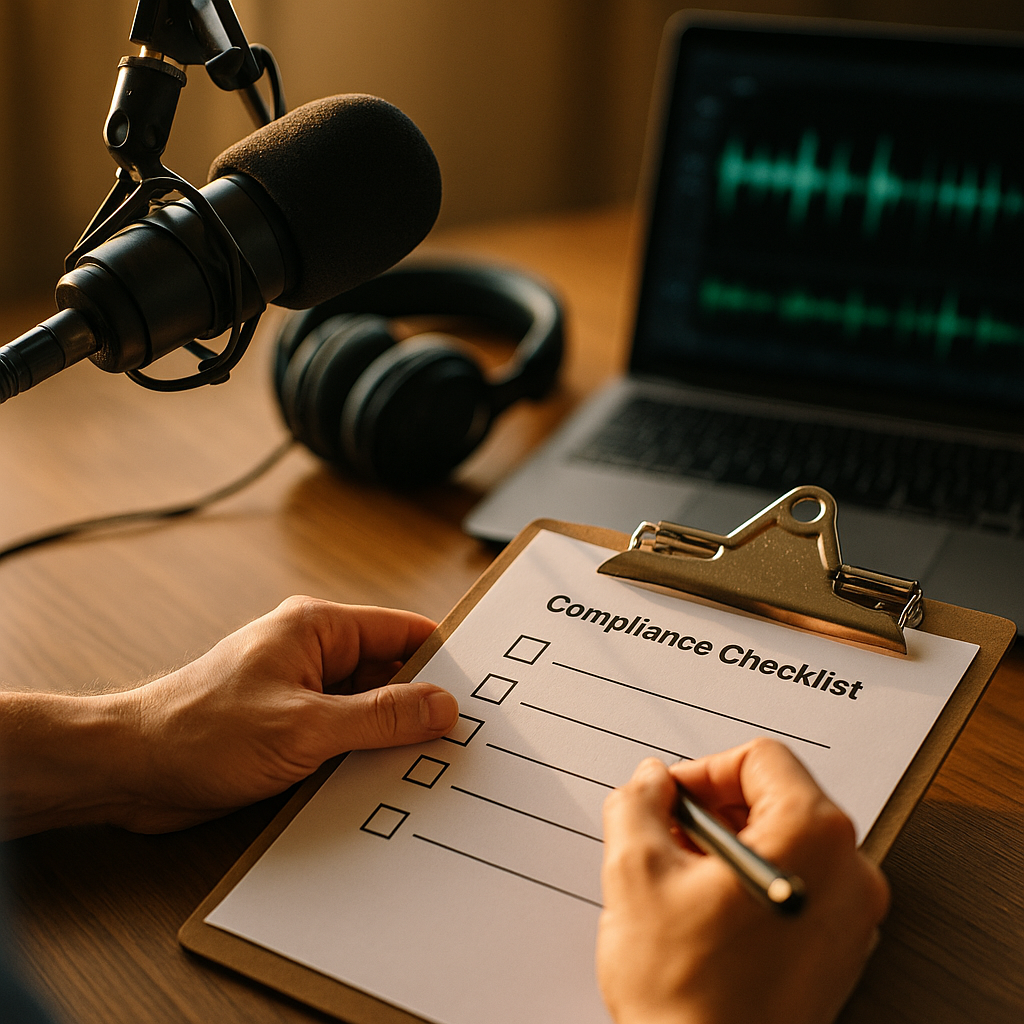
Dynamic ad insertion promised podcast advertisers scale without sacrificing the intimacy of host-read spots. But when a creator ad-libs a live read that never crossed legal’s desk, that intimacy becomes liability. A podcast dynamic ad insertion compliance checklist isn’t a nice-to-have anymore — it’s the difference between a scalable audio strategy and an FTC inquiry waiting to happen.
Roughly 42% of US podcast listeners have taken action after hearing a host-read ad, according to Edison Research trend data cited across the industry. That trust is exactly why regulators watch this format closely. When ad insertion happens dynamically, and the host reads live copy off a talking-points sheet rather than an approved script, brands lose the one thing DAI was supposed to preserve: control.
Why DAI Breaks the Traditional Approval Chain
Traditional pre-roll and mid-roll ads get baked into an episode file. Someone reviews the final cut. Legal signs off. Done. Dynamic ad insertion doesn’t work that way. Ad servers like Megaphone, AdsWizz, or Podscribe drop audio into a slot at request time, based on listener location, device, or even the podcast app being used. The creative itself is often swapped without anyone re-listening to the finished episode.
Now layer in host-read live copy. Instead of a fixed audio file, many podcast networks let hosts read from bullet points during recording, ad-libbing product claims in their own voice because that’s what makes the format convert. It’s also what makes it unauditable at scale. A brand might run the same DAI campaign across 200 episodes and never hear the actual language used in 150 of them.
If your ad ops team can name the exact script a host read on episode 47 of a 200-episode DAI campaign, you’re the exception. Most brands can’t — and that gap is where FTC risk lives.
This isn’t a hypothetical edge case. It’s the default operating model for host-read DAI campaigns across networks like iHeartPodcasts, Wondery, and thousands of independent shows using programmatic audio marketplaces. Scale is the whole point. Scale is also the whole problem.
What Regulators Actually Expect From Brands
The FTC’s Endorsement Guides don’t care that DAI made pre-approval operationally inconvenient. The agency’s position has been consistent for years: advertisers bear responsibility for material connections being disclosed clearly, and for endorsement claims being truthful and substantiated. Whether the ad ran as a fixed file or got dynamically inserted changes nothing about the legal obligation.
That means a live-read claim like “I’ve lost 12 pounds since I started using this” needs the same substantiation a national TV ad would need. If your creator host makes that claim off-script during a live read, and you never approved it, you’re still on the hook if it’s unsubstantiated or misleading. Ignorance isn’t a defense — it’s a liability gap you created by skipping the review step.
This mirrors what we’ve seen play out in adjacent creator-compliance disputes. Our contract audit framework for script control risk covers similar ground for social influencers, and the same logic applies almost verbatim to podcast hosts reading DAI copy.
The Disclosure Problem Nobody’s Solving
Disclosure gets messier with DAI because the ad and the disclosure aren’t always inserted together. Some ad servers insert the sponsor message but rely on the host’s spoken disclosure (“this episode is brought to you by…”) recorded separately, sometimes days earlier, sometimes generically across multiple sponsors in one breath. If a host says “thanks to today’s sponsors” without naming the brand clearly attached to the specific claims that follow, the FTC’s clear-and-conspicuous standard is in trouble.
The Compliance Checklist
Here’s the framework we’d hand a brand safety lead auditing a host-read DAI podcast program right now.
- Script tier mapping. Classify every ad slot as fixed-produced, host-read-from-approved-script, or host-read-freeform. Freeform is where your risk concentrates — flag it for extra review cadence.
- Pre-approval gate for claims-based copy. Any spot containing a quantifiable claim (efficacy, pricing, comparative statements) requires written pre-approval before recording, no exceptions, regardless of DAI insertion timing.
- Post-air spot checks. Randomly sample 10-15% of aired episodes monthly using tools like Podscribe or Chartable’s ad verification features to confirm the actual read matches approved talking points.
- Disclosure placement audit. Confirm the sponsor name is spoken within the same breath or segment as the claim, not buried in a generic sponsor roll-call at the top of the episode.
- Contractual script-deviation clauses. Build language into creator/network agreements that ties payment or renewal to adherence to approved talking points, with defined remediation steps for deviation.
- Claim substantiation file. Maintain a running document of every approved claim and its backing evidence, refreshed whenever new talking points ship to hosts.
- Escalation protocol for live drift. Define what happens when a host materially deviates — pull the ad from future insertions, require a corrective read, or trigger legal review within 48 hours.
Most brands have some version of items one and two. Almost none have built out five through seven. That’s the gap auditors and regulators will find first.
Where the Contract Language Actually Needs to Live
You can’t checklist your way out of a bad contract. If the master services agreement with the podcast network doesn’t grant you audit rights, script review rights, and remediation triggers, your compliance checklist is aspirational at best.
Specifically, push for:
- The right to request talking-points documents for any host-read spot before it airs, with a defined turnaround SLA (48-72 hours is standard).
- Audio verification rights: access to aired copies of spots for post-hoc review, not just aggregated performance metrics.
- A defined definition of “material deviation” from approved copy, since vague language here gets litigated in your favor or against you depending on how it’s drafted.
- Indemnification language covering claims made by the host that fall outside approved talking points — this is where liability actually gets allocated.
This is structurally similar to the script-control work we outlined for social creators. If you haven’t already built that muscle, our script control risk framework is a solid starting template you can adapt for audio.
What This Costs vs. What Non-Compliance Costs
Running a real pre-approval and spot-check program adds friction. Ad ops teams hate friction. But compare that friction to the cost of an FTC consent decree, a corrective advertising order, or the reputational fallout when a host’s ad-libbed health claim goes viral for the wrong reasons.
Podcast ad spend crossed $2 billion in US measured spend per eMarketer estimates, and DAI is the delivery mechanism for a growing share of that. The bigger the program, the bigger the blast radius when one host’s freeform read goes sideways across hundreds of dynamically inserted instances.
A single unapproved claim inserted dynamically across 300 episodes isn’t one compliance incident — it’s 300 simultaneous ones, each potentially actionable on its own.
Building the Audit Cadence That Actually Works
Monthly spot checks aren’t enough on their own. Pair them with a quarterly full-program review: pull every claims-based script that shipped, cross-reference against the substantiation file, and confirm the network’s remediation log (you should be requiring one) shows deviations were caught and corrected.
Assign ownership clearly. Legal shouldn’t be doing this alone, and neither should media buying. The strongest programs we’ve seen split responsibility three ways: media/ad ops owns the spot-check sampling, legal owns the substantiation file and claim review, and a brand safety or compliance function owns the escalation protocol and contract enforcement. Nobody owns everything, but everybody owns something measurable.
If you’re running influencer and podcast programs simultaneously, this is also a good moment to check disclosure consistency across formats. The scrutiny brands face on platform disclosure toggles is instructive: a checkbox or a sponsor mention isn’t compliance by itself, it’s a starting point that still needs verification behind it.
One more thing worth flagging: cross-border podcast syndication complicates this further. If your DAI campaign runs across markets with different ad standards bodies, you’re not just managing FTC exposure. Our cross-border disclosure matrix is a useful reference if your podcast buys extend into UK or EU-distributed shows, where the ASA and DSA introduce separate disclosure thresholds entirely.
The Next Step
Pull your last 90 days of host-read DAI spots, map them against the checklist above, and identify how many freeform reads went to air with zero pre-approval — that number is your real risk exposure, not your impressions report.
FAQs
What is dynamic ad insertion in podcasting?
Dynamic ad insertion (DAI) is a technology that inserts audio ads into a podcast episode at the moment of listener request, rather than baking a fixed ad into the recorded file. It allows advertisers to target by geography, device, or listener segment, and to swap creative without re-uploading the episode.
Why does host-read live copy create compliance risk with DAI?
Host-read live copy is often delivered from talking points rather than an approved script, meaning hosts may ad-lib claims that were never legally reviewed. Combined with DAI’s scale, one unapproved claim can be inserted across hundreds of episodes before anyone catches it.
Is the brand liable if a podcast host makes an unapproved claim?
Generally yes. Under FTC Endorsement Guide principles, advertisers are responsible for the truthfulness and substantiation of endorsement claims made on their behalf, regardless of whether the exact wording was pre-approved.
How often should brands audit aired DAI podcast spots?
A reasonable cadence is monthly random sampling (10-15% of aired episodes) combined with a quarterly full-program review of all claims-based scripts against your substantiation file.
What contract terms protect a brand from DAI compliance risk?
Key terms include audit rights to review aired spots, a defined SLA for requesting talking points before air, a clear definition of “material deviation” from approved copy, and indemnification covering claims made outside approved talking points.
Does disclosure need to happen in every dynamically inserted ad segment?
Yes. The FTC’s clear-and-conspicuous standard requires the sponsor’s identity to be evident alongside the specific claim, not buried in a generic sponsor mention elsewhere in the episode.
FAQs
What is dynamic ad insertion in podcasting?
Dynamic ad insertion (DAI) is a technology that inserts audio ads into a podcast episode at the moment of listener request, rather than baking a fixed ad into the recorded file. It allows advertisers to target by geography, device, or listener segment, and to swap creative without re-uploading the episode.
Why does host-read live copy create compliance risk with DAI?
Host-read live copy is often delivered from talking points rather than an approved script, meaning hosts may ad-lib claims that were never legally reviewed. Combined with DAI’s scale, one unapproved claim can be inserted across hundreds of episodes before anyone catches it.
Is the brand liable if a podcast host makes an unapproved claim?
Generally yes. Under FTC Endorsement Guide principles, advertisers are responsible for the truthfulness and substantiation of endorsement claims made on their behalf, regardless of whether the exact wording was pre-approved.
How often should brands audit aired DAI podcast spots?
A reasonable cadence is monthly random sampling (10-15% of aired episodes) combined with a quarterly full-program review of all claims-based scripts against your substantiation file.
What contract terms protect a brand from DAI compliance risk?
Key terms include audit rights to review aired spots, a defined SLA for requesting talking points before air, a clear definition of “material deviation” from approved copy, and indemnification covering claims made outside approved talking points.
Does disclosure need to happen in every dynamically inserted ad segment?
Yes. The FTC’s clear-and-conspicuous standard requires the sponsor’s identity to be evident alongside the specific claim, not buried in a generic sponsor mention elsewhere in the episode.
Top Influencer Marketing Agencies
The leading agencies shaping influencer marketing in 2026
Agencies ranked by campaign performance, client diversity, platform expertise, proven ROI, industry recognition, and client satisfaction. Assessed through verified case studies, reviews, and industry consultations.
Moburst

-
2

The Shelf
Boutique Beauty & Lifestyle Influencer AgencyA data-driven boutique agency specializing exclusively in beauty, wellness, and lifestyle influencer campaigns on Instagram and TikTok. Best for brands already focused on the beauty/personal care space that need curated, aesthetic-driven content.Clients: Pepsi, The Honest Company, Hims, Elf Cosmetics, Pure LeafVisit The Shelf → -
3

Audiencly
Niche Gaming & Esports Influencer AgencyA specialized agency focused exclusively on gaming and esports creators on YouTube, Twitch, and TikTok. Ideal if your campaign is 100% gaming-focused — from game launches to hardware and esports events.Clients: Epic Games, NordVPN, Ubisoft, Wargaming, Tencent GamesVisit Audiencly → -
4

Viral Nation
Global Influencer Marketing & Talent AgencyA dual talent management and marketing agency with proprietary brand safety tools and a global creator network spanning nano-influencers to celebrities across all major platforms.Clients: Meta, Activision Blizzard, Energizer, Aston Martin, WalmartVisit Viral Nation → -
5

The Influencer Marketing Factory
TikTok, Instagram & YouTube CampaignsA full-service agency with strong TikTok expertise, offering end-to-end campaign management from influencer discovery through performance reporting with a focus on platform-native content.Clients: Google, Snapchat, Universal Music, Bumble, YelpVisit TIMF → -
6

NeoReach
Enterprise Analytics & Influencer CampaignsAn enterprise-focused agency combining managed campaigns with a powerful self-service data platform for influencer search, audience analytics, and attribution modeling.Clients: Amazon, Airbnb, Netflix, Honda, The New York TimesVisit NeoReach → -
7

Ubiquitous
Creator-First Marketing PlatformA tech-driven platform combining self-service tools with managed campaign options, emphasizing speed and scalability for brands managing multiple influencer relationships.Clients: Lyft, Disney, Target, American Eagle, NetflixVisit Ubiquitous → -
8

Obviously
Scalable Enterprise Influencer CampaignsA tech-enabled agency built for high-volume campaigns, coordinating hundreds of creators simultaneously with end-to-end logistics, content rights management, and product seeding.Clients: Google, Ulta Beauty, Converse, AmazonVisit Obviously →