


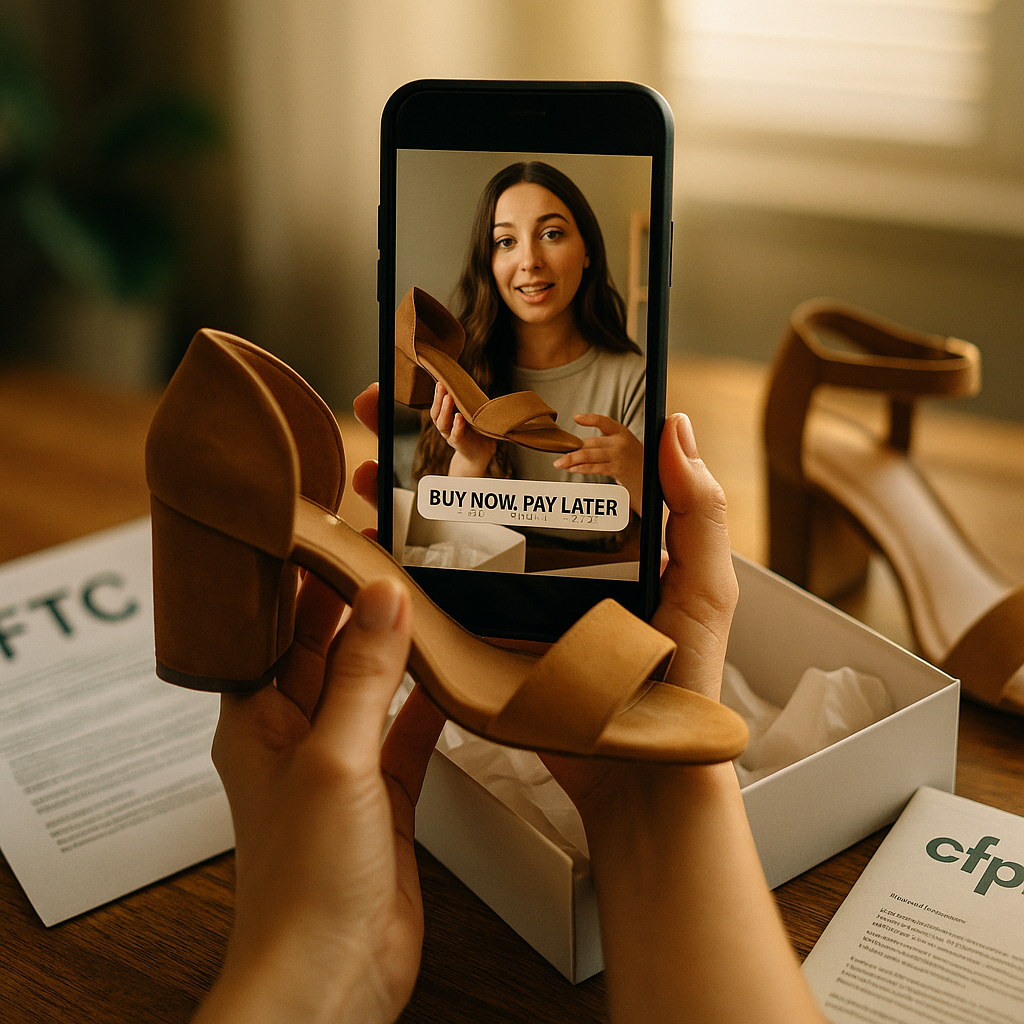
Nearly one in four Gen Z shoppers used a buy-now-pay-later plan in the past year, and creators are pitching those installment offers in the same breath as the product itself. That’s a problem. The FTC rules on creator-promoted buy-now-pay-later arrangements are murkier than standard endorsement disclosure, and most brand compliance teams haven’t caught up.
BNPL partnerships sit at the intersection of two regulatory regimes: endorsement law and consumer financial protection. Get either one wrong, and you’re not just facing an FTC inquiry. You’re facing a potential referral to the Consumer Financial Protection Bureau or state banking regulators. That’s a different level of exposure than a mislabeled #ad.
Why BNPL Promotions Are a Different Animal
A standard sponsored post has one compliance question: did the creator disclose the material connection? BNPL content has at least three. Is the financing partnership disclosed? Are the loan terms accurate and not misleading? And is the creator, functionally, acting as an unlicensed loan originator by making representations about credit terms they’re not authorized to make?
That third question trips up more brands than you’d expect.
Klarna, Afterpay, Affirm, and Sezzle have all scaled creator programs over the past two years, often running through the same affiliate networks brands already use for product promotion. The financing pitch gets bundled into the same content: “get this skincare set for $12.50 today, pay the rest later, no interest.” That single sentence contains a product endorsement, a financial product endorsement, and an implicit credit term claim. Three different disclosure and accuracy obligations, stacked in one caption.
When a creator’s BNPL mention misstates deferred interest, late fees, or credit reporting impact, the brand and the fintech partner both carry liability, not just the creator.
What the FTC Actually Requires
The FTC hasn’t issued BNPL-specific endorsement guidance. It doesn’t need to. The existing Endorsement Guides and Section 5 of the FTC Act already cover this territory:
- Material connection disclosure. If a creator is paid, gifted, or given an affiliate commission by a BNPL provider (or by the brand for promoting the BNPL option), that connection must be disclosed clearly and conspicuously, per standard FTC endorsement guidance.
- Accuracy of claims. Creators cannot say “no interest, ever” if late payments trigger deferred interest or fees. This is a truth-in-advertising issue, not just a disclosure issue.
- No implied endorsement of creditworthiness. A creator saying “you’ll definitely get approved” edges into representations about lending criteria they have no authority to make.
- Dual disclosure when two brands are involved. If the content promotes both the retailer and the BNPL provider, and separate payments come from each, both relationships need disclosure — not just one.
The FTC has already shown it will act on financial-adjacent influencer content. Crypto promotion cases and the FTC’s ongoing scrutiny of “finfluencers” are the closest analog. If your BNPL creator program looks structurally similar to the unregistered financial promotion cases the agency has pursued, expect similar treatment.
The Undisclosed Partnership Problem
Here’s where it gets operationally messy. Most brands don’t pay creators directly for BNPL mentions — the fintech provider does, through its own affiliate or ambassador program, running parallel to the brand’s influencer deal. The creator gets brand product seeding on one track and a BNPL commission on another. Neither side necessarily knows what the other is paying.
That’s an undisclosed financing partnership sitting inside a disclosed brand partnership. Both need separate, plain-language disclosure. A single “#ad” tag covering the brand deal does not automatically cover the BNPL commission structure layered on top.
This mirrors a pattern we’ve flagged before in loyalty and affiliate contexts: creator codes tied to third-party programs create compliance blind spots precisely because the brand doesn’t control the second relationship. BNPL is the same structure with sharper regulatory teeth, because consumer credit is involved.
Who’s Liable When the Creator Gets It Wrong?
Short answer: probably everyone in the chain, to varying degrees. The FTC’s theory of liability under the Endorsement Guides extends to advertisers who knew or should have known about inadequate disclosure. If your brand agreement authorized or encouraged BNPL mentions, and your legal team never reviewed the disclosure language, that’s a “should have known” gap.
Fintech partners aren’t off the hook either. Several BNPL providers have faced CFPB scrutiny over marketing practices unrelated to influencers, and regulators have made clear that deceptive lending representations made through any channel, including a TikTok creator’s video, can trigger enforcement against the lender.
This is functionally the same scripting-and-control problem we’ve written about with brand talking points: when brand talking points become FTC scripting risk, the brand inherits liability for what the creator says on script. BNPL terms are exactly the kind of thing brands hand creators as pre-approved talking points, which means any inaccuracy in that script becomes the brand’s problem too.
Building a Compliant BNPL Creator Program
None of this means brands should avoid BNPL promotion. It’s a genuinely effective conversion lever, particularly for higher-ticket DTC categories. It means the operational build-out needs more rigor than a typical affiliate program.
- Centralize disclosure language. Don’t let the BNPL provider and the brand each hand creators separate disclosure instructions. Reconcile them into one approved script, reviewed by legal, that covers both relationships.
- Require proof of terms accuracy. Before a creator posts, confirm they’re quoting current APR, fee, and eligibility terms directly from the BNPL provider’s compliance sheet, not from memory or a competitor’s terms.
- Audit affiliate link stacking. If a creator uses a BNPL affiliate link and a brand affiliate link in the same post, verify both commissions are disclosed, not just the one the brand manages directly.
- Contractually restrict credit claims. Creator agreements should explicitly prohibit statements implying guaranteed approval, “no risk” credit language, or comparisons to competitors’ financing that aren’t verified.
- Build a takedown clause for regulatory change. BNPL terms shift. A creator’s post from six months ago promoting “0% APR for 90 days” needs to come down fast if the provider changes terms. Your contract needs a removal-on-request clause with a defined SLA, not a polite ask.
This last point matters more than brands assume. Static content promoting time-bound financial terms is a liability that ages badly. Treat it the way you’d treat any content that references temporary claims. There’s a useful parallel in how the FTC has scrutinized countdown timer disclosure rules for scarcity claims that outlive their accuracy — a BNPL promo advertising terms that have since expired is the same category of stale, misleading claim.
Contract Language That Actually Protects You
Generic influencer agreements weren’t written with consumer financing in mind. If your legal team is running BNPL creator deals off a standard endorsement contract template, you have a gap. Specific clauses worth adding:
- A representation warranty that the creator will only state financing terms as provided in a brand-approved document, updated on a defined cadence.
- Indemnification carve-outs specific to financial services claims, separate from general product liability indemnification.
- A right to audit any parallel affiliate relationship the creator holds with the BNPL provider directly.
- Mandatory disclosure format requirements (platform-native disclosure tools, not buried caption text).
This is the same discipline we recommend in our creator contract audit framework for script control risk: treat every pre-approved talking point as a liability surface, and build contract terms that assign responsibility clearly before content goes live, not after a complaint lands.
A brand that hasn’t audited its BNPL creator contracts in the last two quarters is running exposure it likely can’t quantify.
What Enforcement Risk Actually Looks Like
The FTC’s enforcement pattern for financial-adjacent influencer content has favored consent orders and monetary settlements over drawn-out litigation. That’s actually useful signal for brands: the agency wants correction and deterrence, not endless court battles. But settlements still come with reputational cost, mandatory compliance monitoring, and, in several past cases, disgorgement of profits tied to the promotion.
State attorneys general are also increasingly active in this space, particularly around lending-adjacent marketing, which adds a second enforcement track brands need to watch beyond federal action. Multi-state coordination on consumer financial marketing has picked up noticeably in trade press coverage from eMarketer and industry analysis from HubSpot’s marketing compliance resources.
For brand teams running BNPL programs at scale, the practical move is to build a quarterly review cycle: pull every live creator post referencing financing terms, check disclosure formatting, verify terms are current, and flag anything that reads like an implied credit guarantee. This is not a set-it-and-forget-it category.
Next Step
Audit your active creator content for BNPL mentions this week, not next quarter — pull every post referencing installment terms, confirm the disclosure covers both the brand and financing relationship, and kill anything quoting expired rates before a regulator finds it first.
FAQs
Does the FTC have BNPL-specific influencer rules?
No. The FTC applies its existing Endorsement Guides and Section 5 authority to BNPL promotions rather than issuing separate rules. That means standard material connection disclosure, truth-in-advertising, and advertiser liability principles all apply directly to creator content mentioning financing offers.
Who is liable if a creator misstates BNPL terms?
Liability can extend to the creator, the brand, and the BNPL provider. Brands that approved talking points or knew about inaccurate claims face the highest exposure under the “knew or should have known” standard the FTC applies to advertisers.
Do brands need to disclose BNPL partnerships separately from the main sponsorship?
Yes, if the compensation sources are different. A creator paid by the brand and separately compensated or commissioned by the BNPL provider has two material connections, and each generally needs its own clear disclosure.
Can creators say a BNPL offer is “risk-free” or “no interest”?
Only if that’s precisely accurate under current terms, including no deferred interest, no late fees, and no credit impact. Blanket claims like “risk-free” are almost always inaccurate once late payment or deferred interest terms are factored in.
How often should brands audit BNPL creator content?
Quarterly at minimum, and immediately after any change to a BNPL provider’s rate or fee structure. Static posts referencing outdated terms are a common and easily avoidable enforcement trigger.
FAQs
Structured data version below.
Top Influencer Marketing Agencies
The leading agencies shaping influencer marketing in 2026
Agencies ranked by campaign performance, client diversity, platform expertise, proven ROI, industry recognition, and client satisfaction. Assessed through verified case studies, reviews, and industry consultations.
Moburst

-
2

The Shelf
Boutique Beauty & Lifestyle Influencer AgencyA data-driven boutique agency specializing exclusively in beauty, wellness, and lifestyle influencer campaigns on Instagram and TikTok. Best for brands already focused on the beauty/personal care space that need curated, aesthetic-driven content.Clients: Pepsi, The Honest Company, Hims, Elf Cosmetics, Pure LeafVisit The Shelf → -
3

Audiencly
Niche Gaming & Esports Influencer AgencyA specialized agency focused exclusively on gaming and esports creators on YouTube, Twitch, and TikTok. Ideal if your campaign is 100% gaming-focused — from game launches to hardware and esports events.Clients: Epic Games, NordVPN, Ubisoft, Wargaming, Tencent GamesVisit Audiencly → -
4

Viral Nation
Global Influencer Marketing & Talent AgencyA dual talent management and marketing agency with proprietary brand safety tools and a global creator network spanning nano-influencers to celebrities across all major platforms.Clients: Meta, Activision Blizzard, Energizer, Aston Martin, WalmartVisit Viral Nation → -
5

The Influencer Marketing Factory
TikTok, Instagram & YouTube CampaignsA full-service agency with strong TikTok expertise, offering end-to-end campaign management from influencer discovery through performance reporting with a focus on platform-native content.Clients: Google, Snapchat, Universal Music, Bumble, YelpVisit TIMF → -
6

NeoReach
Enterprise Analytics & Influencer CampaignsAn enterprise-focused agency combining managed campaigns with a powerful self-service data platform for influencer search, audience analytics, and attribution modeling.Clients: Amazon, Airbnb, Netflix, Honda, The New York TimesVisit NeoReach → -
7

Ubiquitous
Creator-First Marketing PlatformA tech-driven platform combining self-service tools with managed campaign options, emphasizing speed and scalability for brands managing multiple influencer relationships.Clients: Lyft, Disney, Target, American Eagle, NetflixVisit Ubiquitous → -
8

Obviously
Scalable Enterprise Influencer CampaignsA tech-enabled agency built for high-volume campaigns, coordinating hundreds of creators simultaneously with end-to-end logistics, content rights management, and product seeding.Clients: Google, Ulta Beauty, Converse, AmazonVisit Obviously →