


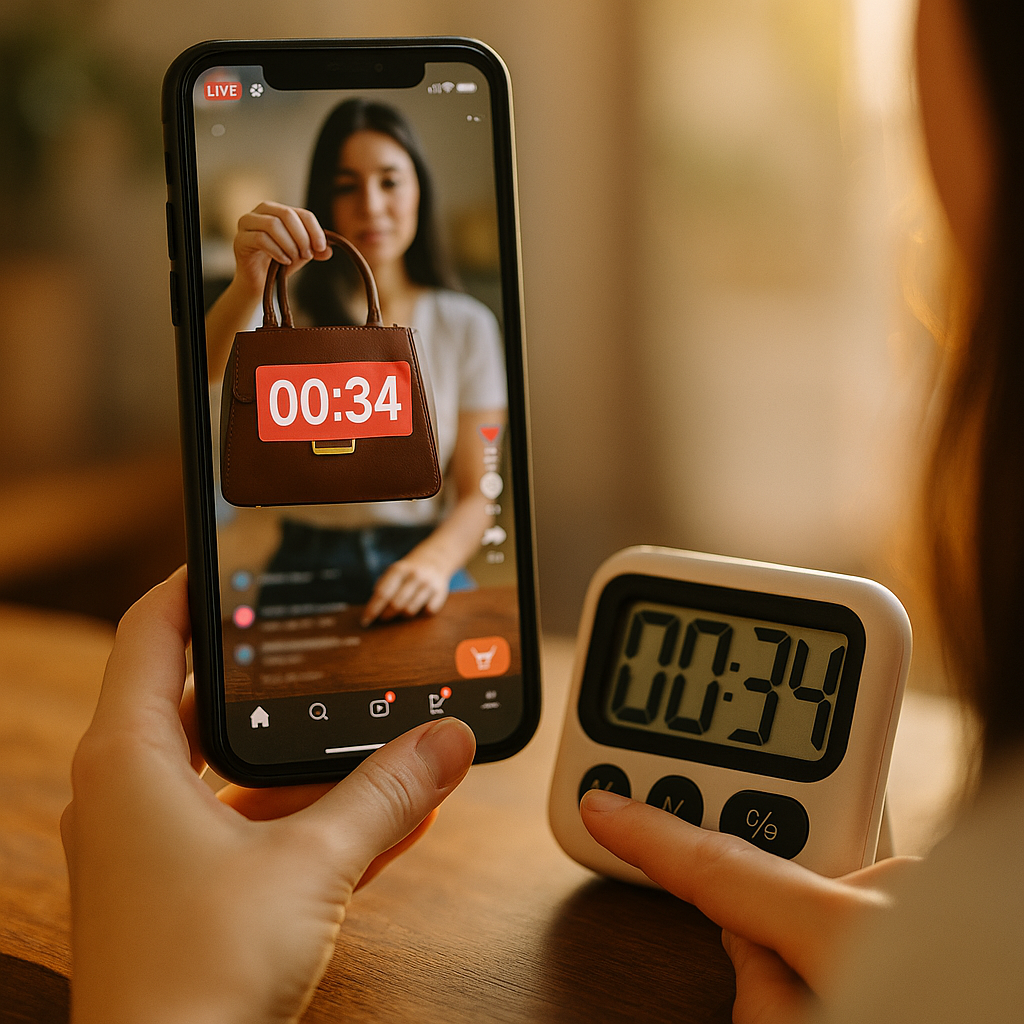
Sixty-two state attorney general inquiries into livestream shopping scarcity tactics landed in the last reporting cycle alone. A ticking clock on a TikTok Shop livestream isn’t just a UX nudge anymore — it’s a legal exhibit. Getting TikTok Shop livestream countdown timer disclosure language wrong can turn a routine sales tactic into a deceptive scarcity claim overnight.
Brands love countdown timers because they work. Conversion lifts of 20-30% during flash windows aren’t unusual. But regulators have caught up to the psychology, and TikTok’s own commerce infrastructure makes the compliance problem worse, not better.
Why Countdown Timers Became a Regulatory Flashpoint
Scarcity marketing isn’t new. Retailers have used “only 3 left” messaging since long before social commerce existed. What’s different with TikTok Shop livestreams is speed, scale, and repetition. A host can reset a countdown timer three or four times in a single two-hour stream, each time implying the deal is genuinely expiring. It usually isn’t.
The FTC has been explicit that scarcity claims must reflect reality. If a “limited time” offer restarts every 20 minutes with a fresh timer, that’s not urgency — that’s a manufactured illusion of urgency, and the agency treats it as a deceptive practice under Section 5 of the FTC Act. State AGs have piled on with parallel actions, particularly around livestream shopping formats where the ephemeral nature of the content makes enforcement harder but not impossible, since TikTok Shop streams are increasingly archived and searchable.
A countdown timer that resets without a genuine change in price, inventory, or offer terms is functionally a false urgency claim — regardless of how the disclosure language around it is worded.
We covered the enforcement trend in detail in TikTok Shop Countdown Timers Face State AG Crackdown, and the pattern hasn’t slowed. If anything, more state consumer protection offices have opened livestream-specific monitoring units since then.
The Core Tension: Disclosure Can’t Fix a False Claim
Here’s the mistake a lot of brand compliance teams make: they think a well-worded disclaimer can neutralize a scarcity claim that’s fundamentally untrue. It can’t. Disclosure language addresses material connection and sponsorship — it does not launder a false or misleading claim about inventory or time limits. These are two separate compliance obligations, and TikTok Shop livestreams force brands to handle both simultaneously, in real time, with no editing pass.
That’s the structural problem. A blog post gets reviewed before publishing. A livestream doesn’t. The host is talking, the timer is ticking, and legal has no chance to intervene mid-sentence.
What Accurate Disclosure Language Actually Requires
Assuming the scarcity claim itself is true — genuine limited inventory, an actual time-boxed discount — the disclosure structure still needs to meet FTC clarity standards. The agency’s endorsement guidance (see ftc.gov) requires disclosures to be clear, conspicuous, and understood by an ordinary consumer without having to hunt for them.
For countdown timers specifically, that means addressing three things at once:
- Sponsorship/material connection — is the host being paid, gifted product, or given commission on sales during this stream?
- Scarcity accuracy — is the timer tied to a real, verifiable inventory count or price change, not a recurring promotional loop?
- Timing of disclosure — does the disclosure appear before the purchase decision point, not buried after the CTA?
Most brands nail the first bullet and completely botch the second two. A pinned comment saying “#ad” at stream start doesn’t cover a scarcity claim made 40 minutes later when the timer resets. Disclosure has to be contextually tied to the claim, not just the stream as a whole.
Sample Structure That Holds Up
A defensible disclosure pattern for a TikTok Shop livestream countdown looks something like this, delivered verbally by the host and reinforced on-screen:
- Verbal cue at timer launch: “This discount is live for the next 15 minutes — after that the price goes back up, this isn’t a loop.”
- On-screen persistent text: “Sponsored — limited quantity, price valid until timer ends”
- Pinned comment refreshed at each new timer instance, not just once at stream start
Notice what’s missing from that list: legal jargon. Regulators don’t want a wall of text. They want plain language that an average TikTok Shop viewer — often scrolling on a phone, half-paying-attention — would actually register.
Where the TikTok Branded Content Toggle Falls Short
A lot of brand teams assume flipping on TikTok’s built-in branded content toggle handles disclosure obligations entirely. It doesn’t. That toggle signals a commercial relationship to the platform’s algorithm and adds a small label. It does nothing to address the accuracy of scarcity claims made during the stream, and it doesn’t satisfy the FTC’s “clear and conspicuous” bar on its own.
We broke this down at length in TikTok Branded-Content Toggle Is Not FTC Compliance. The short version: the toggle is a platform feature, not a legal shield. Brands that treat it as full compliance are exposed the moment a state AG or the FTC pulls stream archives.
This gap becomes especially dangerous with countdown timers because the toggle is static — set once — while the timer-driven scarcity claim is dynamic, repeating throughout the broadcast. One disclosure event cannot cover multiple distinct claims made over a two-hour stream.
Building the Compliance Workflow Before the Stream Starts
Because livestreams can’t be edited after the fact, the entire compliance burden shifts to pre-production. That’s a different operating model than static post compliance, and a lot of brand marketing teams haven’t adjusted their workflows.
Practical steps that actually reduce risk:
- Script the disclosure trigger points, not just the opening disclaimer. Every time a timer resets or a new “deal” launches, the host needs a scripted verbal disclosure moment tied to that specific claim.
- Tie every timer to a real backend event. Inventory counts, price changes, or bundle swaps should be logged and time-stamped so the claim can be verified if challenged. If you can’t produce evidence the deal changed, don’t run a countdown implying it did.
- Brief hosts on FTC language, not just brand talking points. Many compliance failures trace back to creators improvising urgency language (“only a few left!”) without any backend truth behind it. This is the same script-control problem we detailed in line-by-line UGC script approval risk analysis — tight control cuts both ways legally, but loose control on scarcity claims is worse.
- Archive the full stream with timestamps. If regulators request records, brands need the raw footage, not a highlight reel. TikTok Shop’s own seller tools retain some data, but brands should keep independent archives too.
- Cross-check contract language with creators. Contracts should specify who’s liable if a host ad-libs a false scarcity claim outside the approved script. This ties directly into broader creator contract audit practices ahead of renewal cycles.
Notice the throughline: disclosure language is only as good as the operational truth behind it. You can write a perfect sentence and still be liable if the inventory count it references is fictional.
The Livestream-Specific Disclosure Clash
There’s a deeper structural conflict here that we’ve flagged before: FTC disclosure rules were largely written with static or semi-static content in mind, while TikTok Shop’s countdown timer feature is designed for repeated, rapid-fire urgency triggers. Our analysis in FTC Livestream Disclosure Rules Clash With TikTok Countdown Timers goes deeper into why the platform mechanic itself is somewhat at odds with clear-and-conspicuous standards, regardless of how careful brands try to be.
This isn’t a reason to avoid the format. Livestream shopping is too valuable a channel to walk away from — TikTok Shop drove billions in GMV last year, and platforms like TikTok’s ad platform keep investing in commerce features. It’s a reason to build tighter internal controls before your next campaign, not after a cease-and-desist letter.
Cross-Border Complications for Global Brands
If your livestream airs to audiences beyond the US, the compliance math gets more complicated. The UK’s Advertising Standards Authority and the EU’s Digital Services Act frameworks impose their own scarcity and disclosure standards, and they don’t always align neatly with FTC guidance. A countdown structure that clears US review might still fail under UK data and advertising standards or DSA transparency requirements.
Brands running simultaneous or cross-market livestreams should reference a standing comparison framework — we maintain one in Cross-Border Disclosure Matrix for FTC, ASA, and DSA Rules — rather than trying to reconcile three regulatory regimes live, mid-stream, with a host who has ten seconds to read a script cue.
What This Means for Budget and Risk Owners
For brand marketers, this isn’t just a legal footnote. Countdown timer mismanagement carries real budget exposure: FTC penalties, state AG settlements, and — often underestimated — the reputational cost of a viral “gotcha” clip showing a timer resetting for the fourth time in one stream. Consumer trust research from firms like eMarketer consistently shows scarcity fatigue eroding purchase intent when shoppers sense manipulation, independent of any regulatory action.
Treat disclosure language as a risk-mitigation line item with a real budget, not an afterthought handled by whoever’s free the day of the stream. Legal review, host briefing time, and backend inventory verification all cost money and time. Build that into the livestream production budget the same way you’d budget for a producer or a camera operator.
The brands getting this right are the ones running compliance and commerce teams in the same room during pre-production, not in sequence after the fact.
Next Step
Audit your last three TikTok Shop livestreams: pull the archived footage, count how many times the countdown timer reset, and check whether each reset was tied to a documented, verifiable change in price or inventory. If you can’t produce that evidence today, fix the backend process before you write another disclosure script.
FAQs
Does adding a disclosure disclaimer make a countdown timer legally safe?
No. Disclosure addresses sponsorship and material connection. It does not fix a scarcity claim that’s false or exaggerated. If the timer resets without a real change in inventory or price, no disclosure language cures that underlying deceptive practice.
Is TikTok’s branded content toggle enough for FTC compliance during livestreams?
No. The toggle signals a commercial relationship to the platform but doesn’t meet the FTC’s clear-and-conspicuous standard for individual claims made throughout a stream, especially repeated scarcity claims tied to countdown resets.
How often should a host repeat the disclosure during a livestream?
Disclosure should be tied to each distinct claim, not just stated once at the start. If a countdown timer resets and implies a new limited-time offer, that moment needs its own disclosure cue, verbal or on-screen.
What counts as proof that a countdown timer reflects a real offer?
Timestamped inventory logs, documented price changes, or verifiable bundle adjustments tied to the exact moment the timer launched or reset. Without that backend record, the claim is difficult to defend if challenged.
Do state attorneys general enforce this separately from the FTC?
Yes. Several state AG offices have opened independent inquiries into livestream scarcity tactics, often running parallel to or ahead of federal FTC action, particularly targeting TikTok Shop and similar livestream commerce formats.
FAQs
Does adding a disclosure disclaimer make a countdown timer legally safe?
No. Disclosure addresses sponsorship and material connection. It does not fix a scarcity claim that’s false or exaggerated. If the timer resets without a real change in inventory or price, no disclosure language cures that underlying deceptive practice.
Is TikTok’s branded content toggle enough for FTC compliance during livestreams?
No. The toggle signals a commercial relationship to the platform but doesn’t meet the FTC’s clear-and-conspicuous standard for individual claims made throughout a stream, especially repeated scarcity claims tied to countdown resets.
How often should a host repeat the disclosure during a livestream?
Disclosure should be tied to each distinct claim, not just stated once at the start. If a countdown timer resets and implies a new limited-time offer, that moment needs its own disclosure cue, verbal or on-screen.
What counts as proof that a countdown timer reflects a real offer?
Timestamped inventory logs, documented price changes, or verifiable bundle adjustments tied to the exact moment the timer launched or reset. Without that backend record, the claim is difficult to defend if challenged.
Do state attorneys general enforce this separately from the FTC?
Yes. Several state AG offices have opened independent inquiries into livestream scarcity tactics, often running parallel to or ahead of federal FTC action, particularly targeting TikTok Shop and similar livestream commerce formats.
Top Influencer Marketing Agencies
The leading agencies shaping influencer marketing in 2026
Agencies ranked by campaign performance, client diversity, platform expertise, proven ROI, industry recognition, and client satisfaction. Assessed through verified case studies, reviews, and industry consultations.
Moburst

-
2

The Shelf
Boutique Beauty & Lifestyle Influencer AgencyA data-driven boutique agency specializing exclusively in beauty, wellness, and lifestyle influencer campaigns on Instagram and TikTok. Best for brands already focused on the beauty/personal care space that need curated, aesthetic-driven content.Clients: Pepsi, The Honest Company, Hims, Elf Cosmetics, Pure LeafVisit The Shelf → -
3

Audiencly
Niche Gaming & Esports Influencer AgencyA specialized agency focused exclusively on gaming and esports creators on YouTube, Twitch, and TikTok. Ideal if your campaign is 100% gaming-focused — from game launches to hardware and esports events.Clients: Epic Games, NordVPN, Ubisoft, Wargaming, Tencent GamesVisit Audiencly → -
4

Viral Nation
Global Influencer Marketing & Talent AgencyA dual talent management and marketing agency with proprietary brand safety tools and a global creator network spanning nano-influencers to celebrities across all major platforms.Clients: Meta, Activision Blizzard, Energizer, Aston Martin, WalmartVisit Viral Nation → -
5

The Influencer Marketing Factory
TikTok, Instagram & YouTube CampaignsA full-service agency with strong TikTok expertise, offering end-to-end campaign management from influencer discovery through performance reporting with a focus on platform-native content.Clients: Google, Snapchat, Universal Music, Bumble, YelpVisit TIMF → -
6

NeoReach
Enterprise Analytics & Influencer CampaignsAn enterprise-focused agency combining managed campaigns with a powerful self-service data platform for influencer search, audience analytics, and attribution modeling.Clients: Amazon, Airbnb, Netflix, Honda, The New York TimesVisit NeoReach → -
7

Ubiquitous
Creator-First Marketing PlatformA tech-driven platform combining self-service tools with managed campaign options, emphasizing speed and scalability for brands managing multiple influencer relationships.Clients: Lyft, Disney, Target, American Eagle, NetflixVisit Ubiquitous → -
8

Obviously
Scalable Enterprise Influencer CampaignsA tech-enabled agency built for high-volume campaigns, coordinating hundreds of creators simultaneously with end-to-end logistics, content rights management, and product seeding.Clients: Google, Ulta Beauty, Converse, AmazonVisit Obviously →