


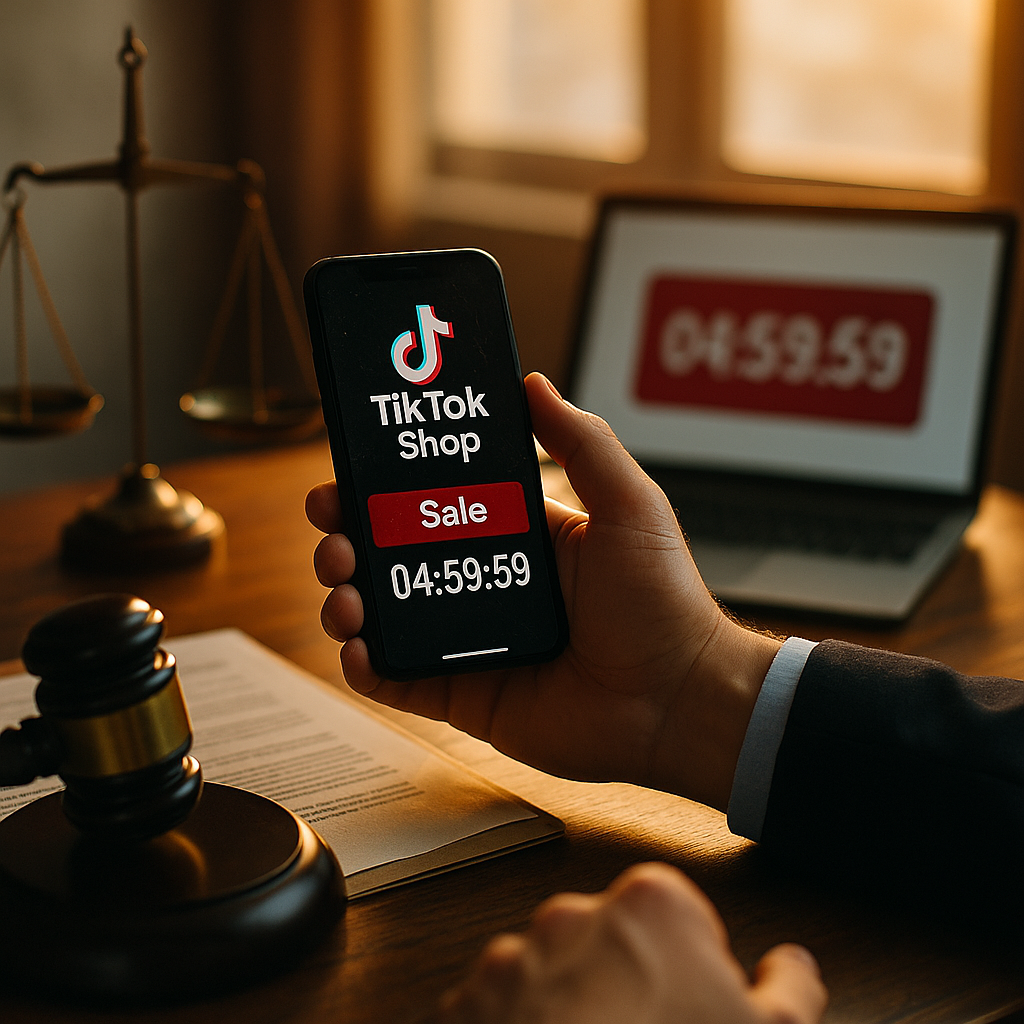
Forty-two state attorneys general have signed onto multistate task forces targeting “dark pattern” urgency tactics since last year — and TikTok Shop’s ubiquitous countdown timer is squarely in the crosshairs. If your brand runs livestream shopping events without a state-specific compliance review, you’re gambling with regulators who no longer wait for the FTC to act first. Heading into Q4, that gamble gets more expensive.
Countdown timers feel harmless. They’re baked into TikTok Shop’s native livestream UI, sitting right next to the “Buy Now” button, ticking down toward a discount expiration that may or may not be real. The problem: several states have decided that a fake or auto-resetting countdown timer is a textbook deceptive practice, regardless of whether TikTok or the brand configured it. And enforcement is no longer theoretical.
Why Countdown Timers Became a Legal Target
Urgency mechanics work. That’s precisely why regulators hate them. A ticking clock triggers scarcity bias, and TikTok Shop’s livestream format was practically engineered around that psychology — hosts verbally reinforce the timer (“only 4 minutes left at this price!”) while the on-screen graphic counts down. The trouble starts when that timer resets after expiring, or when the “sale price” reappears at the same level the next hour, the next day, or in the next livestream.
The FTC’s own guidance on dark patterns already flags false urgency and fake scarcity as unfair or deceptive acts under Section 5. But state consumer protection statutes — many modeled on “Unfair and Deceptive Acts and Practices” (UDAP) laws — often have lower evidentiary bars, private rights of action, or statutory damages that make them more attractive to plaintiffs’ attorneys than a federal complaint. That’s the shift brands need to understand: this isn’t just a Washington problem anymore.
A countdown timer that resets every stream isn’t urgency marketing — in a growing number of states, it’s a per-violation statutory damages claim waiting to be filed.
For background on how the FTC’s own disclosure framework intersects with TikTok’s native livestream tools, see our earlier breakdown of FTC livestream disclosure rules and TikTok countdown timers.
The State-by-State Landscape
Enforcement intensity varies wildly depending on where your customers — not your brand — are located. That’s the part legal teams keep getting wrong: TikTok Shop doesn’t localize disclosures by shipping address, but state UDAP statutes generally apply based on where the consumer resides, not where the seller is headquartered.
- California: The most aggressive posture by far. The California Consumer Protection Prosecutors Association has issued informal guidance treating auto-resetting countdown timers as a per se violation of the state’s Unfair Competition Law when the underlying discount doesn’t actually expire. Combined with California’s private right of action under the Consumers Legal Remedies Act, this is the highest-risk jurisdiction for livestream sellers in Q4.
- New York: The Attorney General’s office has folded countdown-timer scrutiny into its broader “dark patterns” enforcement initiative, which already covers subscription traps and drip pricing. Expect continued focus on repeat-offender brands rather than one-off livestream slip-ups.
- Texas: Took a narrower approach, focusing enforcement on health, beauty, and supplement categories where urgency tactics intersect with unsubstantiated product claims. A countdown timer alone likely won’t trigger a Texas DTPA action, but pair it with an aggressive health claim and you’ve got a two-front problem.
- Colorado: Notable because its state privacy law already requires clear disclosure around “dark patterns” in digital interfaces, giving the AG’s office a statutory hook that’s arguably broader than most states’ general consumer protection acts.
- Illinois and Washington: Both have signaled intent to follow California’s lead but haven’t issued formal guidance yet. Brands running high volume in these states should treat Q4 as a preview of what’s coming, not a safe window.
- Florida: Comparatively quiet on countdown timers specifically, though its Deceptive and Unfair Trade Practices Act remains active against livestream sellers on unrelated disclosure failures — a reminder that a “quiet” state on one issue can still be aggressive on adjacent ones.
This patchwork means a single national livestream event can generate different legal exposure depending on where the viewer happens to be sitting. There’s no clean way to geofence a TikTok Shop live — which is exactly why compliance teams need to build for the strictest state, not the median one.
What Counts as “Deceptive” in Practice?
Regulators generally look at a cluster of factors rather than the timer alone:
- Does the discount actually expire? If the same price reappears in the next stream, the timer misrepresented urgency.
- Is the timer tied to real inventory? “Only 12 left” claims that don’t reflect actual stock levels are a separate but related violation in most states.
- Who controls the reset? Brands often assume TikTok’s platform tooling insulates them from liability. It doesn’t. If the brand configured the promotion parameters or approved the script that reinforced the timer verbally, liability generally follows the party that benefited from the sale — meaning you, not the platform.
- Was the urgency disclosed as promotional, not factual scarcity? This is the subtle one. A host saying “prices go up after this” when they don’t is a factual misrepresentation, not an ad puffery.
The overlap with existing FTC guidance is intentional. Most state AG offices are explicitly citing FTC dark-pattern enforcement actions as precedent, which means brands that already built compliance frameworks around federal guidance have a head start — but shouldn’t assume federal compliance equals state compliance. For a broader operational checklist, our TikTok Shop livestream selling legal checklist covers the baseline controls most legal teams are missing.
The Host Script Problem
Here’s where most brands get exposed without realizing it. TikTok Shop hosts — whether in-house talent or contracted creators — routinely ad-lib urgency language that goes well beyond what any timer graphic shows. “This is literally the lowest it’ll ever be” is a claim, not a vibe. If that claim is false, it’s potentially actionable regardless of what the countdown widget says.
That’s why script approval and disclosure documentation matter more this quarter than ever. Brands that pre-approve host talking tracks — and retain records of what was actually said, not just what was scripted — have a defensible position if a state AG comes knocking. Brands that let hosts improvise urgency claims live, with no record of what was said, are building their own liability case in real time.
We’ve covered the documentation angle from an FTC lens in FTC liability risks of line-by-line UGC script approval, and the state-level exposure runs largely parallel: courts and regulators want to see intent, and intent is easiest to prove — or disprove — through documentation.
Building a Compliance Framework That Survives Multistate Scrutiny
Waiting for a uniform federal standard is not a strategy. Here’s what’s actually working for brands running high-volume TikTok Shop programs right now:
- Timer-to-inventory reconciliation. Tie every countdown promotion to a real, auditable inventory or pricing change. If the price genuinely reverts after the stream, document it with timestamped pricing logs.
- Host disclosure scripts with fallback language. Give hosts pre-approved urgency phrasing that’s true regardless of outcome (“this is today’s live price”) rather than absolute claims (“lowest ever,” “never again”).
- State-tiered legal review. Treat California and Colorado as your baseline compliance standard, not your worst-case scenario. If your promotion clears those two, you’re in reasonable shape almost everywhere else.
- Recorded stream retention. Keep full unedited recordings of every livestream for at least the length of your state’s longest applicable statute of limitations, typically two to four years for UDAP claims.
- Vendor and MCN contract audits. If you’re outsourcing livestream production, your contracts need indemnification language that accounts for state-level dark-pattern claims specifically, not just generic FTC compliance boilerplate. Our piece on indemnification clauses for creator contracts is a useful starting template.
For a more granular walk-through of timer-specific controls, the TikTok Shop countdown timer compliance checklist breaks down the operational steps by campaign stage.
What Happens If You Ignore This
Penalties vary, but the trend line is upward. California’s per-violation UCL penalties can run into five figures when multiplied across viewers or transactions during a single livestream — and multistate coordination means a single complaint can trigger simultaneous inquiries from several AG offices at once. According to FTC enforcement data, dark-pattern-related actions have grown steadily as a share of total consumer protection cases, and state offices are increasingly filing parallel actions rather than waiting for federal resolution. Industry trend data from eMarketer also shows livestream commerce continuing to scale into Q4, which means volume — and exposure — keeps climbing right alongside it.
None of this requires panic. It requires a real audit, done before your next livestream event, not after a demand letter arrives.
Compliance teams should also loop in whoever manages influencer contracts generally — the Sprout Social research on livestream shopping engagement is a useful benchmark for understanding just how much viewer volume, and therefore liability exposure, a single event can generate.
Next Step
Run every planned Q4 livestream promotion through a California-standard compliance filter first — if the countdown timer and host script survive that scrutiny, they’ll likely hold up in every other state, but confirm it against your actual shipping-address data rather than assumptions about where your audience lives.
FAQs
Is a countdown timer on TikTok Shop illegal?
Not inherently. A countdown timer becomes a legal risk when it misrepresents actual urgency — for example, when a “limited-time” discount reappears at the same price in a later stream, or when stated inventory levels don’t match reality.
Which states are most aggressive on countdown-timer enforcement?
California and Colorado currently lead, backed by strong consumer protection statutes and, in Colorado’s case, privacy law provisions that explicitly address dark patterns. New York has folded the issue into a broader dark-patterns initiative, while Illinois and Washington appear likely to follow.
Is TikTok liable for deceptive timers, or is the brand?
Liability generally follows the party that configures the promotion and benefits from the sale — typically the brand or seller, not TikTok as the platform. Brands should not assume platform-native tools shield them from state consumer protection claims.
Does host ad-libbing during a livestream create separate liability?
Yes. Verbal urgency claims made by a host (“lowest price ever”) can be independently actionable even if the on-screen timer is accurate, particularly if the claim is factually false.
How long should brands retain livestream recordings for compliance purposes?
Most legal teams recommend retaining full, unedited recordings for two to four years, aligning with the statute of limitations for UDAP claims in the strictest applicable state.
Does FTC compliance automatically satisfy state law requirements?
No. State consumer protection statutes often have lower evidentiary thresholds or private rights of action that exceed FTC standards. Brands should treat federal compliance as a floor, not a ceiling.
Top Influencer Marketing Agencies
The leading agencies shaping influencer marketing in 2026
Agencies ranked by campaign performance, client diversity, platform expertise, proven ROI, industry recognition, and client satisfaction. Assessed through verified case studies, reviews, and industry consultations.
Moburst

-
2

The Shelf
Boutique Beauty & Lifestyle Influencer AgencyA data-driven boutique agency specializing exclusively in beauty, wellness, and lifestyle influencer campaigns on Instagram and TikTok. Best for brands already focused on the beauty/personal care space that need curated, aesthetic-driven content.Clients: Pepsi, The Honest Company, Hims, Elf Cosmetics, Pure LeafVisit The Shelf → -
3

Audiencly
Niche Gaming & Esports Influencer AgencyA specialized agency focused exclusively on gaming and esports creators on YouTube, Twitch, and TikTok. Ideal if your campaign is 100% gaming-focused — from game launches to hardware and esports events.Clients: Epic Games, NordVPN, Ubisoft, Wargaming, Tencent GamesVisit Audiencly → -
4

Viral Nation
Global Influencer Marketing & Talent AgencyA dual talent management and marketing agency with proprietary brand safety tools and a global creator network spanning nano-influencers to celebrities across all major platforms.Clients: Meta, Activision Blizzard, Energizer, Aston Martin, WalmartVisit Viral Nation → -
5

The Influencer Marketing Factory
TikTok, Instagram & YouTube CampaignsA full-service agency with strong TikTok expertise, offering end-to-end campaign management from influencer discovery through performance reporting with a focus on platform-native content.Clients: Google, Snapchat, Universal Music, Bumble, YelpVisit TIMF → -
6

NeoReach
Enterprise Analytics & Influencer CampaignsAn enterprise-focused agency combining managed campaigns with a powerful self-service data platform for influencer search, audience analytics, and attribution modeling.Clients: Amazon, Airbnb, Netflix, Honda, The New York TimesVisit NeoReach → -
7

Ubiquitous
Creator-First Marketing PlatformA tech-driven platform combining self-service tools with managed campaign options, emphasizing speed and scalability for brands managing multiple influencer relationships.Clients: Lyft, Disney, Target, American Eagle, NetflixVisit Ubiquitous → -
8

Obviously
Scalable Enterprise Influencer CampaignsA tech-enabled agency built for high-volume campaigns, coordinating hundreds of creators simultaneously with end-to-end logistics, content rights management, and product seeding.Clients: Google, Ulta Beauty, Converse, AmazonVisit Obviously →