


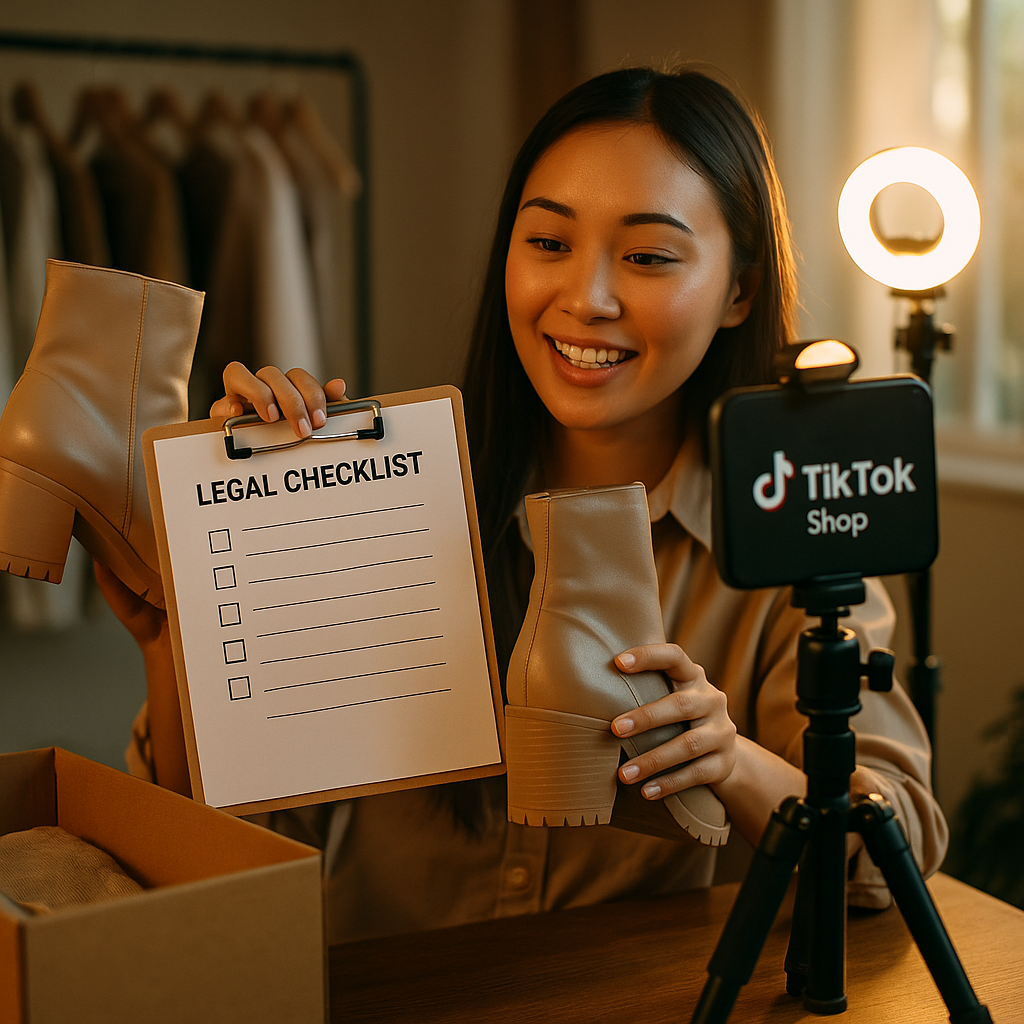
One unapproved supplement claim, spoken live, unscripted, to 40,000 viewers — that’s all it takes to trigger an FTC inquiry. TikTok Shop livestream selling in regulated categories like supplements and financial products has no delete button, no editing window, and increasingly, no patience from regulators. A TikTok Shop livestream selling legal checklist isn’t a nice-to-have anymore. It’s the difference between a profitable channel and a shutdown notice.
Brands treat livestream commerce like an extension of their UGC program. It isn’t. The stakes, speed, and liability profile are different, and regulated categories amplify all three.
Why Livestream Selling Breaks Your Existing Compliance Playbook
Most brand compliance workflows are built around pre-recorded content. Script gets written. Legal reviews it. Creator films it. Brand approves the final cut before it goes live. That entire sequence assumes you have time between creation and publication.
Livestream selling collapses that timeline to zero. The creator is talking, selling, and answering audience questions in real time, with no review layer between their mouth and your brand’s liability exposure. A creator hyping a supplement’s “clinically proven” fat-loss effects, or a fintech affiliate promising “guaranteed returns” during a Q&A tangent, creates the exact kind of unsubstantiated claim the FTC has been aggressively pursuing.
Livestream commerce removes the one thing legal teams rely on most: time to review before publish. Your checklist has to compensate for that gap before the stream ever starts.
This is why a pre-launch checklist matters more here than almost anywhere else in influencer marketing. You’re not reviewing content after the fact. You’re engineering the conditions that prevent violations from happening live.
Start With Category-Specific Regulatory Mapping
Supplements and financial products don’t just fall under FTC advertising rules. They carry category-specific obligations that most general influencer contracts never address.
- Supplements: FDA structure/function claim limits, DSHEA disclaimer requirements, and FTC substantiation standards for health claims all apply simultaneously. A creator saying a product “cures anxiety” or “eliminates inflammation” during a livestream is a structure/function violation and an FTC substantiation problem in one sentence.
- Financial products: Depending on the product, you may be dealing with SEC advertising rules, CFPB guidance on financial influencers (“finfluencers”), and state-level lending or securities disclosure laws. Promising guaranteed returns or downplaying risk during a live Q&A can trigger securities law issues, not just advertising ones.
Your checklist’s first section should map every regulatory body with jurisdiction over the category, not just the FTC. Legal teams that only check FTC guidance are missing half the exposure. For a broader look at how substantiation standards apply across UGC formats, see our breakdown of FTC substantiation standards for before-and-after claims, which translates directly to live product demos.
Pre-Approve Language, Not Just Talking Points
Bullet-point talking points are useless in livestream selling. Creators paraphrase under pressure, especially when viewer comments are flying and sales numbers are climbing. Paraphrasing regulated claims is where things go wrong.
Instead, build an approved-phrase library specific to each SKU. Not “you can say the product supports energy,” but the exact sentence: “This product contains caffeine and B-vitamins, which may support energy levels as part of a balanced diet.” Word-for-word. No room for creative interpretation.
For financial products, this matters even more. “This investment historically performs well” is a different legal animal than “past performance doesn’t guarantee future results, and this product carries risk of loss.” One sentence invites an SEC inquiry. The other is standard disclosure language creators often skip because it’s clunky and kills momentum.
Run a live rehearsal before the actual stream. Not a script read-through — an actual mock livestream with a producer playing hostile commenter, asking “does this guarantee I’ll make money?” or “will this cure my thyroid issue?” If your creator doesn’t have a pre-approved deflection ready, you’re not ready to go live.
Disclosure Placement Rules Are Different in Real Time
FTC guidance requires material connection disclosures to be clear, conspicuous, and hard to miss — ideally in the first few seconds of content, not buried in a bio or a pinned comment nobody scrolls to. Livestreams complicate this because viewers join mid-stream constantly. Someone tuning in twenty minutes into a two-hour session never sees your opening disclosure.
Best practice for regulated categories: recurring verbal and on-screen disclosures, repeated every 10-15 minutes throughout the stream, not just once at the start. TikTok’s Shop interface allows persistent on-screen badges, and brands should require creators to use them for the full stream duration, not just the opening segment.
This lines up with the FTC’s broader stance on first-line disclosure placement, which we’ve covered in detail in our piece on first-line disclosure rules forcing contract rewrites across the industry. Livestream selling just raises the stakes because there’s no “first line” that every viewer sees.
The Countdown Timer and Urgency-Tactic Trap
Regulated category livestreams love urgency mechanics: countdown timers, “only 12 left,” flash pricing. These tactics aren’t automatically illegal, but layered onto supplement or financial claims, they create a compounding risk. A false scarcity claim combined with an unsubstantiated health claim gives regulators two violations for the price of one investigation.
If your brand uses TikTok Shop’s countdown and urgency features during regulated livestreams, audit them against actual inventory and actual pricing history. Fabricated urgency is a separate FTC violation from the product claims themselves, and it’s often the easier one to prove. We’ve built a full framework for this in our countdown timer compliance checklist, which should be a mandatory add-on to any regulated-category launch plan.
Vet the Creator’s Contract Before the Product’s Claims
A lot of brands build claims-review checklists and forget the contractual layer underneath. Who’s actually liable if a creator goes off-script mid-stream? What happens if TikTok flags the livestream and pulls it mid-broadcast? Does your indemnification clause cover unscripted statements, or only pre-approved scripted content?
These questions need answers before launch, not after a violation notice. Build contract language that explicitly addresses live, unscripted statements as a distinct risk category from pre-recorded UGC. General influencer agreements often only cover “content,” a term that’s ambiguous when applied to two hours of continuous live speech.
Our guide on script approval depth and material connection liability is worth reviewing here, since livestream contracts need to specify what level of deviation from approved language triggers brand liability versus creator liability.
Merchant Verification and Entity Name Accuracy
This sounds administrative, but it’s a real failure point. TikTok Shop requires accurate merchant entity information, and mismatches between the legal entity selling the product and the entity named in disclosures or on the storefront have caused real compliance headaches, especially for supplement brands operating through multiple LLCs or white-label arrangements.
Before any regulated-category livestream, confirm:
- The TikTok Shop merchant account matches the FDA-registered facility or the entity named on supplement labels
- Financial product sellers are properly licensed in every state where the livestream is accessible (a genuinely difficult problem given TikTok’s national reach)
- Any name mismatch between storefront, disclosures, and legal paperwork is resolved before launch, not discovered during a Q4 verification sweep
We covered this exact issue in our entity name mismatch checklist, and it’s become more relevant as TikTok tightens merchant verification standards heading into each quarterly review cycle, a trend also flagged in our Q4 merchant verification checklist.
Build a Real-Time Kill Switch
Every regulated-category livestream needs a designated compliance monitor watching the stream live, with the authority to end it immediately if a creator makes a claim that crosses the line. Not “flag it for review after.” End it. Right then.
This requires:
- A live monitor with direct communication access to the creator (earpiece, chat, whatever works) during the entire broadcast
- Pre-agreed trigger phrases that mean “stop talking about that topic now”
- Authority to pull the stream from the brand side if TikTok’s own moderation doesn’t catch it first
- A documented incident log for every intervention, which becomes critical evidence of good-faith compliance effort if regulators ever come asking
Brands skip this step constantly because it feels like overkill for a “routine” sales livestream. It isn’t overkill. It’s the only real-time safeguard you have once the stream goes live, according to industry guidance from the FTC on advertising substantiation, which applies regardless of content format or duration.
Data Collection During Livestream Checkout
Financial product livestreams especially tend to collect sensitive information in real time, through comments, DMs, or in-app forms triggered by the livestream shop flow. Regulated categories mean this data collection needs its own review layer, separate from product claims.
Apply the same data minimization principles used in affiliate programs. If you haven’t audited what your livestream checkout flow actually collects and retains, start with our data minimization framework, which applies directly to livestream shop integrations collecting checkout and contact data in real time.
According to recent eMarketer data, livestream shopping continues to grow as a share of social commerce revenue in the US, which means regulatory attention on the format is only going to intensify, not fade.
The Pre-Launch Checklist, Condensed
If you’re building this from scratch, the core sequence looks like this: map every applicable regulatory body for the category, build a word-for-word approved phrase library, rehearse live objection handling, implement recurring on-screen disclosures, audit urgency tactics against real inventory, tighten contract language for unscripted liability, verify merchant entity accuracy, staff a live compliance monitor with kill-switch authority, and audit your data collection flow separately from content claims.
Skip any one of these and you’re not running a checklist. You’re running a hope-based compliance strategy, and regulators don’t grade on hope.
Frequently Asked Questions
What makes TikTok Shop livestream selling riskier than pre-recorded UGC for regulated categories?
Livestreams happen in real time with no review window before publication. Creators can make unscripted claims about supplements or financial returns that violate FTC, FDA, or SEC rules instantly, with no opportunity for brand approval before the statement reaches viewers.
Do disclosure requirements change for livestream content compared to standard TikTok posts?
Yes. Because viewers join at different points during a livestream, a single opening disclosure isn’t sufficient. Regulated-category livestreams should use recurring verbal and on-screen disclosures throughout the broadcast, not just at the start.
Who is liable if a creator makes an unapproved claim during a live broadcast?
Liability depends on contract language. Brands need agreements that explicitly address unscripted, live statements as a distinct risk category, separate from pre-approved scripted content, to clarify where creator liability ends and brand liability begins.
Can urgency tactics like countdown timers create additional legal risk in regulated categories?
Yes. Fabricated scarcity or urgency claims are a separate FTC violation from product claims. When combined with unsubstantiated supplement or financial claims, they compound a brand’s regulatory exposure rather than offsetting it.
What’s the single most important safeguard for a regulated-category livestream?
A live compliance monitor with real-time kill-switch authority. Post-broadcast review is too late for livestream content, so the only effective safeguard is the ability to stop the stream the moment a violation occurs.
Next step: Pull your last three livestream scripts and check whether any regulated claim was paraphrased rather than delivered word-for-word. If the answer is yes, your checklist has a gap that needs closing before your next broadcast, not after.
Frequently Asked Questions
What makes TikTok Shop livestream selling riskier than pre-recorded UGC for regulated categories?
Livestreams happen in real time with no review window before publication. Creators can make unscripted claims about supplements or financial returns that violate FTC, FDA, or SEC rules instantly, with no opportunity for brand approval before the statement reaches viewers.
Do disclosure requirements change for livestream content compared to standard TikTok posts?
Yes. Because viewers join at different points during a livestream, a single opening disclosure isn’t sufficient. Regulated-category livestreams should use recurring verbal and on-screen disclosures throughout the broadcast, not just at the start.
Who is liable if a creator makes an unapproved claim during a live broadcast?
Liability depends on contract language. Brands need agreements that explicitly address unscripted, live statements as a distinct risk category, separate from pre-approved scripted content, to clarify where creator liability ends and brand liability begins.
Can urgency tactics like countdown timers create additional legal risk in regulated categories?
Yes. Fabricated scarcity or urgency claims are a separate FTC violation from product claims. When combined with unsubstantiated supplement or financial claims, they compound a brand’s regulatory exposure rather than offsetting it.
What’s the single most important safeguard for a regulated-category livestream?
A live compliance monitor with real-time kill-switch authority. Post-broadcast review is too late for livestream content, so the only effective safeguard is the ability to stop the stream the moment a violation occurs.
Top Influencer Marketing Agencies
The leading agencies shaping influencer marketing in 2026
Agencies ranked by campaign performance, client diversity, platform expertise, proven ROI, industry recognition, and client satisfaction. Assessed through verified case studies, reviews, and industry consultations.
Moburst

-
2

The Shelf
Boutique Beauty & Lifestyle Influencer AgencyA data-driven boutique agency specializing exclusively in beauty, wellness, and lifestyle influencer campaigns on Instagram and TikTok. Best for brands already focused on the beauty/personal care space that need curated, aesthetic-driven content.Clients: Pepsi, The Honest Company, Hims, Elf Cosmetics, Pure LeafVisit The Shelf → -
3

Audiencly
Niche Gaming & Esports Influencer AgencyA specialized agency focused exclusively on gaming and esports creators on YouTube, Twitch, and TikTok. Ideal if your campaign is 100% gaming-focused — from game launches to hardware and esports events.Clients: Epic Games, NordVPN, Ubisoft, Wargaming, Tencent GamesVisit Audiencly → -
4

Viral Nation
Global Influencer Marketing & Talent AgencyA dual talent management and marketing agency with proprietary brand safety tools and a global creator network spanning nano-influencers to celebrities across all major platforms.Clients: Meta, Activision Blizzard, Energizer, Aston Martin, WalmartVisit Viral Nation → -
5

The Influencer Marketing Factory
TikTok, Instagram & YouTube CampaignsA full-service agency with strong TikTok expertise, offering end-to-end campaign management from influencer discovery through performance reporting with a focus on platform-native content.Clients: Google, Snapchat, Universal Music, Bumble, YelpVisit TIMF → -
6

NeoReach
Enterprise Analytics & Influencer CampaignsAn enterprise-focused agency combining managed campaigns with a powerful self-service data platform for influencer search, audience analytics, and attribution modeling.Clients: Amazon, Airbnb, Netflix, Honda, The New York TimesVisit NeoReach → -
7

Ubiquitous
Creator-First Marketing PlatformA tech-driven platform combining self-service tools with managed campaign options, emphasizing speed and scalability for brands managing multiple influencer relationships.Clients: Lyft, Disney, Target, American Eagle, NetflixVisit Ubiquitous → -
8

Obviously
Scalable Enterprise Influencer CampaignsA tech-enabled agency built for high-volume campaigns, coordinating hundreds of creators simultaneously with end-to-end logistics, content rights management, and product seeding.Clients: Google, Ulta Beauty, Converse, AmazonVisit Obviously →