


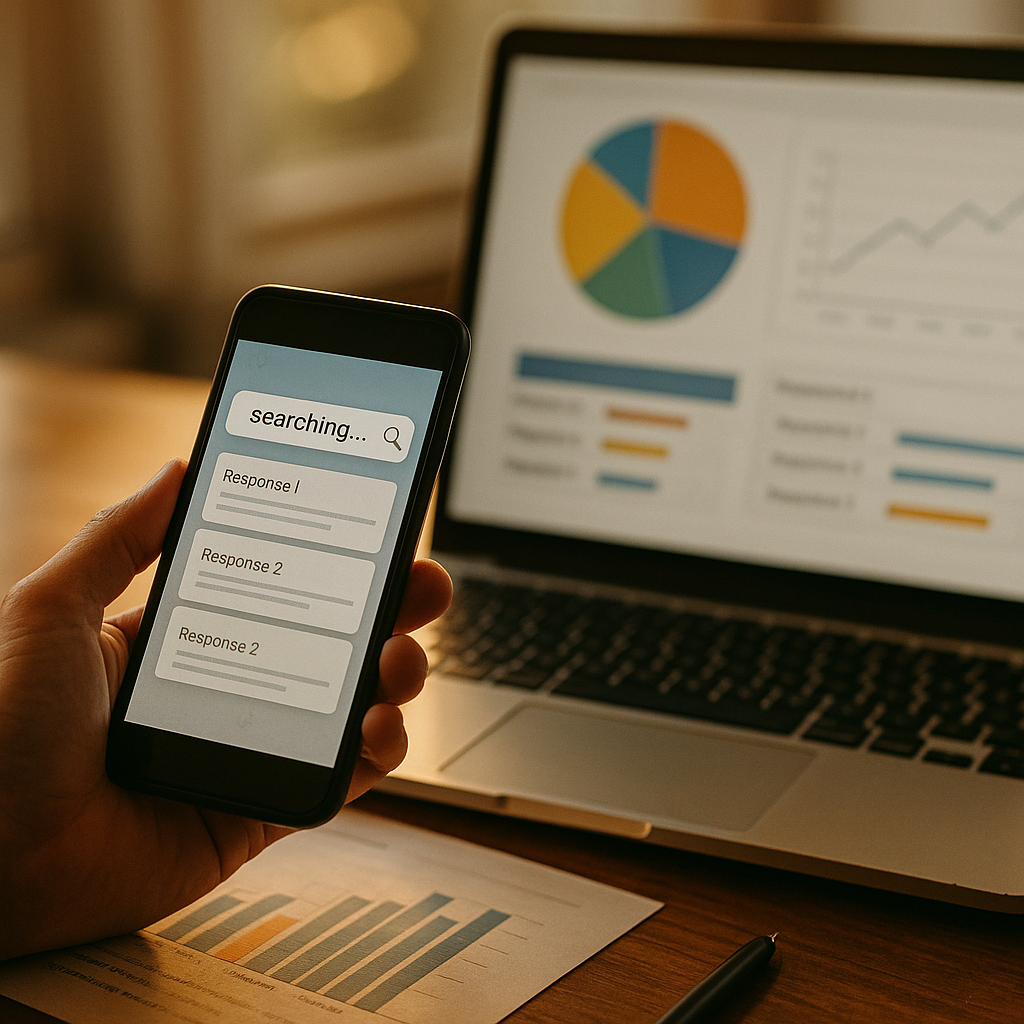
Zero clicks used to be a footnote in your analytics deck. Now it’s the whole story. Agentic search has turned Google from a list of ten links into an AI analyst that reads, synthesizes, and hands users a finished visual report before they ever see your website. If your campaign analysis workflow still assumes someone lands on a page, you’re measuring a funnel that’s quietly disappearing.
The Blue Link Was Already on Life Support
Let’s be honest: the ten blue links model has been dying for a while. AI Overviews softened it up. AI Mode delivered the gut punch. Now Google’s agentic search layer — the version that doesn’t just answer questions but performs multi-step research, compares options, and generates visual summaries — is closing the casket.
What’s new isn’t that Google summarizes information. It’s how it packages that summary. Instead of a wall of text with citations buried at the bottom, agentic search increasingly returns comparison tables, generated charts, product matrices, and structured visual breakdowns — synthesized from dozens of sources the user never sees individually. A search for “best influencer marketing platforms for beauty brands” doesn’t return a page of links anymore. It returns a rendered comparison grid, pros and cons pulled from multiple reviews, and a recommendation, all inside the search surface.
We covered the early tremors of this shift in how AI Mode kills blue links. The visual reporting layer is the next stage: it’s not just answering the query, it’s replacing the research phase entirely.
When Google’s AI generates the comparison chart itself, your brand’s inclusion — or exclusion — happens before a single click occurs. There is no page view to optimize. There is only the source data the model chose to trust.
Why “Visual Reporting” Changes the Math
Text-based AI Overviews were disruptive enough. Visual, agentic reporting is a different order of problem for marketers, for three reasons.
- Synthesis replaces citation. A traditional snippet quotes a source. A visual report restructures information into a new format — a table, a ranked list, a chart — meaning your brand’s data point gets absorbed into something Google authored, not something you published.
- Multi-step research compounds invisibility. Agentic search doesn’t run one query. It runs several in sequence, comparing sources, checking claims, refining the answer. Your content might get scraped in step two and never surface in the final visual output at all.
- Users trust the visual over the source. A clean comparison chart looks authoritative regardless of what’s underneath it. Few users scroll down to verify the underlying pages, which means brand perception is now shaped by how an AI agent chose to represent you, not by your own site design or messaging.
According to eMarketer, zero-click search behavior has been climbing steadily across major markets, and agentic formats accelerate that trend because the “answer” now includes visual proof, not just a paragraph. There’s no incentive left for the user to click through and check your homepage.
What This Does to Campaign Analysis Workflows
Here’s where it gets operationally messy. Most campaign analysis stacks were built around a simple assumption: traffic in, conversion out. Google Analytics, UTM parameters, last-click attribution — all of it depends on someone actually visiting a URL.
Agentic search breaks that chain at the source. If a prospective customer’s entire research journey — comparing brands, reading reviews, checking pricing — happens inside an AI-generated visual report, your traditional funnel metrics show nothing. No sessions, no page views, no attributed conversion path. Just a brand-aware customer who shows up ready to buy, or worse, ready to buy from a competitor because they were positioned better in the AI’s chart.
This is the same structural problem we flagged in AI marketing mix modeling replacing last-click attribution: when the customer journey goes dark inside a black-box research phase, click-based attribution simply stops being able to explain outcomes. Marketing mix modeling and incrementality testing become necessary, not optional.
Teams that have already built CRM-connected measurement frameworks are better positioned here, because they can tie eventual conversions back to brand lift and share-of-voice signals rather than session data that no longer exists.
Reporting Dashboards Need a New Layer
Campaign reporting used to answer: how many people saw this, clicked this, converted from this. Agentic search adds a prior question your dashboard probably can’t answer yet: was my brand even included in the AI’s synthesized answer, and how was it framed?
That requires a monitoring layer most martech stacks don’t have — one that tracks how brands appear inside AI-generated visual summaries, not just search rankings. Some answer engine optimization platforms have started building this capability, tracking citation frequency and sentiment inside AI Overviews and agentic responses. If you’re evaluating vendors here, our answer engine optimization platforms buyers guide and the more specific guide to evaluating AEO platforms for shopping citations are useful starting points before you sign anything.
Attribution Isn’t Dead. It’s Just Not Click-Based Anymore
Marketers keep saying “attribution is broken” like it’s a temporary glitch. It’s not broken — it’s being replaced by a model that doesn’t rely on clicks at all. That’s an uncomfortable adjustment for teams whose entire reporting cadence is built around Google Analytics dashboards and UTM-tagged links.
The practical shift looks like this:
- Shift budget justification from session-based ROI to brand visibility and share-of-model metrics.
- Track how often your brand, product, or spokesperson gets cited inside AI-generated comparisons versus competitors.
- Pair traditional web analytics with analytics platforms that trace spend to revenue using methods beyond last click, including media mix modeling and controlled holdout tests.
- Treat agentic search citation the way you’d treat earned media placement: valuable, hard to control directly, but influenceable through structured data, authoritative content, and consistent public signals.
None of this is theoretical. HubSpot’s own research on buyer behavior has repeatedly shown that B2B buyers complete a majority of their research before ever contacting a vendor. Agentic search just compresses and formalizes that dark-funnel behavior into a single AI-mediated session.
If your reporting deck still leads with “organic traffic,” you’re presenting last quarter’s problem. The board wants to know if your brand showed up in the answer, not whether someone clicked a link that no longer exists in the user’s workflow.
Where Agentic AI Fits Into the Broader Marketing Stack
Campaign analysis doesn’t happen in isolation from the rest of the agentic AI shift sweeping marketing operations. The same autonomous research capability that powers Google’s search agent is showing up in media buying, creative testing, and competitive intelligence tools. Teams are already using browser-based AI agents for competitive research — see our comparison of Dia vs Comet vs Copilot Vision — and the same logic applies to understanding how your brand appears in agentic search results: you need tools that can actually see what the AI sees, not just guess from keyword rankings.
This also intersects with governance questions. If agentic tools are making autonomous decisions about what to surface, cite, or recommend, marketers need the same oversight structures already being built for agentic AI marketing handoffs and agentic AI media-buying audits. The question “why did the AI recommend our competitor” deserves the same rigor as “why did the AI agent overspend on this campaign.”
Google itself has published guidance on how AI-generated search features work and how sites can remain eligible for inclusion; it’s worth reviewing Google’s Search Central documentation directly rather than relying on secondhand interpretations, since the guidance updates frequently as these features mature.
Practical Moves for the Next Two Quarters
You don’t need a full stack rebuild tomorrow. You need a prioritized list.
- Audit your citation footprint. Run your top ten commercial queries through Google’s AI Mode and note whether your brand appears, how it’s framed, and who it’s compared against.
- Structure your data for machine synthesis. Clear schema markup, well-organized comparison content, and clean factual claims make it easier for agentic crawlers to cite you accurately instead of paraphrasing you into irrelevance.
- Add brand-visibility metrics to your reporting cadence. Even a rough monthly snapshot of AI citation frequency beats having zero visibility into the fastest-growing research channel.
- Pressure-test vendor claims. If a measurement or AEO vendor claims to “track AI visibility,” ask for methodology. Sprout Social’s own research on social and search behavior trends is a useful benchmark for sanity-checking vendor data.
- Keep a human in the loop. Just as brands are building red-teams to stress-test creative (see AI red-teaming for ad creative), someone on your team should be regularly stress-testing how agentic search represents your brand versus competitors.
Frequently Asked Questions
What is agentic search, and how is it different from AI Overviews?
Agentic search refers to AI systems that perform multi-step research autonomously — running several queries, comparing sources, and synthesizing a final answer — rather than simply summarizing a single search result. AI Overviews typically generate a text summary for one query; agentic search can research a topic the way a human analyst would, then present findings as structured visual reports, comparisons, or recommendations.
Why does agentic search hurt traditional campaign attribution?
Traditional attribution relies on tracking clicks, sessions, and page visits. When research happens entirely inside an AI-generated report, the user never visits your site during the consideration phase, so there’s no session data to attribute. Conversions still happen, but the influence path becomes invisible to click-based tools, requiring brand-lift and mix-modeling approaches instead.
Can brands influence how they appear in agentic search visual reports?
Not directly, but structured data, clear factual content, consistent third-party citations, and authoritative comparison content all improve the odds of accurate representation. Think of it as earned media influence rather than paid placement: you can’t buy your way into the chart, but you can make your brand easier and safer for the model to cite correctly.
Should marketers stop tracking organic traffic altogether?
No. Organic traffic still matters for queries where users click through, but it’s no longer a complete picture of search-driven influence. Pair traffic metrics with AI citation tracking and incrementality testing to capture the full impact of search on brand consideration.
What tools exist for tracking brand visibility inside AI search results?
A growing category of answer engine optimization (AEO) platforms tracks citation frequency, sentiment, and positioning inside AI Overviews and agentic responses. Evaluate these carefully, since methodologies vary widely and the category is still maturing.
Agentic search didn’t kill the blue link out of spite. It killed it because users wanted answers, not homework. The brands that win from here treat AI citation tracking as seriously as they once treated keyword rankings, and rebuild campaign reporting around visibility and influence, not just clicks.
Frequently Asked Questions
What is agentic search, and how is it different from AI Overviews?
Agentic search refers to AI systems that perform multi-step research autonomously — running several queries, comparing sources, and synthesizing a final answer — rather than simply summarizing a single search result. AI Overviews typically generate a text summary for one query; agentic search can research a topic the way a human analyst would, then present findings as structured visual reports, comparisons, or recommendations.
Why does agentic search hurt traditional campaign attribution?
Traditional attribution relies on tracking clicks, sessions, and page visits. When research happens entirely inside an AI-generated report, the user never visits your site during the consideration phase, so there’s no session data to attribute. Conversions still happen, but the influence path becomes invisible to click-based tools, requiring brand-lift and mix-modeling approaches instead.
Can brands influence how they appear in agentic search visual reports?
Not directly, but structured data, clear factual content, consistent third-party citations, and authoritative comparison content all improve the odds of accurate representation. Think of it as earned media influence rather than paid placement: you can’t buy your way into the chart, but you can make your brand easier and safer for the model to cite correctly.
Should marketers stop tracking organic traffic altogether?
No. Organic traffic still matters for queries where users click through, but it’s no longer a complete picture of search-driven influence. Pair traffic metrics with AI citation tracking and incrementality testing to capture the full impact of search on brand consideration.
What tools exist for tracking brand visibility inside AI search results?
A growing category of answer engine optimization (AEO) platforms tracks citation frequency, sentiment, and positioning inside AI Overviews and agentic responses. Evaluate these carefully, since methodologies vary widely and the category is still maturing.
Top Influencer Marketing Agencies
The leading agencies shaping influencer marketing in 2026
Agencies ranked by campaign performance, client diversity, platform expertise, proven ROI, industry recognition, and client satisfaction. Assessed through verified case studies, reviews, and industry consultations.
Moburst

-
2

The Shelf
Boutique Beauty & Lifestyle Influencer AgencyA data-driven boutique agency specializing exclusively in beauty, wellness, and lifestyle influencer campaigns on Instagram and TikTok. Best for brands already focused on the beauty/personal care space that need curated, aesthetic-driven content.Clients: Pepsi, The Honest Company, Hims, Elf Cosmetics, Pure LeafVisit The Shelf → -
3

Audiencly
Niche Gaming & Esports Influencer AgencyA specialized agency focused exclusively on gaming and esports creators on YouTube, Twitch, and TikTok. Ideal if your campaign is 100% gaming-focused — from game launches to hardware and esports events.Clients: Epic Games, NordVPN, Ubisoft, Wargaming, Tencent GamesVisit Audiencly → -
4

Viral Nation
Global Influencer Marketing & Talent AgencyA dual talent management and marketing agency with proprietary brand safety tools and a global creator network spanning nano-influencers to celebrities across all major platforms.Clients: Meta, Activision Blizzard, Energizer, Aston Martin, WalmartVisit Viral Nation → -
5

The Influencer Marketing Factory
TikTok, Instagram & YouTube CampaignsA full-service agency with strong TikTok expertise, offering end-to-end campaign management from influencer discovery through performance reporting with a focus on platform-native content.Clients: Google, Snapchat, Universal Music, Bumble, YelpVisit TIMF → -
6

NeoReach
Enterprise Analytics & Influencer CampaignsAn enterprise-focused agency combining managed campaigns with a powerful self-service data platform for influencer search, audience analytics, and attribution modeling.Clients: Amazon, Airbnb, Netflix, Honda, The New York TimesVisit NeoReach → -
7

Ubiquitous
Creator-First Marketing PlatformA tech-driven platform combining self-service tools with managed campaign options, emphasizing speed and scalability for brands managing multiple influencer relationships.Clients: Lyft, Disney, Target, American Eagle, NetflixVisit Ubiquitous → -
8

Obviously
Scalable Enterprise Influencer CampaignsA tech-enabled agency built for high-volume campaigns, coordinating hundreds of creators simultaneously with end-to-end logistics, content rights management, and product seeding.Clients: Google, Ulta Beauty, Converse, AmazonVisit Obviously →