


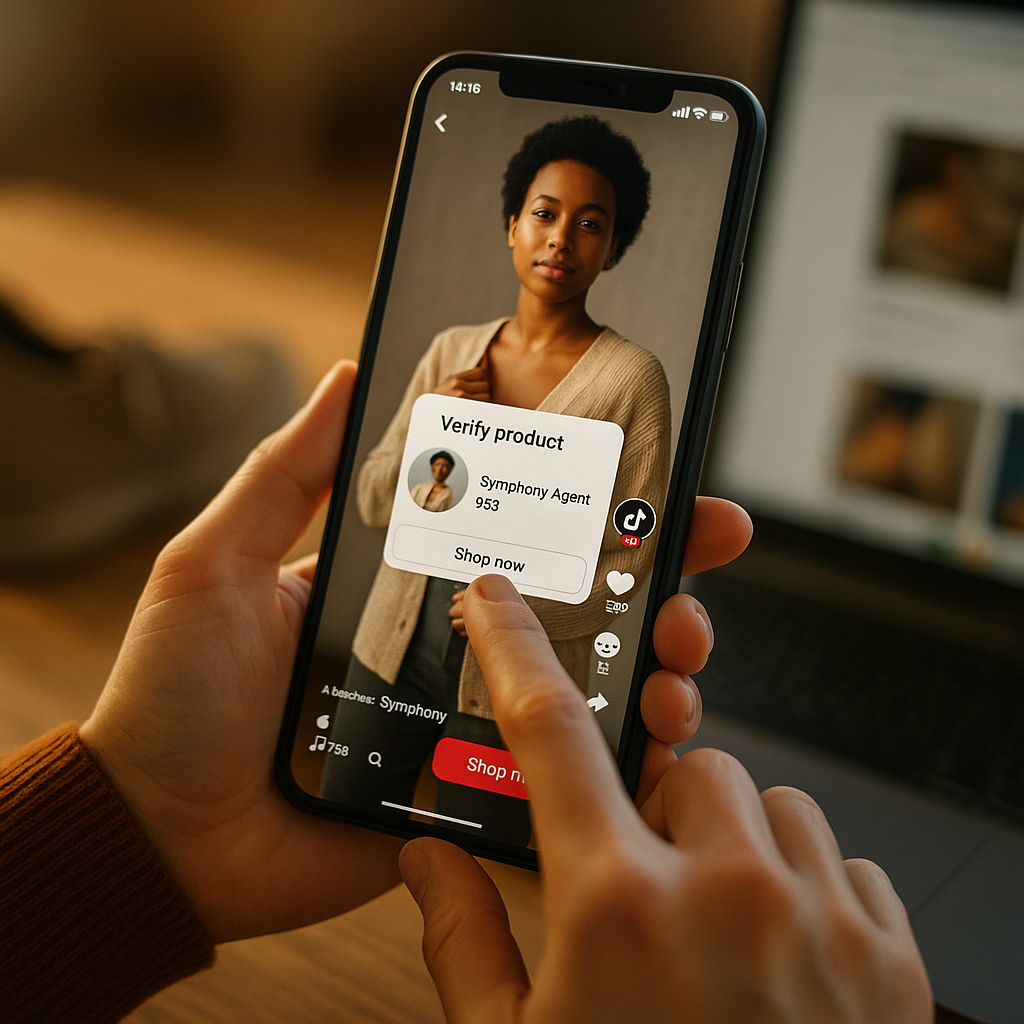
TikTok now claims its Symphony Agent can turn a single brand video into a fully shoppable ad in under five minutes. For a mid-market retail team running lean on production budget and even leaner on patience for manual catalog tagging, that sounds almost too good. The real question isn’t whether TikTok Symphony Agent works in a demo. It’s whether the conversion quality holds up once you’re running it across a few hundred SKUs, three regional teams, and a compliance department that doesn’t move at TikTok speed.
What Symphony Agent Actually Does
Symphony Agent is TikTok’s generative AI layer inside its broader Symphony creative suite. Feed it a brand video, a product feed, or even a static asset, and it outputs variations, ad copy, and — the feature under scrutiny here — automatic shoppable tagging that links on-screen products to your catalog for TikTok Shop or web checkout.
In practice, that means the agent scans video frames, identifies products (or attempts to), matches them against your product feed via image and metadata similarity, and inserts clickable overlays or product cards. No manual hotspot placement. No separate creative team briefing a video editor to sync timestamps with SKUs. TikTok positions it as a time-to-market play, and for brands with dozens of new drops a month, that pitch lands.
But automatic matching is only as good as the feed behind it. If your product data is messy, thin on attributes, or inconsistently categorized, the agent has to guess. And guessing at scale is where mid-market brands get burned, because unlike enterprise retailers, they rarely have a dedicated QA layer checking every auto-generated ad before it goes live.
Why Mid-Market Brands Are the Real Test Case
Enterprise retailers can afford a human-in-the-loop review of every AI-generated ad variant. Mid-market brands, typically running influencer and paid social with a team of three to eight people, cannot. That’s exactly why Symphony Agent’s promise matters more here than anywhere else in the market.
Consider the math. A brand spending $40,000 to $150,000 a month on TikTok, per benchmarks from eMarketer’s social ad spend data, doesn’t have the luxury of a 20-person creative ops team. If Symphony Agent genuinely cuts shoppable-ad production time from hours to minutes, the labor savings alone could fund additional test budget. That’s the efficiency case TikTok is selling.
The efficiency gain only counts if the conversion quality matches manual tagging. A faster ad that mis-tags products or breaks checkout flow isn’t a time save — it’s a returns and refund problem wearing a productivity costume.
Where the Feature Performs Well
- Simple, single-product videos: Unboxing-style or product demo content with one clear hero item tags accurately most of the time, since there’s no ambiguity for the model to resolve.
- Brands with clean, structured feeds: If your Shopify or catalog feed has strong image quality and complete attribute fields, matching accuracy improves noticeably. Garbage in, garbage out still applies to generative tagging.
- Speed on volume drops: Apparel and beauty brands launching frequent limited drops report the biggest time savings, since manual tagging previously created a bottleneck between content approval and ad live-date.
Where It Breaks Down
- Multi-product lifestyle content: Videos showing a full outfit or a tablescape with five products confuse the matching logic. Expect mis-tags or missed products, particularly with visually similar SKUs (same style, different colorway).
- Low-differentiation catalogs: Home goods and beauty brands with near-identical packaging across a product line see higher error rates. The agent can’t always tell a 30ml bottle from a 50ml one based on video alone.
- Regional or multi-market feeds: If your product feed varies by market (different SKUs, different pricing, different availability), the agent’s matching can pull the wrong regional variant into the ad, which creates a genuine compliance and pricing-accuracy issue.
None of this makes the feature useless. It makes it a tool that needs a review gate, not a set-it-and-forget-it pipeline. That distinction matters for how you staff around it.
The Compliance Angle Nobody’s Talking About Enough
Here’s the part that should worry brand and legal teams more than it currently does: auto-generated shoppable tags create a new surface area for pricing errors, availability mismatches, and — in regulated categories like supplements or financial products — potential disclosure gaps.
If Symphony Agent tags the wrong SKU and that SKU is out of stock or priced differently than shown, you’ve got a customer experience problem that can escalate to a FTC advertising compliance conversation faster than most marketing teams expect. The FTC has been explicit that deceptive pricing or availability claims don’t get a pass because “an AI did it.” Brand teams are still the accountable party.
This is the same category of risk we’ve flagged in brand-safety scanning tools coverage: automation that removes a manual step also removes a manual check. If your governance process hasn’t been updated to include a review pass on AI-tagged shoppable ads, you’re operating with a gap you probably don’t know exists yet.
Mid-market teams evaluating this feature should treat it the way they’d treat any new agentic tool touching live budget or live product data — with a kill-switch and a sign-off gate, not blind trust. Our AI agent kill-switch certification framework is a useful reference point for building that gate before launch, not after an incident.
Running the Numbers: Is the Time Savings Real?
TikTok’s internal claims (five minutes per shoppable ad conversion) sound impressive on a slide. But the comparison point matters. Five minutes versus what, exactly?
If your prior process was a designer manually placing hotspots in CapCut or a similar editor, then yes, five minutes versus 45 minutes is a legitimate efficiency win. If your prior process was already semi-automated through TikTok’s Shop catalog sync, the marginal gain shrinks considerably. Most mid-market teams fall somewhere in between: partially manual, partially templated.
A more honest framing: budget for Symphony Agent to save time on the first draft, not the final asset. Build in a review pass of roughly five to ten minutes per ad for a human to confirm SKU accuracy, pricing, and that the shoppable overlay doesn’t obscure key messaging or your creator’s face at a critical moment (a smaller issue, but one that affects click-through rate more than people assume).
Net time savings land closer to 15-20 minutes per ad once you factor in the review step, not the full 40 minutes TikTok’s messaging implies. Still a real win at volume. Just don’t build your Q1 headcount plan on the optimistic number.
A Practical Rollout Checklist
- Audit your product feed quality before testing the feature. Fix attribute gaps first; don’t blame the AI for your own data debt.
- Pilot on a single, low-risk product category before rolling out across the full catalog.
- Assign a named reviewer for every auto-tagged shoppable ad during the first 60-90 days. Don’t skip this to “save time” — that’s the exact false economy that creates compliance exposure.
- Track mis-tag rate as a formal KPI, not an anecdotal complaint. If it’s above 5-8%, the labor savings likely don’t offset the QA burden.
- Loop in legal or compliance for a one-time review of your disclosure language, especially if you sell in regulated categories.
This kind of structured evaluation isn’t unique to TikTok. It’s the same discipline we recommend across internal AI sandboxes for vendor tools generally — test small, measure error rates, then scale. Marketing teams that skip the pilot phase on agentic features tend to be the ones writing the incident post-mortems six months later.
How It Stacks Up Against Manual and Competitor Tools
Meta’s Advantage+ catalog ads and Google’s Performance Max both offer automated product tagging, but neither works directly from raw brand video the way Symphony Agent does. That’s a genuine differentiator, not marketing spin. Most competing tools require a structured feed-to-creative pipeline; TikTok’s version works from unstructured video input, which is a harder technical problem and explains why the error rate on complex scenes is still noticeably higher than feed-based systems.
For brands already running TikTok Ads Manager campaigns with Shop integration, testing Symphony Agent is low-friction: no new platform, no new contract, just a feature toggle. That lowers the evaluation cost considerably compared to bringing in a third-party AI creative vendor, where procurement and legal review alone can eat a quarter.
If your team is also evaluating broader creative-scoring or brand-compliance software to sit alongside this kind of generative tagging, it’s worth reviewing how those tools handle brand compliance scoring before adding another vendor to the stack. Overlapping tools that don’t talk to each other create more manual reconciliation work, not less.
One more consideration: attribution. If Symphony Agent-generated ads perform differently than manually tagged ones, you need your measurement stack to actually catch that distinction. That means tagging campaigns clearly at the ad-set level and checking how conversion data flows into your broader creator attribution stack before you scale spend based on early results.
Sprout Social’s research on social commerce trends consistently shows shoppable video outperforming static product ads on engagement, but engagement isn’t the same as accurate, compliant checkout. Keep those two metrics separate in your reporting.
Bottom line for mid-market teams: pilot Symphony Agent on a narrow, clean product set, keep a human reviewer in the loop for the first quarter, and track mis-tag rate alongside time savings before expanding budget. The feature is genuinely useful, not yet fully autonomous, and the gap between those two things is exactly where your operational risk sits.
FAQs
What is TikTok Symphony Agent’s shoppable ad conversion feature?
It’s an AI feature within TikTok’s Symphony creative suite that automatically converts brand video into shoppable ads by identifying products on screen and matching them to a brand’s product catalog, then inserting clickable overlays without manual tagging.
Is Symphony Agent accurate enough for mid-market retail brands to trust fully?
Not without a review step. Accuracy is strong for single-product, simple videos with clean product feeds, but drops noticeably with multi-product scenes, similar-looking SKUs, or inconsistent regional catalogs. Most mid-market teams should keep a human reviewer checking tags during the first several months of use.
Does using AI to auto-tag shoppable ads create compliance risk?
Yes, potentially. Mis-tagged pricing, availability, or product details can trigger deceptive advertising concerns under FTC guidance. Brands remain accountable for ad accuracy regardless of whether a human or an AI agent created the tagging.
How much time does Symphony Agent actually save compared to manual tagging?
TikTok’s marketing suggests conversion in around five minutes, but realistic net savings after factoring in a human QA review are closer to 15-20 minutes per ad versus a fully manual process, depending on how automated your prior workflow already was.
What product feed conditions improve Symphony Agent’s tagging accuracy?
Clean, high-resolution product images, complete attribute fields (color, size, SKU-level distinctions), and consistent catalog structure across markets all improve matching accuracy. Feeds with thin data or heavy visual similarity between SKUs see higher error rates.
How does Symphony Agent compare to Meta’s automated catalog ad tools?
Meta’s Advantage+ catalog ads and Google’s Performance Max rely on structured feed-to-creative pipelines, while Symphony Agent works from raw, unstructured brand video. That’s a harder technical task, which explains both its unique value and its higher error rate on complex scenes.
Visible FAQ (duplicate for schema)
Top Influencer Marketing Agencies
The leading agencies shaping influencer marketing in 2026
Agencies ranked by campaign performance, client diversity, platform expertise, proven ROI, industry recognition, and client satisfaction. Assessed through verified case studies, reviews, and industry consultations.
Moburst

-
2

The Shelf
Boutique Beauty & Lifestyle Influencer AgencyA data-driven boutique agency specializing exclusively in beauty, wellness, and lifestyle influencer campaigns on Instagram and TikTok. Best for brands already focused on the beauty/personal care space that need curated, aesthetic-driven content.Clients: Pepsi, The Honest Company, Hims, Elf Cosmetics, Pure LeafVisit The Shelf → -
3

Audiencly
Niche Gaming & Esports Influencer AgencyA specialized agency focused exclusively on gaming and esports creators on YouTube, Twitch, and TikTok. Ideal if your campaign is 100% gaming-focused — from game launches to hardware and esports events.Clients: Epic Games, NordVPN, Ubisoft, Wargaming, Tencent GamesVisit Audiencly → -
4

Viral Nation
Global Influencer Marketing & Talent AgencyA dual talent management and marketing agency with proprietary brand safety tools and a global creator network spanning nano-influencers to celebrities across all major platforms.Clients: Meta, Activision Blizzard, Energizer, Aston Martin, WalmartVisit Viral Nation → -
5

The Influencer Marketing Factory
TikTok, Instagram & YouTube CampaignsA full-service agency with strong TikTok expertise, offering end-to-end campaign management from influencer discovery through performance reporting with a focus on platform-native content.Clients: Google, Snapchat, Universal Music, Bumble, YelpVisit TIMF → -
6

NeoReach
Enterprise Analytics & Influencer CampaignsAn enterprise-focused agency combining managed campaigns with a powerful self-service data platform for influencer search, audience analytics, and attribution modeling.Clients: Amazon, Airbnb, Netflix, Honda, The New York TimesVisit NeoReach → -
7

Ubiquitous
Creator-First Marketing PlatformA tech-driven platform combining self-service tools with managed campaign options, emphasizing speed and scalability for brands managing multiple influencer relationships.Clients: Lyft, Disney, Target, American Eagle, NetflixVisit Ubiquitous → -
8

Obviously
Scalable Enterprise Influencer CampaignsA tech-enabled agency built for high-volume campaigns, coordinating hundreds of creators simultaneously with end-to-end logistics, content rights management, and product seeding.Clients: Google, Ulta Beauty, Converse, AmazonVisit Obviously →