


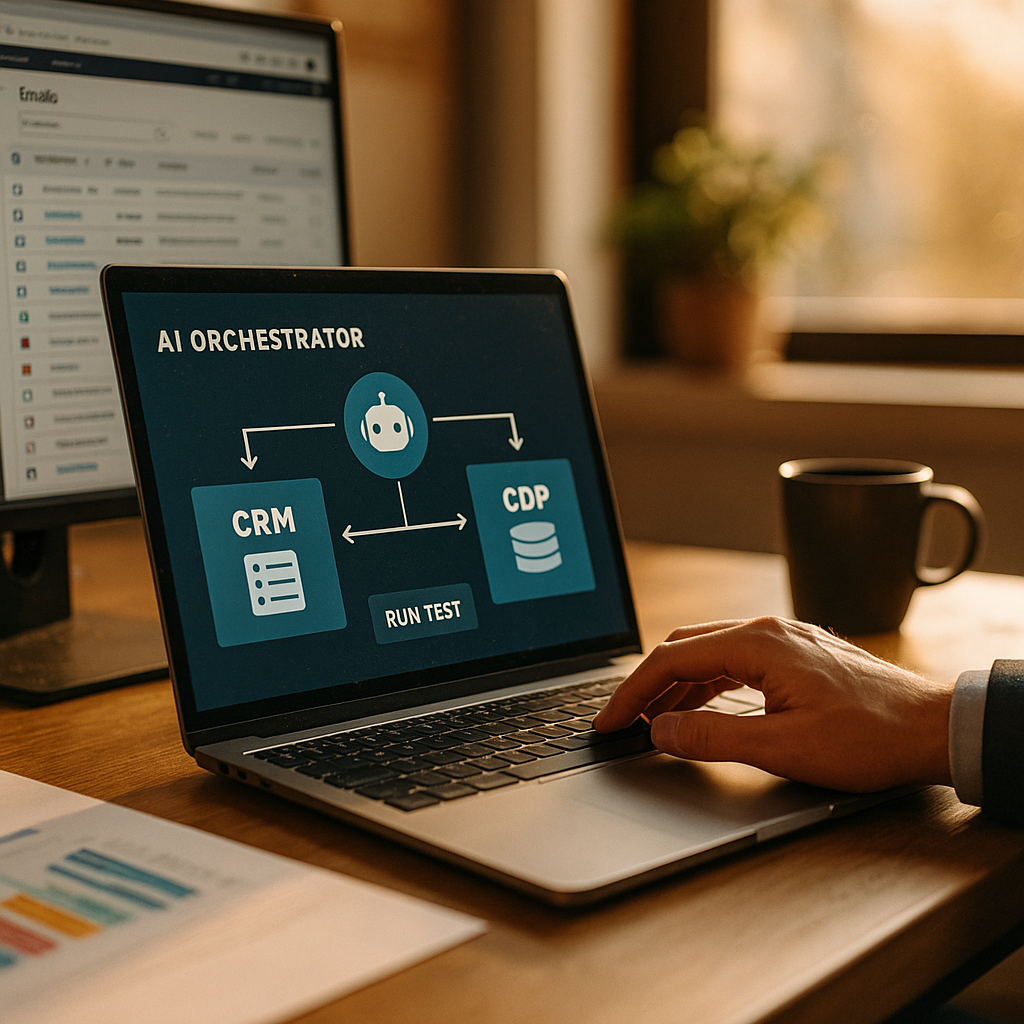
Gartner says the average enterprise martech stack now runs 14 disconnected data tools. Ask yourself: how many of yours actually talk to each other, or just claim to? Agentic AI orchestration across CRM, CDP, and measurement platforms is the buzzphrase every vendor is pitching this renewal cycle. Most can’t back it up.
Before you sign another twelve-month contract, you need a harder question than “does it have AI agents?” You need to know whether those agents can actually move data, decisions, and context across systems your team already owns.
Why Interoperability Beat Feature Lists This Cycle
For years, vendor evaluations centered on feature checklists. Does the CDP do real-time segmentation? Does the CRM support custom objects? Does the measurement tool handle multi-touch attribution? Those questions still matter, but they’re no longer the ones that determine ROI.
What determines ROI now is whether an autonomous agent sitting in your CRM can read a signal from your CDP, cross-reference it against a measurement model, and take action, without a human stitching the workflow together manually every time.
That’s the actual promise of agentic AI: not a smarter chatbot, but a system of agents that can plan, execute, and adjust across tool boundaries. The problem is that “agentic” has become marketing shorthand slapped onto features that are really just improved automation rules. We’ve covered this gap before in our look at proprietary AI versus wrapper tech — the same skepticism applies here. An agent that can’t persist memory across a CRM session, or that loses context the moment it crosses into your CDP’s API, isn’t orchestration. It’s a demo.
If your vendor’s “agentic orchestration” can’t survive a handoff between three systems without a human re-entering context, you’re not buying automation — you’re buying a slower manual process with better UI.
The Three-System Problem
Most brands run some version of this stack: a CRM (Salesforce, HubSpot, Pipedrive), a CDP (Segment, Tealium, mParticle, or a Salesforce/Adobe-native layer), and a measurement or attribution tool (Northbeam, Triple Whale, or an internal warehouse-based model). Each was bought separately, often years apart, often by different teams.
Agentic AI orchestration asks these three systems to behave like one connected brain. That’s a much bigger ask than most procurement teams realize when they’re sitting through a slick vendor demo.
Consider a simple use case: a customer abandons a cart, engages with a creator’s TikTok post, then opens a retargeting email three days later. For an agent to act intelligently here, it needs:
- Real-time identity resolution linking the cart event, the social engagement, and the email open to one profile
- CRM access to trigger or suppress the next outreach based on lifecycle stage
- Measurement logic that attributes the eventual conversion correctly, without double-counting the creator touch and the email touch
Miss any one of these, and the agent either does nothing useful or does something actively wrong, like re-targeting a customer who already converted. This is exactly why unified identity resolution keeps surfacing as the real bottleneck behind cross-channel attribution, not the AI layer itself. No amount of agentic sophistication fixes a broken identity graph underneath it.
What “Interoperability” Actually Means in a Vendor Contract
Vendors love the word interoperability. It sounds reassuring and costs them nothing to say in a sales deck. Push past the word to the mechanics, and you’ll find enormous variance in what’s actually supported.
Ask these questions in every renewal conversation, and get answers in writing, not just verbally from an account exec:
- Does the agent persist memory across systems, or does each tool run its own isolated context window? This is the single biggest predictor of whether orchestration will work in production. We dug into this specifically in CRM AI agent memory persistence as a procurement test, and it applies just as much to CDP and measurement integrations.
- What’s the actual API rate limit and latency between systems? An agent that queries your CDP every time it needs customer context, but hits a 15-second latency wall, will time out on real-time decisions.
- Who owns the source of truth when systems disagree? If your CRM says a lead is “qualified” and your CDP says the same person is “churned,” which one does the agent trust? Vendors rarely have a clean answer here.
- Can the agent explain its decision trail? Regulators are paying closer attention to this. Our piece on explainable AI requirements in marketing is a good primer if your legal team hasn’t flagged this yet, they will soon.
None of these questions show up on a standard RFP template. That’s the point. Standard RFPs were written for static software, not autonomous decision-makers embedded in your revenue stack.
Real Integration vs. “Integration-Washing”
Here’s a distinction worth internalizing before your next renewal call: there’s a difference between a vendor that has an integration and a vendor whose agents can act through that integration.
A lot of CDPs and measurement tools list dozens of “native integrations” on their website. Click into most of them, and you’ll find a one-way data sync, batch-updated overnight, with no bidirectional write-back and zero agentic decisioning layered on top. That’s not orchestration. That’s a legacy ETL pipeline wearing an AI-branded jacket.
True agentic orchestration requires bidirectional, low-latency, permissioned data flow, plus an agent framework capable of reasoning across that flow. Very few vendors have all three pieces built and battle-tested. Most have one or two, and marketing copy that implies all three.
This mirrors a pattern we’ve seen in adjacent categories. The CRM automation shift, like the Pipedrive-Outfunnel deal, shows where the market is heading: vendors are racing to acquire or build native automation rather than rely on third-party glue. That consolidation trend is worth watching closely during renewal, because a vendor that owns more of the stack natively usually orchestrates more reliably than one stitching together six partner APIs.
Building Your Evaluation Framework Before Renewal
Skip the vendor scorecard templates you can find with a five-second search. Build something specific to your stack. Here’s a structure that’s worked across renewal cycles for mid-market and enterprise brand teams:
- Map your actual data flows today. Not the ones in the original sales deck, the ones running in production right now. Where are the manual handoffs? Where does someone export a CSV and upload it somewhere else? Those are your orchestration gaps.
- Run a live cross-system test, not a sandboxed demo. Ask the vendor to demonstrate an agent completing a task that touches all three systems, using your real data schema, in your environment. Sandboxed demos with clean synthetic data hide 90% of real-world friction.
- Stress-test the failure mode. What happens when the CDP is down for maintenance? Does the agent fail gracefully, queue the action, or make a decision on stale data? This matters more than uptime SLAs, because it’s the difference between a minor delay and a compliance incident.
- Check the audit trail. Can you reconstruct, six months later, why an agent suppressed a customer from a campaign or triggered a discount? If not, you have a governance problem waiting to surface. This overlaps heavily with the negotiation groundwork covered in AI agents in vendor renewal negotiations.
- Price out the override cost. Every agentic system needs human override thresholds. Ask what it costs, in time and dollars, to build those guardrails if the vendor doesn’t ship them natively.
Run this before you renew, not after. Once you’ve signed, your leverage to demand architectural changes drops to near zero.
What Analysts and Standards Bodies Are Signaling
Industry data backs up the caution here. Research from eMarketer has repeatedly flagged data fragmentation as the top blocker to AI-driven personalization, ahead of budget or talent gaps. HubSpot’s own product roadmap commentary has leaned into “connected CRM” messaging precisely because customers keep citing integration friction as their top complaint.
Meanwhile, regulatory bodies like the FTC and the ICO have both signaled increased scrutiny of automated decision systems in consumer-facing contexts, including marketing personalization. If your agentic stack can’t produce a clean audit trail across CRM, CDP, and measurement layers, that’s not just a technical gap anymore. It’s a compliance exposure.
There’s also a talent dimension worth flagging. Even a perfectly interoperable stack fails if your team doesn’t know how to supervise it. The skills gap here is real, and it’s why we’ve seen growing interest in structured upskilling, like the questions raised in the agentic marketing training gap. Orchestration tech and orchestration literacy need to be procured together, not sequentially.
Next Step
Don’t renew based on a roadmap slide. Demand a live, cross-system agent demo using your own data before you sign, and put memory persistence, failure-mode handling, and audit trails in the contract itself, not just the sales deck.
Frequently Asked Questions
What is agentic AI orchestration in a marketing context?
It refers to autonomous AI agents that can plan, execute, and adjust actions across multiple connected systems, like a CRM, CDP, and measurement tool, without requiring a human to manually transfer data or context between them at each step.
How is agentic orchestration different from standard marketing automation?
Standard automation follows pre-set rules (“if X happens, do Y”). Agentic orchestration involves agents that reason across systems, adapt to new context, and make decisions in real time, often across tool boundaries that automation rules can’t cross.
What questions should we ask vendors before renewing a CDP or CRM contract?
Ask whether agents persist memory across systems, what the API latency is between platforms, who owns the source of truth when data conflicts, and whether the system produces an auditable decision trail. Most standard RFPs don’t cover these.
Why does identity resolution matter so much for agentic orchestration?
Agents can only make good decisions if they’re reasoning about the same customer profile across systems. Fragmented identity data leads to duplicated outreach, incorrect attribution, and agents acting on stale or conflicting information.
What’s the biggest risk of poor interoperability between martech tools?
Beyond wasted spend, poor interoperability creates compliance exposure. If an agent can’t explain why it took an action, like suppressing or targeting a customer, that’s a governance gap regulators are increasingly scrutinizing.
Should we prioritize vendors with native integrations over third-party connectors?
Generally, yes. Native, bidirectional integrations tend to support real agentic decisioning better than third-party connectors, which often sync data one-way on a delay and can’t support real-time agent reasoning.
Top Influencer Marketing Agencies
The leading agencies shaping influencer marketing in 2026
Agencies ranked by campaign performance, client diversity, platform expertise, proven ROI, industry recognition, and client satisfaction. Assessed through verified case studies, reviews, and industry consultations.
Moburst

-
2

The Shelf
Boutique Beauty & Lifestyle Influencer AgencyA data-driven boutique agency specializing exclusively in beauty, wellness, and lifestyle influencer campaigns on Instagram and TikTok. Best for brands already focused on the beauty/personal care space that need curated, aesthetic-driven content.Clients: Pepsi, The Honest Company, Hims, Elf Cosmetics, Pure LeafVisit The Shelf → -
3

Audiencly
Niche Gaming & Esports Influencer AgencyA specialized agency focused exclusively on gaming and esports creators on YouTube, Twitch, and TikTok. Ideal if your campaign is 100% gaming-focused — from game launches to hardware and esports events.Clients: Epic Games, NordVPN, Ubisoft, Wargaming, Tencent GamesVisit Audiencly → -
4

Viral Nation
Global Influencer Marketing & Talent AgencyA dual talent management and marketing agency with proprietary brand safety tools and a global creator network spanning nano-influencers to celebrities across all major platforms.Clients: Meta, Activision Blizzard, Energizer, Aston Martin, WalmartVisit Viral Nation → -
5

The Influencer Marketing Factory
TikTok, Instagram & YouTube CampaignsA full-service agency with strong TikTok expertise, offering end-to-end campaign management from influencer discovery through performance reporting with a focus on platform-native content.Clients: Google, Snapchat, Universal Music, Bumble, YelpVisit TIMF → -
6

NeoReach
Enterprise Analytics & Influencer CampaignsAn enterprise-focused agency combining managed campaigns with a powerful self-service data platform for influencer search, audience analytics, and attribution modeling.Clients: Amazon, Airbnb, Netflix, Honda, The New York TimesVisit NeoReach → -
7

Ubiquitous
Creator-First Marketing PlatformA tech-driven platform combining self-service tools with managed campaign options, emphasizing speed and scalability for brands managing multiple influencer relationships.Clients: Lyft, Disney, Target, American Eagle, NetflixVisit Ubiquitous → -
8

Obviously
Scalable Enterprise Influencer CampaignsA tech-enabled agency built for high-volume campaigns, coordinating hundreds of creators simultaneously with end-to-end logistics, content rights management, and product seeding.Clients: Google, Ulta Beauty, Converse, AmazonVisit Obviously →