


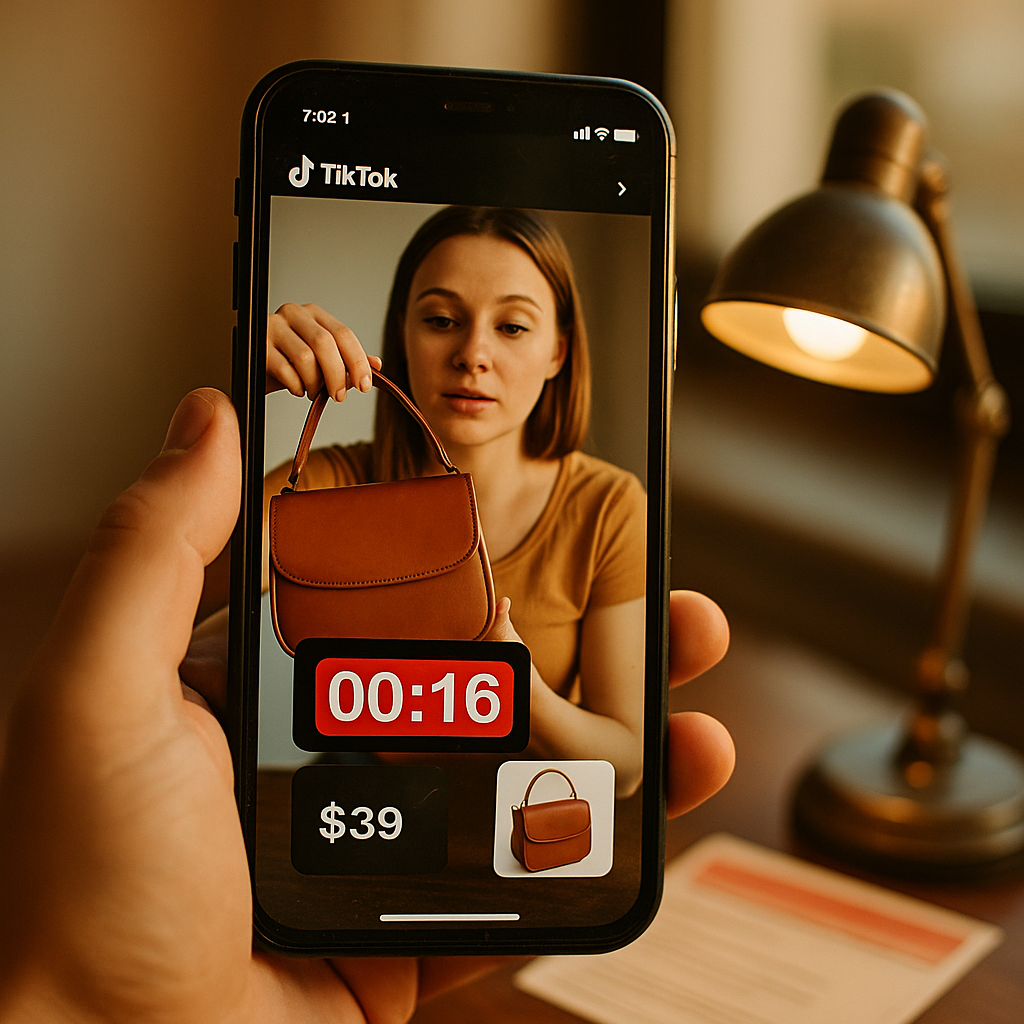
Every second a TikTok Shop countdown ticks down, someone in your legal department should be watching. In Q1 alone, the FTC’s staff flagged dozens of livestream sellers for phantom “limited stock” claims that never actually ran out. A TikTok Shop livestream countdown-timer playbook isn’t a nice-to-have anymore. It’s the difference between a conversion spike and a consent-order headache.
Urgency sells. That’s not in question. The question is whether your hosts are manufacturing scarcity that doesn’t exist, or reflecting real constraints in real time. Get that wrong, and a great sales night becomes Exhibit A.
Why Countdown Timers Are Suddenly a Legal Liability, Not Just a Sales Tactic
TikTok Shop’s built-in countdown sticker was designed to do one thing: compress decision time. Hosts love it because it works — livestreams with visible timers see meaningfully higher checkout completion than those without, according to internal creator benchmarks TikTok has shared with select agency partners. But the same mechanic that drives urgency is exactly what regulators scrutinize under deceptive-scarcity rules.
The FTC’s guidance on unfair or deceptive practices has long covered false urgency: fake “sale ends tonight” banners, invented low-stock counts, countdowns that reset. What’s changed is enforcement appetite. Livestream commerce, with its rapid-fire scripted pitches and screen-recorded evidence trail, is a much easier case to build than a static banner ad ever was. Every stream is archived. Every claim is timestamped. That’s a gift to investigators and a trap for hosts riffing off a loose script.
If your countdown timer doesn’t correspond to an actual inventory, price, or availability event, you’re not creating urgency — you’re creating a liability with a timestamp attached.
What Counts as “Deceptive Scarcity” in a Livestream Context
Deceptive scarcity isn’t just lying about numbers. It’s a spectrum, and most brands get tripped up in the gray zone, not the obvious violations. Here’s where the lines typically fall:
- Fabricated countdowns: A timer hits zero, then quietly resets for the next segment. No new offer, same “final minutes” language.
- Invented stock numbers: “Only 12 left!” when the warehouse has 400 units and restocks weekly.
- Vague but implied exclusivity: “This deal won’t last” with no defined end condition — no time, no unit cap, nothing.
- Recycled urgency across streams: Same “today only” claim used in Tuesday’s stream and Thursday’s stream, for the same SKU, at the same price.
- Host improvisation: A brand’s compliant script gets abandoned mid-stream because the host feels the room needs more pressure.
Notice that most of these aren’t about the timer widget itself. They’re about what the host says while it’s running. TikTok’s countdown sticker is just a UI element — it doesn’t know if your claim is true. That verification job falls entirely on your script and your host training, which is precisely where most compliance programs are thin.
The Three-Layer Script Framework: Claim, Trigger, Proof
The fix isn’t to strip urgency out of your streams. That would tank conversion and hand the advantage to competitors still willing to play fast and loose (until they get caught). The fix is to build every urgency claim on three layers that can each survive a screenshot: the claim, the trigger, and the proof.
Layer one: the claim. This is what the host says out loud. It must be specific and falsifiable. Not “selling fast,” but “43 units left of the 200 we launched with today.” Not “price goes up soon,” but “price returns to $34 at 8pm ET when this timer ends.”
Layer two: the trigger. This is the actual event tied to the countdown. A real inventory cap. A real time-boxed discount. A real bundle that disappears from the shop tab when the timer hits zero. If there’s no operational trigger behind the timer, don’t run the timer. Full stop.
Layer three: the proof. This is your internal documentation — inventory logs, pricing change timestamps, backend shop configuration screenshots — that would let you defend the claim if a regulator or a plaintiff’s attorney ever asked. If you can’t produce proof within an hour of a request, the claim shouldn’t have gone out live.
Brands running compliant restock livestreams in beauty have already had to solve this exact problem, because “restock” claims are especially easy to fabricate and especially easy to disprove. The same discipline applies to any countdown-driven format.
Scripting Templates That Hold Up
Here’s the part your host training deck is probably missing: pre-approved language that’s flexible enough to feel live, but tight enough to survive scrutiny. Build a bank of these, categorized by trigger type.
Time-boxed discount: “This price is only active while this timer’s running — once it hits zero, we’re back to full price, no exceptions.” This works because the trigger (price change) is objective, verifiable, and the host isn’t inventing urgency, just narrating a scheduled event.
Inventory cap: “We’ve got [exact number] of these in this bundle for today’s stream. Once they’re gone, they’re gone until our next restock.” Pair this with a real-time counter pulled from your inventory management system, not a guess. If TikTok Shop’s dashboard shows 340 units and your host says 40, that’s the kind of discrepancy that turns a routine complaint into a pattern-of-practice investigation.
Bundle exclusivity: “This exact bundle — the two shades plus the tool — only exists in this stream. After the timer, we go back to selling them separately.” This is defensible because the SKU configuration itself is the constraint, not an invented number.
What doesn’t hold up: anything using words like “almost gone,” “selling out fast,” or “everyone’s grabbing these” without a number attached. Vague urgency language is actually riskier than specific claims, because it invites the assumption of falsity without giving you anything concrete to defend.
Host Training Is Where Compliance Actually Lives or Dies
You can write the tightest script in the world and still get burned by a host who goes off-book because the chat’s gone quiet and they’re panicking. This is the operational reality nobody likes to admit: live commerce compliance is mostly a training problem, not a legal-review problem.
Three things fix this:
- Pre-stream briefings with real numbers. Hosts get the actual inventory count, actual price schedule, and actual timer logic before they go live — not vague direction to “create urgency.”
- A banned-phrase list. Compile the vague-urgency phrases your legal team flags most often and give hosts a literal do-not-say list. Keep it under 15 items so it’s memorable.
- Real-time compliance monitoring. Someone on your team (or your agency’s) should be watching the stream live with the ability to flag the host via chat or earpiece if a claim drifts from the script.
This mirrors what’s happening across other formats where brands are re-tightening creator scripts after algorithm or platform shifts made improvisation more tempting. The shift toward casual, unscripted content on TikTok has made hosts more comfortable riffing generally, which is great for engagement and genuinely risky for urgency claims specifically. Casual tone, disciplined claims: that’s the balance.
Building the Audit Trail Before You Need It
Regulators and plaintiffs’ attorneys don’t ask nicely and they don’t ask fast. If a demand letter shows up eight weeks after a stream, can you reconstruct exactly what your host said, what the inventory actually was, and when the price changed? Most brands can’t, because they treat livestream archives as a marketing asset instead of a compliance record.
Fix this with a standing process: export the stream recording, timestamp every urgency claim against your inventory and pricing system logs, and store both together for a minimum retention period aligned with your legal team’s guidance (many brands default to three years given FTC’s typical lookback windows). This isn’t glamorous work. It’s also the single highest-leverage thing you can do to de-risk your livestream program, and it costs almost nothing compared to the cost of a consent order.
Platforms are watching this space too. TikTok has tightened TikTok Shop seller policies around exaggerated claims following advertiser pressure after last year’s trust issues, part of the broader effort to rebuild advertiser confidence in the platform’s commerce ecosystem. Brands that get caught gaming countdown timers don’t just risk regulatory action — they risk losing shop-tab placement and algorithmic reach, which compounds the damage well beyond any single stream.
Where This Fits Into Your Broader Livestream Strategy
Countdown compliance shouldn’t live in a silo separate from your conversion strategy. The brands doing this well have folded urgency scripting into the same planning process they use for structuring TikTok Shop content that converts generally: same rigor around hooks, same rigor around claims. Urgency is just one lever in a bigger machine, and it shouldn’t be the lever that blows up the rest of the program.
It’s also worth benchmarking against how other regulated-adjacent formats handle real-time claims. Sprout Social’s research on livestream commerce and eMarketer’s data on live shopping growth both point to urgency mechanics as a top driver of conversion, which is exactly why regulators are paying closer attention now rather than later.
Run every countdown script through the claim-trigger-proof test before your next livestream, and build the audit trail into your standard production checklist rather than treating it as an afterthought. That single habit will do more to protect your program than any legal disclaimer flashed on screen for two seconds.
FAQs
Is TikTok Shop’s countdown timer sticker itself illegal to use?
No. The countdown sticker is a neutral tool. The legal risk comes from pairing it with false or unverifiable claims about scarcity, price changes, or inventory — not from the feature itself.
What’s the safest way to phrase inventory-based urgency?
Use exact, verifiable numbers tied to your actual inventory system, and update them live if stock changes. Vague phrases like “almost gone” are riskier than precise ones because they can’t be defended with documentation.
Can I reuse the same countdown claim across multiple livestreams?
Only if the underlying trigger is genuinely repeating, such as a recurring weekly promotion clearly labeled as such. Reusing “today only” language for the same offer across multiple days without disclosure is a classic deceptive-scarcity pattern.
How long should we retain livestream recordings for compliance purposes?
Many brands retain recordings and matching inventory/pricing logs for at least three years, aligned with typical FTC lookback periods, though your legal counsel should confirm retention requirements for your specific category and jurisdiction.
Who’s ultimately responsible if a host improvises a false urgency claim?
The brand or seller of record typically bears primary liability, even if the host is an independent creator. That’s why pre-stream briefings, banned-phrase lists, and real-time monitoring matter as much as the script itself.
Visible FAQ Section
See above.
Top Influencer Marketing Agencies
The leading agencies shaping influencer marketing in 2026
Agencies ranked by campaign performance, client diversity, platform expertise, proven ROI, industry recognition, and client satisfaction. Assessed through verified case studies, reviews, and industry consultations.
Moburst

-
2

The Shelf
Boutique Beauty & Lifestyle Influencer AgencyA data-driven boutique agency specializing exclusively in beauty, wellness, and lifestyle influencer campaigns on Instagram and TikTok. Best for brands already focused on the beauty/personal care space that need curated, aesthetic-driven content.Clients: Pepsi, The Honest Company, Hims, Elf Cosmetics, Pure LeafVisit The Shelf → -
3

Audiencly
Niche Gaming & Esports Influencer AgencyA specialized agency focused exclusively on gaming and esports creators on YouTube, Twitch, and TikTok. Ideal if your campaign is 100% gaming-focused — from game launches to hardware and esports events.Clients: Epic Games, NordVPN, Ubisoft, Wargaming, Tencent GamesVisit Audiencly → -
4

Viral Nation
Global Influencer Marketing & Talent AgencyA dual talent management and marketing agency with proprietary brand safety tools and a global creator network spanning nano-influencers to celebrities across all major platforms.Clients: Meta, Activision Blizzard, Energizer, Aston Martin, WalmartVisit Viral Nation → -
5

The Influencer Marketing Factory
TikTok, Instagram & YouTube CampaignsA full-service agency with strong TikTok expertise, offering end-to-end campaign management from influencer discovery through performance reporting with a focus on platform-native content.Clients: Google, Snapchat, Universal Music, Bumble, YelpVisit TIMF → -
6

NeoReach
Enterprise Analytics & Influencer CampaignsAn enterprise-focused agency combining managed campaigns with a powerful self-service data platform for influencer search, audience analytics, and attribution modeling.Clients: Amazon, Airbnb, Netflix, Honda, The New York TimesVisit NeoReach → -
7

Ubiquitous
Creator-First Marketing PlatformA tech-driven platform combining self-service tools with managed campaign options, emphasizing speed and scalability for brands managing multiple influencer relationships.Clients: Lyft, Disney, Target, American Eagle, NetflixVisit Ubiquitous → -
8

Obviously
Scalable Enterprise Influencer CampaignsA tech-enabled agency built for high-volume campaigns, coordinating hundreds of creators simultaneously with end-to-end logistics, content rights management, and product seeding.Clients: Google, Ulta Beauty, Converse, AmazonVisit Obviously →