


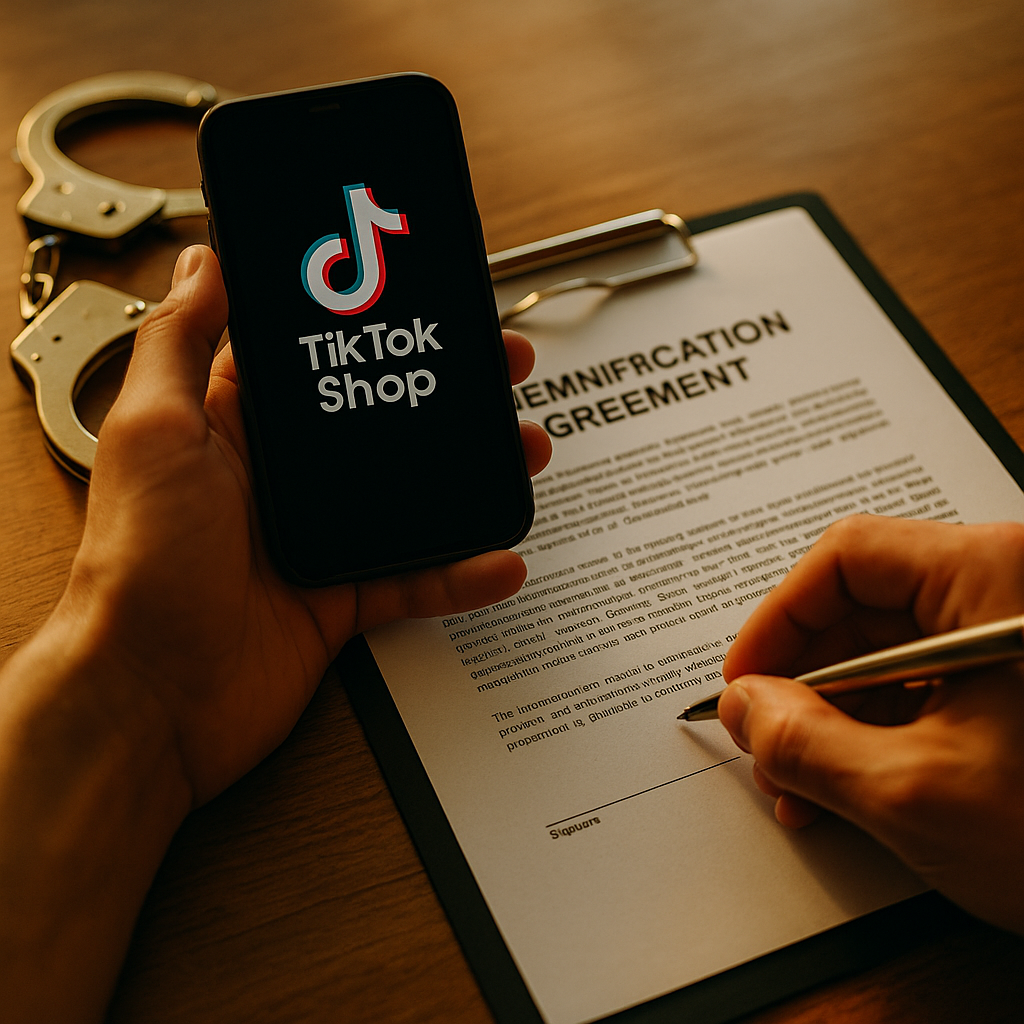
TikTok Shop’s Real IP Verification system has frozen livestream selling privileges for thousands of merchants without warning, mid-campaign, mid-quarter, mid-invoice. If your indemnification clause doesn’t already address platform-triggered account freezes, you’re negotiating your next contract from a position of pure exposure. This isn’t hypothetical risk anymore. It’s a recurring operational event.
Why This Freeze Keeps Blowing Up Contracts
TikTok’s Real IP Verification checks whether a merchant’s login location matches their registered business address. It’s meant to catch fraud, VPN abuse, and unauthorized reseller networks. Reasonable goal. Messy execution.
The problem: verification triggers can fire on legitimate merchants using cloud VPNs for security, agencies managing multiple client accounts from a shared office network, or brands with distributed teams logging in from different countries. When it fires, TikTok can suspend livestream selling access instantly, sometimes for days, sometimes for weeks, while the merchant resubmits documentation. Meanwhile, the campaign you booked creators for, budgeted media spend against, and promised a client is dead in the water.
We’ve covered the mechanics of this extensively — see our Real IP freeze checklist and the broader merchant verification compliance guide for prevention tactics. This article is about what happens after prevention fails: who pays when the freeze hits mid-campaign.
An indemnification clause written before you understood platform freeze risk is a clause written for a different war. Update it before your next campaign, not after your next incident.
Who Actually Bears the Loss When TikTok Freezes an Account?
Here’s the uncomfortable truth: in most existing influencer and agency contracts, nobody explicitly bears it. The clauses were drafted for content disputes, IP infringement, or FTC disclosure failures — not for a platform unilaterally cutting off revenue access. That silence gets expensive fast.
Think through the parties typically involved in a TikTok Shop livestream campaign:
- The merchant/brand — owns the shop, loses sales velocity and inventory turnover during the freeze.
- The agency or MCN — booked the creators, scheduled the livestream slots, and now has to explain the gap to the client.
- The creator/livestreamer — showed up, performed, generated views, but earned nothing because the shop link went dead mid-stream.
- TikTok itself — triggered the freeze, and its Terms of Service almost certainly disclaim liability for account actions taken “in its sole discretion.”
Without a clause allocating this specific risk, the default answer is: everyone eats their own loss, and relationships fray. That’s not a legal strategy. That’s an accident waiting to happen twice.
What an Indemnification Clause Needs to Cover Here
A standard indemnification clause protects one party from losses caused by the other party’s breach, negligence, or misrepresentation. A Real IP freeze scenario needs something more specific: a clause that addresses third-party platform action as a distinct risk category, separate from either party’s fault.
Structure it around four components.
1. Define the Triggering Event Precisely
Vague language like “platform disruption” invites disputes. Name the mechanism: “suspension or restriction of livestream selling privileges resulting from TikTok Shop’s Real IP Verification process, including account freezes, re-verification holds, or geofencing mismatches.” Specificity here does two things — it makes the clause enforceable, and it forces both parties to actually understand the risk they’re allocating before signing.
2. Separate Fault-Based Indemnification from No-Fault Cost-Sharing
This is where most drafts go wrong. If the merchant caused the freeze — say, by logging in through unauthorized VPN networks against TikTok’s terms, or by failing to complete requested re-verification within the platform’s deadline — that’s a fault-based scenario. The merchant should indemnify the agency and creators for resulting losses: forfeited creator fees, wasted media spend, breach-of-schedule penalties owed to sponsors.
But if the freeze hits despite good-faith compliance — a false positive, an algorithmic flag, a documentation processing delay on TikTok’s end — that’s no-fault. Nobody breached anything. Here, the smarter move isn’t a one-sided indemnity. It’s a pre-negotiated cost-sharing or make-good mechanism: rescheduled livestream slots, prorated creator compensation, or a defined “force majeure-adjacent” carve-out that caps each party’s exposure.
Fault-based indemnification and no-fault cost-sharing are not the same clause. Conflating them is why so many post-freeze negotiations turn adversarial instead of procedural.
3. Set a Notification and Cure Window
Require the merchant to notify the agency and talent within a fixed window (24-48 hours is standard) of receiving any TikTok verification hold notice. Build in a cure period tied to TikTok’s own resubmission timelines — typically 5-7 business days per our Real IP verification checklist. If the merchant fails to notify or fails to attempt resolution within that window, indemnification obligations shift more heavily toward the merchant, since inaction compounds the damage.
4. Cap and Carve Out
Every indemnification clause needs a liability cap. Without one, you’re exposing a mid-size merchant to potentially unlimited creator fee claims, agency management fee claims, and downstream sponsor penalty claims from a single platform glitch. Standard practice: cap indemnification obligations at the total contract value or a defined multiple of monthly campaign spend, whichever is lower. Carve out gross negligence or willful violation of TikTok’s merchant terms from the cap — those should remain uncapped, because that’s genuinely the merchant’s fault.
Sample Clause Language (Adapt, Don’t Copy-Paste)
Below is a starting framework. No template survives contact with your actual jurisdiction and counsel unedited, but this gives your legal team a structural head start:
“In the event that Merchant’s TikTok Shop livestream selling privileges are suspended, restricted, or frozen due to TikTok’s Real IP Verification process during the Term, Merchant shall notify Agency within [48] hours of receiving notice from TikTok. If such suspension results from Merchant’s failure to comply with TikTok’s merchant verification requirements, including but not limited to submission of accurate business registration or IP address documentation, Merchant shall indemnify and hold harmless Agency and Creator(s) for direct losses including forfeited scheduled livestream fees, up to a cap of [contract value / defined multiple]. If such suspension arises despite Merchant’s good-faith compliance with TikTok’s verification requirements, the parties agree to a make-good remedy consisting of [rescheduled livestream slots / prorated fee / defined alternative], with no indemnification obligation attaching absent a showing of Merchant fault or negligence.”
Note what this does: it doesn’t pretend every freeze is someone’s fault. It builds a decision tree into the contract itself, so you’re not litigating causation from scratch every time TikTok’s system flags an account.
That’s the operational efficiency angle here — a well-drafted clause saves you a renegotiation cycle every time this happens, and it will happen again.
Where Creators and Agencies Should Push Back
If you’re on the agency or creator side, don’t accept a clause that makes you absorb freeze-related losses by default. You had no control over the merchant’s IP verification status. Push for:
- A minimum guaranteed fee structure independent of livestream completion, similar to the guarantees increasingly standard in whitelisting agreements.
- A right to reschedule within a defined window without forfeiting original booking rates.
- Documentation rights — the ability to request proof that the merchant initiated re-verification promptly, so you’re not blindsided by a merchant sitting on a freeze notice for a week.
This mirrors the logic we outlined in our piece on platform indemnification for TikTok Remix risk — when a platform mechanic (not a contracting party) causes the disruption, the contract needs a pathway that doesn’t force either side into unilateral loss absorption.
Contracts that ignore this dynamic tend to produce one-time clients, not repeat business.
Don’t Forget the Insurance Angle
Some agencies are now asking whether media liability or errors-and-omissions policies extend to platform account freezes. Most standard E&O policies don’t, but it’s worth a direct conversation with your broker before your next renewal. Platform dependency risk is becoming a recognized category in creator economy insurance discussions, and marketing operations platforms increasingly flag single-platform revenue concentration as a documented business risk in vendor risk assessments. If 40%+ of a merchant’s Q4 revenue runs through TikTok Shop livestreams, per patterns tracked by eMarketer’s retail media research, that concentration alone justifies a harder look at contractual risk allocation.
Diversifying platform dependency is the longer-term fix. The indemnification clause is the short-term insurance policy while you get there.
The Takeaway
Draft the clause before the freeze, not after. Separate fault from no-fault scenarios, set notification deadlines tied to TikTok’s own resubmission windows, and cap exposure so one platform glitch doesn’t sink a client relationship. If your current contracts are silent on Real IP freeze risk, that’s the redline to send this week, not next quarter.
FAQs
What is a Real IP Verification freeze on TikTok Shop?
It’s an automated or manual suspension of a merchant’s livestream selling privileges, triggered when TikTok’s system detects a mismatch between the merchant’s login IP location and their registered business address or documentation.
Can a merchant get indemnification from TikTok for lost revenue during a freeze?
No. TikTok’s merchant terms of service typically disclaim liability for account actions taken at its discretion, including verification-related suspensions. Indemnification in this context is negotiated between the merchant, agency, and creators, not with TikTok.
Should indemnification clauses treat every Real IP freeze as the merchant’s fault?
No. Freezes can occur even with good-faith compliance due to false positives or processing delays. A well-drafted clause distinguishes fault-based scenarios, where the merchant caused the freeze, from no-fault scenarios, and applies different remedies to each.
How long does a typical Real IP re-verification take?
Timelines vary, but 5-7 business days is a common window for TikTok to process resubmitted documentation. Contracts should tie cure periods and notification deadlines to this timeline rather than leaving them open-ended.
What should creators ask for if a merchant’s account freezes mid-campaign?
Minimum guaranteed fees independent of livestream completion, a defined rescheduling window at original rates, and documentation showing the merchant acted promptly to resolve the freeze.
Does a liability cap weaken an indemnification clause?
No, it strengthens it for both sides by making exposure predictable. Caps should exclude gross negligence or willful non-compliance, which remain uncapped to preserve accountability for genuinely avoidable failures.
Top Influencer Marketing Agencies
The leading agencies shaping influencer marketing in 2026
Agencies ranked by campaign performance, client diversity, platform expertise, proven ROI, industry recognition, and client satisfaction. Assessed through verified case studies, reviews, and industry consultations.
Moburst

-
2

The Shelf
Boutique Beauty & Lifestyle Influencer AgencyA data-driven boutique agency specializing exclusively in beauty, wellness, and lifestyle influencer campaigns on Instagram and TikTok. Best for brands already focused on the beauty/personal care space that need curated, aesthetic-driven content.Clients: Pepsi, The Honest Company, Hims, Elf Cosmetics, Pure LeafVisit The Shelf → -
3

Audiencly
Niche Gaming & Esports Influencer AgencyA specialized agency focused exclusively on gaming and esports creators on YouTube, Twitch, and TikTok. Ideal if your campaign is 100% gaming-focused — from game launches to hardware and esports events.Clients: Epic Games, NordVPN, Ubisoft, Wargaming, Tencent GamesVisit Audiencly → -
4

Viral Nation
Global Influencer Marketing & Talent AgencyA dual talent management and marketing agency with proprietary brand safety tools and a global creator network spanning nano-influencers to celebrities across all major platforms.Clients: Meta, Activision Blizzard, Energizer, Aston Martin, WalmartVisit Viral Nation → -
5

The Influencer Marketing Factory
TikTok, Instagram & YouTube CampaignsA full-service agency with strong TikTok expertise, offering end-to-end campaign management from influencer discovery through performance reporting with a focus on platform-native content.Clients: Google, Snapchat, Universal Music, Bumble, YelpVisit TIMF → -
6

NeoReach
Enterprise Analytics & Influencer CampaignsAn enterprise-focused agency combining managed campaigns with a powerful self-service data platform for influencer search, audience analytics, and attribution modeling.Clients: Amazon, Airbnb, Netflix, Honda, The New York TimesVisit NeoReach → -
7

Ubiquitous
Creator-First Marketing PlatformA tech-driven platform combining self-service tools with managed campaign options, emphasizing speed and scalability for brands managing multiple influencer relationships.Clients: Lyft, Disney, Target, American Eagle, NetflixVisit Ubiquitous → -
8

Obviously
Scalable Enterprise Influencer CampaignsA tech-enabled agency built for high-volume campaigns, coordinating hundreds of creators simultaneously with end-to-end logistics, content rights management, and product seeding.Clients: Google, Ulta Beauty, Converse, AmazonVisit Obviously →