


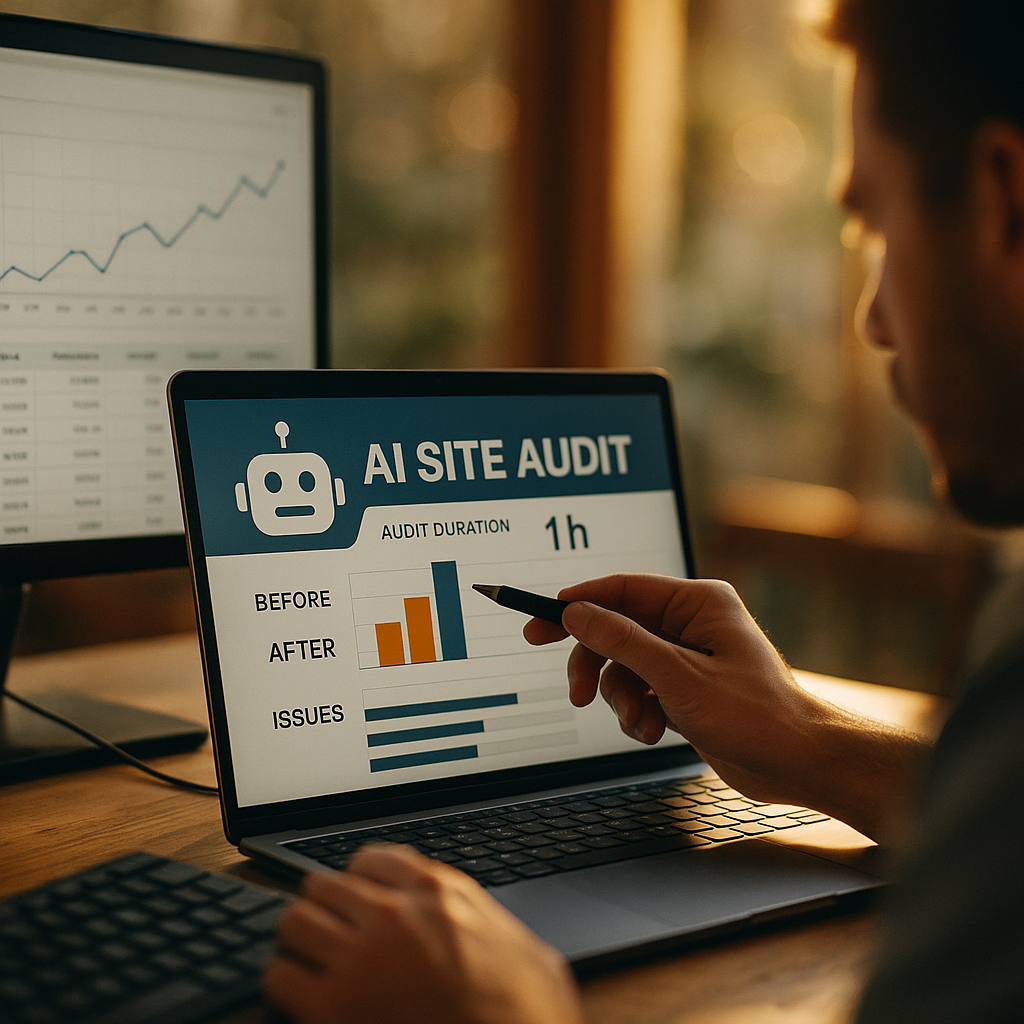
Forty hours of crawling, spot-checking, and spreadsheet triage — or sixty minutes. That’s the gap Ahrefs is putting in front of every in-house SEO team right now, and it’s the kind of claim that should make you skeptical before it makes you excited. An AI-powered site audit that compresses weeks of technical review into a single coffee break sounds like marketing copy. But the underlying shift is real, and it’s forcing a hard conversation about what SEO teams are actually for.
The Claim, Stripped of Hype
Ahrefs says its newer AI audit workflows can take a domain from raw crawl data to prioritized, explained findings in about 60 minutes — a task that traditionally consumed 40 hours of manual analyst time for a mid-size site. That’s not a 10% efficiency gain. That’s a 97.5% reduction in labor hours for one of SEO’s most tedious, high-stakes deliverables.
The 40-hour baseline isn’t invented for effect, either. Anyone who’s run a full technical audit knows the routine: crawl the site, cross-reference against Search Console and log files, manually flag duplicate content and orphaned pages, write up recommendations, then translate all of it into something a dev team will actually act on. A full week, easily, for a site with more than a few thousand URLs.
The real story isn’t the 60 minutes. It’s what happens to the other 39 hours — and whether your team is prepared to spend them on judgment instead of data collection.
Why This Matters More Now Than It Would Have Two Years Ago
Site audits used to be a quarterly (or annual) exercise. Now they need to happen continuously, because the thing you’re auditing for has changed. It’s not just Googlebot crawling your site anymore — it’s GPTBot, ClaudeBot, PerplexityBot, and a growing list of AI crawlers deciding whether your content gets cited in an answer engine response. Generative Engine Optimization (GEO) has added a whole new layer of technical requirements: structured data completeness, entity clarity, content chunking for retrieval, llms.txt files. Traditional audits weren’t built to check for any of that.
Running a 40-hour manual audit against a moving target like this is a losing game. By the time the analyst finishes documenting findings, the AI crawler behavior has shifted again, or a competitor has restructured their FAQ schema and started winning citations you used to get. Speed isn’t a vanity metric here — it’s the difference between auditing a site as it exists today versus auditing it as it existed six weeks ago. Our AI traffic audit framework covers how to evaluate whether your architecture is even built for this kind of scrutiny in the first place.
What Actually Gets Automated (and What Doesn’t)
Ahrefs, Semrush, and similar platforms are automating the parts of an audit that were always mechanical, not the parts that required judgment. That distinction matters a lot for how you restaff this work.
- Automated well: crawl error detection, broken link mapping, duplicate content clustering, redirect chain analysis, Core Web Vitals scoring, schema validation, canonical tag conflicts.
- Still human-dependent: prioritization against business goals, deciding which fixes actually move revenue, translating findings into dev tickets that survive a sprint-planning meeting, and judging whether a “critical” AI-flagged issue is actually critical for your specific site.
An AI tool can tell you that 340 pages have thin content. It can’t tell you which 40 of those pages are actually worth saving versus pruning, because that decision depends on context the model doesn’t have — seasonal demand, sales team feedback, brand priorities that never made it into a CMS field. This is precisely where in-house SEO expertise remains non-negotiable, not despite the automation, but because of it. The tool clears the noise so a human can focus on the 10% of findings that carry 90% of the business impact.
The GEO Wrinkle Nobody’s Pricing In
Here’s where it gets more interesting for teams straddling SEO and GEO responsibilities, which by 2026 is most of them. Traditional audits check whether Google can crawl and index your pages. GEO audits need to check something different: whether an LLM can extract a clean, quotable, structurally sound answer from your content without hallucinating around the gaps.
That’s a fundamentally different audit surface. It means checking whether your product pages have parseable specs, whether your FAQ content is structured well enough to be extracted verbatim, and whether your entity signals (brand name, author, organization schema) are consistent enough for a model to trust the source. Get this wrong and you don’t just rank lower — you get misrepresented in an AI answer, or left out of the citation set entirely. Our structured data checklist breaks down the specific schema gaps that most commonly block AI citation, and it’s worth running alongside any AI-generated technical audit rather than instead of one.
The risk with fast, cheap audits is that teams treat “AI-powered” as synonymous with “GEO-ready.” It isn’t. Ahrefs’ 60-minute claim is largely about traditional technical SEO speed — crawl efficiency, issue detection, reporting generation. Whether that same audit engine is checking for AI-crawler accessibility, content chunkability, or citation-worthy structure is a separate question you need to ask your vendor directly, not assume.
What This Does to Team Structure and Headcount
If a task that used to require a full-time analyst for a week now takes an hour, the honest question is: what happens to that analyst’s other 39 hours? There are really only three answers, and most organizations are living out some blend of all three.
- Reallocation to judgment work. Analysts spend freed-up time on prioritization, stakeholder communication, and cross-functional fixes — the work that was always the bottleneck anyway, since findings sitting in a spreadsheet nobody reads deliver zero ROI.
- Audit frequency increases. Instead of one deep audit per quarter, teams run lighter audits weekly or even daily, catching regressions before they compound. This is arguably the better use of the time savings, since SEO decay is often gradual and invisible until a traffic drop forces a panic audit.
- Headcount consolidation. Some organizations will simply need fewer technical SEO analysts per site under management. This is uncomfortable to say plainly, but it’s the same pattern seen in other AI-driven marketing functions — the value shifts from execution to oversight, and oversight requires fewer people, even if those people need to be more senior.
For agencies and in-house teams managing multiple domains or franchise/multi-location sites, option two is where the real ROI shows up. An audit that took 40 hours per site meant you could realistically audit a portfolio of 20 sites once or twice a year. At 60 minutes per site, that same team can run near-continuous monitoring across the entire portfolio — catching a broken canonical tag or a missing schema field within days instead of discovering it in next year’s audit cycle.
The Trust and Verification Problem
Speed introduces a new risk: false confidence in AI-generated findings. A 40-hour manual audit, however slow, forces a human to actually look at the site, page by page, and develop an intuition for what’s structurally wrong. A 60-minute automated audit produces a report, but someone still has to verify that the AI correctly interpreted ambiguous signals — a redirect that looks broken but is intentional, a “duplicate” page that’s actually a legitimate localized variant.
This is the same governance question showing up across every AI marketing tool right now, and it’s worth treating it with the same rigor you’d apply to any other automated decision system. Our piece on RAG and hallucinated reporting numbers covers a parallel problem in attribution — AI tools that sound confident and are occasionally, quietly wrong. Site audits carry the same risk. An AI tool flagging “critical crawl budget waste” on a page that gets 40% of your organic traffic needs a human sanity check before anyone touches a robots.txt file.
The same logic applies to vendor selection. If you’re bringing in a new AI audit tool or replacing an agency retainer with software, run it through the same due-diligence process you’d apply to any AI vendor touching your marketing stack. Our AI vendor due-diligence checklist was written for creator fraud detection tools, but the underlying questions — model transparency, error rates, what happens when the model gets it wrong — apply just as well to audit software making recommendations about your site architecture.
What To Actually Do With This
Don’t take the 60-minute claim at face value, and don’t dismiss it either. Test it against your own site. Run an AI-powered audit through Ahrefs or a comparable tool, then have a senior analyst manually verify a sample of the flagged issues — say, 20 findings across different categories. If the accuracy holds up, you’ve just found real capacity. According to eMarketer, marketing teams are already reallocating a growing share of automatable work toward strategy and analysis, and technical SEO is following the same curve other channels hit first.
Budget-wise, this changes the case for in-house tooling versus agency retainers. If a platform subscription replaces 30+ hours of billable agency time per audit cycle, the math shifts fast, particularly for teams managing multiple domains or international sites. Worth running past finance before your next contract renewal, especially if audit work has historically been a line item you’ve outsourced by default rather than by strategic choice.
It’s also worth checking what these tools do (or don’t do) for AI-crawler readiness specifically. Most audit platforms are still catching up on GEO-specific checks, and the gap between “SEO-audited” and “GEO-ready” is where a lot of visibility is quietly being lost. Resources like Google Search Central and HubSpot’s marketing research are useful benchmarks for keeping your audit criteria current as crawler behavior and AI Overview requirements keep shifting.
Visible FAQs
Frequently Asked Questions
Is Ahrefs’ 60-minute audit claim realistic for large or enterprise sites?
The 60-minute figure is more realistic for mid-size sites with a few thousand URLs. Enterprise sites with hundreds of thousands of pages will still take longer to crawl and process, though the relative time savings compared to manual analysis remain substantial.
Does an AI-powered site audit replace the need for a technical SEO specialist?
No. AI audits automate data collection and issue detection, but prioritizing findings against business goals, verifying edge cases, and translating recommendations into development work still requires human judgment and SEO expertise.
Are AI SEO audits the same as GEO audits for AI answer engines?
Not automatically. Most AI-powered SEO audit tools focus on traditional technical SEO signals like crawlability and Core Web Vitals. Checking for AI-crawler accessibility, structured data completeness, and citation-worthy content structure requires a separate, GEO-specific evaluation.
How often should teams run AI-powered site audits?
Because AI audits are fast and low-cost relative to manual reviews, many teams are shifting from quarterly or annual audits to weekly or continuous monitoring, which catches regressions and crawler issues before they compound.
What’s the risk of relying too heavily on AI-generated audit findings?
AI tools can misinterpret ambiguous signals, such as intentional redirects or legitimate localized content flagged as duplicates. Findings should be spot-checked by a human analyst before major site changes are made based on them.
FAQPage Schema
The teams that win here won’t be the ones with the fastest audit tool — they’ll be the ones who redirect the 39 hours they just got back toward the judgment calls a machine still can’t make.
Top Influencer Marketing Agencies
The leading agencies shaping influencer marketing in 2026
Agencies ranked by campaign performance, client diversity, platform expertise, proven ROI, industry recognition, and client satisfaction. Assessed through verified case studies, reviews, and industry consultations.
Moburst

-
2

The Shelf
Boutique Beauty & Lifestyle Influencer AgencyA data-driven boutique agency specializing exclusively in beauty, wellness, and lifestyle influencer campaigns on Instagram and TikTok. Best for brands already focused on the beauty/personal care space that need curated, aesthetic-driven content.Clients: Pepsi, The Honest Company, Hims, Elf Cosmetics, Pure LeafVisit The Shelf → -
3

Audiencly
Niche Gaming & Esports Influencer AgencyA specialized agency focused exclusively on gaming and esports creators on YouTube, Twitch, and TikTok. Ideal if your campaign is 100% gaming-focused — from game launches to hardware and esports events.Clients: Epic Games, NordVPN, Ubisoft, Wargaming, Tencent GamesVisit Audiencly → -
4

Viral Nation
Global Influencer Marketing & Talent AgencyA dual talent management and marketing agency with proprietary brand safety tools and a global creator network spanning nano-influencers to celebrities across all major platforms.Clients: Meta, Activision Blizzard, Energizer, Aston Martin, WalmartVisit Viral Nation → -
5

The Influencer Marketing Factory
TikTok, Instagram & YouTube CampaignsA full-service agency with strong TikTok expertise, offering end-to-end campaign management from influencer discovery through performance reporting with a focus on platform-native content.Clients: Google, Snapchat, Universal Music, Bumble, YelpVisit TIMF → -
6

NeoReach
Enterprise Analytics & Influencer CampaignsAn enterprise-focused agency combining managed campaigns with a powerful self-service data platform for influencer search, audience analytics, and attribution modeling.Clients: Amazon, Airbnb, Netflix, Honda, The New York TimesVisit NeoReach → -
7

Ubiquitous
Creator-First Marketing PlatformA tech-driven platform combining self-service tools with managed campaign options, emphasizing speed and scalability for brands managing multiple influencer relationships.Clients: Lyft, Disney, Target, American Eagle, NetflixVisit Ubiquitous → -
8

Obviously
Scalable Enterprise Influencer CampaignsA tech-enabled agency built for high-volume campaigns, coordinating hundreds of creators simultaneously with end-to-end logistics, content rights management, and product seeding.Clients: Google, Ulta Beauty, Converse, AmazonVisit Obviously →