


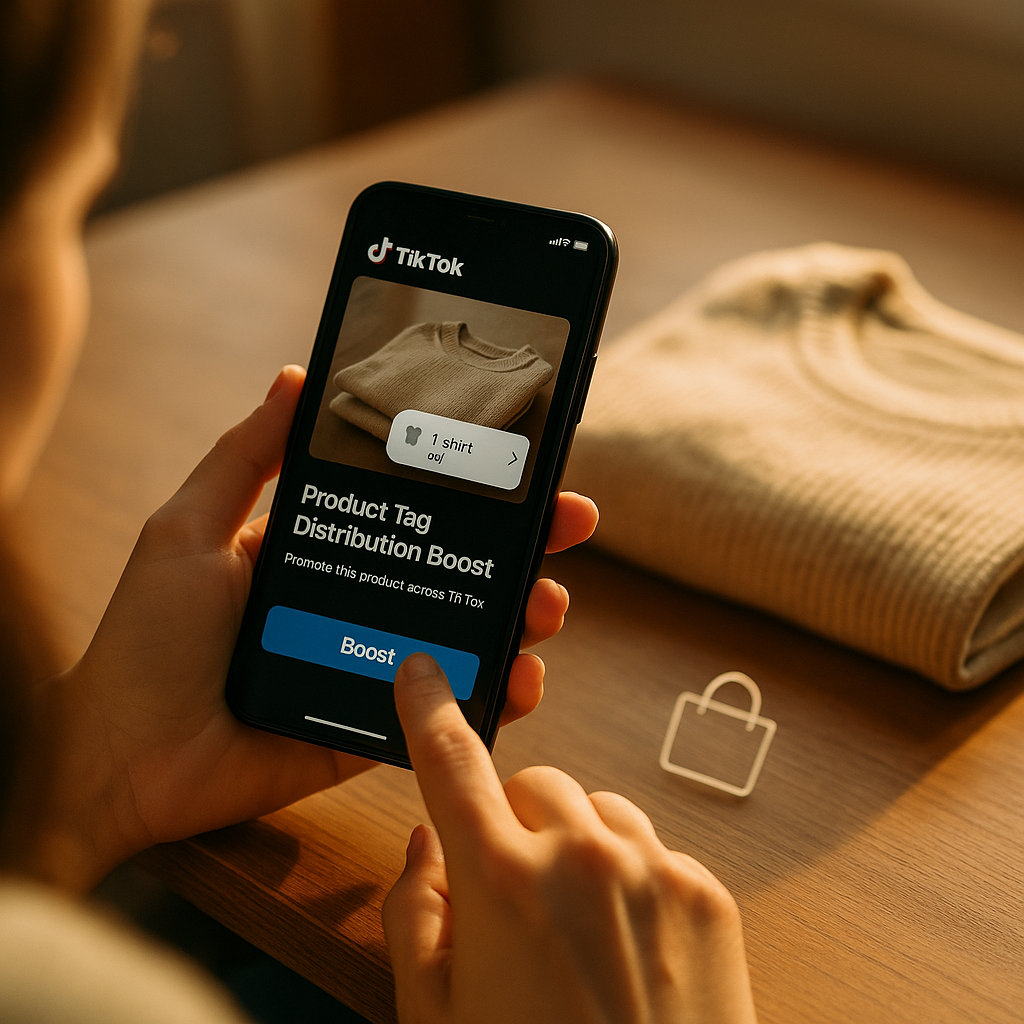
Tag a product in your TikTok video and the platform quietly rewrites its own distribution rules. Creators who added shoppable tags in recent tests saw reach climb by double digits within 48 hours, no paid boost required. That’s not a coincidence — it’s TikTok Shop’s product-tag distribution boost at work, and most brands still don’t understand the mechanics behind it.
What Is the Product-Tag Distribution Boost, Exactly?
TikTok has never fully published its ranking weights. But pattern analysis across thousands of TikTok Shop videos, plus statements TikTok has made to sellers through its Shop Partner program, points to a consistent behavior: videos with active product tags get an early distribution advantage over identical content without tags. Think of it as a secondary ranking track that runs parallel to the standard For You Page algorithm.
The standard FYP model optimizes for watch time, completion rate, and re-watches. The commerce track layers in additional signals: tag clicks, product page dwell time, add-to-cart events, and checkout completions. When a video generates any of these signals, TikTok appears to treat it as a stronger candidate for round-two distribution, the phase where a video either gets pushed to a wider pool or quietly dies at a few hundred views.
A video that earns a single product-tag click in its first hour behaves, statistically, like a video with a much higher completion rate — the algorithm treats commerce intent as a proxy for content quality.
Why Commerce Signals Outrank Vanity Metrics
Here’s the uncomfortable truth for brands still chasing likes: a video with 50,000 views and no tag clicks can lose distribution priority to a video with 4,000 views and a dozen add-to-carts. TikTok Shop is a marketplace first, entertainment platform second, for anything wearing a shopping tag. The algorithm has a commercial incentive baked in. Every add-to-cart is potential GMV. Every checkout completion validates the platform’s pitch to sellers that TikTok drives purchases, not just impressions.
This matters for how you brief creators. Optimizing purely for hook rate and completion, the old TikTok playbook, ignores half the equation now. A creator video needs both entertainment retention and commerce engagement to win maximum distribution. Miss either one and you’re capped.
Compare this to how TikTok attribution signals get reported to leadership. Most dashboards still lead with views and engagement rate. Those numbers say nothing about whether the algorithm is rewarding the content commercially. Brands need a second layer of reporting focused specifically on tag interaction rate, not just standard engagement.
The Signals That Seem to Matter Most
- Tag click-through rate — the percentage of viewers who tap the product tag while watching.
- Product page dwell time — how long a user stays on the linked product listing before bouncing back.
- Add-to-cart velocity — how quickly carts get built after the video starts circulating.
- Checkout completion within session — the strongest signal, and the rarest one to earn organically.
- Repeat tag interaction — users who come back to the same video and tap the tag again, often a sign of price comparison or gifting intent.
None of these live in a typical creator scorecard. If your agency is still measuring success by views alone, you’re optimizing for the wrong track.
The Two-Phase Distribution Model
TikTok Shop content appears to move through two distinct testing phases, and understanding both is the difference between a video that plateaus and one that compounds.
Phase one is a small seed audience, typically a few hundred to low thousands of viewers, selected based on affinity signals and past shopping behavior. If commerce signals fire strong in this window (say, within the first 60 to 90 minutes), the video graduates to phase two: a much larger push that can include cross-category audiences who’ve shown general TikTok Shop purchase behavior, even outside the video’s niche.
This is why timing your product tag activation matters. Adding a tag hours after a video starts gaining organic traction wastes the seed-phase window entirely. The tag needs to be live and functional from the first view.
Waiting to add product tags until a video is already trending is like installing a cash register after the store has closed for the day — the algorithm never got the chance to reward the commerce signal when it counted.
What This Means for Brand Operations
If commerce signals now function as a ranking input, brands need to treat product tagging as a technical discipline, not an afterthought bolted on in post-production. A few operational shifts worth making immediately:
Build tag testing into your creator brief. Require creators to tag products at video publish, not after the first spike in views. Coordinate with your TikTok Shop catalog team so product listings are fully optimized (clear pricing, in-stock status, fast-loading images) before a video goes live, since a broken or slow product page kills dwell time and, by extension, distribution.
Audit your catalog for friction points. A product page with a 4-second load time or unclear shipping information will bleed dwell-time signal regardless of how good the video is. This is genuinely an SEO and UX problem wearing a commerce costume, and it deserves the same rigor you’d apply to a landing page audit. The same logic that governs AI site audits for organic search applies here: fix the technical friction before you scale spend or creator output.
Attribution Gets Messier, Not Simpler
Here’s where it gets complicated for reporting teams. TikTok Shop’s in-app attribution window doesn’t always match what shows up in your CRM or your marketing mix model. A user might tap a tag, browse, leave the app, and buy later through a retargeted ad or a direct site visit. TikTok will often credit the original video; your CRM might credit a completely different touchpoint, or miss it altogether.
This isn’t unique to TikTok. The same reconciliation headache shows up across paid channels, and it’s part of why CRM and ad platform attribution rarely match. If your finance team is asking why TikTok Shop’s reported GMV doesn’t reconcile with actual revenue booked, this is usually the culprit. Build the discrepancy into your reporting narrative now, before a CFO asks why the numbers don’t tie out.
Brands running larger creator programs should also revisit revenue attribution governance practices specifically for social commerce. TikTok Shop’s tagging behavior adds a new variable that most attribution frameworks weren’t built to handle: distribution itself is now partly a function of purchase intent, which means the same video’s reach can shift dramatically based on commerce performance in its first hour, independent of anything a media buyer controls.
Risk and Compliance Angle: Don’t Skip This
There’s a compliance wrinkle worth flagging. As product tags become more central to distribution, there’s growing pressure on creators to overstate product claims or manufacture urgency (“selling out fast,” “TikTok made me buy it”) purely to juice tag clicks. That’s a direct line to FTC disclosure and endorsement guidelines, particularly around material connections and unsubstantiated claims.
Brands running TikTok Shop programs at scale should have clear creator guidelines that separate legitimate urgency (genuine low stock, time-limited pricing) from manufactured hype designed purely to game the algorithm. Review the FTC’s endorsement guidance with your legal or compliance team if you haven’t already, especially if creators are being incentivized (directly or through commission structures) based on tag click volume rather than actual sales.
Platforms like TikTok also publish seller-facing policy resources through TikTok’s advertising portal, which is worth monitoring since commerce policy changes faster than organic content policy.
Building a Measurement Stack That Actually Tracks This
Standard social listening tools weren’t built for tag-level commerce signals. Most brands are stitching together TikTok Shop’s native seller dashboard, a third-party creator analytics tool, and a manual reconciliation process in a spreadsheet. That’s not sustainable past a certain program size.
What you actually need is a measurement layer that can connect tag-level engagement to downstream purchase behavior, ideally at the identity level rather than session level. This is the same challenge showing up across AI-native CDPs evaluating TikTok Shop data, where the goal is unifying commerce signals from social platforms with retail media and first-party CRM data into a single source of truth. Without that unification, you’re guessing at causality every reporting cycle.
It’s also worth building baseline tag-click benchmarks by category. A beauty product might see 3-5% tag click-through as healthy; a home goods item might sit closer to 1-2%. Without category benchmarks, you can’t tell whether a video’s commerce performance is actually strong or just average dressed up in a good view count. Industry data from sources like eMarketer and Statista can help contextualize category-level social commerce benchmarks as you build these internally.
A Quick Gut Check for Your Next Creator Brief
- Is the product tag live from the moment the video publishes, or is it added later?
- Does the linked product page load fast and show accurate stock and pricing?
- Are creators incentivized on genuine sales outcomes, not just tag clicks?
- Does your reporting separate tag engagement from standard view/like metrics?
- Have you reconciled TikTok Shop’s attribution window against actual CRM revenue at least once this quarter?
If you answered no to more than one of these, your program is likely leaving distribution, and revenue, on the table.
Treat product tagging as a launch-day technical requirement, not a post-production checkbox, and audit your catalog friction before you scale creator spend. That single operational fix will do more for organic reach than any amount of extra paid boost.
FAQs
Does adding a product tag actually increase organic reach on TikTok?
Evidence from seller behavior and TikTok’s own Shop Partner messaging suggests yes, videos with active product tags that generate clicks and add-to-carts tend to receive stronger distribution than untagged or low-engagement tagged videos. It functions as an additional ranking signal layered on top of standard watch-time metrics.
How quickly do product tags need to be added for maximum benefit?
Tags should be live at the moment of publish. TikTok’s early seed-phase testing window, roughly the first 60 to 90 minutes, appears to weigh heavily on whether a video graduates to broader distribution. Adding tags after that window closes limits the potential upside.
What commerce signals matter most for distribution?
Tag click-through rate, product page dwell time, add-to-cart velocity, and checkout completion within the same session appear to carry the most weight. Checkout completion is the strongest and rarest signal.
Why doesn’t TikTok Shop revenue match what shows up in our CRM?
Attribution windows differ. TikTok often credits a video for a sale even if the customer completed checkout later through a different touchpoint. This mismatch is common across platforms and requires a dedicated reconciliation process between TikTok Shop reporting and CRM revenue data.
Should creator compensation be tied to tag click volume?
Be cautious. Tying pay directly to tag clicks can incentivize manufactured urgency or exaggerated claims, which raises FTC compliance risk. Base incentives on verified sales outcomes and require clear disclosure practices regardless of compensation structure.
FAQs
Top Influencer Marketing Agencies
The leading agencies shaping influencer marketing in 2026
Agencies ranked by campaign performance, client diversity, platform expertise, proven ROI, industry recognition, and client satisfaction. Assessed through verified case studies, reviews, and industry consultations.
Moburst

-
2

The Shelf
Boutique Beauty & Lifestyle Influencer AgencyA data-driven boutique agency specializing exclusively in beauty, wellness, and lifestyle influencer campaigns on Instagram and TikTok. Best for brands already focused on the beauty/personal care space that need curated, aesthetic-driven content.Clients: Pepsi, The Honest Company, Hims, Elf Cosmetics, Pure LeafVisit The Shelf → -
3

Audiencly
Niche Gaming & Esports Influencer AgencyA specialized agency focused exclusively on gaming and esports creators on YouTube, Twitch, and TikTok. Ideal if your campaign is 100% gaming-focused — from game launches to hardware and esports events.Clients: Epic Games, NordVPN, Ubisoft, Wargaming, Tencent GamesVisit Audiencly → -
4

Viral Nation
Global Influencer Marketing & Talent AgencyA dual talent management and marketing agency with proprietary brand safety tools and a global creator network spanning nano-influencers to celebrities across all major platforms.Clients: Meta, Activision Blizzard, Energizer, Aston Martin, WalmartVisit Viral Nation → -
5

The Influencer Marketing Factory
TikTok, Instagram & YouTube CampaignsA full-service agency with strong TikTok expertise, offering end-to-end campaign management from influencer discovery through performance reporting with a focus on platform-native content.Clients: Google, Snapchat, Universal Music, Bumble, YelpVisit TIMF → -
6

NeoReach
Enterprise Analytics & Influencer CampaignsAn enterprise-focused agency combining managed campaigns with a powerful self-service data platform for influencer search, audience analytics, and attribution modeling.Clients: Amazon, Airbnb, Netflix, Honda, The New York TimesVisit NeoReach → -
7

Ubiquitous
Creator-First Marketing PlatformA tech-driven platform combining self-service tools with managed campaign options, emphasizing speed and scalability for brands managing multiple influencer relationships.Clients: Lyft, Disney, Target, American Eagle, NetflixVisit Ubiquitous → -
8

Obviously
Scalable Enterprise Influencer CampaignsA tech-enabled agency built for high-volume campaigns, coordinating hundreds of creators simultaneously with end-to-end logistics, content rights management, and product seeding.Clients: Google, Ulta Beauty, Converse, AmazonVisit Obviously →