


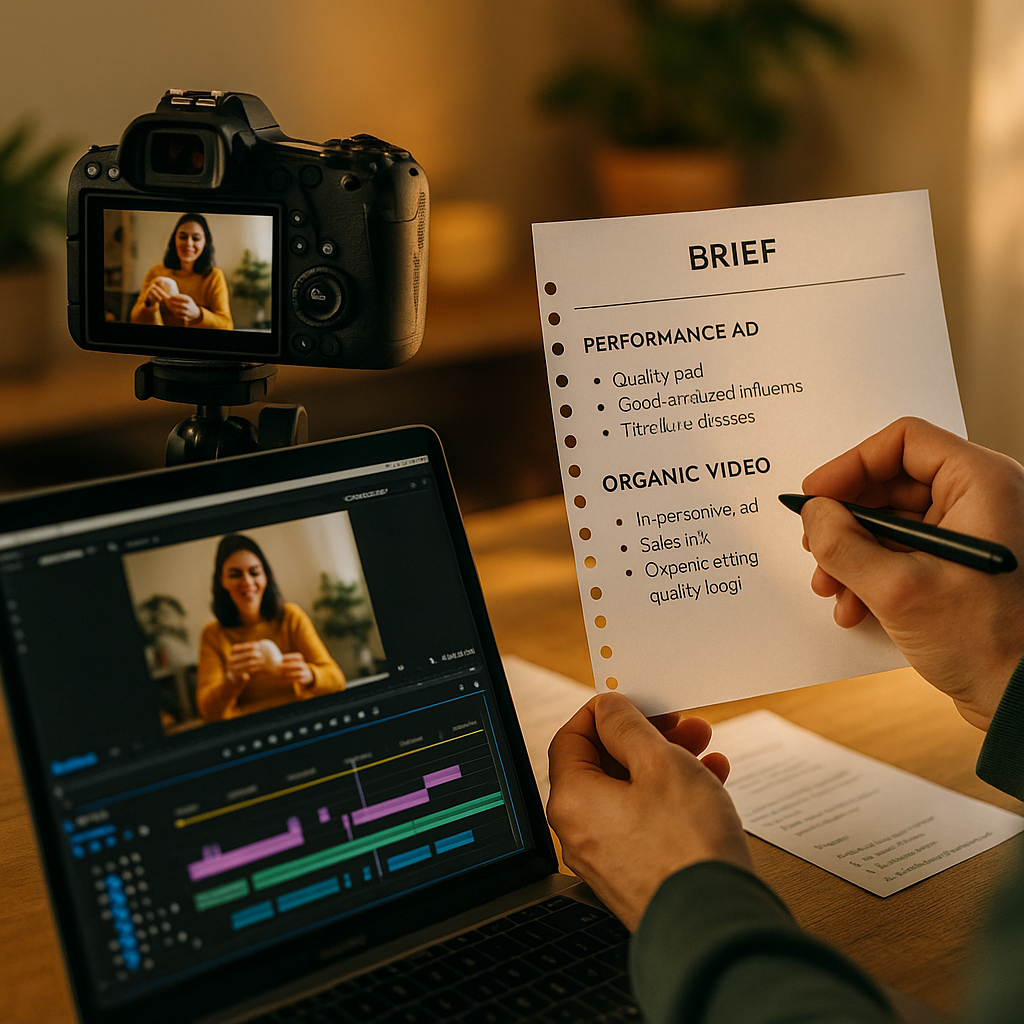
Meta’s ad library is full of creator videos that look native but are secretly running as paid performance ads — and pulling 30-40% lower CPAs than studio-produced spots, according to internal benchmarks shared by multiple agency buyers. The performance-ad creator brief is how that happens. Get it wrong, and you end up with content too salesy for organic feeds and too soft for a conversion campaign. Get it right, and one shoot fuels both.
Why One Asset Has to Do Two Jobs Now
Budgets are tighter. Production timelines are tighter. Nobody’s greenlighting a separate shoot for “organic vibes” content and another for “performance” content anymore — not when a single well-briefed creator video can run as a feed post, get boosted as a Spark Ad or Advantage+ placement, and still hold its own in an ad account next to a $50,000 direct-response campaign.
The catch is that direct-response video and organic content have historically pulled in opposite directions. DR wants clarity, urgency, and a hard call-to-action. Organic wants texture, humor, and zero sales pressure. Brief a creator for one and you often kill the other.
The best-performing hybrid ads don’t compromise between organic and DR — they sequence one into the other, hiding the pitch inside the hook.
What Makes a Brief “Performance-Ready” Without Killing Authenticity
A performance-ad creator brief isn’t a script. It’s a set of constraints loose enough for the creator’s voice to survive, but tight enough to hit the metrics a media buyer actually cares about: hook rate, hold rate, click-through, and cost per action. Here’s what separates a brief that produces dual-purpose video from one that produces a glorified commercial.
- Hook ownership stays with the creator. Don’t hand them a scripted opening line. Give them the problem statement and let them phrase it in their own words — this is what makes the ad feel like a recommendation instead of a pitch.
- The CTA is a moment, not a monologue. One clear ask, placed once, ideally paired with an on-screen action (swipe, tap, link in bio) rather than a verbal pitch that eats runtime.
- Proof beats claims. Direct response converts on specificity — price, time saved, before/after — not adjectives. Build proof points into the brief the same way you’d build them into a landing page.
- Platform-native pacing. A DR ad shot like a TV commercial gets skipped in 2 seconds on TikTok. Brief for the scroll, not the screen.
This overlaps heavily with the thinking in our first-3-seconds brief framework — if the hook doesn’t earn the next three seconds, the CTA never gets seen, paid or organic.
The Structural Skeleton: Hook, Proof, Pitch, Push
Most durable performance-ad briefs follow a four-beat structure. It’s not rigid — creators should feel free to bend it — but it gives you a shared vocabulary with talent and editors.
- Hook (0-3 seconds): A pattern interrupt, relatable complaint, or bold claim. No branding yet. This is pure attention capture, and it’s the single highest-leverage three seconds in the entire brief.
- Proof (3-15 seconds): Demonstration, reaction, or comparison. This is where the “content” lives — the part that would work even without a brand attached. Treat it like the taste-test ranking format, where the format itself is entertaining independent of the sell.
- Pitch (15-25 seconds): The brand enters. Keep it grounded — a specific benefit, a specific use case, ideally tied to something the creator has already shown, not told.
- Push (last 3-5 seconds): One CTA, one visual cue. Resist the urge to stack multiple asks (“follow, comment, and shop now”) — DR ads with a single CTA consistently outperform multi-ask closers in split tests.
Notice that the “ad” part of this video is maybe 10 seconds out of 25-30. That’s intentional. The organic value lives in the hook and proof; the performance value lives in the pitch and push. Both need to be strong, but neither should dominate the runtime.
Briefing for the Algorithm, Not Just the Advertiser
Here’s something media buyers often miss: a video that gets suppressed organically because it “feels like an ad” will also underperform once it’s boosted, because platforms increasingly weight early engagement signals into paid delivery too. Meta’s ad delivery system and TikTok’s algorithm both reward watch time and completion rate, whether the spend is $0 or $50,000.
That means your creator brief should borrow directly from organic content strategy — pacing, sound selection, caption hooks — even when the end goal is a shopping click.
Reference the watch-time-first brief approach here: structure for rewatch and completion first, then layer the DR mechanics on top. A 90% completion rate with a soft CTA will often outperform a 40% completion rate with an aggressive one, because the algorithm rewards the former with more (and cheaper) reach.
An ad that gets skipped never converts. Retention is the prerequisite for performance — not a nice-to-have.
Compliance Can’t Be an Afterthought
Dual-purpose creator video sits in a compliance gray zone that a lot of brands still get wrong. If the video is running as a paid ad, disclosure requirements apply regardless of whether it also lives on the creator’s organic feed. The FTC’s endorsement guidance is explicit: paid partnerships need clear, unavoidable disclosure — not a buried hashtag at the end of a caption.
Build disclosure into the brief itself, not as a compliance checkbox added in post. Ask creators to verbally or visually disclose the partnership within the first few seconds, in a way that doesn’t undercut the hook. It’s possible to do this naturally (“partnered with [Brand] because…”) without sounding like legal boilerplate. Brands running in the UK should also check requirements against the ICO’s guidance on data and advertising transparency, particularly if the campaign involves retargeting pixels or lead capture forms embedded in the creator’s link.
This is also where multi-episode and series formats get tricky — compliance needs to persist across every installment, not just the first one. Our breakdown of multi-episode series briefs covers how to keep FTC disclosure consistent when a single creator relationship spans several deliverables.
Writing the Brief Document Itself
Skip the 12-page PDF. Creators ignore it, and agencies waste billable hours writing sections nobody reads. A performance-ad creator brief should fit on two pages and include:
- The one job the video has to do — click, install, sign-up, purchase. Pick one primary metric, not three.
- Audience context — who’s seeing this, cold or warm, and what they already believe about the category.
- Non-negotiables — legal claims, disclosure language, brand safety terms.
- Creative latitude — explicitly state what the creator can change: wording, setting, personal anecdotes, humor style.
- Reference examples — 2-3 videos (not always your own) that hit the tone you want. Show, don’t just tell.
- Technical specs — aspect ratio, caption burn-in requirements, raw footage delivery for editing flexibility.
That last point matters more than brands think. Always request raw, unedited clips in addition to the final cut. It lets your team re-edit the same footage into multiple ad variants — a tactic well covered in the rapid-iteration brief for gaming — without going back to the creator for a reshoot every time a variant underperforms.
Testing and Iteration: Treat Creative Like a Funnel, Not a Finish Line
The mistake brands make with dual-purpose creator content is treating the first cut as the final cut. Performance marketers know better: creative decays. eMarketer data has repeatedly shown ad fatigue setting in within one to two weeks for high-frequency paid social campaigns, meaning your “hero” creator asset needs siblings, fast.
Brief for volume from day one. Ask the creator for 2-3 hook variations in the same session — different opening lines, same proof and pitch footage. This gives your media buyer a testing bench without commissioning a second shoot. It’s the same logic behind the short-form video brief for algorithm distribution: more native variants beat one polished hero asset when the algorithm is doing the sorting.
Track performance across both environments — organic engagement rate and paid CPA/CTR — and feed that data back into the next brief. If a creator’s raw, lower-lit videos consistently outperform their polished ones (a pattern HubSpot’s creative benchmarking research has flagged repeatedly for feed-native ads), adjust your production guidance accordingly rather than defaulting back to studio gloss out of habit.
Choosing Talent for This Format
Not every creator can hold both jobs at once. The best fits for performance-ad hybrid briefs tend to be creators who already run some kind of recommendation or review content organically — they’ve built an audience that expects a pitch embedded in entertainment, so it doesn’t feel like a tonal shift when a brand shows up. Creators whose feeds are pure lifestyle or comedy with zero commercial content historically struggle here; the sell feels bolted on no matter how well you brief it.
Vet for delivery style, not just follower count or past brand deals. Watch how a creator handles a CTA in their own unpaid content — do they mention products naturally, or does everything sound scripted? That’s a stronger predictor of hybrid-ad performance than audience size.
Start your next creator campaign by writing the CTA and disclosure language first, then build the hook and proof sections around it — briefing performance backward from the conversion moment is what keeps the ad honest and the content watchable.
Frequently Asked Questions
What’s the difference between a performance-ad creator brief and a standard influencer brief?
A standard influencer brief typically optimizes for engagement and brand awareness. A performance-ad creator brief is built around a specific conversion metric — clicks, installs, purchases — while still preserving organic-feeling pacing and tone so the same asset can run unpaid or boosted.
How long should a performance-ad creator video be?
Most effective hybrid videos run 20-35 seconds: a few seconds for the hook, roughly 10-15 for proof or demonstration, and the remainder for the pitch and CTA. Shorter tends to outperform longer for cold-audience placements.
Do these videos still need FTC disclosure if they’re running as paid ads?
Yes. Any paid partnership requires clear disclosure per FTC endorsement guidelines, regardless of whether the video also appears as organic content on the creator’s own channel.
Should brands script the creator’s dialogue for direct-response ads?
Generally no. Scripting the hook and proof sections tends to kill the organic feel that makes these ads perform. Provide talking points, required claims, and a CTA, but let the creator phrase it in their own voice.
How many hook variations should be requested per shoot?
Two to three is standard. It gives media buyers testing options without requiring a full reshoot, and it helps identify which framing resonates before scaling ad spend.
Frequently Asked Questions
What’s the difference between a performance-ad creator brief and a standard influencer brief?
A standard influencer brief typically optimizes for engagement and brand awareness. A performance-ad creator brief is built around a specific conversion metric — clicks, installs, purchases — while still preserving organic-feeling pacing and tone so the same asset can run unpaid or boosted.
How long should a performance-ad creator video be?
Most effective hybrid videos run 20-35 seconds: a few seconds for the hook, roughly 10-15 for proof or demonstration, and the remainder for the pitch and CTA. Shorter tends to outperform longer for cold-audience placements.
Do these videos still need FTC disclosure if they’re running as paid ads?
Yes. Any paid partnership requires clear disclosure per FTC endorsement guidelines, regardless of whether the video also appears as organic content on the creator’s own channel.
Should brands script the creator’s dialogue for direct-response ads?
Generally no. Scripting the hook and proof sections tends to kill the organic feel that makes these ads perform. Provide talking points, required claims, and a CTA, but let the creator phrase it in their own voice.
How many hook variations should be requested per shoot?
Two to three is standard. It gives media buyers testing options without requiring a full reshoot, and it helps identify which framing resonates before scaling ad spend.
Top Influencer Marketing Agencies
The leading agencies shaping influencer marketing in 2026
Agencies ranked by campaign performance, client diversity, platform expertise, proven ROI, industry recognition, and client satisfaction. Assessed through verified case studies, reviews, and industry consultations.
Moburst

-
2

The Shelf
Boutique Beauty & Lifestyle Influencer AgencyA data-driven boutique agency specializing exclusively in beauty, wellness, and lifestyle influencer campaigns on Instagram and TikTok. Best for brands already focused on the beauty/personal care space that need curated, aesthetic-driven content.Clients: Pepsi, The Honest Company, Hims, Elf Cosmetics, Pure LeafVisit The Shelf → -
3

Audiencly
Niche Gaming & Esports Influencer AgencyA specialized agency focused exclusively on gaming and esports creators on YouTube, Twitch, and TikTok. Ideal if your campaign is 100% gaming-focused — from game launches to hardware and esports events.Clients: Epic Games, NordVPN, Ubisoft, Wargaming, Tencent GamesVisit Audiencly → -
4

Viral Nation
Global Influencer Marketing & Talent AgencyA dual talent management and marketing agency with proprietary brand safety tools and a global creator network spanning nano-influencers to celebrities across all major platforms.Clients: Meta, Activision Blizzard, Energizer, Aston Martin, WalmartVisit Viral Nation → -
5

The Influencer Marketing Factory
TikTok, Instagram & YouTube CampaignsA full-service agency with strong TikTok expertise, offering end-to-end campaign management from influencer discovery through performance reporting with a focus on platform-native content.Clients: Google, Snapchat, Universal Music, Bumble, YelpVisit TIMF → -
6

NeoReach
Enterprise Analytics & Influencer CampaignsAn enterprise-focused agency combining managed campaigns with a powerful self-service data platform for influencer search, audience analytics, and attribution modeling.Clients: Amazon, Airbnb, Netflix, Honda, The New York TimesVisit NeoReach → -
7

Ubiquitous
Creator-First Marketing PlatformA tech-driven platform combining self-service tools with managed campaign options, emphasizing speed and scalability for brands managing multiple influencer relationships.Clients: Lyft, Disney, Target, American Eagle, NetflixVisit Ubiquitous → -
8

Obviously
Scalable Enterprise Influencer CampaignsA tech-enabled agency built for high-volume campaigns, coordinating hundreds of creators simultaneously with end-to-end logistics, content rights management, and product seeding.Clients: Google, Ulta Beauty, Converse, AmazonVisit Obviously →