


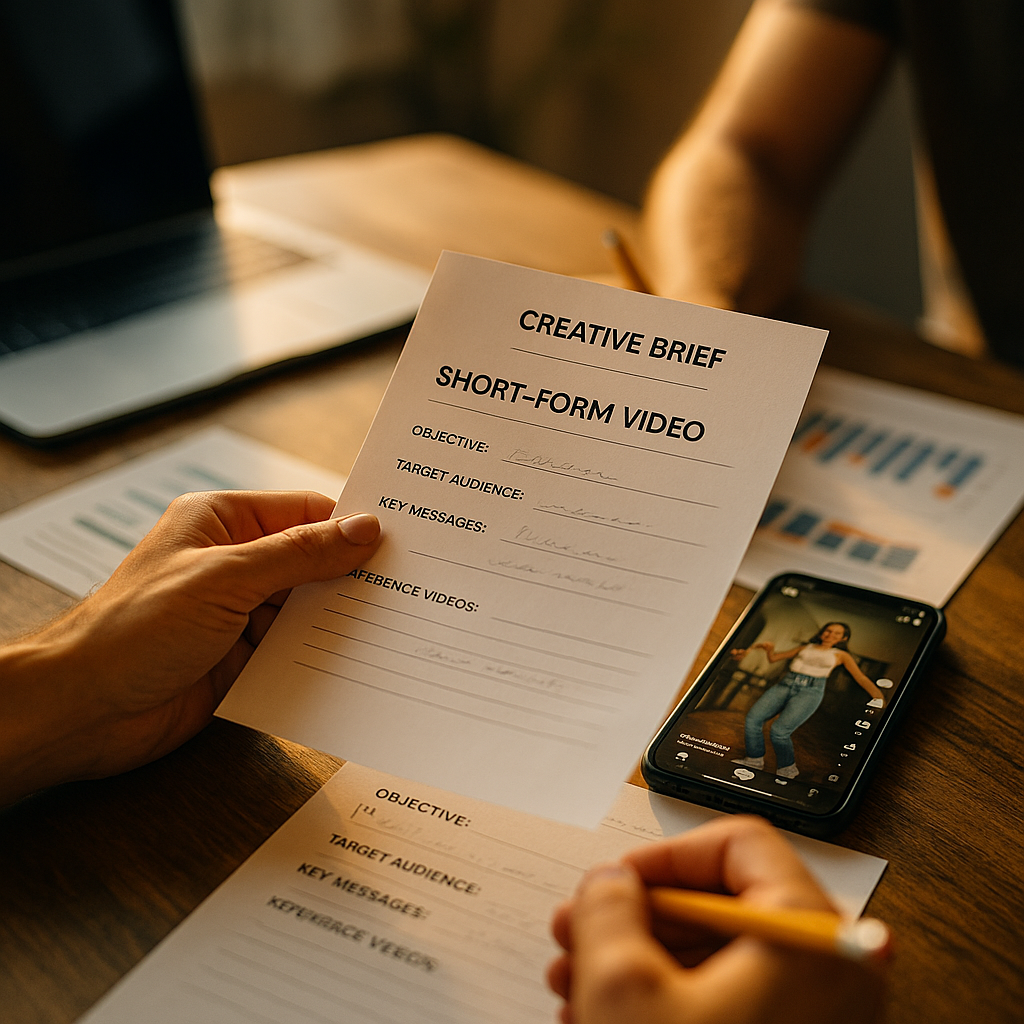
Organic reach on TikTok and Instagram Reels has been quietly cut in half for most brand accounts over the past two years. Meta and TikTok now openly favor content that proves itself in tiny test pools before releasing it wider. So the question isn’t “is this a good ad” anymore. It’s: does this survive the first 500 views? A short-form video creative brief built for that reality looks nothing like the briefs marketers wrote three years ago.
The Algorithm Doesn’t Care About Your Brand Guidelines
Here’s the uncomfortable truth: platforms have stopped distributing content based on who posted it. They distribute based on what happens in the first few seconds after it’s posted. TikTok’s recommendation system, Instagram’s Reels ranking, even YouTube Shorts — all of them run a forced meritocracy. Your content gets shown to a small sample audience, the platform measures completion rate, rewatches, and shares, and then it decides whether to push further or let the post die quietly at 300 views.
This is what “force-fed algorithm” distribution actually means. Nobody is guaranteed reach. Not creators with a million followers, not brands with seven-figure ad budgets. The algorithm force-feeds your content to a cold sample, and if that sample doesn’t react, distribution stops. Full stop.
A branded post from a 500K-follower creator and a branded post from a 5K-follower creator now compete on nearly identical terms in that first test pool. Follower count buys you almost nothing at the moment that matters most.
Most brand creative briefs still treat distribution as a given — as if posting is the hard part and views just happen. That assumption is costing brands real money. If your brief doesn’t explicitly direct creators toward surviving the algorithmic test, you’re paying creator rates for content that never leaves the sample pool.
What a Distribution-First Brief Actually Requires
Traditional briefs specify message, tone, key selling points, and legal disclosures. All still necessary. But a distribution-first brief adds a second layer entirely focused on retention mechanics — the specific structural choices that determine whether a platform’s algorithm keeps pushing a video or buries it.
That means briefing creators on:
- Hook construction for the first 1.5 seconds. Not “grab attention” — literal shot direction. Text-on-screen at frame one, a visual pattern interrupt, or a question that can’t be answered by scrolling past.
- Pacing cuts every 2-4 seconds. Long static shots kill completion rate. Direct creators to plan cut points during scripting, not editing.
- Loop-friendly endings. A final frame that connects back to the opening, encouraging rewatch. Rewatch rate is one of the strongest signals TikTok’s algorithm rewards, according to TikTok’s own creator guidance on the TikTok for Business platform.
- Native imperfection. Overly polished ads get suppressed as “ad-like” by pattern-matching systems. This is the whole premise behind the shift toward casual over polished content — and it’s not an aesthetic preference, it’s a distribution tactic.
None of this is creative fluff. It’s operational instruction, the same way you’d brief a paid media buyer on bid strategy. Treat the algorithm as a stakeholder in the creative process, because functionally, it is.
Retention Signals Beat Reach Metrics in the Brief Itself
Ask any performance marketing lead what KPI they report to leadership, and most will still say reach or impressions. That’s a legacy metric from an era of guaranteed distribution. In a force-fed environment, the metric that actually predicts campaign success is average watch time as a percentage of total video length.
Sprout Social’s platform research consistently shows completion rate as the strongest early predictor of a post’s algorithmic trajectory across TikTok, Reels, and Shorts (see Sprout Social’s social media benchmarks). If a brief doesn’t set a target completion rate — say, 55% or higher for a 20-second clip — the creator has no way to know whether they’ve succeeded structurally, only whether the brand liked the vibe.
This is a mindset shift for brand teams used to approving creative on subjective grounds. Approve based on structure and pacing first. Brand fit second. If it doesn’t survive the algorithm, brand fit is irrelevant — nobody sees it.
Build the Brief Around a Watch-Time Target, Not a Vibe
Concretely, this means your brief should specify:
- Target video length (shorter isn’t always better; 20-34 seconds often outperforms sub-10-second clips for completion rate on TikTok, per platform-reported trends)
- A named hook technique the creator will use, chosen from a short list you provide
- A defined “value delivery” moment — the point where the viewer gets the payoff they were hooked with
- An instruction to test 2-3 hook variants if the creator is comfortable shooting multiple opens
This structural approach mirrors what we’ve laid out in watch-time-first briefing for TikTok, and it applies just as directly to Reels and Shorts, where similar completion-based ranking logic governs distribution.
Give Creators Creative Room, But Inside Guardrails
Here’s where a lot of brand teams overcorrect. They read “the algorithm rewards authenticity” and conclude the brief should just say “be yourself, shoot whatever feels natural.” That’s not a brief, that’s an abdication.
Creators need structural guardrails and message discipline, combined with genuine latitude on delivery, wardrobe, location, and personal voice. The brief’s job is to constrain the things that affect distribution and compliance, while staying loose on everything else.
Think of it like a sports play call. The formation and the route are fixed. How the receiver reads the defense in real time is not. Direct the structure, trust the performer.
This is also where FTC compliance intersects with creative freedom. The more improvisational a piece feels, the more critical it becomes to lock disclosure requirements into the brief itself, rather than leaving them to creator discretion. The FTC’s endorsement guidance hasn’t changed just because platforms have — disclosure still needs to be clear, conspicuous, and placed before the viewer scrolls away, not buried in a caption nobody reads.
Format Choice Is a Distribution Lever, Not Just a Creative One
Some formats are structurally built to win algorithmic tests better than others, independent of execution quality. A ranking or countdown format creates natural rewatch incentive. A “customer cameo” format built around real user footage tends to read as native rather than promotional, which matters enormously for suppression avoidance — see the approach detailed in the customer cameo format guide.
Similarly, micro-tutorial loop formats are engineered specifically to trigger rewatch behavior, which is one of the highest-weighted signals in TikTok’s recommendation system. If your brief specifies a format like this at the concept stage, you’re stacking distribution odds in your favor before a single frame is shot.
Multi-part or series-based briefs offer another lever entirely: they train the algorithm to associate a creator’s account with a topic, improving distribution on subsequent posts. The mechanics are covered well in our breakdown of multi-episode creator series briefs, which also happens to simplify FTC disclosure tracking across a campaign arc.
What This Means for Budget Allocation and Testing
If distribution is now algorithmically gated rather than guaranteed, the operational implication is clear: brands need to brief for volume and variation, not a single “hero” asset. eMarketer’s creator economy research has repeatedly flagged that brands running multiple creative variants per campaign see materially better cost-per-result than single-asset campaigns, because more shots at the algorithmic test pool means more chances one clears the bar (see eMarketer’s creator marketing coverage).
Practically, that means your brief should authorize creators to shoot 2-3 hook variations per core script, rather than one polished take. It costs marginally more in creator time. It’s far cheaper than paying full rate for content that dies in the test pool.
Budget for variation, not perfection. One flawless video that never clears the algorithmic test pool is worth less than three rough ones, one of which breaks through.
This also changes how you evaluate creator partners at the sourcing stage. A creator’s historical completion rates and rewatch performance are now more predictive of campaign ROI than raw follower count or even engagement rate. If you’re not asking creators for that data during vetting, you’re flying blind. HubSpot’s marketing research has noted a similar trend across paid social generally: performance history is displacing audience size as the primary vetting criterion for marketers building creator rosters, a shift you can read more about via HubSpot’s marketing research hub.
Where Brands Get This Wrong
The most common failure isn’t bad creative. It’s a brief that never mentions distribution mechanics at all, leaving structural decisions entirely to the creator’s instinct. Instinct is valuable, but it’s not a substitute for platform literacy that most brand marketing teams have not yet built in-house.
The second most common failure: briefs so tightly scripted that they strip out the native, imperfect quality that helps content survive suppression filters. Overcorrecting toward control kills the exact signal you need.
Get both wrong simultaneously — vague on structure, rigid on delivery — and you end up with content that’s neither strategically sound nor authentically performing. That’s the expensive middle ground most campaigns land in by accident.
Cost efficiency matters here too. Briefs that maximize reusable footage across formats reduce the number of dedicated shoots needed per campaign, a principle covered thoroughly in remixable asset briefing. Pair that operational efficiency with algorithm-aware structure, and you get a brief that’s both cheaper to execute and more likely to actually get seen.
Next step: audit your last five creator briefs. If none of them mention hook timing, target completion rate, or rewatch mechanics, you’re briefing for a distribution environment that no longer exists.
FAQs
What is a distribution-first creative brief?
It’s a creator brief that directs structural elements proven to influence algorithmic distribution — hook timing, pacing, loop endings, native tone — in addition to standard messaging and brand guidance. It treats surviving the platform’s initial test pool as a primary objective, not an afterthought.
Why is organic reach declining on TikTok and Instagram Reels?
Both platforms now use sample-based distribution, showing new content to a small test audience before deciding whether to expand reach. As competition for attention grows and more branded content floods these platforms, the bar for clearing that initial test has risen, shrinking effective organic reach for accounts that don’t optimize for retention signals.
Does follower count still matter for creator selection?
It matters less than it used to for organic distribution. Completion rate, rewatch rate, and historical retention performance are now stronger predictors of whether a creator’s content will clear algorithmic test pools, regardless of audience size.
How do I brief for FTC compliance without killing the casual, native feel creators need?
Lock disclosure placement and wording into the brief as a non-negotiable structural requirement, positioned early in the video before the viewer can scroll past. Everything else — delivery, wording of the organic content, personal style — can remain flexible without compromising compliance.
Should brands request multiple hook variants from creators?
Yes. Since the algorithm tests content in small batches before wider release, having 2-3 hook variants per core asset increases the odds that at least one clears the test pool. This is generally more cost-effective than investing all budget in a single polished take.
FAQs
What is a distribution-first creative brief?
It’s a creator brief that directs structural elements proven to influence algorithmic distribution — hook timing, pacing, loop endings, native tone — in addition to standard messaging and brand guidance. It treats surviving the platform’s initial test pool as a primary objective, not an afterthought.
Why is organic reach declining on TikTok and Instagram Reels?
Both platforms now use sample-based distribution, showing new content to a small test audience before deciding whether to expand reach. As competition for attention grows and more branded content floods these platforms, the bar for clearing that initial test has risen, shrinking effective organic reach for accounts that don’t optimize for retention signals.
Does follower count still matter for creator selection?
It matters less than it used to for organic distribution. Completion rate, rewatch rate, and historical retention performance are now stronger predictors of whether a creator’s content will clear algorithmic test pools, regardless of audience size.
How do I brief for FTC compliance without killing the casual, native feel creators need?
Lock disclosure placement and wording into the brief as a non-negotiable structural requirement, positioned early in the video before the viewer can scroll past. Everything else — delivery, wording of the organic content, personal style — can remain flexible without compromising compliance.
Should brands request multiple hook variants from creators?
Yes. Since the algorithm tests content in small batches before wider release, having 2-3 hook variants per core asset increases the odds that at least one clears the test pool. This is generally more cost-effective than investing all budget in a single polished take.
Top Influencer Marketing Agencies
The leading agencies shaping influencer marketing in 2026
Agencies ranked by campaign performance, client diversity, platform expertise, proven ROI, industry recognition, and client satisfaction. Assessed through verified case studies, reviews, and industry consultations.
Moburst

-
2

The Shelf
Boutique Beauty & Lifestyle Influencer AgencyA data-driven boutique agency specializing exclusively in beauty, wellness, and lifestyle influencer campaigns on Instagram and TikTok. Best for brands already focused on the beauty/personal care space that need curated, aesthetic-driven content.Clients: Pepsi, The Honest Company, Hims, Elf Cosmetics, Pure LeafVisit The Shelf → -
3

Audiencly
Niche Gaming & Esports Influencer AgencyA specialized agency focused exclusively on gaming and esports creators on YouTube, Twitch, and TikTok. Ideal if your campaign is 100% gaming-focused — from game launches to hardware and esports events.Clients: Epic Games, NordVPN, Ubisoft, Wargaming, Tencent GamesVisit Audiencly → -
4

Viral Nation
Global Influencer Marketing & Talent AgencyA dual talent management and marketing agency with proprietary brand safety tools and a global creator network spanning nano-influencers to celebrities across all major platforms.Clients: Meta, Activision Blizzard, Energizer, Aston Martin, WalmartVisit Viral Nation → -
5

The Influencer Marketing Factory
TikTok, Instagram & YouTube CampaignsA full-service agency with strong TikTok expertise, offering end-to-end campaign management from influencer discovery through performance reporting with a focus on platform-native content.Clients: Google, Snapchat, Universal Music, Bumble, YelpVisit TIMF → -
6

NeoReach
Enterprise Analytics & Influencer CampaignsAn enterprise-focused agency combining managed campaigns with a powerful self-service data platform for influencer search, audience analytics, and attribution modeling.Clients: Amazon, Airbnb, Netflix, Honda, The New York TimesVisit NeoReach → -
7

Ubiquitous
Creator-First Marketing PlatformA tech-driven platform combining self-service tools with managed campaign options, emphasizing speed and scalability for brands managing multiple influencer relationships.Clients: Lyft, Disney, Target, American Eagle, NetflixVisit Ubiquitous → -
8

Obviously
Scalable Enterprise Influencer CampaignsA tech-enabled agency built for high-volume campaigns, coordinating hundreds of creators simultaneously with end-to-end logistics, content rights management, and product seeding.Clients: Google, Ulta Beauty, Converse, AmazonVisit Obviously →