


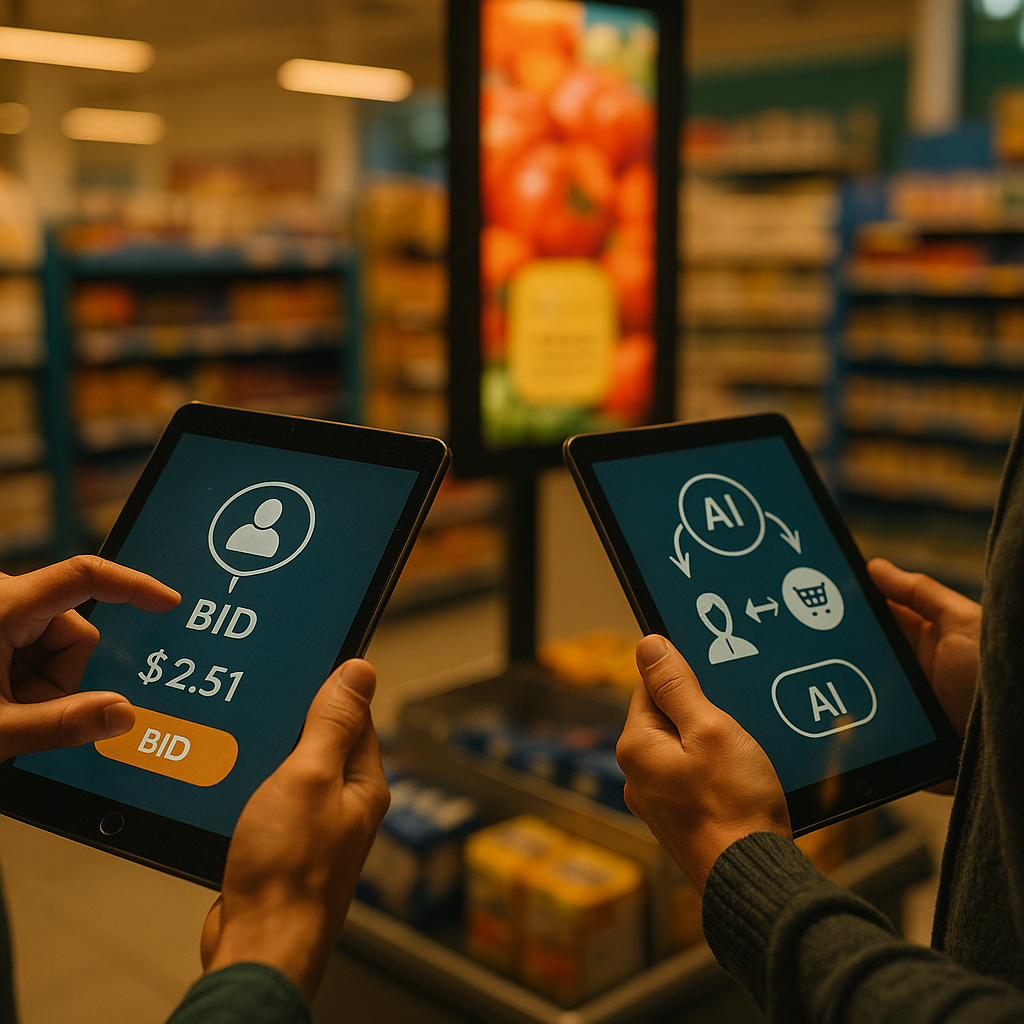
By some estimates, autonomous shopping agents could influence a meaningful share of online transactions before the decade closes. That’s not a hypothetical anymore. Agent-to-agent commerce protocols, the machine-to-machine handshakes letting AI shopping assistants negotiate prices and place orders without a human clicking “buy,” are already being piloted by major retailers. Retail media bidding, built for human eyeballs and human procurement teams, was never designed for this. Brands that ignore it now will be renegotiating from a position of weakness later.
What Agent-to-Agent Commerce Actually Means for Bidding
Strip away the jargon and the concept is simple. An AI agent representing a shopper (think a smarter version of a browser extension or a voice assistant) queries multiple retailers’ inventory systems, compares price and availability, and completes a purchase. No scrolling. No banner ads. No influencer unboxing video swaying the decision in real time.
Now layer in retail media. Amazon, Walmart Connect, Target Roundel, Instacart Ads — these networks generate billions by auctioning placement to brands competing for human attention. But if the “shopper” evaluating options is itself a piece of software, the auction dynamics change entirely. An agent doesn’t get swayed by a hero image or a catchy headline. It reads structured data: price, delivery time, return policy, review scores, maybe a sustainability tag. Protocols like Google’s Agent Payments Protocol and emerging standards from groups working alongside the HubSpot ecosystem and major ad platforms are quietly formalizing how these machine transactions get verified, priced, and settled.
When the buyer is an algorithm, retail media stops being an advertising channel and starts becoming a data feed competition.
Why Retail Media Networks Are Nervous (Even If They Won’t Say So)
Retail media is projected to surpass $175 billion in ad spend globally within the next couple of years, according to eMarketer estimates. That’s a business built almost entirely on the assumption that humans browse, compare, and get persuaded. Agent-to-agent commerce threatens the persuasion layer entirely.
Think about it from a retailer’s side. If Instacart’s shopping agent can negotiate directly with a CPG brand’s inventory agent for a bulk restock deal, where does the sponsored placement fee fit in? Retailers have two choices: build agent-native bidding layers that charge brands for algorithmic visibility instead of human visibility, or watch a chunk of that ad revenue evaporate as transactions move machine-to-machine. Nobody in retail media wants to say this out loud, but several platforms are already testing “agent slots” — paid positioning specifically for how a brand’s product data gets surfaced to shopping bots, not shoppers.
This isn’t dissimilar to what’s happening in search, where AI assistants feeding search results have already forced a rethink of how visibility gets earned and paid for.
The Bidding Mechanics Nobody’s Talking About Yet
Traditional retail media auctions run on cost-per-click or cost-per-thousand-impressions logic. Agent-to-agent bidding will likely run on something closer to cost-per-qualified-consideration — a bid that only triggers when an autonomous agent actually includes your product in its comparison set. That’s a fundamentally different metric, and most brand measurement stacks aren’t built to track it.
Here’s the uncomfortable part: agents will favor structured, verifiable data over persuasive creative. Brands with clean product feeds, real-time inventory accuracy, and machine-readable trust signals (verified reviews, authenticated sustainability claims, accurate delivery windows) will win agent consideration. Brands relying on glossy campaign creative to carry the day will simply not show up in the agent’s shortlist, no matter how big the media budget.
This echoes a pattern already visible in how GEO, AEO, and SEO are merging — optimization is shifting from persuading humans to satisfying machine evaluation criteria. Retail media bidding is just the next domain where that shift lands.
- Product feed accuracy becomes a bidding variable, not just an operational nicety.
- Review authenticity signals carry more weight than sponsored placement spend.
- Delivery and return data get baked directly into agent decision logic.
- Brand creative shifts from persuasion to machine-readable differentiation.
Compliance and Risk: The Part CFOs Should Care About
Every new transaction layer brings new liability questions, and agent-to-agent commerce is no exception. Who’s accountable if a shopping agent misreads a promotional term and over-purchases? What happens when an agent negotiates a price that violates minimum advertised price agreements? The FTC hasn’t issued specific guidance on autonomous purchasing agents yet, but given its recent posture on commercial intent enforcement, it’s reasonable to expect scrutiny once agent-negotiated deals start affecting consumer pricing at scale.
Brands should also expect data privacy questions to resurface. Shopping agents often act on behalf of a consumer using stored preferences, payment credentials, and purchase history. That’s a fresh vector for the kind of identity and data governance issues already reshaping martech, similar to what’s playing out with identity resolution as martech’s connective tissue. Legal and compliance teams need a seat at this table now, not after the first agent-driven pricing dispute makes headlines.
A Quiet Precedent: JD.com’s AI Ad Margins
Retail media players are already testing how AI-driven placement affects margins. JD.com’s experiments with AI-optimized ad inventory, covered in JD.com’s AI ad margins signaling retail media’s next move, offer an early signal. When algorithms handle more of the placement decision-making, margin structures shift, and so does the leverage brands hold in negotiations. Agent-to-agent commerce is the next iteration of that same pressure, just applied to the demand side instead of the supply side.
What Brands Should Actually Do Before Everyone Else Panics
You don’t need a fully built agent-commerce strategy by next quarter. You do need to stop treating this as science fiction. A few practical moves:
Audit your product data infrastructure now. If your feed has inconsistent pricing, outdated inventory counts, or messy attribute tagging, no amount of retail media spend will help you when the buyer is a machine reading structured fields. This is unglamorous work, but it’s the foundation everything else sits on.
Pressure-test your retail media vendor contracts. Ask platform reps directly: is there an agent-facing bidding product on the roadmap? Most won’t have a polished answer yet, but the question itself signals you’re paying attention, and it gives you negotiating leverage when the product does launch. This connects to the broader discipline covered in adaptive martech vendor selection — treat agent-readiness as a new evaluation criterion, not an afterthought.
Reframe internal KPIs. Click-through rate and impression share won’t mean much in a world where an algorithm skips straight to a shortlist. Teams should start tracking “agent inclusion rate” or similar proxy metrics as pilots emerge, even if the data is imperfect at first.
Watch the AI tooling landscape closely. Plenty of vendors will rush to sell “agent commerce optimization” tools before the standards even settle. Apply the same scrutiny you’d apply to any martech purchase, because AI tool sprawl is already draining budgets without proportional ROI, and this category is primed for the same trap.
The brands that win agent-driven retail media won’t be the ones with the biggest budgets. They’ll be the ones with the cleanest, most trustworthy product data.
Where This Leaves Creator Partnerships
It’s tempting to think agent-to-agent commerce spells doom for influencer-driven retail media, the kind of sponsored product placement that’s fueled platforms like Amazon Live and TikTok Shop. That’s probably overstated, at least in the near term. Human consumers still make plenty of purchase decisions unassisted, and creator content still shapes brand consideration long before an agent gets involved in the final transaction.
But the mechanics of measurement will shift. If a shopper watches a creator’s review, then delegates the actual purchase to an agent that compares prices across retailers, attributing that sale back to the influencer campaign gets murkier. This is where models like the ones described in tying influencer hiring to CAC and LTV become even more relevant. Brands need attribution frameworks resilient enough to survive a purchase journey that ends in a machine-to-machine handshake rather than a single click.
FAQs
What is agent-to-agent commerce in retail media?
It refers to autonomous software agents, acting on behalf of consumers or businesses, negotiating and completing transactions directly with retailer systems, bypassing traditional human browsing and ad-click behavior.
How does this affect retail media bidding models?
Traditional bidding relies on human attention metrics like clicks and impressions. Agent-driven bidding shifts toward machine-readable data quality, such as accurate product feeds, verified reviews, and real-time inventory, since algorithms evaluate options differently than people do.
Will influencer marketing become irrelevant if shopping agents take over purchasing?
Unlikely in the near term. Creators still influence consideration and brand trust earlier in the funnel. What changes is attribution complexity, since agents may complete the actual transaction after a human has already been influenced by content elsewhere.
What should brands do now to prepare for agent-driven retail media?
Start by auditing product data accuracy, questioning retail media vendors about agent-facing roadmaps, and building attribution models that can track influence across a purchase journey that ends in a machine transaction rather than a manual click.
Are there compliance risks with agent-to-agent commerce?
Yes. Questions around pricing agreement violations, consumer consent, and data privacy are largely unresolved. Regulatory bodies like the FTC have not issued specific guidance yet, so brands should involve legal and compliance teams early.
FAQs
What is agent-to-agent commerce in retail media?
It refers to autonomous software agents, acting on behalf of consumers or businesses, negotiating and completing transactions directly with retailer systems, bypassing traditional human browsing and ad-click behavior.
How does this affect retail media bidding models?
Traditional bidding relies on human attention metrics like clicks and impressions. Agent-driven bidding shifts toward machine-readable data quality, such as accurate product feeds, verified reviews, and real-time inventory, since algorithms evaluate options differently than people do.
Will influencer marketing become irrelevant if shopping agents take over purchasing?
Unlikely in the near term. Creators still influence consideration and brand trust earlier in the funnel. What changes is attribution complexity, since agents may complete the actual transaction after a human has already been influenced by content elsewhere.
What should brands do now to prepare for agent-driven retail media?
Start by auditing product data accuracy, questioning retail media vendors about agent-facing roadmaps, and building attribution models that can track influence across a purchase journey that ends in a machine transaction rather than a manual click.
Are there compliance risks with agent-to-agent commerce?
Yes. Questions around pricing agreement violations, consumer consent, and data privacy are largely unresolved. Regulatory bodies like the FTC have not issued specific guidance yet, so brands should involve legal and compliance teams early.
The teams that treat agent-to-agent commerce as an IT problem will lose ground to the teams that treat it as a marketing infrastructure problem. Start the product data audit this quarter, ask your retail media reps the uncomfortable questions now, and build attribution models flexible enough for a future where the “click” disappears entirely.
Top Influencer Marketing Agencies
The leading agencies shaping influencer marketing in 2026
Agencies ranked by campaign performance, client diversity, platform expertise, proven ROI, industry recognition, and client satisfaction. Assessed through verified case studies, reviews, and industry consultations.
Moburst

-
2

The Shelf
Boutique Beauty & Lifestyle Influencer AgencyA data-driven boutique agency specializing exclusively in beauty, wellness, and lifestyle influencer campaigns on Instagram and TikTok. Best for brands already focused on the beauty/personal care space that need curated, aesthetic-driven content.Clients: Pepsi, The Honest Company, Hims, Elf Cosmetics, Pure LeafVisit The Shelf → -
3

Audiencly
Niche Gaming & Esports Influencer AgencyA specialized agency focused exclusively on gaming and esports creators on YouTube, Twitch, and TikTok. Ideal if your campaign is 100% gaming-focused — from game launches to hardware and esports events.Clients: Epic Games, NordVPN, Ubisoft, Wargaming, Tencent GamesVisit Audiencly → -
4

Viral Nation
Global Influencer Marketing & Talent AgencyA dual talent management and marketing agency with proprietary brand safety tools and a global creator network spanning nano-influencers to celebrities across all major platforms.Clients: Meta, Activision Blizzard, Energizer, Aston Martin, WalmartVisit Viral Nation → -
5

The Influencer Marketing Factory
TikTok, Instagram & YouTube CampaignsA full-service agency with strong TikTok expertise, offering end-to-end campaign management from influencer discovery through performance reporting with a focus on platform-native content.Clients: Google, Snapchat, Universal Music, Bumble, YelpVisit TIMF → -
6

NeoReach
Enterprise Analytics & Influencer CampaignsAn enterprise-focused agency combining managed campaigns with a powerful self-service data platform for influencer search, audience analytics, and attribution modeling.Clients: Amazon, Airbnb, Netflix, Honda, The New York TimesVisit NeoReach → -
7

Ubiquitous
Creator-First Marketing PlatformA tech-driven platform combining self-service tools with managed campaign options, emphasizing speed and scalability for brands managing multiple influencer relationships.Clients: Lyft, Disney, Target, American Eagle, NetflixVisit Ubiquitous → -
8

Obviously
Scalable Enterprise Influencer CampaignsA tech-enabled agency built for high-volume campaigns, coordinating hundreds of creators simultaneously with end-to-end logistics, content rights management, and product seeding.Clients: Google, Ulta Beauty, Converse, AmazonVisit Obviously →