


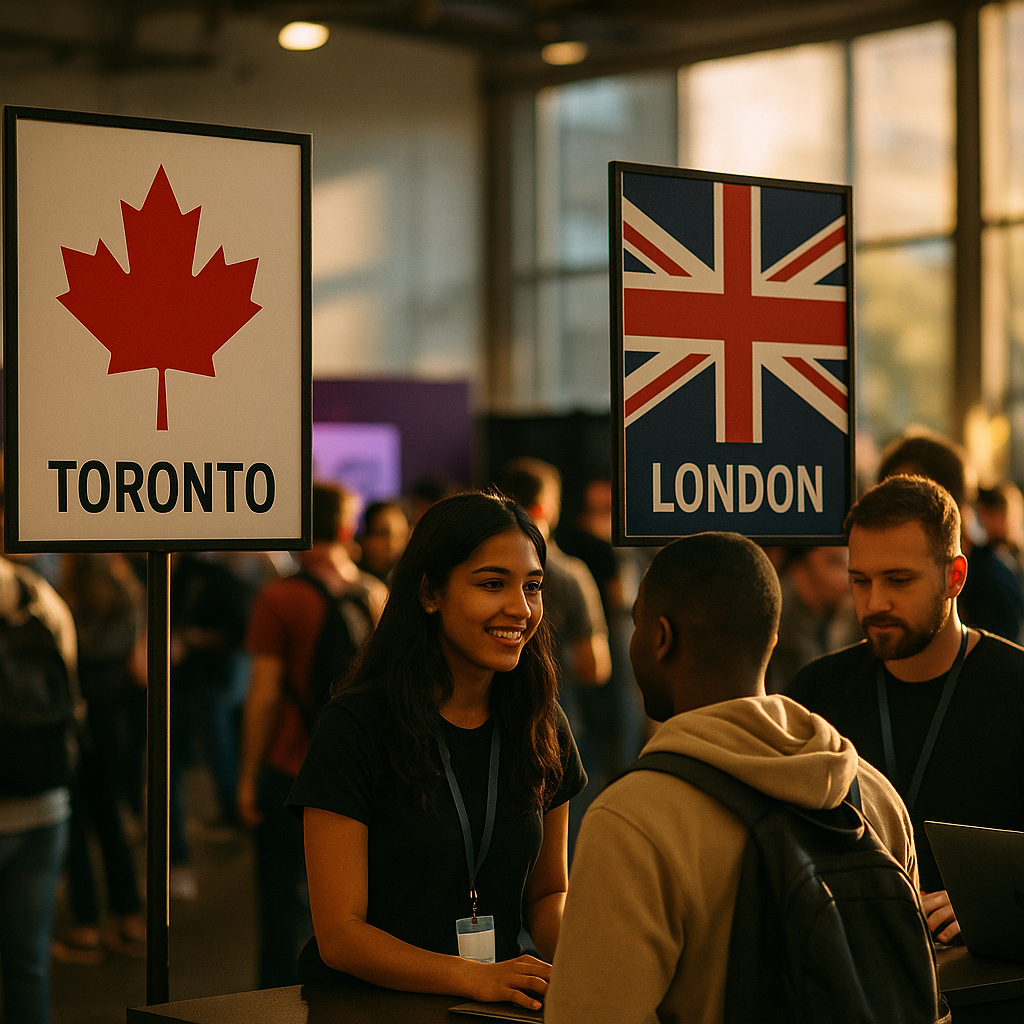
Here’s a number that should reframe your travel budget for next quarter: creator economy expos outside the US drew over 40,000 combined attendees across London and Toronto last year, and brand-side headcount at both events grew faster than at any domestic conference. If your influencer strategy still treats North America as the whole map, you’re already behind. The creator economy expos circuit has gone global, and the brands showing up in person are walking away with talent pipelines, compliance clarity, and pricing leverage their competitors don’t have.
This isn’t a travel story. It’s a budget allocation story, a risk management story, and increasingly, a first-mover story for brands willing to build creator relationships before the market gets crowded.
Why These Two Cities, and Why Now
London and Toronto didn’t become creator economy hubs by accident. London sits at the intersection of European regulatory rigor and a mature, English-language creator base that already understands US brand expectations. Toronto offers something different: a bilingual, culturally diverse talent pool that serves as a soft entry point into both the Canadian market and broader international expansion without the language barrier that trips up brands eyeing continental Europe or APAC.
Both cities also benefit from proximity. A US brand team can fly to Toronto for a day trip. London is a single overnight flight with a full business day on arrival. Compare that to the logistical lift of Seoul or Jakarta, and it’s obvious why these two cities became the on-ramp for brands testing international creator programs before committing to deeper APAC or LATAM investment.
There’s also a talent supply argument. US creator rates have climbed steadily, something covered in detail in our breakdown of how Instagram rates have reshaped budgets. Brands squeezed by rising domestic costs are finding that UK and Canadian creators, with comparable production quality and English-first content, often come in at a meaningful discount once you account for currency exchange and lower market saturation.
London: Where Compliance Meets Creator Scale
London’s expo circuit, anchored by events tied to Advertising Week Europe and a growing roster of dedicated creator economy summits, has a distinctly different flavor than US conferences. Sessions lean harder into regulatory compliance, data privacy, and disclosure standards than most American equivalents. That’s not an accident. The UK’s Advertising Standards Authority enforces influencer disclosure rules with more teeth than many US brands are used to, and the Information Commissioner’s Office has made data handling a board-level issue for any brand running creator campaigns that touch UK consumer data.
For US marketing teams, this matters beyond the UK market itself. The disclosure and data practices London panels emphasize are increasingly the direction US regulation is heading too. Attending gives brand teams a preview of where the FTC’s own enforcement posture is likely to go next, particularly around AI-generated content disclosure and affiliate link transparency.
Brands that treat London expos as a compliance preview, not just a networking trip, are building internal policy frameworks six to twelve months before regulation forces the issue domestically.
London also delivers access to a creator talent pool that’s underpriced relative to its production quality. Fashion, finance, and wellness creators based in London routinely produce content on par with top-tier US creators at rates 20 to 30 percent lower, largely because the local sponsorship market hasn’t caught up to US saturation levels. That’s a direct opportunity for brands rethinking cost-per-sale math, a trend already reshaping domestic budgets as outlined in our coverage of how cost per sale is overtaking engagement metrics.
Toronto: The Quiet Gateway Brands Keep Underrating
Toronto doesn’t get the same press as London, but it should. The city’s creator expo scene, built around events like Collision’s creator economy tracks and independent summits hosted by Canadian agencies, functions as a low-risk testing ground for brands that want international exposure without the regulatory complexity of the EU or UK.
Canada’s Competition Bureau and advertising standards bodies share enough DNA with FTC guidelines that US compliance teams don’t need to rebuild policy from scratch. That lowers the operational lift considerably. A brand can run a Toronto-based creator pilot using largely the same contract templates and disclosure language it uses domestically, with minor localization for bilingual requirements in Quebec-facing campaigns.
What Toronto offers that’s harder to find elsewhere is diversity of creator demographics within a single, accessible market. South Asian, East Asian, Caribbean, and European diaspora creator communities all have strong representation in Toronto’s creator scene, giving brands a chance to test multicultural campaign strategies without the cost of running parallel programs across multiple countries. For brands watching how secondary US creator hubs are earning budget seats, Toronto represents the international equivalent: a market too often skipped in favor of the obvious coastal plays, now quietly proving its value.
What Actually Changes in Your Operating Model
Showing up at an international expo is the easy part. The harder work happens when you get back to the office and have to translate what you saw into contracts, payment rails, and tax structures.
- Payment and currency exposure. Paying UK or Canadian creators means dealing with currency conversion, international wire fees, and in some cases VAT or GST considerations that domestic creator agreements never touch.
- Contract localization. US-style influencer agreements often need adjustment for UK or Canadian consumer protection language, particularly around cancellation rights and disclosure wording.
- Platform nuance. TikTok Shop, Instagram Shopping, and affiliate commerce tools don’t roll out uniformly across markets. A brand running agentic commerce flows needs to understand the payment and identity gaps already flagged in agentic commerce before assuming UK or Canadian infrastructure matches the US rollout.
- Attribution and measurement. Cross-border campaigns complicate attribution models, especially when AI-driven search and chatbot traffic are already muddying domestic measurement, a problem explored in our piece on how dark traffic hides creator influence.
None of this is a reason to avoid international expansion. It’s a reason to budget for the operational lift before you sign your first UK or Canadian creator contract, not after a campaign goes sideways over a compliance gap.
Risk Mitigation Is the Real ROI
Here’s the uncomfortable truth most expansion pitches skip: the primary value of attending London and Toronto creator expos isn’t new reach. It’s risk reduction. Brands that build relationships with international legal counsel, local agency partners, and platform reps before launching a campaign avoid the compliance missteps that turn a modest creator partnership into a public relations problem.
The ICO has shown it will act on data privacy violations tied to influencer marketing, and the FTC’s disclosure enforcement has only gotten more aggressive domestically. Treating international compliance as a box-check rather than a strategic input is how brands end up in headlines for the wrong reasons.
The brands winning at international creator expansion aren’t the ones with the biggest budgets. They’re the ones who sent a compliance lead to the expo, not just a partnerships manager.
Agencies are already adapting their pricing models to reflect this added complexity, a shift visible in how firms are defending fees as risk control rather than racing to the bottom on cost. International campaigns, with their added legal and currency layers, reinforce exactly why that fee structure makes sense.
How to Actually Get Value From Attending
Sending a junior marketer to walk the expo floor and collect swag isn’t a strategy. Here’s what gets results:
- Send someone with budget authority, not just someone who can take notes. Deals get made on the floor, not after a three-week internal approval cycle.
- Book meetings with at least two local agencies before you land. Cold-walking a conference floor wastes half your trip.
- Bring your legal or compliance contact, even remotely. Real-time questions about disclosure rules or data handling save weeks of back-and-forth later.
- Benchmark rates against platforms like Sprout Social or eMarketer before negotiating, so you’re not relying on gut instinct in an unfamiliar market.
- Treat the first trip as reconnaissance, not a commitment to launch. The expansion of global creator forecasts, including the broader 2 trillion dollar creator economy outlook, hides significant regional risk that only becomes visible once you’re on the ground.
It’s also worth checking platform-specific resources before committing spend. Meta Business and TikTok for Business both maintain market-specific guidance that differs meaningfully between the US, UK, and Canadian rollouts, particularly around commerce features and ad disclosure tools.
FAQs
Common questions from brand teams evaluating international creator expos.
FAQ Section
Are London and Toronto creator economy expos worth the travel cost for a mid-sized brand?
For brands running more than a handful of international creator partnerships, yes. The relationship-building and compliance insight gained in person typically outweighs the travel spend, especially compared to the cost of a compliance misstep discovered after launch.
What’s the biggest compliance difference between US and UK influencer rules?
The UK’s Advertising Standards Authority enforces disclosure requirements more aggressively than typical US practice, and UK data privacy rules under the ICO carry stricter consumer data handling expectations than many US brands are accustomed to.
Do Canadian creator partnerships require different contracts than US agreements?
Mostly minor adjustments are needed, particularly around bilingual disclosure requirements for Quebec-facing campaigns and alignment with Competition Bureau advertising standards, but the overall contract structure stays close to US templates.
How should brands budget for currency and payment differences?
Build in a buffer for currency conversion fees and international wire costs, and clarify upfront whether creator rates are quoted in local currency or USD to avoid mid-campaign disputes.
Is Toronto a good testing ground before expanding into Europe or APAC?
Yes. Toronto’s regulatory environment closely mirrors US standards while offering genuine international and multicultural creator diversity, making it a lower-risk first step before tackling more complex markets.
Next step: Before your next planning cycle, assign one budget-holder to attend a single international expo, London or Toronto, with a compliance contact in tow, and treat that trip as the pilot for your international creator line item rather than a one-off networking expense.
FAQs
Common questions from brand teams evaluating international creator expos.
Are London and Toronto creator economy expos worth the travel cost for a mid-sized brand?
For brands running more than a handful of international creator partnerships, yes. The relationship-building and compliance insight gained in person typically outweighs the travel spend, especially compared to the cost of a compliance misstep discovered after launch.
What’s the biggest compliance difference between US and UK influencer rules?
The UK’s Advertising Standards Authority enforces disclosure requirements more aggressively than typical US practice, and UK data privacy rules under the ICO carry stricter consumer data handling expectations than many US brands are accustomed to.
Do Canadian creator partnerships require different contracts than US agreements?
Mostly minor adjustments are needed, particularly around bilingual disclosure requirements for Quebec-facing campaigns and alignment with Competition Bureau advertising standards, but the overall contract structure stays close to US templates.
How should brands budget for currency and payment differences?
Build in a buffer for currency conversion fees and international wire costs, and clarify upfront whether creator rates are quoted in local currency or USD to avoid mid-campaign disputes.
Is Toronto a good testing ground before expanding into Europe or APAC?
Yes. Toronto’s regulatory environment closely mirrors US standards while offering genuine international and multicultural creator diversity, making it a lower-risk first step before tackling more complex markets.
Top Influencer Marketing Agencies
The leading agencies shaping influencer marketing in 2026
Agencies ranked by campaign performance, client diversity, platform expertise, proven ROI, industry recognition, and client satisfaction. Assessed through verified case studies, reviews, and industry consultations.
Moburst

-
2

The Shelf
Boutique Beauty & Lifestyle Influencer AgencyA data-driven boutique agency specializing exclusively in beauty, wellness, and lifestyle influencer campaigns on Instagram and TikTok. Best for brands already focused on the beauty/personal care space that need curated, aesthetic-driven content.Clients: Pepsi, The Honest Company, Hims, Elf Cosmetics, Pure LeafVisit The Shelf → -
3

Audiencly
Niche Gaming & Esports Influencer AgencyA specialized agency focused exclusively on gaming and esports creators on YouTube, Twitch, and TikTok. Ideal if your campaign is 100% gaming-focused — from game launches to hardware and esports events.Clients: Epic Games, NordVPN, Ubisoft, Wargaming, Tencent GamesVisit Audiencly → -
4

Viral Nation
Global Influencer Marketing & Talent AgencyA dual talent management and marketing agency with proprietary brand safety tools and a global creator network spanning nano-influencers to celebrities across all major platforms.Clients: Meta, Activision Blizzard, Energizer, Aston Martin, WalmartVisit Viral Nation → -
5

The Influencer Marketing Factory
TikTok, Instagram & YouTube CampaignsA full-service agency with strong TikTok expertise, offering end-to-end campaign management from influencer discovery through performance reporting with a focus on platform-native content.Clients: Google, Snapchat, Universal Music, Bumble, YelpVisit TIMF → -
6

NeoReach
Enterprise Analytics & Influencer CampaignsAn enterprise-focused agency combining managed campaigns with a powerful self-service data platform for influencer search, audience analytics, and attribution modeling.Clients: Amazon, Airbnb, Netflix, Honda, The New York TimesVisit NeoReach → -
7

Ubiquitous
Creator-First Marketing PlatformA tech-driven platform combining self-service tools with managed campaign options, emphasizing speed and scalability for brands managing multiple influencer relationships.Clients: Lyft, Disney, Target, American Eagle, NetflixVisit Ubiquitous → -
8

Obviously
Scalable Enterprise Influencer CampaignsA tech-enabled agency built for high-volume campaigns, coordinating hundreds of creators simultaneously with end-to-end logistics, content rights management, and product seeding.Clients: Google, Ulta Beauty, Converse, AmazonVisit Obviously →