


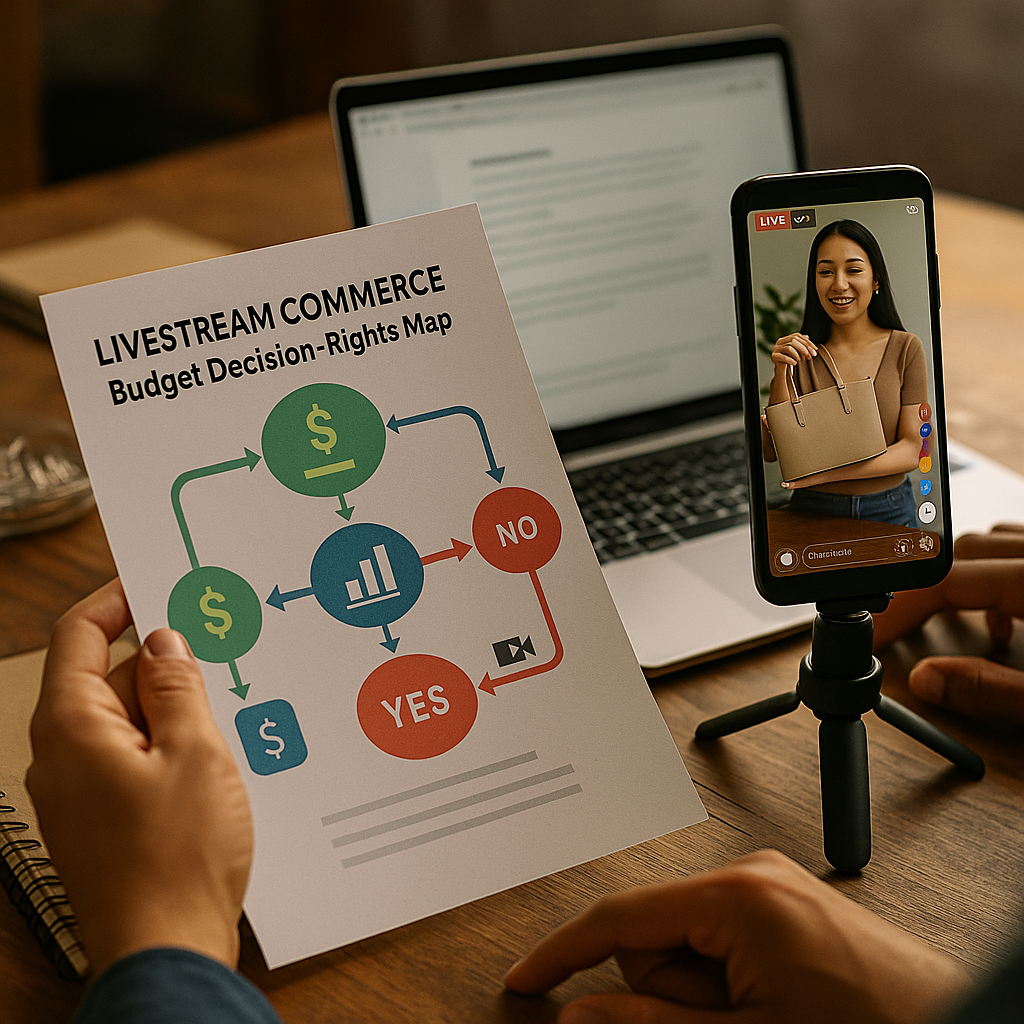
Three teams, one livestream, zero agreement on who signs the check. Sixty-seven percent of retailers now say livestream shopping is a strategic priority, according to eMarketer, yet most brands still can’t answer a basic question: who actually owns the budget? Building a livestream commerce budget decision-rights map isn’t bureaucratic overhead. It’s the thing standing between you and a quarter of wasted spend.
If you’ve sat in a planning meeting where brand marketing, retail media, and influencer ops all claimed the same livestream line item, you know the problem. Nobody’s wrong, exactly. They’re just operating from different mandates, different KPIs, and different budget pools that were never designed to intersect. Livestream commerce forced the intersection. Most org charts haven’t caught up.
Why This Turf War Keeps Happening
Livestream commerce sits at an awkward crossroads. It looks like content (influencer team’s turf), it converts on-platform like retail media (retail media team’s turf), and it carries brand voice and creative risk (brand marketing’s turf). Each function has a legitimate claim, and each function has a budget cycle that assumes it controls the channel.
Retail media teams are used to owning anything that touches point-of-sale or on-platform conversion — Amazon Live, Walmart Connect, TikTok Shop placements. Influencer teams are used to owning anything involving a creator contract, a brand deal, or a talent fee. Brand marketing sits above both, worried about tone, safety, and long-term equity, and increasingly gets looped in only when something goes wrong.
The absence of a decision-rights map doesn’t create equilibrium — it creates three teams independently negotiating with the same creator, at three different price points, for the same event.
This isn’t hypothetical. It’s the most common failure mode reported in cross-functional livestream planning right now: duplicate outreach, conflicting deal terms, and a creator who quietly plays teams against each other because nobody told them who’s actually authorized to negotiate.
What a Decision-Rights Map Actually Solves
A decision-rights map isn’t an org chart. It’s a document — usually a matrix — that specifies, for every category of livestream commerce decision, which team proposes, which team approves, which team executes, and which team gets informed after the fact. Think RACI, but built specifically around the friction points unique to livestream: creator selection, platform spend, promo mechanics, inventory commitment, and post-event attribution.
Done well, it answers questions like: Who decides which platform hosts the livestream — TikTok Shop, Amazon Live, or a brand-owned channel? Who negotiates creator fees when the creator is also running paid amplification? Who owns the P&L if the livestream underperforms against a retail media benchmark but overperforms against an influencer engagement benchmark?
These aren’t edge cases. They’re the default state of livestream commerce, where a single event generates data that three different teams will use to justify three different budget requests next quarter.
The Three Claims, Broken Down
Brand marketing’s claim rests on stewardship. They argue livestream commerce is still brand expression — tone, message discipline, creative approval — and that treating it purely as a performance channel invites reputational risk. They’re usually the team that gets pulled in during a crisis, so they want veto rights on creator selection and script review, even if they don’t want to own daily execution.
Retail media’s claim rests on measurement maturity. They already have attribution models, platform relationships, and shopper data that influencer teams typically lack. Retail media teams point to hard numbers — one widely cited stat has livestream shopping converting at rates as high as 30% compared to under 3% for static ads — and argue that anything converting at that rate belongs under performance marketing governance, with the budget discipline that implies.
Influencer teams’ claim rests on relationship equity. They built the creator roster, negotiated the rates, and understand which talent can actually hold an audience for a 45-minute selling session without losing them. They argue, reasonably, that treating creators as inventory rather than partners degrades the very asset that makes livestream commerce work in the first place.
All three claims are valid. That’s precisely the problem. Validity without hierarchy just produces gridlock.
Building the Matrix: A Practical Framework
Start by breaking livestream commerce into its actual decision categories rather than treating it as one monolithic budget line. In practice, most organizations land on six to eight categories:
- Creator/talent selection and contracting — typically influencer team-led, with brand marketing holding approval rights on final creative and script.
- Platform and channel selection — often retail media-led, since they hold the platform relationships and negotiated media rates.
- Paid amplification budget — usually split, with retail media controlling in-platform boosting and influencer teams controlling creator-driven organic promotion.
- Promo mechanics and discounting — should sit with whichever team owns the P&L for the product category, not the channel.
- Inventory and fulfillment commitment — belongs with commerce or supply chain, informed by both marketing functions but decided by neither.
- Post-event attribution and reporting — needs a single owner, full stop, or you’ll get three conflicting readouts of the same event.
For each category, assign a decision owner, an approver, and a consulted party. Resist the urge to make everything a joint decision. Joint ownership sounds collaborative; in practice it means nothing ships on time.
If more than one team can say no to a decision, you don’t have shared ownership — you have a veto system disguised as collaboration.
Where the Budget Actually Sits
The map tells you who decides. Someone still has to write the check, and that’s a separate conversation worth having explicitly rather than assuming. Three models tend to work, depending on organizational maturity:
Centralized livestream fund. A single pooled budget, governed by a cross-functional committee, that any of the three teams can draw from with sign-off. This works well for organizations running fewer than a dozen livestream events per quarter, where the volume doesn’t justify separate infrastructure. It mirrors the pooled-budget logic used in zero-based budgeting for livestream spend, where funds get allocated per-event rather than locked into annual departmental silos.
Split-and-reconcile. Each team keeps its own budget, but a quarterly reconciliation process tracks contribution and return per team, adjusting future allocations based on performance. This is more common in larger organizations where retail media and influencer budgets already report through different P&Ls and merging them isn’t realistic in the near term.
Program office ownership. A dedicated livestream commerce function — increasingly common at retailers running high event volume — owns the budget outright and “purchases” services from brand marketing (creative), retail media (platform), and influencer teams (talent) as internal vendors. This is the most operationally clean model but requires enough scale to justify a standalone team.
Whichever model you choose, document it the same way you’d document a steering committee charter: named roles, escalation paths, and a review cadence. Verbal agreements evaporate the moment a livestream underperforms and someone needs a scapegoat.
The Attribution Problem Nobody Wants to Own
Here’s the uncomfortable part. Even with a clean decision-rights map, livestream commerce attribution remains genuinely hard. A creator drives awareness on their own channel, promotes the event via retail media boosting, and closes the sale on a platform’s checkout flow. Which team gets credit?
Most organizations default to whichever team has the best dashboard, which is a terrible way to allocate credit. It’s the same trap explored in revenue attribution governance work: without a shared measurement framework agreed upon before the campaign runs, attribution becomes a post-hoc negotiation rather than a data exercise.
Fix this before launch, not after. Assign a single analytics owner for the event, agree on a multi-touch attribution model that credits creator-driven traffic, platform-driven conversion, and brand-driven consideration separately, and publish the readout to all three teams simultaneously. Anything less invites cherry-picked metrics in the next budget meeting.
Governance Cadence That Doesn’t Collapse Under Its Own Weight
A decision-rights map that lives in a slide deck and never gets revisited is worse than no map at all — it creates false confidence. Build in a review cadence, ideally quarterly, aligned to your broader budget planning cycle. This is also the moment to audit whether the map still reflects reality; livestream commerce platforms shift fast (TikTok Shop’s rules alone have changed materially over recent cycles), and a decision-rights structure built around last year’s platform mix may already be stale.
Borrow the audit discipline from governance audits used for creator vertical expansion: check who actually made each decision against who was supposed to, flag drift, and adjust. Most decision-rights failures aren’t design failures. They’re maintenance failures — a good map that nobody updated after the org reshuffled six months in.
Keep the committee small. Three voting members, one from each function, plus a rotating chair, works better than a standing meeting with a dozen stakeholders. If your governance structure needs its own governance structure, you’ve already lost the plot.
What Good Looks Like in Practice
A mid-size DTC beauty brand running weekly TikTok Shop livestreams eventually settled on a hybrid model: influencer teams own creator relationships and script approval, retail media owns platform spend and boosting decisions, and brand marketing holds a 24-hour creative veto window before any event goes live. Budget sits in a shared pool, replenished quarterly, with draw-down rights tied to a pre-approved event calendar rather than ad hoc requests.
It’s not elegant. It took two failed quarters to get there. But disputes that used to consume a week of email threads now get resolved in a fifteen-minute weekly sync, because everyone already knows who’s supposed to decide what.
Frequently Asked Questions
Which team should own livestream commerce budget by default?
There’s no universal default — it depends on where the majority of conversion happens. If most sales close on a retail platform’s checkout, retail media typically holds budget authority with influencer and brand teams as approvers. If the event is creator-led with the platform as a secondary channel, influencer teams often lead. The decision-rights map should specify this per category rather than assigning one team blanket ownership.
How do we handle disputes when the decision-rights map doesn’t cover a new scenario?
Route it to the governance committee with a 48-hour resolution window, then update the map immediately so the same ambiguity doesn’t resurface. Treat every unmapped scenario as a signal that the framework needs revision, not a one-off exception.
Should creator fees come out of the influencer budget or the livestream commerce budget?
Increasingly, organizations separate these. Baseline creator fees for content creation sit in the influencer budget; incremental fees tied specifically to livestream selling events sit in a dedicated commerce fund. This keeps influencer budgets predictable while letting livestream spend scale with event volume and performance.
How often should the decision-rights map be reviewed?
Quarterly, at minimum, and immediately after any major reorg or platform policy change. Livestream commerce platforms evolve quickly, and a map built around last year’s channel mix can misallocate authority within a few months.
What’s the biggest sign a decision-rights map isn’t working?
Duplicate creator outreach. If a talent manager or creator ever mentions being contacted by two teams from the same brand about the same event, your decision rights aren’t being followed, regardless of what the document says.
Start with one livestream event category, map the decision rights end to end, and expand from there. Trying to govern everything at once is how these frameworks stall before they ever get used.
FAQs
Which team should own livestream commerce budget by default?
There’s no universal default — it depends on where the majority of conversion happens. If most sales close on a retail platform’s checkout, retail media typically holds budget authority with influencer and brand teams as approvers. If the event is creator-led with the platform as a secondary channel, influencer teams often lead. The decision-rights map should specify this per category rather than assigning one team blanket ownership.
How do we handle disputes when the decision-rights map doesn’t cover a new scenario?
Route it to the governance committee with a 48-hour resolution window, then update the map immediately so the same ambiguity doesn’t resurface. Treat every unmapped scenario as a signal that the framework needs revision, not a one-off exception.
Should creator fees come out of the influencer budget or the livestream commerce budget?
Increasingly, organizations separate these. Baseline creator fees for content creation sit in the influencer budget; incremental fees tied specifically to livestream selling events sit in a dedicated commerce fund. This keeps influencer budgets predictable while letting livestream spend scale with event volume and performance.
How often should the decision-rights map be reviewed?
Quarterly, at minimum, and immediately after any major reorg or platform policy change. Livestream commerce platforms evolve quickly, and a map built around last year’s channel mix can misallocate authority within a few months.
What’s the biggest sign a decision-rights map isn’t working?
Duplicate creator outreach. If a talent manager or creator ever mentions being contacted by two teams from the same brand about the same event, your decision rights aren’t being followed, regardless of what the document says.
Top Influencer Marketing Agencies
The leading agencies shaping influencer marketing in 2026
Agencies ranked by campaign performance, client diversity, platform expertise, proven ROI, industry recognition, and client satisfaction. Assessed through verified case studies, reviews, and industry consultations.
Moburst

-
2

The Shelf
Boutique Beauty & Lifestyle Influencer AgencyA data-driven boutique agency specializing exclusively in beauty, wellness, and lifestyle influencer campaigns on Instagram and TikTok. Best for brands already focused on the beauty/personal care space that need curated, aesthetic-driven content.Clients: Pepsi, The Honest Company, Hims, Elf Cosmetics, Pure LeafVisit The Shelf → -
3

Audiencly
Niche Gaming & Esports Influencer AgencyA specialized agency focused exclusively on gaming and esports creators on YouTube, Twitch, and TikTok. Ideal if your campaign is 100% gaming-focused — from game launches to hardware and esports events.Clients: Epic Games, NordVPN, Ubisoft, Wargaming, Tencent GamesVisit Audiencly → -
4

Viral Nation
Global Influencer Marketing & Talent AgencyA dual talent management and marketing agency with proprietary brand safety tools and a global creator network spanning nano-influencers to celebrities across all major platforms.Clients: Meta, Activision Blizzard, Energizer, Aston Martin, WalmartVisit Viral Nation → -
5

The Influencer Marketing Factory
TikTok, Instagram & YouTube CampaignsA full-service agency with strong TikTok expertise, offering end-to-end campaign management from influencer discovery through performance reporting with a focus on platform-native content.Clients: Google, Snapchat, Universal Music, Bumble, YelpVisit TIMF → -
6

NeoReach
Enterprise Analytics & Influencer CampaignsAn enterprise-focused agency combining managed campaigns with a powerful self-service data platform for influencer search, audience analytics, and attribution modeling.Clients: Amazon, Airbnb, Netflix, Honda, The New York TimesVisit NeoReach → -
7

Ubiquitous
Creator-First Marketing PlatformA tech-driven platform combining self-service tools with managed campaign options, emphasizing speed and scalability for brands managing multiple influencer relationships.Clients: Lyft, Disney, Target, American Eagle, NetflixVisit Ubiquitous → -
8

Obviously
Scalable Enterprise Influencer CampaignsA tech-enabled agency built for high-volume campaigns, coordinating hundreds of creators simultaneously with end-to-end logistics, content rights management, and product seeding.Clients: Google, Ulta Beauty, Converse, AmazonVisit Obviously →