


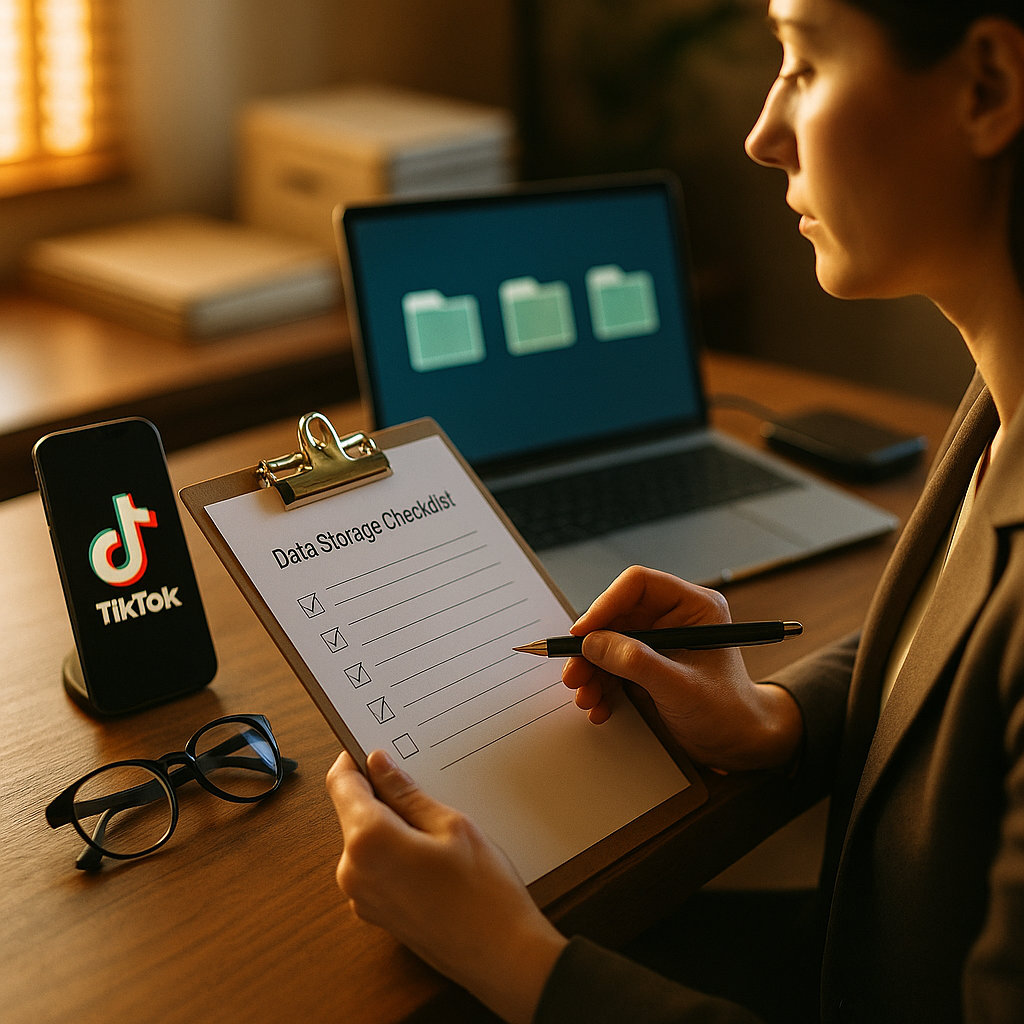
$14 billion. That’s roughly what TikTok’s US joint venture is worth on paper, and it’s also the size of the compliance headache now sitting on every brand’s desk. If your team runs paid partnerships, TikTok Shop affiliate programs, or API-connected campaign tooling, the TikTok settlement data storage rules aren’t background noise anymore. They’re an operational deadline with real contract exposure attached.
The settlement finalized the terms of the US TikTok divestiture, and buried in the legal text are cybersecurity and data-residency mandates that touch far more than TikTok’s own servers. They touch every brand, agency, and MCN that pushes data into or pulls data out of the platform.
What the Settlement Actually Requires
Strip away the political noise and the mandate is fairly mechanical: US user data must be stored on US-controlled infrastructure, audited by an independent American security monitor, and walled off from ByteDance’s China-based engineering teams through code review and access controls. Oracle remains the backbone cloud provider, and a new oversight board — staffed with US national security appointees — gets audit rights over the algorithm and data pipelines.
For brands, that means the TikTok Ads Manager, TikTok Shop backend, and Creator Marketplace API you’ve built workflows around are being re-architected in real time. Endpoints may shift. Data processing agreements may need amendments. And if your legal team hasn’t already requested TikTok’s updated DPA language, that’s step one on this checklist.
Brands that treat this as “TikTok’s problem” are the ones most likely to get caught with stale data processing agreements when auditors come asking who had access to what.
The Compliance Checklist, Section by Section
1. Audit Your Data Flows First
You can’t comply with a data residency mandate if you don’t know where your data actually lives. Most brand marketing teams underestimate how many tools touch TikTok data: CRM syncs, attribution platforms, influencer payment processors, creative testing dashboards. Map every integration that pulls TikTok user or campaign data, and flag which ones route through third-party servers outside the US.
- List every API key or app connected to TikTok Ads Manager and TikTok Shop
- Identify which vendors cache or store TikTok-sourced data on non-US infrastructure
- Confirm whether your MMP (mobile measurement partner) has updated its TikTok SDK integration for the new data boundary rules
This is the same due diligence brands went through with the earlier TikTok US data localization requirements, just with sharper teeth now that the settlement is legally binding rather than voluntary.
2. Update Your Data Processing Agreements
If your DPA with TikTok, or with any agency subcontractor handling TikTok campaign data, hasn’t been revised since the settlement closed, it’s outdated. The new mandate requires specific language around US-only storage, breach notification timelines, and third-party audit rights. Brands running influencer payment flows through TikTok’s Creator Marketplace should pay particular attention here, since payment data crosses into financial compliance territory too.
For a broader view of how this fits into platform-wide data agreements, our guide on DPAs for TikTok, Instagram, and YouTube APIs breaks down the clauses legal teams should be pushing back on.
3. Reconcile Payment and Targeting Data Separately
Here’s where things get operationally messy. The settlement’s data rules interact with, but don’t replace, existing TikTok peer-to-peer payment compliance work and ad targeting restrictions tied to age assurance. Brands running influencer gifting or affiliate commission payouts through TikTok Shop need to verify that payment processor data (bank details, tax IDs, payout history) is stored under the same US-residency umbrella as ad targeting data — and that your compliance team isn’t treating these as one unified dataset when they’re governed by different rule sets.
We’ve covered the payment side in detail in our TikTok peer-to-peer payment compliance checklist, and it’s worth cross-referencing against this settlement’s requirements rather than assuming overlap.
4. Reassess Age-Assurance and Ad Targeting Overlap
Cybersecurity mandates and age-verification mandates are converging faster than most legal teams anticipated. The independent security monitor overseeing TikTok’s US data now has visibility into age-assurance signal data too, since that data flows through the same US-controlled servers. If your targeting strategy relies on any workaround involving lookalike audiences built from pre-mandate data pools, that data may no longer be usable, or may require re-certification. Our earlier coverage on TikTok COPPA age-assurance rules is a useful companion read for teams untangling this overlap.
5. Verify Your Incident Response Plan Matches New Breach Timelines
The settlement imposes stricter breach notification windows than most brands’ existing incident response playbooks account for. If TikTok (or a vendor processing TikTok data on your behalf) suffers a breach, your legal team needs a pre-drafted notification workflow ready to go, not something improvised under deadline pressure. Ask your agency or MCN partner directly: what’s their documented breach notification SLA, and does it meet the new threshold?
According to the Federal Trade Commission, breach response speed is increasingly a factor in enforcement actions against companies with lax vendor oversight, not just the platform itself.
6. Don’t Skip Third-Party Creator Tools
Plenty of brands run creator discovery, content licensing, and rights management through third-party SaaS tools that plug into TikTok’s API. These tools are not automatically covered by TikTok’s own compliance work. If your influencer marketing stack includes a discovery platform, a UGC licensing tool, or a creator CRM, get written confirmation from each vendor that they’ve adjusted their data storage architecture to match the settlement’s US-residency requirement. Don’t assume; get it in writing.
A vendor’s marketing page saying “SOC 2 compliant” tells you nothing about whether their TikTok data pipeline routes through US-only infrastructure. Ask the specific question.
Where Brands Are Getting This Wrong
The most common mistake? Treating this as a one-time audit instead of an ongoing monitoring obligation. The settlement includes a rolling compliance review process, meaning TikTok’s infrastructure and access controls will keep shifting over the coming quarters as the joint venture matures. A checklist you complete once in isolation will be stale within two or three quarters.
The second mistake is assuming legal and marketing operations are talking to each other. In most mid-size brands, the marketing team managing the TikTok Shop storefront has no idea what the legal team negotiated in the updated DPA, and vice versa. Build a recurring sync, even quarterly, between whoever owns platform compliance and whoever owns campaign execution.
Third mistake: ignoring the cybersecurity monitor’s audit rights as something abstract. That monitor can request documentation from brands that operate at scale on the platform, particularly those running TikTok Shop storefronts with significant transaction volume. According to eMarketer, TikTok Shop’s US GMV has continued climbing steadily, which means audit scrutiny on high-volume merchants is only going to intensify.
How This Connects to Your Broader Data Strategy
None of this happens in a vacuum. Brands already juggling cross-border creator disclosure requirements and state-level privacy statutes now have another layer to reconcile. The smart move is folding TikTok-specific compliance into your existing data governance framework rather than building a parallel, TikTok-only process that nobody maintains after the initial scramble.
If your team already has a data minimization practice in place for other platforms, extend that same discipline here. Our piece on data minimization for livestream hiring tools outlines a framework that translates well to TikTok’s new residency requirements: collect less, store shorter, document everything.
For teams benchmarking their overall compliance maturity, HubSpot’s resources on data governance frameworks and Sprout Social’s platform policy tracking are worth bookmarking alongside your internal audit calendar.
Compliance here isn’t glamorous work. It won’t show up in a campaign recap deck. But the brands that get ahead of this checklist now will spend less time firefighting audits later, and more time actually running campaigns. That’s the ROI case, plain and simple.
Next step: pull your current TikTok DPA, compare it against the settlement’s US-storage language line by line, and flag gaps to legal before your next campaign flight goes live.
Frequently Asked Questions
What is the TikTok settlement’s core data storage requirement?
US user data must be stored and processed on US-controlled infrastructure, monitored by an independent American cybersecurity firm with audit rights over TikTok’s data pipelines and algorithm access controls.
Does this settlement affect brands that only run organic content, not paid ads?
Yes, if those brands use any third-party tool connected to TikTok’s API for analytics, content licensing, or creator discovery. Data residency rules apply to any pipeline touching US user data, not just ad accounts.
How often should brands re-audit their TikTok data compliance?
Quarterly, at minimum. The settlement includes rolling compliance reviews, so infrastructure and access policies will continue evolving well beyond the initial enforcement date.
Are TikTok Shop payment flows covered by the same data storage mandate?
Payment data intersects with the mandate but is also governed by separate financial compliance rules. Brands should treat payment data and ad targeting data as related but distinct compliance tracks.
What happens if a brand’s vendor isn’t compliant with the new mandate?
The brand carries the risk, not just the vendor. Get written confirmation of compliance from every tool connected to TikTok’s API, and build vendor compliance verification into contract renewal cycles.
FAQs
Top Influencer Marketing Agencies
The leading agencies shaping influencer marketing in 2026
Agencies ranked by campaign performance, client diversity, platform expertise, proven ROI, industry recognition, and client satisfaction. Assessed through verified case studies, reviews, and industry consultations.
Moburst

-
2

The Shelf
Boutique Beauty & Lifestyle Influencer AgencyA data-driven boutique agency specializing exclusively in beauty, wellness, and lifestyle influencer campaigns on Instagram and TikTok. Best for brands already focused on the beauty/personal care space that need curated, aesthetic-driven content.Clients: Pepsi, The Honest Company, Hims, Elf Cosmetics, Pure LeafVisit The Shelf → -
3

Audiencly
Niche Gaming & Esports Influencer AgencyA specialized agency focused exclusively on gaming and esports creators on YouTube, Twitch, and TikTok. Ideal if your campaign is 100% gaming-focused — from game launches to hardware and esports events.Clients: Epic Games, NordVPN, Ubisoft, Wargaming, Tencent GamesVisit Audiencly → -
4

Viral Nation
Global Influencer Marketing & Talent AgencyA dual talent management and marketing agency with proprietary brand safety tools and a global creator network spanning nano-influencers to celebrities across all major platforms.Clients: Meta, Activision Blizzard, Energizer, Aston Martin, WalmartVisit Viral Nation → -
5

The Influencer Marketing Factory
TikTok, Instagram & YouTube CampaignsA full-service agency with strong TikTok expertise, offering end-to-end campaign management from influencer discovery through performance reporting with a focus on platform-native content.Clients: Google, Snapchat, Universal Music, Bumble, YelpVisit TIMF → -
6

NeoReach
Enterprise Analytics & Influencer CampaignsAn enterprise-focused agency combining managed campaigns with a powerful self-service data platform for influencer search, audience analytics, and attribution modeling.Clients: Amazon, Airbnb, Netflix, Honda, The New York TimesVisit NeoReach → -
7

Ubiquitous
Creator-First Marketing PlatformA tech-driven platform combining self-service tools with managed campaign options, emphasizing speed and scalability for brands managing multiple influencer relationships.Clients: Lyft, Disney, Target, American Eagle, NetflixVisit Ubiquitous → -
8

Obviously
Scalable Enterprise Influencer CampaignsA tech-enabled agency built for high-volume campaigns, coordinating hundreds of creators simultaneously with end-to-end logistics, content rights management, and product seeding.Clients: Google, Ulta Beauty, Converse, AmazonVisit Obviously →