


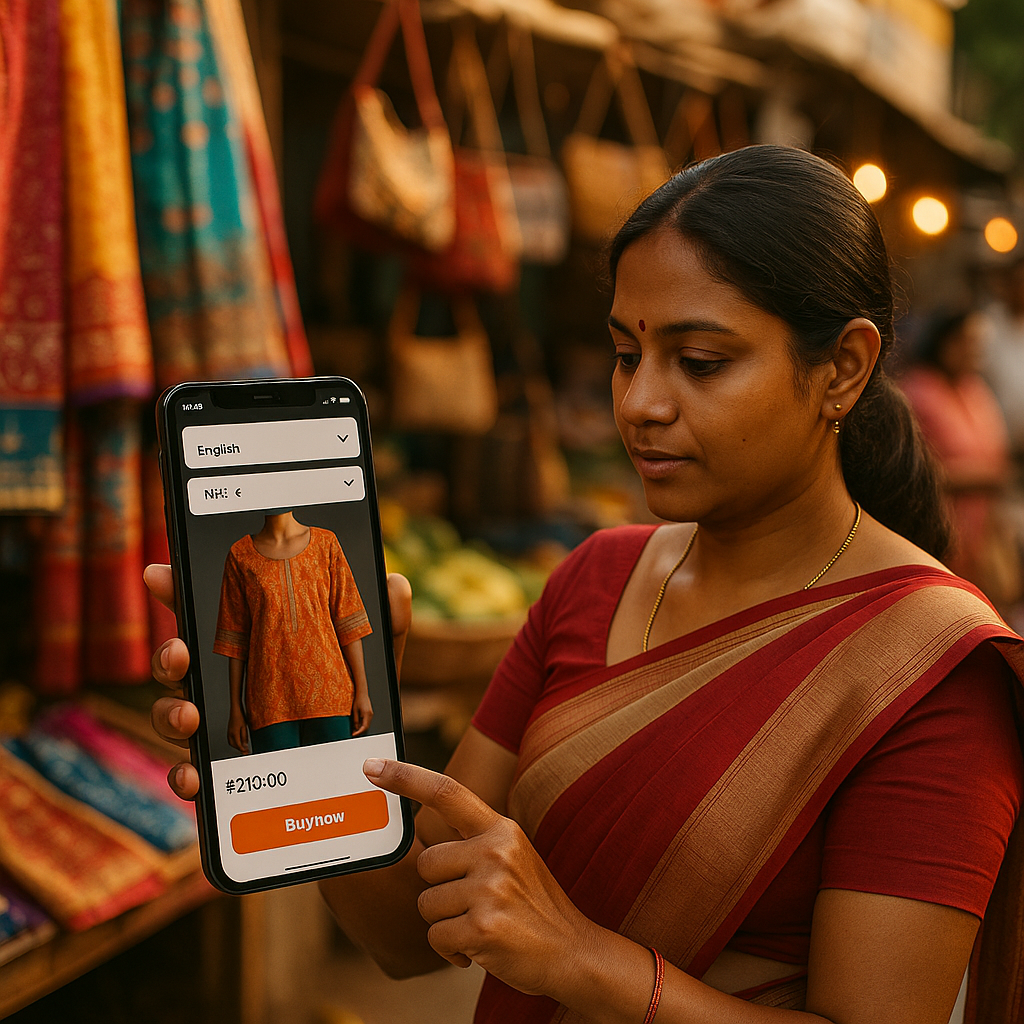
India now has over 700 million internet users, and more than half shop primarily in a language other than English. Yet most brands still run their social commerce campaigns through translation memory built for e-commerce PDPs, not the punchy, vernacular hooks that convert on Meesho or WhatsApp Business. If your AI-powered regional-language content localization stack can’t handle Tanglish captions or Bhojpuri voiceovers, you’re leaving conversions on the table.
This isn’t a nice-to-have anymore. It’s the difference between a campaign that scales past Tier 1 metros and one that plateaus at 40 million addressable users. Let’s get into how to actually evaluate these tools, not just buy the one with the flashiest demo.
Why India’s Social Commerce Boom Is a Language Problem First
Social commerce in India is projected to cross $16 billion in GMV within the next couple of years, driven overwhelmingly by Tier 2 and Tier 3 shoppers on platforms like Meesho, WhatsApp catalogs, and Instagram Reels-linked storefronts. These buyers aren’t browsing in English. They’re watching creator content in Hindi, Tamil, Telugu, Marathi, Bengali, and a dozen other languages, and they expect brand messaging to match that fluency, not just be translated into it.
Here’s the uncomfortable truth: translation and localization are not the same discipline. A tool that swaps English words for Hindi ones without adjusting idiom, humor, or regional purchase triggers will produce content that reads like a government notice. Regional-language shoppers can smell machine-translated copy from a mile away, and it kills trust faster than a bad review.
Brands that treat regional-language content as a translation task rather than a cultural localization task see engagement rates roughly 30-40% lower than those using culturally-tuned AI localization, according to multiple agency benchmarking studies circulating in the Indian creator economy this year.
What “AI-Powered” Actually Means Here — And Where It Breaks
Vendors love the term “AI-powered localization,” but the label covers wildly different capabilities. Some tools are essentially neural machine translation (NMT) engines with a UI wrapper. Others layer in generative models fine-tuned on regional social media corpora, capable of producing culturally-aware slang, festival references, and platform-native tone.
You need to know which one you’re buying. Ask vendors directly: is the underlying model trained on formal text corpora (news, government documents) or on informal, code-mixed social content (the Hindi-English “Hinglish” or Tamil-English “Tanglish” blends that dominate actual creator posts)? Most enterprise NMT APIs, including the big cloud providers, were originally built for document translation. They struggle with code-mixing, emoji context, and sarcasm.
This matters more than most procurement teams realize. A tool that nails formal Hindi press releases can still butcher a WhatsApp-style product pitch aimed at a 24-year-old shopper in Indore.
The Code-Mixing Problem Nobody Talks About
Roughly 60-70% of social commerce conversations in urban and semi-urban India involve some degree of code-mixing — switching between English and a regional language mid-sentence. “Yeh dress bahut trendy hai, order kar lo” isn’t broken language. It’s how people actually talk. Most localization engines flatten this into either pure English or pure Hindi, losing the authenticity that makes creator content work in the first place.
When evaluating tools, run a code-mixing stress test before you sign anything. Feed the tool five or six real creator captions scraped from Meesho-affiliated influencers or regional Instagram accounts. If the output reads stiffer or more formal than the source, that’s a red flag. This is similar to how brands now stress-test AI platforms evaluating creator intent before trusting them with campaign decisions — you don’t take the vendor’s word for it, you test with your own data.
Building an Evaluation Framework: Six Things to Score
Skip the generic “AI vs human translation” debate. Here’s what actually differentiates tools in production:
- Dialect granularity: Does the tool distinguish between Mumbai Hindi and Lucknow Hindi, or Chennai Tamil and Madurai Tamil? Regional nuance drives conversion in ways generic “Hindi” output cannot.
- Platform-native formatting: Can it generate content optimized for WhatsApp catalog descriptions differently than Instagram Reels captions differently than Meesho product titles? One-size-fits-all output is a signal the tool wasn’t built for social commerce.
- Turnaround at scale: Can it localize 500 SKU descriptions or 200 creator scripts in under an hour without quality drop-off? Batch consistency matters more than single-example brilliance.
- Compliance and brand safety filters: Does it flag culturally sensitive terms, religious references, or region-specific taboos automatically? This ties directly into risk management, not just linguistics.
- Human-in-the-loop workflow: Can regional-language reviewers easily edit, approve, or reject AI output inside the same interface, or does it require exporting to spreadsheets? Friction here kills adoption.
- Feedback loop learning: Does the tool improve based on human corrections over time, or does it make the same mistakes campaign after campaign?
Score every vendor against this list with actual test content, not vendor-supplied demos. Demos are theater. Your SKU catalog and your creator brief library are the real test.
Vendor Landscape: Who’s Actually Playing in This Space
The market splits into three camps. First, global localization platforms (Smartling, Lokalise, Phrase) that have added Indian language support but weren’t purpose-built for social/vernacular content — strong for document and app localization, weaker for creator-style copy. Second, India-specific AI language startups (Reverie Language Technologies, Gnani.ai, and others building on IndicNLP research) that specialize in code-mixed, colloquial content and often integrate directly with WhatsApp Business APIs. Third, generative AI platforms like those built on fine-tuned LLMs, which brands are increasingly using for on-the-fly caption generation across regional languages, though quality control remains inconsistent without strong human review layers.
For social commerce specifically, the India-specific players tend to outperform on authenticity, while the global platforms win on enterprise workflow integration, SSO, version control, and API reliability. Mid-market brands often end up running a hybrid: enterprise platform for workflow, India-specific model for the actual language generation.
No single vendor currently dominates every dimension. The brands seeing the best ROI are the ones stitching together best-of-breed tools rather than betting everything on one platform’s roadmap.
The Compliance Layer Most Brands Skip
Localization isn’t just a linguistics exercise, it’s a legal one. India’s advertising regulations, including guidelines from the Advertising Standards Council of India, apply regardless of language. Misleading claims translated into Telugu are just as actionable as misleading claims in English. If your localization tool doesn’t have a compliance review step baked in, you’re exporting risk into every regional market you enter.
This is where localization decisions start overlapping with broader marketing governance. The same discipline brands apply when cleaning data before deploying AI agents applies here too: garbage or unreviewed inputs produce risky outputs, regardless of how sophisticated the model is. Regional-language claims around pricing, health, or financial products need the same legal sign-off as English claims — arguably more, since regulators and consumer groups increasingly monitor vernacular content precisely because brands assume it gets less scrutiny.
Build a compliance checkpoint into your localization workflow before content ships, not after a complaint lands. It’s cheaper, and it protects the brand relationships you’ve built with regional creators.
Measuring ROI: What to Actually Track
Don’t just measure “content produced.” Measure conversion lift by language cohort. Track engagement rate, click-through, and add-to-cart specifically for Hindi, Tamil, Telugu, and Bengali-localized creator content versus English-only campaigns running in the same markets. If localized content isn’t outperforming English baseline by a meaningful margin (most brands report 20-35% lift in Tier 2/3 markets when localization is done well), something in your pipeline is broken — either the tool’s output quality or your creator-matching strategy.
This is also where attribution gets messy. Regional-language social commerce often drives WhatsApp inquiries or Meesho reseller orders that don’t show up cleanly in standard analytics dashboards. Brands wrestling with this should look at how similar attribution gaps are being addressed in generative search attribution work — the underlying problem (AI-mediated discovery breaking traditional tracking) rhymes closely with what’s happening in regional social commerce funnels.
Operational Efficiency: Where AI Actually Saves Money
The real ROI case for AI localization tools isn’t creative quality, it’s speed and cost at scale. Manually translating and culturally adapting content for eight Indian languages across fifty creator briefs a month is not sustainable with human translators alone, not at social commerce speed. Agencies running influencer programs across multiple regional markets report cutting localization turnaround from days to hours using AI-first workflows with human QA layered on top.
That efficiency gain only holds if governance keeps up. Teams evaluating AI tools for high-volume content generation should apply the same rigor used when budgeting for agentic AI systems — build in failure-rate assumptions, don’t assume 100% automation, and staff enough regional reviewers to catch the errors AI will inevitably make. Nearly half of agentic AI marketing deployments underdeliver when governance is an afterthought; localization tools are not immune to that pattern.
A few practical staffing notes: budget for at least one native-speaking reviewer per major language you’re targeting, not one generalist reviewing everything. Regional nuance doesn’t transfer across languages the way people assume. A Hindi-fluent reviewer catching Tamil errors is a false sense of security, not real coverage.
Picking Creators Who Match Your Localized Content
Localization tools solve half the problem. The other half is creator selection — content localized perfectly for Kannada audiences still flops if your creator roster skews North Indian and English-first. Brands doing this well are pairing localization tooling with AI-powered creator discovery platforms that can filter by language fluency and regional audience concentration, not just follower count or engagement rate. The vetting discipline used by major brands, similar to large-scale creator vetting programs, translates directly to regional-language commerce: match the tool’s output language to creators whose actual audience speaks it natively.
Platforms like Meta’s Meta Business Suite and TikTok’s TikTok for Business hub both offer regional targeting layers that pair well with localized creative once the language quality is solid. But the tooling only amplifies what’s already working; it won’t fix bad localization.
Next step: before your next quarterly planning cycle, run a side-by-side pilot — two vendors, same 20-piece content batch, same three regional languages — and score output against real creator briefs, not vendor demos. The brand that gets this right first in a given regional market usually keeps the trust advantage for years.
FAQs
What’s the difference between translation and localization for social commerce content?
Translation converts words from one language to another. Localization adapts tone, idiom, cultural references, and platform format so content feels native to the target audience — critical for social commerce where authenticity drives conversion.
Which Indian languages should brands prioritize for social commerce localization?
Hindi, Tamil, Telugu, Bengali, and Marathi typically cover the largest addressable social commerce audiences, but Tier 2/3 growth markets like Kannada, Gujarati, and Punjabi are increasingly high-ROI as regional platforms expand.
Can AI fully replace human reviewers in regional-language content?
No. AI handles speed and scale, but code-mixed slang, cultural sensitivity, and compliance nuance still require native-speaking human review, especially for claims-based or promotional content.
How do I test an AI localization tool before committing budget?
Feed it real, unedited creator captions and product descriptions from your target regional markets, including code-mixed language, and compare output against how native speakers actually communicate on that platform.
Does regional-language content need separate compliance review?
Yes. Advertising regulations apply regardless of language, and regional-language claims often receive less scrutiny internally, which increases risk rather than reducing it.
Visible FAQ (HTML)
See above.
Top Influencer Marketing Agencies
The leading agencies shaping influencer marketing in 2026
Agencies ranked by campaign performance, client diversity, platform expertise, proven ROI, industry recognition, and client satisfaction. Assessed through verified case studies, reviews, and industry consultations.
Moburst

-
2

The Shelf
Boutique Beauty & Lifestyle Influencer AgencyA data-driven boutique agency specializing exclusively in beauty, wellness, and lifestyle influencer campaigns on Instagram and TikTok. Best for brands already focused on the beauty/personal care space that need curated, aesthetic-driven content.Clients: Pepsi, The Honest Company, Hims, Elf Cosmetics, Pure LeafVisit The Shelf → -
3

Audiencly
Niche Gaming & Esports Influencer AgencyA specialized agency focused exclusively on gaming and esports creators on YouTube, Twitch, and TikTok. Ideal if your campaign is 100% gaming-focused — from game launches to hardware and esports events.Clients: Epic Games, NordVPN, Ubisoft, Wargaming, Tencent GamesVisit Audiencly → -
4

Viral Nation
Global Influencer Marketing & Talent AgencyA dual talent management and marketing agency with proprietary brand safety tools and a global creator network spanning nano-influencers to celebrities across all major platforms.Clients: Meta, Activision Blizzard, Energizer, Aston Martin, WalmartVisit Viral Nation → -
5

The Influencer Marketing Factory
TikTok, Instagram & YouTube CampaignsA full-service agency with strong TikTok expertise, offering end-to-end campaign management from influencer discovery through performance reporting with a focus on platform-native content.Clients: Google, Snapchat, Universal Music, Bumble, YelpVisit TIMF → -
6

NeoReach
Enterprise Analytics & Influencer CampaignsAn enterprise-focused agency combining managed campaigns with a powerful self-service data platform for influencer search, audience analytics, and attribution modeling.Clients: Amazon, Airbnb, Netflix, Honda, The New York TimesVisit NeoReach → -
7

Ubiquitous
Creator-First Marketing PlatformA tech-driven platform combining self-service tools with managed campaign options, emphasizing speed and scalability for brands managing multiple influencer relationships.Clients: Lyft, Disney, Target, American Eagle, NetflixVisit Ubiquitous → -
8

Obviously
Scalable Enterprise Influencer CampaignsA tech-enabled agency built for high-volume campaigns, coordinating hundreds of creators simultaneously with end-to-end logistics, content rights management, and product seeding.Clients: Google, Ulta Beauty, Converse, AmazonVisit Obviously →