


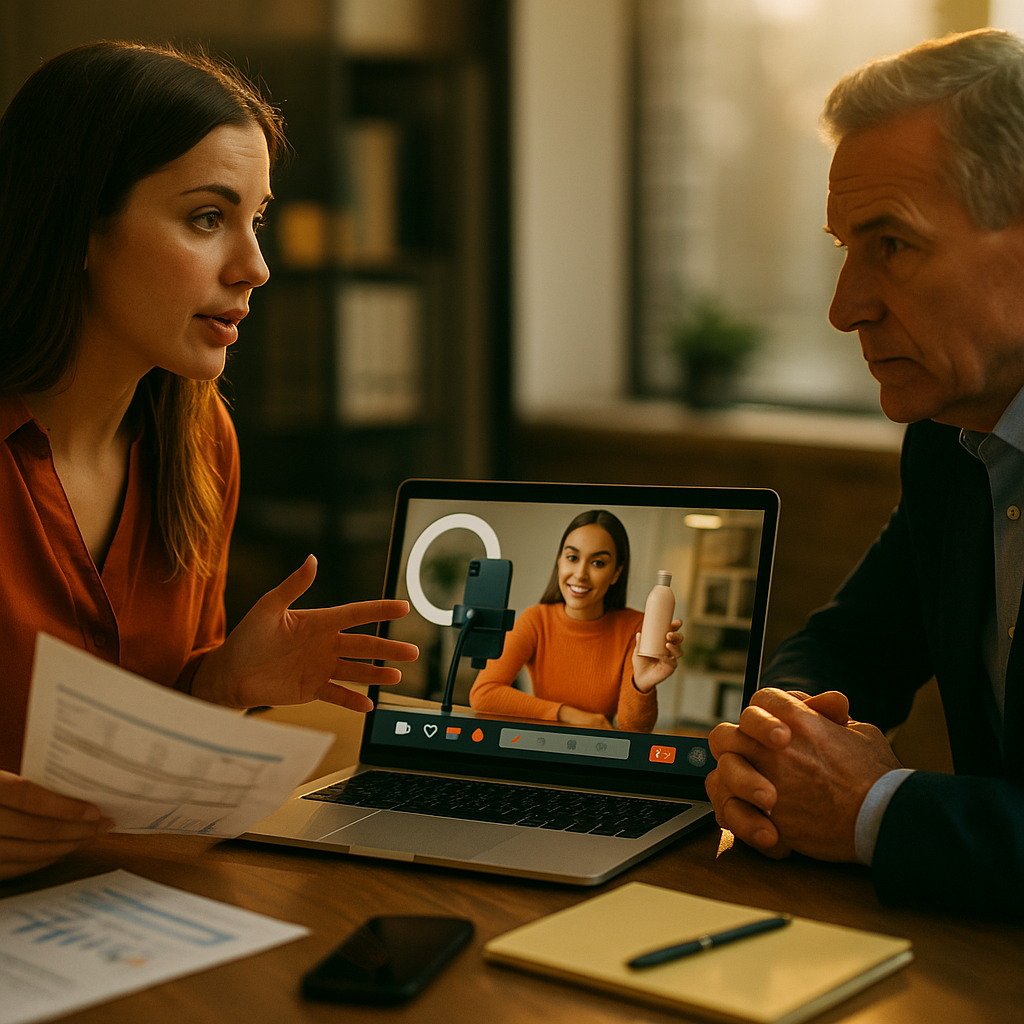
Thirty percent conversion. Read that twice. Static product ads convert at 2-3% on a good day, yet TikTok Shop and Amazon Live are posting livestream commerce conversion rates ten times higher, and most finance teams still treat livestream as a marketing experiment instead of a budget line. That gap between performance and funding is the real story here.
If you’re pitching a CFO on dedicated livestream commerce spend, you need more than exciting conversion stats. You need a framework that survives a finance review, not a marketing deck.
Why “Just Add It to Social Budget” Doesn’t Work Anymore
Most brands still fund livestream out of the general influencer or paid social line. That’s the mistake. Livestream commerce has a fundamentally different cost structure, revenue attribution model, and risk profile than a sponsored post or a UGC ad. Lumping it into an existing bucket means it competes with campaigns that were already funded, already justified, and already have a track record. Livestream loses that fight almost every time, regardless of its conversion numbers, because it looks like a rounding error in a spreadsheet built for different KPIs.
A dedicated, zero-based line forces the opposite discipline: livestream commerce has to justify its existence every cycle, on its own merits, with its own numbers. That’s actually good news for a channel converting at 30%. Zero-based budgeting rewards performance, and this channel has performance to spare.
We’ve covered the mechanics of this shift before in zero-based budgeting for influencer and livestream spend, but the CFO conversation requires a sharper, more finance-native argument than “the engagement is great.”
Start With the Number the CFO Actually Cares About
Not conversion rate. Not GMV. Contribution margin per livestream hour.
CFOs don’t fund channels because they’re trendy. They fund channels that produce a defensible return per dollar of input, with a cost structure they can model. So before you walk into that meeting, build the unit economics:
- Cost per livestream event (host fees, production, platform fees, promoted placement)
- Average order value during livestream vs. site average
- Conversion rate by product category and by host tier
- Repeat purchase rate from livestream-acquired customers
- Blended CAC for livestream vs. paid social and vs. standard influencer posts
Amazon Live and TikTok Shop both publish aggregate conversion benchmarks near 30%, according to platform-reported data cited widely across eMarketer retail commerce coverage, but your job is to translate that into a number specific to your catalog and your customer base. A CFO won’t fund an industry average. They’ll fund your model.
A 30% conversion rate means nothing on a P&L until you attach a cost basis to it. The pitch isn’t “livestream converts better.” The pitch is “livestream converts better at a lower blended CAC than our current top three channels, and here’s the math.”
Building the Zero-Based Case, Line by Line
Zero-based budgeting means you don’t inherit last year’s number. You build the request from zero, justifying every dollar against expected output. For livestream commerce, that structure typically breaks into four cost categories.
1. Host and talent costs. Whether you’re paying a flat fee, a commission split, or a hybrid, this is your largest controllable variable. We’ve broken down the tradeoffs in flat fees vs commission splits, and livestream specifically favors a hybrid: a modest base to guarantee host commitment, plus commission to align incentives with conversion. Pure commission sounds appealing to finance, but top hosts won’t commit calendar time without a floor.
2. Platform and production costs. TikTok Shop and Amazon Live both take a commission on livestream GMV, on top of any promoted slot fees. Build this into your margin model upfront, not as a surprise line item after the first quarter.
3. Amplification and pre-promotion. A livestream event with no pre-promotion converts a fraction as well as one teased across owned and paid channels for 48-72 hours beforehand. This is where amplification rights matter, and where the debate over flat fee vs commission amplification rights becomes directly relevant to your livestream contracts.
4. Measurement and attribution tooling. If you can’t prove the ROI cleanly, the second budget cycle gets harder, not easier. Don’t skip this line to save money in year one.
Present these four categories as a single, ring-fenced line item with its own quarterly review cadence. That’s what makes it “CFO-ready” rather than just another marketing ask.
The Risk Section CFOs Will Ask For (Even If You Don’t Volunteer It)
Every finance leader who’s been burned by an influencer program disaster will ask about risk before they ask about upside. Have the answers ready.
Platform concentration risk. If 90% of your livestream GMV runs through TikTok Shop, what happens if that platform faces a regulatory action or algorithm change? Diversifying across TikTok Shop and Amazon Live isn’t just a growth tactic, it’s a hedge.
Host dependency risk. A handful of top hosts driving most conversion is efficient until one of them leaves, gets embroiled in controversy, or renegotiates their rate mid-contract. Build a bench, not a single star.
Compliance risk. Livestream sales claims happen in real time, unscripted, often without legal review. That’s a liability surface most brands underestimate. The FTC’s endorsement guidance applies just as much to a live shopping event as it does to a static sponsored post, and enforcement doesn’t care that the claim happened live and can’t be edited after the fact. Build disclosure requirements and claim-approval guardrails into host contracts before the first stream, not after a complaint.
Framing risk mitigation as part of the funding request, not an afterthought, is what separates a mature pitch from a hopeful one. It also mirrors the governance-first thinking we’ve argued for in governance-first org redesign for creator programs generally.
What the Pilot-to-Scale Timeline Should Look Like
Don’t ask for a full-year budget on day one. Ask for a structured pilot with pre-agreed scale triggers.
- Quarter one: Run 8-12 livestream events across two platforms, two product categories, and three host tiers. Fund it modestly, but fund it as its own line, not a test-and-see add-on.
- Quarter two: Compare blended CAC, contribution margin, and repeat purchase rate against your paid social and influencer benchmarks. If livestream outperforms on even two of three, that’s your renewal case.
- Quarter three and beyond: Scale budget in proportion to proven contribution margin, not in proportion to enthusiasm. This is the zero-based discipline in action: growth is earned every cycle, not assumed.
This mirrors the sequencing logic in our budget sequencing framework for discovery, GEO, and livestream, where livestream commerce sits deliberately downstream of discovery investment because it converts existing demand more than it generates new demand. Know which job you’re asking the channel to do before you fund it.
How to Handle the “Why Not Just Increase Influencer Budget” Objection
You’ll get this question. Answer it directly: standard influencer posts and livestream commerce solve different problems. Influencer content builds awareness and consideration over weeks. Livestream commerce compresses consideration and purchase into a single real-time event, with urgency mechanics (limited stock counters, live Q&A, flash pricing) that static content simply cannot replicate.
They’re complementary, not substitutable. In fact, the strongest livestream performance tends to come from audiences already warmed by influencer content, which is another reason to keep the budget lines separate but coordinated, similar to how we’ve argued for separating genre-specific creator budgets rather than treating all creator spend as one undifferentiated pool.
For a deeper look at the conversion data itself and why static ads are losing ground, our earlier coverage on livestream shopping hitting 30% conversion lays out the platform-by-platform breakdown worth citing directly in your CFO deck.
Decision Rights Matter More Than the Budget Number
Even a well-funded livestream line fails if nobody owns the go/no-go calls in real time. Who approves a mid-stream price drop? Who signs off on a host’s live claim about product benefits? Who decides whether to extend a high-converting stream past its scheduled end time? These aren’t hypotheticals, they happen mid-broadcast, and waiting for a committee kills the moment.
Map decision rights before launch, not during a live crisis. We’ve laid out a practical model for this in our livestream commerce decision-rights map, and it’s worth attaching to your CFO proposal as an operational appendix. Finance leaders respond well to seeing that you’ve thought past the funding ask into actual execution governance.
FAQs
Frequently Asked Questions
What is a zero-based budget for livestream commerce?
It’s a funding approach where livestream commerce spend is built from zero each budget cycle, justified entirely on its own projected contribution margin and unit economics, rather than inheriting or borrowing from an existing social or influencer budget line.
Why are TikTok Shop and Amazon Live conversion rates so much higher than standard ads?
Livestream commerce combines real-time urgency, host credibility, and instant purchase flow within a single session. Viewers can ask questions, see live demonstrations, and buy without leaving the platform, which removes friction points that typically cause drop-off in static ad funnels.
How much should a brand budget for a livestream commerce pilot?
Most mid-market brands start with 8-12 livestream events across two platforms and multiple host tiers over one quarter, sized modestly enough to limit downside risk but large enough to generate statistically useful conversion and CAC data for the renewal decision.
What’s the biggest risk finance teams overlook with livestream commerce?
Compliance risk during live, unscripted host claims. Because livestream content happens in real time, it’s harder to review before publication, which raises exposure under FTC endorsement guidance if hosts make unverified or exaggerated claims.
Should livestream commerce come out of the influencer budget or its own line?
Its own line. Livestream has a distinct cost structure, platform commission model, and attribution path compared to standard influencer content, and folding it into an existing budget makes it harder to measure and easier to defund during cuts.
Next step: Before your next budget cycle, build the four-category cost model outlined above, attach one quarter of pilot data if you have it, and bring a decision-rights map, not just a spending request, into the room with finance.
FAQs
What is a zero-based budget for livestream commerce?
It’s a funding approach where livestream commerce spend is built from zero each budget cycle, justified entirely on its own projected contribution margin and unit economics, rather than inheriting or borrowing from an existing social or influencer budget line.
Why are TikTok Shop and Amazon Live conversion rates so much higher than standard ads?
Livestream commerce combines real-time urgency, host credibility, and instant purchase flow within a single session. Viewers can ask questions, see live demonstrations, and buy without leaving the platform, which removes friction points that typically cause drop-off in static ad funnels.
How much should a brand budget for a livestream commerce pilot?
Most mid-market brands start with 8-12 livestream events across two platforms and multiple host tiers over one quarter, sized modestly enough to limit downside risk but large enough to generate statistically useful conversion and CAC data for the renewal decision.
What’s the biggest risk finance teams overlook with livestream commerce?
Compliance risk during live, unscripted host claims. Because livestream content happens in real time, it’s harder to review before publication, which raises exposure under FTC endorsement guidance if hosts make unverified or exaggerated claims.
Should livestream commerce come out of the influencer budget or its own line?
Its own line. Livestream has a distinct cost structure, platform commission model, and attribution path compared to standard influencer content, and folding it into an existing budget makes it harder to measure and easier to defund during cuts.
Top Influencer Marketing Agencies
The leading agencies shaping influencer marketing in 2026
Agencies ranked by campaign performance, client diversity, platform expertise, proven ROI, industry recognition, and client satisfaction. Assessed through verified case studies, reviews, and industry consultations.
Moburst

-
2

The Shelf
Boutique Beauty & Lifestyle Influencer AgencyA data-driven boutique agency specializing exclusively in beauty, wellness, and lifestyle influencer campaigns on Instagram and TikTok. Best for brands already focused on the beauty/personal care space that need curated, aesthetic-driven content.Clients: Pepsi, The Honest Company, Hims, Elf Cosmetics, Pure LeafVisit The Shelf → -
3

Audiencly
Niche Gaming & Esports Influencer AgencyA specialized agency focused exclusively on gaming and esports creators on YouTube, Twitch, and TikTok. Ideal if your campaign is 100% gaming-focused — from game launches to hardware and esports events.Clients: Epic Games, NordVPN, Ubisoft, Wargaming, Tencent GamesVisit Audiencly → -
4

Viral Nation
Global Influencer Marketing & Talent AgencyA dual talent management and marketing agency with proprietary brand safety tools and a global creator network spanning nano-influencers to celebrities across all major platforms.Clients: Meta, Activision Blizzard, Energizer, Aston Martin, WalmartVisit Viral Nation → -
5

The Influencer Marketing Factory
TikTok, Instagram & YouTube CampaignsA full-service agency with strong TikTok expertise, offering end-to-end campaign management from influencer discovery through performance reporting with a focus on platform-native content.Clients: Google, Snapchat, Universal Music, Bumble, YelpVisit TIMF → -
6

NeoReach
Enterprise Analytics & Influencer CampaignsAn enterprise-focused agency combining managed campaigns with a powerful self-service data platform for influencer search, audience analytics, and attribution modeling.Clients: Amazon, Airbnb, Netflix, Honda, The New York TimesVisit NeoReach → -
7

Ubiquitous
Creator-First Marketing PlatformA tech-driven platform combining self-service tools with managed campaign options, emphasizing speed and scalability for brands managing multiple influencer relationships.Clients: Lyft, Disney, Target, American Eagle, NetflixVisit Ubiquitous → -
8

Obviously
Scalable Enterprise Influencer CampaignsA tech-enabled agency built for high-volume campaigns, coordinating hundreds of creators simultaneously with end-to-end logistics, content rights management, and product seeding.Clients: Google, Ulta Beauty, Converse, AmazonVisit Obviously →