


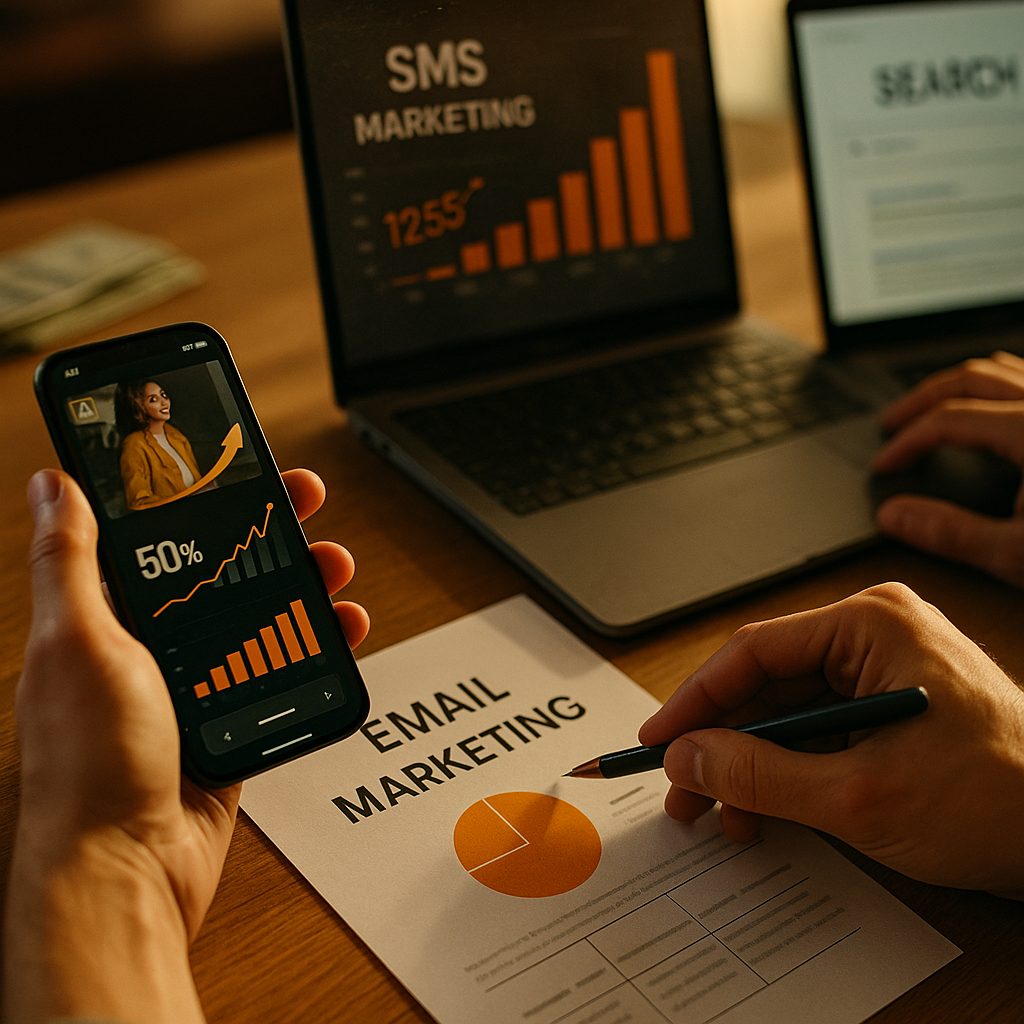
Most brands spend 90% of their creator budget on production and ship the content once, into one feed, then let it die. Meanwhile the same asset could be driving email opens, filling SMS flows, and cutting paid search CPCs by 20% or more. Omnichannel creator content budgets are the fix: a deliberate split of spend that treats creator assets as reusable media, not one-off social posts.
If your creator line item still ends at “post goes live,” you’re leaving money on the table. This is about rebuilding the budget line to fund distribution, not just creation.
Why the Single-Channel Model Is Quietly Failing
Organic reach on Instagram and TikTok keeps sliding. Even strong creator content now gets throttled unless you pay to push it. Brands that pour 100% of their creator budget into content fees and nothing into distribution are essentially gambling on an algorithm they don’t control.
Compare that to a brand that takes the same UGC asset and runs it as a Meta ad, drops a still into an abandoned-cart email, and tests the hook line as a paid search headline. Same production cost, three revenue streams. That’s the arithmetic CFOs want to see, and it’s the same logic behind shifting display budget to creator formats in the first place.
Treating a creator asset as a single-channel social post instead of a reusable media unit is the single biggest source of wasted influencer spend in 2026 budgets.
The Allocation Question: How Much Goes Where?
There’s no universal ratio, but the brands getting this right tend to land somewhere close to this split for the “distribution” portion of their creator budget (separate from production fees and usage rights):
- Paid social amplification: 45-55%. Still the biggest lever since it’s where creator content performs natively.
- Paid search: 20-25%. Creator-sourced imagery and testimonial language in search ads consistently lifts click-through rate versus stock creative.
- Email: 10-15%. Low cost to execute, high lifetime value when creator content refreshes stale flows.
- SMS: 10-15%. Smallest dollar allocation but often the highest conversion rate per send when the content feels native rather than promotional.
Notice paid social still dominates. This isn’t about abandoning the primary channel, it’s about not letting it absorb 100% of the distribution dollar when three other channels are sitting there underfunded.
Email: The Underpriced Channel
Email marketing still returns some of the highest ROI of any digital channel, according to data regularly cited by HubSpot, yet most creator budgets allocate zero dollars to it. That’s a mistake. A creator unboxing video repurposed into a welcome series, or a testimonial clip embedded in a cart abandonment email, costs almost nothing to deploy once the asset exists.
The budget line here isn’t for new content. It’s for the engineering time to integrate creator assets into existing flows, and occasionally for a small licensing fee if the creator’s usage rights don’t already cover email placement.
That’s exactly why annual usage rights buyouts have become more common. Paying once for broad usage across email, SMS, and search beats negotiating a new fee every time marketing wants to reuse a clip.
SMS: Small Spend, Outsized Signal
SMS budgets are usually an afterthought, a rounding error next to the paid media line. But the channel rewards authenticity more than any other, and creator content is built for that. A 15-second creator clip linked in a text message outperforms generic promotional copy because it reads like a recommendation, not an ad.
Budget for SMS should mostly cover platform fees (Attentive, Klaviyo, Postscript) and a small creative adaptation cost: trimming vertical video into a thumbnail or GIF that renders well in a message thread. It’s cheap. It’s also frequently skipped, which is exactly why it’s underpriced opportunity.
Paid Search: Where Creator Content Gets Surprisingly Good Traction
This is the channel most marketers don’t associate with creator content at all, and that’s the opportunity. Google’s performance max and demand gen formats increasingly reward image and video assets that look native rather than studio-polished. Creator content, by design, looks native.
Running a creator testimonial as a demand gen ad, or using creator-sourced product imagery in a shopping campaign, frequently drives lower CPCs than agency-produced creative because the algorithm and the human both read it as more trustworthy. Google’s ad platform documentation has leaned into this with expanded asset requirements for demand gen campaigns specifically built around vertical, creator-style video.
Budgeting for this means setting aside a slice of the paid search line, not the creator line, to license and test creator assets inside search campaigns. That requires your media buying and influencer teams to actually talk to each other, which, candidly, is rarer than it should be.
Building the Cross-Functional Budget Line
The hardest part of omnichannel creator budgeting isn’t the math. It’s the org chart. Email lives in lifecycle marketing. SMS often sits with retention or CRM. Paid search belongs to performance marketing. Creator content usually reports up through brand or social. Four teams, four budgets, four sets of KPIs that rarely talk to each other.
Brands solving this well are centralizing the decision, not necessarily the execution. A creator center of excellence model works here: one group owns the content library and usage rights, then “licenses” assets internally to email, SMS, and paid search teams who fund their own distribution spend. The creator team isn’t paying for the email send, they’re just making sure the asset exists and is cleared for use.
This also solves a reporting headache. When creator marketing reporting lines are fragmented, the budget is the first thing cut because no single team can prove full-funnel impact. Centralizing the asset library (even if spend stays distributed) makes it far easier to show a finance team the total return across four channels instead of one.
A single piece of creator content funded once and deployed across four channels can outperform four separate single-channel budgets, simply because the cost per impression collapses with reuse.
What This Does to Your Attribution Model
Omnichannel distribution complicates measurement, no way around it. A creator clip that appears in an Instagram ad, a welcome email, and a search campaign makes last-click attribution almost meaningless. The purchase might get credited to search when the email actually drove the open.
This is where signal stack approaches matter more than ever. Instead of chasing a single source of truth, track content performance at the asset level across channels: did this specific creator clip, wherever it appeared, correlate with lift in conversion rate, open rate, and CTR simultaneously? If it did across all three, that’s a stronger signal than any single platform’s attribution model gives you.
Marketing mix modeling and incrementality testing, the kind eMarketer has covered extensively as privacy restrictions tighten, becomes the more honest way to assess omnichannel creator spend. It’s slower and less satisfying than a dashboard number, but it’s accurate.
A Practical Starting Framework
If you’re building this out for the first time, don’t try to boil the ocean. Start with a pilot:
- Pick five high-performing creator assets from the last quarter that already cleared broad usage rights.
- Allocate a small test budget (even 10% of your paid social spend) to run the same assets in a Meta demand gen campaign, a Google demand gen campaign, one email flow, and one SMS segment.
- Measure lift against a control group that saw only the original organic post.
- Compare cost per acquisition across all four deployments, not just the original channel.
Most teams are surprised by which channel wins. It’s rarely the one they expected, and that’s the point of running the test before scaling the budget split.
This pilot also forces a usage rights conversation early. If your creator contracts only cover “organic social,” you’ll hit a wall fast. Build that into the next round of negotiations, following the usage rights terms that actually hold up when content gets reused across paid channels months later.
The Takeaway
Stop budgeting for creator content as a single social post and start budgeting for it as a media asset with a shelf life across four channels. Run the five-asset pilot this quarter, measure CPA across email, SMS, paid search, and paid social side by side, then rebuild next year’s split around whichever channel actually moved the number, not the one that felt obvious.
FAQs
What percentage of a creator budget should go toward distribution versus production?
Many brands are now splitting roughly 60% toward production and talent fees and 40% toward distribution across paid social, paid search, email, and SMS. The exact ratio depends on how much organic reach you still get, but any brand paying zero for distribution is underusing its content.
Can creator content really improve paid search performance?
Yes. Creator-style video and imagery frequently outperform traditional studio creative in demand gen and performance max campaigns because it reads as more authentic to both users and the algorithm, often resulting in lower cost per click.
Do I need new usage rights to run creator content in email and SMS?
Usually, yes. Most creator contracts default to organic social usage only. Running the same asset in email, SMS, or paid search typically requires an expanded or annual usage rights agreement negotiated upfront.
Which team should own the omnichannel creator budget?
Ownership works best when split: a central creator or content team manages the asset library and usage rights, while email, SMS, paid search, and paid social teams each fund their own distribution spend using those cleared assets.
How do you measure ROI when one creator asset runs across four channels?
Last-click attribution breaks down quickly in this model. Track performance at the asset level across channels and lean on incrementality testing or marketing mix modeling to see the true lift rather than relying on any single platform’s dashboard.
Top Influencer Marketing Agencies
The leading agencies shaping influencer marketing in 2026
Agencies ranked by campaign performance, client diversity, platform expertise, proven ROI, industry recognition, and client satisfaction. Assessed through verified case studies, reviews, and industry consultations.
Moburst

-
2

The Shelf
Boutique Beauty & Lifestyle Influencer AgencyA data-driven boutique agency specializing exclusively in beauty, wellness, and lifestyle influencer campaigns on Instagram and TikTok. Best for brands already focused on the beauty/personal care space that need curated, aesthetic-driven content.Clients: Pepsi, The Honest Company, Hims, Elf Cosmetics, Pure LeafVisit The Shelf → -
3

Audiencly
Niche Gaming & Esports Influencer AgencyA specialized agency focused exclusively on gaming and esports creators on YouTube, Twitch, and TikTok. Ideal if your campaign is 100% gaming-focused — from game launches to hardware and esports events.Clients: Epic Games, NordVPN, Ubisoft, Wargaming, Tencent GamesVisit Audiencly → -
4

Viral Nation
Global Influencer Marketing & Talent AgencyA dual talent management and marketing agency with proprietary brand safety tools and a global creator network spanning nano-influencers to celebrities across all major platforms.Clients: Meta, Activision Blizzard, Energizer, Aston Martin, WalmartVisit Viral Nation → -
5

The Influencer Marketing Factory
TikTok, Instagram & YouTube CampaignsA full-service agency with strong TikTok expertise, offering end-to-end campaign management from influencer discovery through performance reporting with a focus on platform-native content.Clients: Google, Snapchat, Universal Music, Bumble, YelpVisit TIMF → -
6

NeoReach
Enterprise Analytics & Influencer CampaignsAn enterprise-focused agency combining managed campaigns with a powerful self-service data platform for influencer search, audience analytics, and attribution modeling.Clients: Amazon, Airbnb, Netflix, Honda, The New York TimesVisit NeoReach → -
7

Ubiquitous
Creator-First Marketing PlatformA tech-driven platform combining self-service tools with managed campaign options, emphasizing speed and scalability for brands managing multiple influencer relationships.Clients: Lyft, Disney, Target, American Eagle, NetflixVisit Ubiquitous → -
8

Obviously
Scalable Enterprise Influencer CampaignsA tech-enabled agency built for high-volume campaigns, coordinating hundreds of creators simultaneously with end-to-end logistics, content rights management, and product seeding.Clients: Google, Ulta Beauty, Converse, AmazonVisit Obviously →