


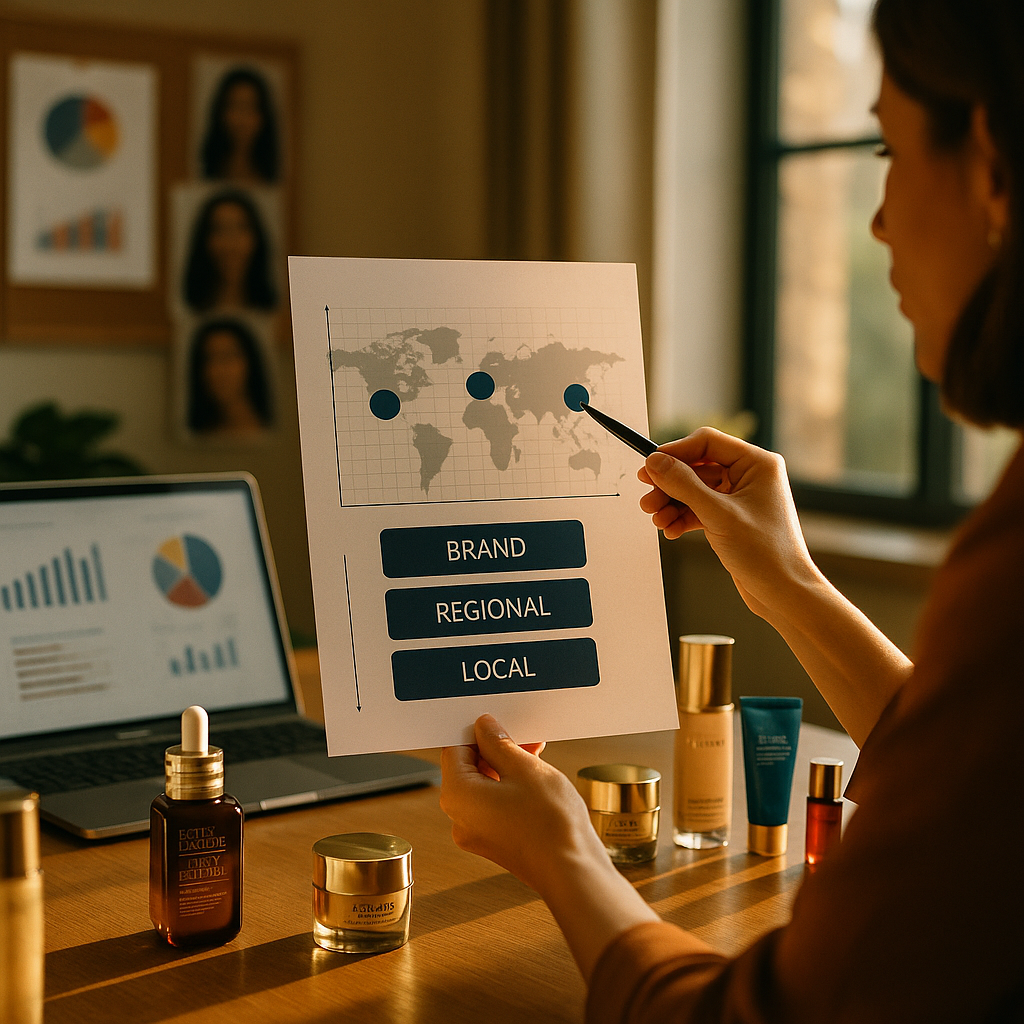
Seventy percent of global marketing leaders say organizational structure, not budget, is their biggest barrier to scaling influencer programs. Estée Lauder just handed the industry a blueprint for fixing that. Its newly clarified global operating model splits marketing accountability into three explicit layers — brand, regional, local — and it’s forcing multinational CMOs to ask whether their own org charts are quietly sabotaging campaign performance.
Why This Matters Beyond One Beauty Giant
Estée Lauder Companies has spent recent quarters restructuring how it builds and deploys influencer, content, and creator programs across its portfolio of brands. The headline isn’t the reorg itself — big companies reorganize constantly. The headline is the clarity of the role split it published: brand teams own strategy and asset creation, regional teams own market adaptation and compliance, local teams own execution and community relationships. No overlap. No “shared ownership” language that means nobody’s actually accountable.
That distinction sounds bureaucratic until you’ve sat in a planning meeting where a global campaign brief contradicts a local legal requirement, and three teams each assume someone else caught it. Anyone running influencer programs across more than two markets has lived this. It’s rarely a talent problem. It’s a structure problem.
The companies scaling influencer marketing profitably aren’t the ones with the biggest budgets — they’re the ones who’ve eliminated the ambiguity about who decides what.
The Three-Layer Model, Broken Down
Estée Lauder’s approach maps closely to what enterprise operations consultants have pushed for years, but marketing orgs have resisted adopting because it feels rigid. Here’s the practical breakdown:
- Brand layer: Sets global creative platforms, defines the creator tiering framework, approves master content, and owns the measurement standard used to judge every market’s performance.
- Regional layer: Translates brand strategy into market-cluster reality — think APAC versus EMEA versus LatAm — handling regulatory nuance, budget allocation across countries, and vendor or agency relationships that span multiple local markets.
- Local layer: Executes creator partnerships, manages day-to-day community relationships, and feeds performance data back up the chain without needing sign-off for every micro-decision.
Notice what’s missing: a fourth layer where global and regional teams both weigh in on the same creator contract. That’s the point. Estée Lauder’s model, discussed in depth in our earlier coverage of the enterprise standardization signal, treats decision rights as a design problem, not a diplomacy exercise.
What Breaks Without This Clarity?
Ask any regional marketing director running influencer campaigns across ten-plus countries what their biggest time sink is. It’s rarely creative development. It’s approval loops — waiting on legal in one office, brand sign-off in another, and a local team that’s already lost the creator’s attention because the deal took six weeks to close.
Influencer marketing runs on speed. A creator’s audience trust, their content cadence, their platform’s algorithm — all of it rewards brands that move in days, not quarters. According to eMarketer, global influencer marketing spend continues climbing at double-digit rates annually, but the brands capturing the most value are consistently the ones with the shortest decision cycles, not necessarily the largest budgets.
Without role clarity, three failure modes repeat themselves:
- Duplicate creator outreach — regional and local teams independently contacting the same influencer, damaging brand credibility.
- Compliance gaps — a global campaign asset gets deployed in a market without the disclosure language required by local regulators.
- Measurement chaos — every region reports “engagement” differently because no one enforced a single standard, making cross-market ROI comparison nearly impossible.
That last point connects directly to a problem we’ve flagged before: brands chasing verifiable ROI benchmarks can’t get there if every market defines success differently. Role clarity is a measurement prerequisite, not just an org chart preference.
Is This Just Another Reorg, or a Real Standard?
Skepticism is fair. Marketing orgs reorganize every 18 to 24 months on average, and most reorgs are cosmetic — new titles, same confusion. What separates Estée Lauder’s move from typical reshuffling is that it’s paired with operational infrastructure: a tiered creator model, a shared platform for managing partnerships, and standardized measurement criteria that travel across markets.
We covered the tiering component in detail in our piece on Estée Lauder’s creator tiering model, which showed how the company cut agency dependency by codifying which creator tiers get handled in-house versus externally. The role clarification is the missing piece that makes tiering actually work at scale — because tiering only functions if everyone agrees who approves tier assignments in the first place.
Put those two pieces together — tiering plus role clarity — and you get something closer to genuine enterprise infrastructure than a seasonal org change. That’s the real story here.
The Compliance Angle Nobody’s Talking About Enough
Here’s where this gets urgent for legal and risk teams, not just marketing. Influencer disclosure rules vary significantly by jurisdiction — the FTC’s endorsement guidelines in the US differ from the UK’s ICO requirements around data and advertising transparency, which differ again from emerging frameworks across APAC markets. A global brand asset that’s compliant in New York can be a liability in London or Mumbai if nobody at the regional layer is explicitly tasked with catching that.
Estée Lauder’s model assigns regulatory interpretation squarely to the regional layer. That’s a deliberate risk-mitigation choice. It means brand teams don’t have to become legal experts in 40 markets, and local teams don’t have to guess whether a global asset needs modification before it goes live. One layer, one job.
Compliance failures in influencer marketing rarely stem from ignorance of the rules — they stem from nobody being assigned to check them before launch.
How to Apply This If You’re Not a $16 Billion Beauty Company
You don’t need Estée Lauder’s headcount to borrow its logic. Mid-market multinationals can adapt the three-layer model with a fraction of the resources, provided they’re disciplined about where they draw the lines. A few starting moves:
- Audit your current decision rights. Pull the last five influencer campaigns that touched multiple markets. Trace who actually approved creator selection, budget, and compliance sign-off. If the answer is “it depends” more than twice, you have a structure gap.
- Assign one measurement standard globally. Whatever metric your brand layer picks — verified engagement rate, incremental sales lift, share of voice — every region reports against it the same way. No local exceptions.
- Give regional teams real compliance authority. Don’t just ask them to flag issues; give them sign-off power to hold or modify assets before local deployment.
- Let local teams move fast on execution. If every creator contract needs global sign-off, you’ve recreated the bottleneck this model is designed to eliminate.
This mirrors a broader shift we’ve tracked across the creator economy: hiring patterns increasingly reflect this layered structure, with brands building out dedicated regional operations roles specifically to own the middle layer that used to fall through the cracks between global strategy and local execution.
What Tools Support This Structure?
Structure without systems just creates new bottlenecks with better titles. Platforms like Meta Business Suite and enterprise influencer management tools increasingly support multi-tier permission settings, letting brand teams lock certain approval fields while giving regional and local users edit access to others. That’s not a cosmetic feature. It’s the technical enforcement of the org structure Estée Lauder is describing.
Tools referenced in our coverage of creator economy hiring trends show the same pattern: platform investment and org design are moving together, not sequentially. Brands buying influencer management software without first fixing decision rights tend to end up with expensive systems that replicate old confusion in a new interface.
For teams benchmarking their own maturity, HubSpot’s resources on marketing operations and Sprout Social’s reporting tools both offer practical starting points for standardizing measurement across regional teams, even outside the influencer-specific context.
The Real Test Is Cross-Market Consistency
None of this matters if a customer in São Paulo gets a wildly different brand experience than one in Seoul because local teams interpreted “brand guidelines” as suggestions. The three-layer model’s ultimate job is consistency without rigidity — global coherence, local relevance, no permission-seeking theater in between.
Multinational marketing orgs watching Estée Lauder’s move should treat it less as a case study and more as a diagnostic. Where’s your ambiguity? Who actually owns the decision when brand and local disagree? If you can’t answer that in one sentence, you already know where to start.
Next Step
Map your last three cross-market campaigns against the brand-regional-local framework this week — if you can’t assign a single owner to each decision point, that’s your first fix, not your fifth.
FAQs
What is the brand-regional-local operating model in marketing?
It’s an organizational structure that assigns distinct, non-overlapping responsibilities to three layers: the brand layer sets global strategy and standards, the regional layer adapts strategy to market clusters and handles compliance, and the local layer executes creator partnerships and community management on the ground.
Why did Estée Lauder clarify these roles now?
As influencer and creator programs scaled across dozens of markets, ambiguous decision rights created duplicate outreach, inconsistent compliance, and fragmented measurement. Clarifying roles was necessary to make its tiered creator model and enterprise influencer platform function at scale.
How does this model reduce compliance risk?
By assigning regulatory interpretation explicitly to the regional layer, brands avoid situations where global assets deploy in markets without required local disclosures or adaptations, since one team is clearly accountable for catching those gaps before launch.
Can smaller multinational brands adopt this structure?
Yes. Companies without Estée Lauder’s scale can apply the same logic by auditing current decision rights, assigning one global measurement standard, and giving regional teams real compliance sign-off authority rather than advisory input only.
What’s the biggest mistake brands make when restructuring for global influencer programs?
Treating the reorg as cosmetic — changing titles without changing actual decision authority, or investing in influencer management software before fixing the underlying ambiguity about who approves what.
Top Influencer Marketing Agencies
The leading agencies shaping influencer marketing in 2026
Agencies ranked by campaign performance, client diversity, platform expertise, proven ROI, industry recognition, and client satisfaction. Assessed through verified case studies, reviews, and industry consultations.
Moburst

-
2

The Shelf
Boutique Beauty & Lifestyle Influencer AgencyA data-driven boutique agency specializing exclusively in beauty, wellness, and lifestyle influencer campaigns on Instagram and TikTok. Best for brands already focused on the beauty/personal care space that need curated, aesthetic-driven content.Clients: Pepsi, The Honest Company, Hims, Elf Cosmetics, Pure LeafVisit The Shelf → -
3

Audiencly
Niche Gaming & Esports Influencer AgencyA specialized agency focused exclusively on gaming and esports creators on YouTube, Twitch, and TikTok. Ideal if your campaign is 100% gaming-focused — from game launches to hardware and esports events.Clients: Epic Games, NordVPN, Ubisoft, Wargaming, Tencent GamesVisit Audiencly → -
4

Viral Nation
Global Influencer Marketing & Talent AgencyA dual talent management and marketing agency with proprietary brand safety tools and a global creator network spanning nano-influencers to celebrities across all major platforms.Clients: Meta, Activision Blizzard, Energizer, Aston Martin, WalmartVisit Viral Nation → -
5

The Influencer Marketing Factory
TikTok, Instagram & YouTube CampaignsA full-service agency with strong TikTok expertise, offering end-to-end campaign management from influencer discovery through performance reporting with a focus on platform-native content.Clients: Google, Snapchat, Universal Music, Bumble, YelpVisit TIMF → -
6

NeoReach
Enterprise Analytics & Influencer CampaignsAn enterprise-focused agency combining managed campaigns with a powerful self-service data platform for influencer search, audience analytics, and attribution modeling.Clients: Amazon, Airbnb, Netflix, Honda, The New York TimesVisit NeoReach → -
7

Ubiquitous
Creator-First Marketing PlatformA tech-driven platform combining self-service tools with managed campaign options, emphasizing speed and scalability for brands managing multiple influencer relationships.Clients: Lyft, Disney, Target, American Eagle, NetflixVisit Ubiquitous → -
8

Obviously
Scalable Enterprise Influencer CampaignsA tech-enabled agency built for high-volume campaigns, coordinating hundreds of creators simultaneously with end-to-end logistics, content rights management, and product seeding.Clients: Google, Ulta Beauty, Converse, AmazonVisit Obviously →