


Roughly 95% of website visitors never fill out a form, log in, or hand over an email. They browse, they bounce, they show up again next week on a different device — and most identity stacks lose them completely. The question isn’t whether you have an anonymous traffic problem. You do. The question is whether your identity decisioning engine can actually resolve it, or just report on it.
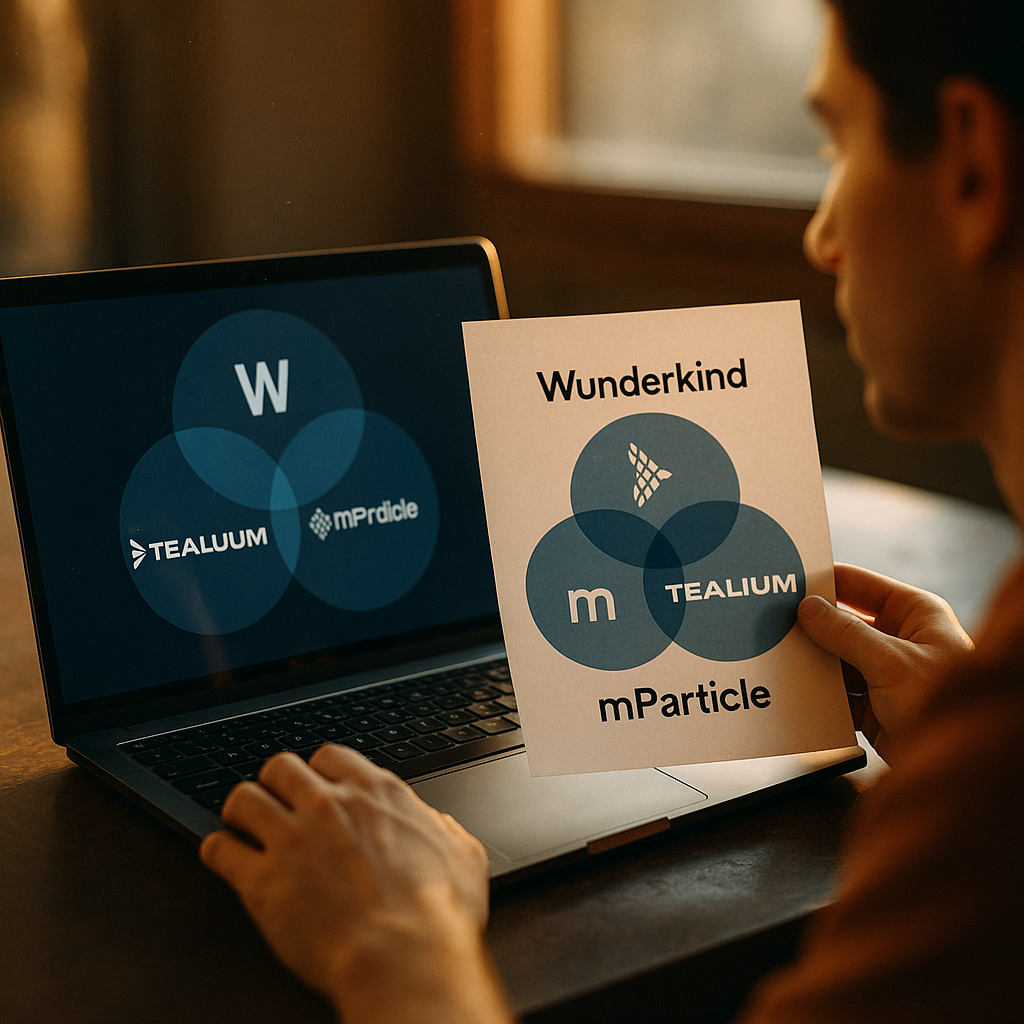
Wunderkind, Tealium, and mParticle all claim to solve identity resolution. They don’t solve it the same way, and the differences matter a lot once real budget is on the line.
Three Different Philosophies, One Shared Problem
Tealium and mParticle are customer data platforms (CDPs) at their core. They’re built to ingest, unify, and route data across your martech stack. Identity resolution is a feature of that broader mission — a necessary layer, but not the reason the product exists.
Wunderkind approaches it differently. It was built specifically to de-anonymize commerce traffic in real time and convert that identity into revenue, largely through triggered messaging and onsite personalization. Identity resolution isn’t a module bolted onto a CDP. It’s the entire product thesis.
That distinction shapes everything downstream: latency, match rates, activation speed, and — frankly — what “resolved” even means at each vendor.
A visitor identity that resolves in 400 milliseconds and triggers an on-page offer is worth more than one that resolves overnight in a batch job. Speed isn’t a nice-to-have in identity resolution — it’s the entire value proposition.
How Each Engine Actually Resolves Identity
Tealium’s AudienceStream and EventStream products stitch identities using deterministic keys (logins, CRM matches, loyalty IDs) supplemented by probabilistic signals across devices. It’s a flexible, tag-management-native approach that plays well with an existing enterprise data warehouse. But Tealium doesn’t own a proprietary identity graph the way a commerce-focused vendor does — it depends heavily on the data sources you feed it.
mParticle (now part of Rokt) takes a similar CDP-first stance, with strong deterministic matching and a well-documented identity resolution API. It’s engineered for teams that want granular control over merge rules, survivorship logic, and namespace management. That control is powerful, but it also means more engineering lift to get anonymous resolution humming at scale. For a deeper breakdown of how mParticle compares against adjacent tools, see this stack comparison.
Wunderkind’s engine leans harder into probabilistic and behavioral signals paired with a massive first-party identity graph built from its publisher and retailer network. It’s optimized for one job: turning an anonymous shopper into a known, addressable identity before they leave the page. That specialization shows up in reported match rates — Wunderkind has publicly cited identity match rates in the 60-70% range for e-commerce traffic, well above what most generic CDP identity modules achieve out of the box.
Match Rate Claims Deserve Scrutiny
Every vendor in this space quotes a match rate. Almost none of them define it the same way. Is it match rate against total sessions? Against unique visitors? Against traffic that already carries some cookie or device signal? This is where a lot of brands get burned during procurement.
Before you sign anything, ask each vendor to walk through their match rate methodology using your own historical traffic sample, not their case study numbers. If you want a structured way to do this, this match rate verification framework is a useful starting point, and it applies equally to Tealium, mParticle, and Wunderkind pitches.
- Ask for cohort-level data — not aggregate percentages across all client traffic.
- Separate deterministic from probabilistic matches — the confidence levels are not interchangeable.
- Request a live sandbox test against a slice of your actual site traffic before renewal or purchase.
Latency: The Metric Everyone Underrates
Resolution speed determines what you can actually do with an identity once you have it. Tealium and mParticle typically process identity stitching in near-real-time to real-time depending on configuration, but activation into downstream tools (email, ad platforms, personalization engines) often introduces additional lag — sometimes minutes, sometimes longer if it’s routed through a batch sync.
Wunderkind’s architecture is built for sub-second resolution specifically because its core use case — triggering an onsite message or cart-abandonment email before the visitor leaves — dies if the identity resolves too slowly. If your primary use case is real-time onsite personalization, this is the single biggest differentiator. If your primary use case is warehouse-level customer analytics, it matters less.
Not sure whether your current CDP is genuinely real-time or just marketed that way? Run it through this verification test before you take any vendor’s latency claims at face value.
Where Tealium and mParticle Actually Win
It would be lazy to frame this as Wunderkind-good, CDP-bad. Tealium and mParticle win decisively in scenarios Wunderkind isn’t built for:
- Multi-brand, multi-domain enterprises that need a single identity spine across dozens of properties and offline data sources.
- Complex governance requirements where legal and privacy teams need granular control over consent, data residency, and merge logic.
- Heavy warehouse-native stacks already built around Snowflake, BigQuery, or Databricks, where CDP-native reverse ETL matters more than onsite activation speed.
If your organization already treats a consolidated CDP as the backbone of martech, ripping it out for a commerce-specific identity engine is rarely the right call. The smarter move for a lot of enterprises is layering Wunderkind (or a similar specialist) on top of the CDP for high-value commerce moments, while letting Tealium or mParticle handle the broader identity graph and governance.
Where Wunderkind Pulls Ahead
For pure e-commerce and direct-to-consumer brands, Wunderkind’s specialization tends to win on the metrics that actually move revenue: identified-visitor conversion rate, cart recovery speed, and time-to-first-message after an anonymous session begins. Its acquisition of Cordial expanded that further into cross-channel orchestration, which changes the buying calculus for brands evaluating an all-in-one identity-plus-messaging stack. That merger is worth understanding in detail — see this buyer’s guide to the merger and the follow-up on the AI de-identification model that came out of it.
Direct head-to-head performance data against Cordial specifically — a closer competitor in the commerce-identity space than Tealium or mParticle — is broken down in this anonymous traffic comparison.
Privacy and Compliance: Not an Afterthought
Identity resolution vendors sit close to some of the thorniest privacy questions in marketing right now. Probabilistic matching, in particular, draws scrutiny from regulators. The FTC has increased enforcement attention on data brokers and identity resolution practices, and UK-facing brands should keep an eye on ICO guidance on tracking technologies and legitimate interest.
All three vendors publish compliance documentation, but the depth and transparency vary. Ask specifically how each handles:
- Consent signal propagation across the identity graph
- Data retention windows for unresolved probabilistic matches
- Cross-device linking disclosure in privacy policies
If your legal team hasn’t reviewed a data contract with your identity vendor recently, now’s the time. This piece on data contracts lays out what should be in that agreement before you scale usage across more of your funnel.
What This Means for Your Vendor Evaluation
Stop evaluating identity resolution vendors as if they’re interchangeable line items in an RFP. They’re not. Tealium and mParticle are infrastructure decisions — you’re building the plumbing for years. Wunderkind is closer to a performance channel decision — you’re buying incremental revenue from traffic you’re currently wasting.
Run the evaluation with that framing in mind. If you’re heading into a renewal cycle on any identity or CDP contract, this renewal audit checklist is worth running through before you sign anything for another 12-24 months. Vendors count on inertia at renewal time. Don’t give it to them for free.
According to eMarketer research on the creator and commerce economy, identity resolution investment continues to climb as third-party cookie deprecation reshapes how brands find and re-engage anonymous shoppers. That trend isn’t slowing down, and the vendors best positioned to benefit are the ones with proprietary first-party graphs — not just clever stitching logic layered on top of someone else’s data.
FAQs
Is Wunderkind a replacement for a CDP like Tealium or mParticle?
No. Wunderkind is a commerce-focused identity resolution and activation engine, not a full customer data platform. Most enterprises run it alongside a CDP rather than instead of one, using Wunderkind for real-time onsite and email activation while the CDP handles broader data governance and cross-system orchestration.
Which vendor has the highest identity match rate?
Wunderkind has publicly cited match rates in the 60-70% range for e-commerce traffic, which is higher than typical out-of-the-box CDP identity modules. However, match rate definitions vary significantly by vendor, so any comparison should be based on a sandbox test against your own traffic, not published case study figures.
Do Tealium and mParticle resolve anonymous traffic in real time?
Both platforms support near-real-time identity stitching, but activation into downstream channels often introduces lag depending on integration configuration. Neither was purpose-built for the sub-second resolution-to-activation loop that commerce-specific tools like Wunderkind prioritize.
What questions should I ask before signing an identity resolution contract?
Ask for cohort-level match rate data on your own traffic, clarity on deterministic versus probabilistic matching, consent signal handling across the identity graph, and data retention policies for unresolved matches. A live sandbox test should be a non-negotiable part of procurement.
Does probabilistic identity matching create compliance risk?
It can, particularly around consent propagation and cross-device linking disclosures. Regulators including the FTC have increased scrutiny of data broker and identity resolution practices, so legal review of vendor data contracts is essential before scaling usage.
Next Step
Before your next renewal cycle, run a side-by-side sandbox test of Wunderkind, Tealium, and mParticle against the same 30-day traffic sample and score them on match rate, activation latency, and compliance documentation — not published benchmarks.
FAQs
Is Wunderkind a replacement for a CDP like Tealium or mParticle?
No. Wunderkind is a commerce-focused identity resolution and activation engine, not a full customer data platform. Most enterprises run it alongside a CDP rather than instead of one, using Wunderkind for real-time onsite and email activation while the CDP handles broader data governance and cross-system orchestration.
Which vendor has the highest identity match rate?
Wunderkind has publicly cited match rates in the 60-70% range for e-commerce traffic, which is higher than typical out-of-the-box CDP identity modules. However, match rate definitions vary significantly by vendor, so any comparison should be based on a sandbox test against your own traffic, not published case study figures.
Do Tealium and mParticle resolve anonymous traffic in real time?
Both platforms support near-real-time identity stitching, but activation into downstream channels often introduces lag depending on integration configuration. Neither was purpose-built for the sub-second resolution-to-activation loop that commerce-specific tools like Wunderkind prioritize.
What questions should I ask before signing an identity resolution contract?
Ask for cohort-level match rate data on your own traffic, clarity on deterministic versus probabilistic matching, consent signal handling across the identity graph, and data retention policies for unresolved matches. A live sandbox test should be a non-negotiable part of procurement.
Does probabilistic identity matching create compliance risk?
It can, particularly around consent propagation and cross-device linking disclosures. Regulators including the FTC have increased scrutiny of data broker and identity resolution practices, so legal review of vendor data contracts is essential before scaling usage.
Top Influencer Marketing Agencies
The leading agencies shaping influencer marketing in 2026
Agencies ranked by campaign performance, client diversity, platform expertise, proven ROI, industry recognition, and client satisfaction. Assessed through verified case studies, reviews, and industry consultations.
Moburst

-
2

The Shelf
Boutique Beauty & Lifestyle Influencer AgencyA data-driven boutique agency specializing exclusively in beauty, wellness, and lifestyle influencer campaigns on Instagram and TikTok. Best for brands already focused on the beauty/personal care space that need curated, aesthetic-driven content.Clients: Pepsi, The Honest Company, Hims, Elf Cosmetics, Pure LeafVisit The Shelf → -
3

Audiencly
Niche Gaming & Esports Influencer AgencyA specialized agency focused exclusively on gaming and esports creators on YouTube, Twitch, and TikTok. Ideal if your campaign is 100% gaming-focused — from game launches to hardware and esports events.Clients: Epic Games, NordVPN, Ubisoft, Wargaming, Tencent GamesVisit Audiencly → -
4

Viral Nation
Global Influencer Marketing & Talent AgencyA dual talent management and marketing agency with proprietary brand safety tools and a global creator network spanning nano-influencers to celebrities across all major platforms.Clients: Meta, Activision Blizzard, Energizer, Aston Martin, WalmartVisit Viral Nation → -
5

The Influencer Marketing Factory
TikTok, Instagram & YouTube CampaignsA full-service agency with strong TikTok expertise, offering end-to-end campaign management from influencer discovery through performance reporting with a focus on platform-native content.Clients: Google, Snapchat, Universal Music, Bumble, YelpVisit TIMF → -
6

NeoReach
Enterprise Analytics & Influencer CampaignsAn enterprise-focused agency combining managed campaigns with a powerful self-service data platform for influencer search, audience analytics, and attribution modeling.Clients: Amazon, Airbnb, Netflix, Honda, The New York TimesVisit NeoReach → -
7

Ubiquitous
Creator-First Marketing PlatformA tech-driven platform combining self-service tools with managed campaign options, emphasizing speed and scalability for brands managing multiple influencer relationships.Clients: Lyft, Disney, Target, American Eagle, NetflixVisit Ubiquitous → -
8

Obviously
Scalable Enterprise Influencer CampaignsA tech-enabled agency built for high-volume campaigns, coordinating hundreds of creators simultaneously with end-to-end logistics, content rights management, and product seeding.Clients: Google, Ulta Beauty, Converse, AmazonVisit Obviously →