


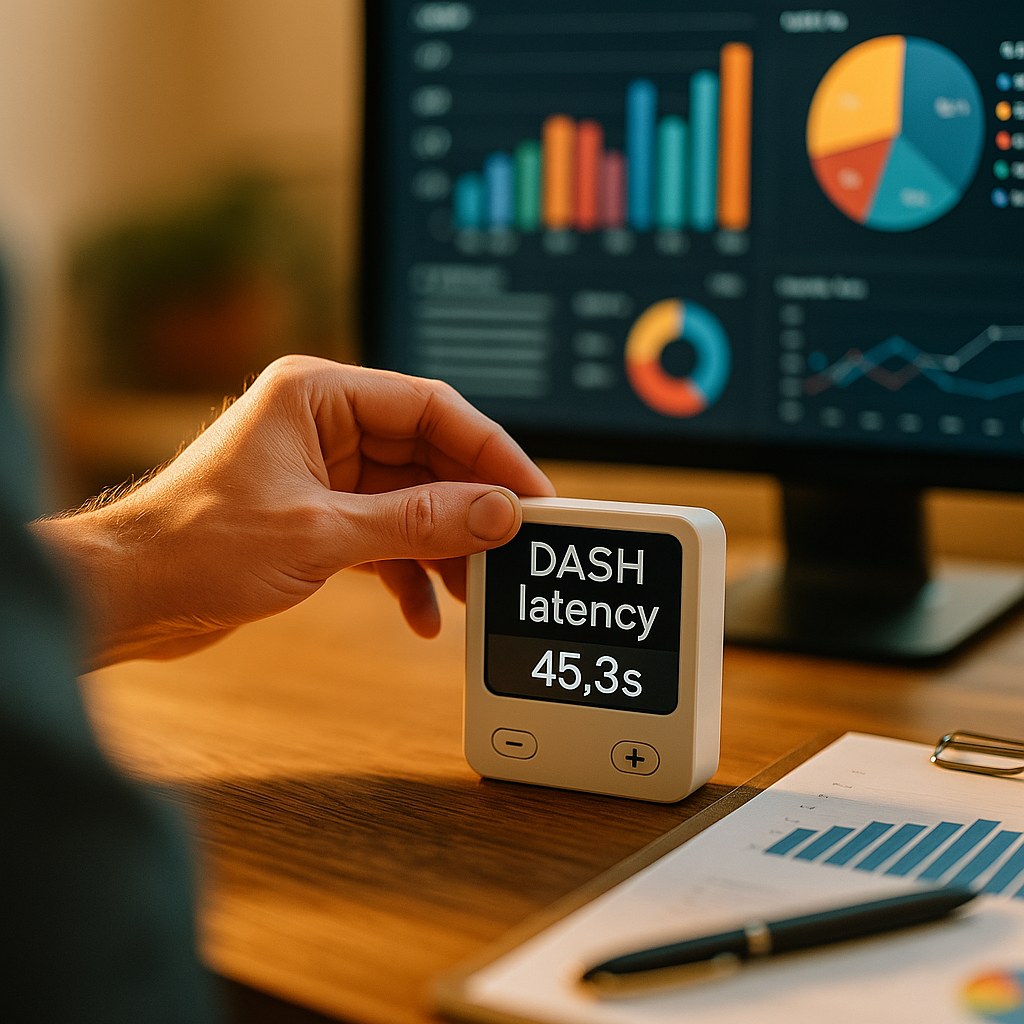
Six-second delays used to be a rounding error. Now they’re a measurement crisis. Nielsen’s DASH latency adjustment just forced the industry to admit that streaming ad-delivery timestamps have been quietly lying to everyone, and the fix changes how every fragmented-screen campaign gets scored.
If you’re running budget across connected TV, mobile apps, and browser-based streaming, this isn’t a footnote update. It’s a recalibration of the trust layer underneath your entire cross-screen measurement stack.
What Actually Changed With DASH Latency
DASH — Dynamic Adaptive Streaming over HTTP — is the delivery protocol behind most modern video streaming, including ad-supported tiers on platforms using adaptive bitrate technology. The problem Nielsen identified is straightforward once you say it out loud: ad server logs record when a creative is requested, not when it actually renders on a viewer’s screen. Buffering, segment downloads, device processing, and manifest fetches all introduce lag between those two moments.
That gap used to be treated as negligible. It isn’t. Nielsen’s own research pointed to latency windows that can stretch several seconds depending on device type, network conditions, and player configuration. Multiply that across millions of impressions and you get systematic misattribution: ads credited to the wrong programming context, completion rates skewed, and cross-platform de-duplication thrown off because the “same” ad appears to fire at different times across measurement partners.
A few seconds of latency sounds trivial until you realize it can shift an impression’s attributed program segment entirely, corrupting content adjacency reporting and co-viewing measurement in the process.
The adjustment itself works by applying device- and platform-specific correction factors to align recorded ad-fire timestamps with actual on-screen delivery. Nielsen isn’t just patching a bug. It’s acknowledging that fragmented-screen measurement needs structurally different math than linear broadcast ever did.
Why Fragmented Screens Broke the Old Model
Linear TV measurement had one big advantage: a relatively closed, predictable delivery chain. Broadcast signal goes out, set-top box receives it, panel meters record it. Simple.
Streaming shattered that chain into dozens of variants. Smart TV apps, mobile OS players, browser-based DASH players, gaming consoles, and connected devices all handle segment buffering differently. A Roku app and a Samsung Tizen app can process the same ad pod with meaningfully different latency profiles. Add in variable network conditions — someone streaming on hotel Wi-Fi versus fiber broadband — and you’ve got a measurement environment where “when did the ad play” is no longer a single, stable answer.
This is the core tension every brand running omnichannel video should sit with: the more fragmented your screen mix, the more your blended metrics depend on assumptions you probably haven’t audited. Nielsen’s adjustment is a direct response to advertiser and agency pressure over discrepancies between server-side ad-fire logs and Nielsen’s own panel-based and census-based measurement.
The ROI Question Brands Need to Ask
Here’s the uncomfortable part. If your media mix models or in-house attribution frameworks have been trained on pre-adjustment data, your baselines just moved. Not because your campaigns got better or worse, but because the ruler changed.
Practically, that means:
- Completion rate benchmarks tied to specific platforms may shift once latency-corrected timestamps reclassify which content segment an ad actually appeared within.
- Content adjacency and brand safety reporting could reassign impressions that were previously logged against the wrong program segment, particularly around ad pod boundaries.
- Cross-platform frequency capping logic that relies on precise timing to de-duplicate viewers may need retuning, especially for households co-viewing across CTV and mobile simultaneously.
For media buyers, the immediate move is simple: ask your Nielsen rep and your DSPs exactly which device categories and platforms are covered under the new correction factors, and which are still pending. Not every partner rolls out latency adjustments on the same timeline, which means your walled-garden reporting and your third-party verification numbers could diverge even more than usual during the transition window.
Recalibrating Measurement Without Blowing Up Your Reporting Cadence
You don’t need to rebuild your entire measurement stack. But you do need a structured recalibration pass. A few things worth doing this quarter:
Re-baseline your historical comparisons. Any quarter-over-quarter or year-over-year performance comparison that spans the adjustment rollout needs a footnote, at minimum. Better yet, request restated historical data from Nielsen where available so your trend lines aren’t quietly lying to your CMO.
Reconcile server-side logs against panel data on a rolling basis. This is the same discipline that real-time verification testing demands in the CDP world — don’t trust a vendor’s freshness or accuracy claims without checking them yourself on a cadence. Set up a quarterly discrepancy audit between your ad server, your DSP, and Nielsen’s reporting.
Loop in your server-side tagging strategy. If you’ve already migrated tagging infrastructure for creator or influencer attribution, the same latency-awareness principles apply to video ad delivery. Teams that have gone through a server-side tagging migration already understand how timestamp precision affects downstream attribution models — this is the same problem, different channel.
Update your MMM and MTA inputs. Media mix models are sensitive to timing assumptions, especially when reconciling linear and streaming spend in the same model. If you’re weighing MTA versus MMM approaches for creator and video ROI, factor in that streaming timestamp corrections could shift how much credit different touchpoints receive, particularly near conversion windows.
Treat this like any other data freshness problem: if the timestamp is wrong, everything downstream — attribution, frequency capping, brand safety — inherits that error.
Compliance and Vendor Accountability Angle
There’s a risk-mitigation dimension here that shouldn’t get buried under the technical detail. Advertisers pay for measurement accuracy as a contractual expectation, not a nice-to-have. If your Nielsen or third-party verification contracts include accuracy guarantees or make-good clauses tied to measurement discrepancies, this is the moment to review them.
Ask your legal and procurement teams to pull any measurement SLA language before your next renewal cycle. The same audit discipline that applies to vendor renewal scorecards in the identity resolution space translates directly here: know what accuracy thresholds you’re contractually owed, and know whether the latency adjustment materially changes historical reporting you’ve already been billed against.
This also intersects with broader industry standards. The Interactive Advertising Bureau has pushed for standardized latency and viewability measurement across streaming environments for years, and Nielsen’s move likely won’t be the last correction we see from measurement providers as DASH and HLS delivery continues to fragment across device ecosystems. eMarketer’s ongoing coverage of CTV ad spend trends is worth monitoring for how quickly the broader market absorbs this kind of methodological shift.
What This Means for Creator and Branded Video Specifically
If your influencer and creator budgets include CTV amplification, YouTube connected TV placements, or streaming pre-roll tied to creator content, the DASH latency issue compounds an already messy measurement environment. YouTube’s own view count methodology changes already forced brands to recheck their creator ROI math this cycle. Add streaming ad-delivery timestamp corrections on top, and you’ve got two independent variables moving simultaneously in your cross-platform reporting.
The practical takeaway for creator-focused media teams: don’t attribute performance swings to creative or targeting changes until you’ve ruled out measurement methodology shifts. Pull your platform-level data alongside Nielsen or third-party verification numbers before drawing conclusions about which creators or formats are underperforming.
Building a More Resilient Measurement Framework
The deeper lesson from the DASH adjustment isn’t really about Nielsen. It’s about the fragility of any measurement framework built on the assumption that timestamps are ground truth. They’re not. They’re estimates, shaped by infrastructure, device behavior, and network conditions that vary constantly.
Smart brands are already applying the same rigor to video measurement that they’ve had to apply to data freshness metrics elsewhere in the stack: define acceptable latency thresholds, monitor for drift, and rebuild trust through verification rather than assumption. That’s not a one-time fix. It’s an operating discipline.
Practically, that means building a standing quarterly review into your measurement governance: pull Nielsen’s latest methodology notes, cross-check against your DSP and ad server logs, and flag any material shifts to your finance and analytics teams before they show up as unexplained variance in quarterly reporting.
Frequently Asked Questions
FAQs
What is Nielsen’s DASH latency adjustment?
It’s a methodology correction that accounts for the delay between when an ad server logs an ad request and when the ad actually renders on a viewer’s screen during DASH-based streaming delivery. The adjustment applies device- and platform-specific correction factors to align reported timestamps with actual on-screen delivery.
Why does ad-delivery latency matter for measurement accuracy?
Latency of even a few seconds can shift which program segment an ad is attributed to, distort completion rate calculations, and throw off cross-platform de-duplication and frequency capping logic that depends on precise timing.
Will this change historical campaign reporting?
It can. Any historical comparisons spanning the rollout period may need restatement or at least a methodology footnote, since pre- and post-adjustment data aren’t measuring on the same clock.
How should brands respond operationally?
Reconcile server-side ad logs against Nielsen and DSP reporting on a recurring basis, review measurement SLA language in vendor contracts, and factor timing corrections into MMM and MTA models before drawing conclusions about creative or targeting performance.
Does this affect all streaming devices equally?
No. Correction factors are being rolled out by device and platform, meaning some environments — smart TV apps, mobile players, browser-based streaming — may be adjusted on different timelines, which can temporarily widen discrepancies between measurement partners.
Is this related to broader CTV measurement standardization efforts?
Yes. It reflects industry-wide pressure, including from bodies like the IAB, to standardize latency and viewability measurement across increasingly fragmented streaming delivery protocols.
The bottom line: audit your latency assumptions before your next budget cycle, not after a discrepancy shows up in a board deck. Pull your Nielsen methodology notes, cross-check against DSP logs, and rebuild your cross-screen baselines now while the correction window is still fresh.
Top Influencer Marketing Agencies
The leading agencies shaping influencer marketing in 2026
Agencies ranked by campaign performance, client diversity, platform expertise, proven ROI, industry recognition, and client satisfaction. Assessed through verified case studies, reviews, and industry consultations.
Moburst

-
2

The Shelf
Boutique Beauty & Lifestyle Influencer AgencyA data-driven boutique agency specializing exclusively in beauty, wellness, and lifestyle influencer campaigns on Instagram and TikTok. Best for brands already focused on the beauty/personal care space that need curated, aesthetic-driven content.Clients: Pepsi, The Honest Company, Hims, Elf Cosmetics, Pure LeafVisit The Shelf → -
3

Audiencly
Niche Gaming & Esports Influencer AgencyA specialized agency focused exclusively on gaming and esports creators on YouTube, Twitch, and TikTok. Ideal if your campaign is 100% gaming-focused — from game launches to hardware and esports events.Clients: Epic Games, NordVPN, Ubisoft, Wargaming, Tencent GamesVisit Audiencly → -
4

Viral Nation
Global Influencer Marketing & Talent AgencyA dual talent management and marketing agency with proprietary brand safety tools and a global creator network spanning nano-influencers to celebrities across all major platforms.Clients: Meta, Activision Blizzard, Energizer, Aston Martin, WalmartVisit Viral Nation → -
5

The Influencer Marketing Factory
TikTok, Instagram & YouTube CampaignsA full-service agency with strong TikTok expertise, offering end-to-end campaign management from influencer discovery through performance reporting with a focus on platform-native content.Clients: Google, Snapchat, Universal Music, Bumble, YelpVisit TIMF → -
6

NeoReach
Enterprise Analytics & Influencer CampaignsAn enterprise-focused agency combining managed campaigns with a powerful self-service data platform for influencer search, audience analytics, and attribution modeling.Clients: Amazon, Airbnb, Netflix, Honda, The New York TimesVisit NeoReach → -
7

Ubiquitous
Creator-First Marketing PlatformA tech-driven platform combining self-service tools with managed campaign options, emphasizing speed and scalability for brands managing multiple influencer relationships.Clients: Lyft, Disney, Target, American Eagle, NetflixVisit Ubiquitous → -
8

Obviously
Scalable Enterprise Influencer CampaignsA tech-enabled agency built for high-volume campaigns, coordinating hundreds of creators simultaneously with end-to-end logistics, content rights management, and product seeding.Clients: Google, Ulta Beauty, Converse, AmazonVisit Obviously →