


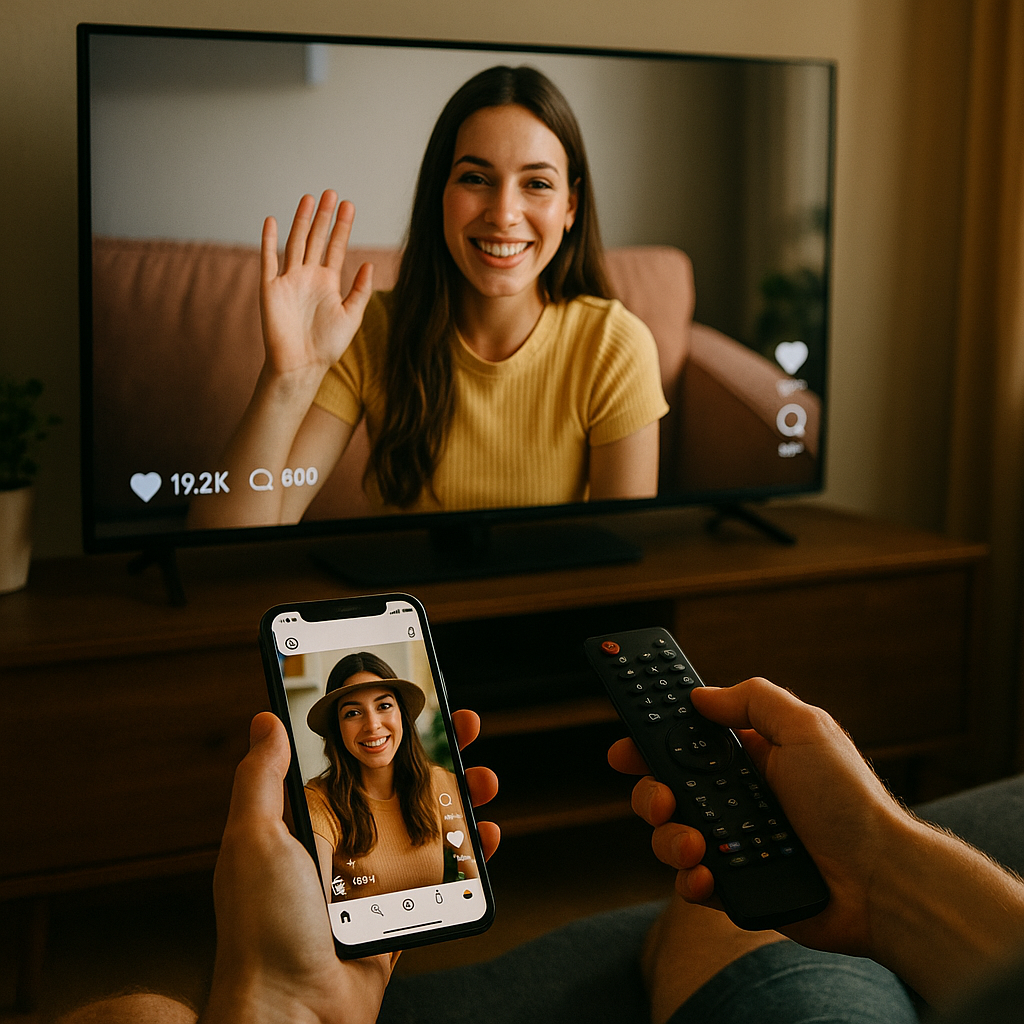
Meta just put a social feed on your television and asked two people to scroll it together. Instagram for TV’s shared-scrolling creator campaign isn’t a gimmick — it’s a signal that the boundary between “feed” and “channel” is dissolving fast. If your influencer strategy still treats mobile and connected TV as separate budgets, you’re already behind.
What Actually Launched
Instagram’s TV app now supports synchronized, shared scrolling: two or more users on separate devices (or one household split across a phone and a big screen) can browse the same Reels queue in real time, reacting together via a companion mobile view. Meta paired the rollout with a creator campaign recruiting lifestyle, comedy, and commentary accounts to produce content specifically formatted for the lean-back, shared-viewing context — longer setups, group-reaction-friendly pacing, less reliance on silent-scroll hooks.
That last detail matters more than the tech itself. For years, creator briefs have been built around the assumption of a lone thumb on a phone, sound off, three seconds to earn attention. Shared-scrolling TV breaks that assumption. Sound is on. The audience is plural. Attention spans stretch because someone else in the room is deciding whether to skip.
The moment a feed becomes a shared, sound-on, living-room experience, every performance metric built for solo mobile scrolling needs a second look.
Why Brands Should Care Right Now
Connected TV ad spend keeps climbing — eMarketer estimates show CTV has become one of the fastest-growing line items in video budgets, and Meta clearly wants a bigger slice of that money without abandoning its feed-native ad products. A hybrid format lets Meta sell CTV-style reach with feed-style targeting and creator authenticity baked in. For brands, that’s a new inventory category worth understanding before competitors lock up the best creator slots.
There’s also a measurement angle. Shared-scrolling sessions likely produce different engagement signals than solo mobile sessions — longer watch time, group-driven completion rates, potentially lower click-through since remotes aren’t built for impulse taps. Brands that wait for “best practices” to be published by someone else will spend a full quarter figuring this out the hard way. Brands that test now get a data advantage.
The Living Room Isn’t a Second Screen Anymore
For a decade, marketers treated the TV as background noise while the “real” engagement happened on phones. Shared-scrolling flips that. Now the TV is the primary surface and the phone becomes the control layer — closer to how gaming consoles use companion apps. This matters for creative strategy: a Reel optimized for silent, solo scrolling won’t necessarily land in a group, sound-on, big-screen context. Pacing that feels snappy on a phone can feel frantic on a 65-inch display shared by three people.
Brands running influencer campaigns need to ask creators for TV-aware cuts, not just repurposed vertical video. That might mean simpler on-screen text, stronger audio cues, and reaction-friendly beats where the content pauses just long enough for a room to comment. It’s a genuinely different craft, closer to writing for broadcast comedy than optimizing a TikTok hook.
The Format Blur Has Been Building for a While
This isn’t Instagram’s first move toward TV-native behavior, and it won’t be the last cross-platform blur of feed and screen. YouTube has spent years optimizing for living-room viewing, and its watch-time KPI shifts already forced sponsors to rethink what “engagement” means outside mobile. TikTok’s own watch-time algorithm update pushed creators toward longer, more deliberate pacing rather than pure hook-and-skip content — a precursor to the kind of format Instagram now needs for shared TV sessions.
FAST channels have quietly normalized creator-brand deals built for lean-back viewing too. Our breakdown of FAST channel sponsorship structures on Roku and Tubi shows how brands are already negotiating rates based on household reach rather than per-view mobile metrics. Instagram’s shared-scrolling push borrows from that same playbook, just wrapped in a more social, algorithm-driven skin.
Even the upfront market is adjusting. Buyers are increasingly asking for combined creator-and-CTV packages instead of siloed line items, a trend covered in our look at CreatorFronts convergence. Instagram for TV is essentially forcing that convergence at the platform level rather than leaving it to media buyers to stitch together manually.
Operational Questions Brands Need Answered Before Budgeting
Before you shift spend into this format, get clarity on a few operational realities. Meta hasn’t published granular measurement standards for shared-scrolling sessions yet, and until it does, brands are flying partially blind.
- Attribution: If two people watch the same ad-adjacent Reel on one TV session, does that count as one impression or two? Ask your Meta rep directly, and get it in writing before signing creator deals tied to reach guarantees.
- Disclosure compliance: Shared-scrolling sound-on formats change how sponsorship disclosures need to appear — a small text overlay that works on mobile might be unreadable or missed entirely on a shared TV session where attention is split among viewers. Review this against current FTC endorsement guidance before greenlighting creative.
- Whitelisting and usage rights: TV-native cuts may require separate usage terms from standard Reels ads. Brands already adjusting to the Instagram whitelisting update should fold TV-format rights into the same contract review cycle rather than treating it as a separate negotiation later.
- Creative production cost: TV-aware cuts aren’t free repurposes. Budget for a genuine second edit, not a resize.
How This Changes Creator Selection
Not every creator translates to a shared, sound-on, group-viewing context. Comedians and reaction-style creators, hosts who already perform “at” an audience rather than “for” a lone scroller, and anyone with broadcast or podcast hosting experience will likely outperform creators whose strength is purely visual, silent-hook mobile content. Vetting criteria needs an update: ask for samples of longer-form, sound-on delivery, not just top-performing Reels screenshots.
This also reopens the influencer-versus-traditional-talent debate. Brands used to running creator campaigns purely through TikTok Shop or Reels ad units may find themselves competing for the same talent pool as CTV and Twitch-style sponsorship buyers, a dynamic we’ve tracked in PlayFronts convergence coverage. Expect rate cards to shift as creators realize their content now serves two very different consumption contexts simultaneously.
A creator who can’t hold a room’s attention for fifteen seconds of sound-on content shouldn’t be your first pick for a TV-native brief, no matter how strong their mobile completion rate is.
What Early Testing Should Look Like
Treat this like any new inventory launch: small, controlled, measured against a clear hypothesis. A few practical steps for teams considering a pilot:
- Run a limited creator cohort test (three to five creators) producing both a standard Reel and a TV-optimized cut of the same campaign concept, then compare engagement and completion metrics across formats.
- Build disclosure language and on-screen sponsorship tags specifically for the shared-scrolling format, and have legal or compliance sign off before launch, not after.
- Negotiate creator contracts with explicit language covering TV-native usage rights, separate from standard Reels licensing.
- Set a measurement baseline now, even an imperfect one, so you have comparative data once Meta publishes official shared-scrolling metrics.
Marketing teams that skip the pilot phase and jump straight to scaled spend risk repeating mistakes brands made early in TikTok Shop’s rollout, when structure and compliance lagged behind hype. Our coverage of TikTok Shop’s structure-over-followers algorithm shift is a good reminder: platforms reward operational discipline eventually, even if the early gold rush rewards speed.
Where This Leaves Brand Strategy
Instagram for TV’s shared-scrolling push isn’t just a feature update. It’s a bet that the next growth phase for feeds is the living room, and that creators — not traditional TV production — will populate that inventory. Meta gets to monetize CTV attention without building a studio system. Brands get a genuinely new context to reach audiences, provided they’re willing to rebuild briefs, contracts, and measurement frameworks rather than copy-pasting mobile playbooks onto a bigger screen.
The upside is real: household reach, sound-on engagement, and a format Meta will likely prioritize in distribution as it tries to prove out the category. The risk is equal parts real: unclear attribution, compliance gaps, and production costs that catch procurement teams off guard mid-quarter.
Frequently Asked Questions
FAQs
What is Instagram for TV’s shared-scrolling feature?
It’s a synchronized viewing mode that lets multiple users browse the same Reels queue together in real time, with the TV as the primary screen and a mobile device acting as the control and reaction layer.
How does this differ from standard Instagram Reels ads?
Standard Reels ads are built for solo, mobile, often sound-off scrolling. Shared-scrolling content is sound-on, viewed in groups, and requires different pacing, disclosure placement, and creative structure to land effectively.
Should brands shift budget from mobile-first creator campaigns to TV-native formats?
Not entirely, and not yet. Treat it as a pilot category. Run small tests, measure against your existing mobile benchmarks, and scale only once Meta publishes clearer measurement standards for the format.
Does FTC disclosure guidance change for shared-scrolling content?
The underlying rules don’t change, but the execution needs review. Disclosures must remain “clear and conspicuous” per FTC guidance, and what’s conspicuous on a phone screen may not be on a shared TV session with split attention.
What kind of creators perform best in this new format?
Creators comfortable with sound-on, longer-form, group-oriented delivery — think comedians, hosts, and reaction-style talent — generally translate better than creators whose strength is purely visual, silent-hook mobile content.
The brands that win this cycle won’t be the ones with the biggest CTV budgets — they’ll be the ones who pilot fast, document what they learn, and rebuild their creator briefs before shared-scrolling becomes standard inventory instead of a novelty.
Top Influencer Marketing Agencies
The leading agencies shaping influencer marketing in 2026
Agencies ranked by campaign performance, client diversity, platform expertise, proven ROI, industry recognition, and client satisfaction. Assessed through verified case studies, reviews, and industry consultations.
Moburst

-
2

The Shelf
Boutique Beauty & Lifestyle Influencer AgencyA data-driven boutique agency specializing exclusively in beauty, wellness, and lifestyle influencer campaigns on Instagram and TikTok. Best for brands already focused on the beauty/personal care space that need curated, aesthetic-driven content.Clients: Pepsi, The Honest Company, Hims, Elf Cosmetics, Pure LeafVisit The Shelf → -
3

Audiencly
Niche Gaming & Esports Influencer AgencyA specialized agency focused exclusively on gaming and esports creators on YouTube, Twitch, and TikTok. Ideal if your campaign is 100% gaming-focused — from game launches to hardware and esports events.Clients: Epic Games, NordVPN, Ubisoft, Wargaming, Tencent GamesVisit Audiencly → -
4

Viral Nation
Global Influencer Marketing & Talent AgencyA dual talent management and marketing agency with proprietary brand safety tools and a global creator network spanning nano-influencers to celebrities across all major platforms.Clients: Meta, Activision Blizzard, Energizer, Aston Martin, WalmartVisit Viral Nation → -
5

The Influencer Marketing Factory
TikTok, Instagram & YouTube CampaignsA full-service agency with strong TikTok expertise, offering end-to-end campaign management from influencer discovery through performance reporting with a focus on platform-native content.Clients: Google, Snapchat, Universal Music, Bumble, YelpVisit TIMF → -
6

NeoReach
Enterprise Analytics & Influencer CampaignsAn enterprise-focused agency combining managed campaigns with a powerful self-service data platform for influencer search, audience analytics, and attribution modeling.Clients: Amazon, Airbnb, Netflix, Honda, The New York TimesVisit NeoReach → -
7

Ubiquitous
Creator-First Marketing PlatformA tech-driven platform combining self-service tools with managed campaign options, emphasizing speed and scalability for brands managing multiple influencer relationships.Clients: Lyft, Disney, Target, American Eagle, NetflixVisit Ubiquitous → -
8

Obviously
Scalable Enterprise Influencer CampaignsA tech-enabled agency built for high-volume campaigns, coordinating hundreds of creators simultaneously with end-to-end logistics, content rights management, and product seeding.Clients: Google, Ulta Beauty, Converse, AmazonVisit Obviously →