


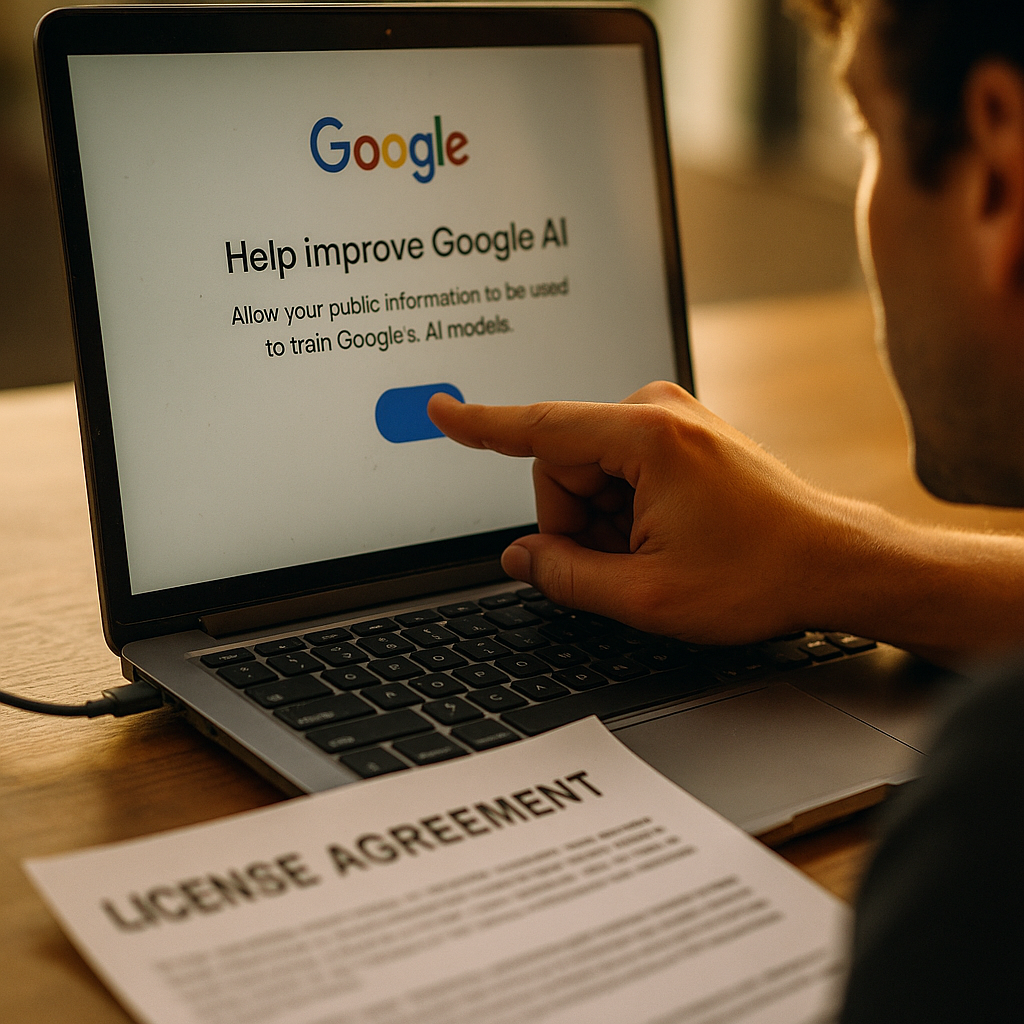
One checkbox now decides whether your brand’s content trains the models answering billions of search queries. Google’s opt-out option for AI search inclusion sounds like a minor technical toggle. It isn’t. It’s a governance decision with revenue implications, and most brands are making it by default, not by design.
The setting sits quietly inside Search Console. Flip it, and your content stops feeding Google’s AI Overviews and Gemini-powered summaries. Leave it alone, and you’re opted in automatically, no consent form, no negotiation, no royalty check. For an industry that spent the last three years building content engines to win organic visibility, that’s a strange trade to accept passively.
Why This Opt-Out Actually Matters
Search used to be a straightforward exchange. You published content, Google indexed it, users clicked through, you got traffic and attribution. AI Overviews break that loop. Google’s own AI now synthesizes your content into an answer, serves it directly in the results page, and the user often never clicks anywhere. eMarketer research has repeatedly flagged declining click-through rates on queries that trigger AI-generated summaries, and that trend has only accelerated as Overviews expand into more verticals.
The opt-out lets publishers exclude their content from that summarization layer specifically, while still allowing standard indexing for traditional search results. Sounds like a fair compromise. In practice, it forces every content team to answer a question they’ve never had to answer before: is visibility inside an AI answer worth more or less than a click to our site?
Brands that treat the AI opt-out as a “set it once” technical task are missing that it’s actually a recurring licensing decision, one that needs review every quarter as AI search formats keep changing.
The Licensing Problem Nobody Priced In
Content licensing used to mean syndication deals, stock photo rights, maybe a UGC usage agreement with a creator. Now it means deciding whether Google, OpenAI, Perplexity, and Microsoft get to train on and republish your brand’s intellectual property inside their AI products, often without compensation.
Publishers like News Corp and The New York Times have already litigated this exact tension with AI companies over training data rights. Most B2B and DTC brands don’t have legal teams built for that fight. But the underlying question is identical: your blog posts, product pages, comparison guides, all of it is training data and answer-fodder unless you explicitly say otherwise.
Here’s the uncomfortable part. Opting out of AI Overviews doesn’t opt you out of other AI systems. Google’s toggle only controls Google’s AI surfaces. Bing, Perplexity, and ChatGPT’s browsing features operate under separate crawler rules (Bingbot, PerplexityBot, GPTBot) that require separate robots.txt directives. A brand that flips the Google switch and calls it done has secured maybe a third of the actual exposure surface. This is the same fragmentation problem marketing teams are already fighting with data contracts for AI systems: every platform has its own rules, and there’s no unified standard yet.
What Brands Are Actually Doing About It
- Segmenting content by strategic value. High-funnel educational content stays open for AI training (brand awareness upside outweighs the click loss). Proprietary research, pricing pages, and gated comparison content get excluded.
- Auditing crawler permissions across all major bots, not just Googlebot, and updating robots.txt and llms.txt files to reflect a deliberate policy rather than defaults.
- Building licensing clauses into content creation contracts with freelancers and agencies, clarifying who owns AI-training rights on commissioned work.
- Tracking AI referral traffic separately from organic search to understand which content actually drives value when it appears inside an AI answer versus a standard listing.
That last point matters more than most teams realize. If you can’t measure the traffic AI assistants are already sending you, you can’t make an informed opt-in or opt-out decision. Teams running this analysis in GA4 have found ways to isolate AI assistant referral traffic for exactly this reason, feeding the data into quarterly reviews instead of guessing.
Risk, Not Just Reach
SEO teams are trained to chase visibility. Legal and compliance teams are trained to limit exposure. The AI opt-out sits exactly at that intersection, and it’s exposing how few brands have a shared process for making the call.
Consider the compliance angle. If your content includes customer data references, proprietary pricing models, or claims that require substantiation (health, finance, and legal verticals especially), letting that material feed an AI Overview means Google’s model might restate it inaccurately, out of context, or in a way that creates regulatory exposure. The FTC’s guidance on AI-generated claims and endorsements already signals where scrutiny is heading. If Google’s AI misrepresents your product claim in a summary, you’re the one who answers for it, not Google.
This is why licensing strategy can’t sit only with the content or SEO team anymore. It needs input from legal, from brand, and increasingly from whoever owns AI governance internally. Brands that already built governance-first AI marketing frameworks are ahead here, because the opt-out decision is really just another control point in a system that should already have controls.
The Attribution Blind Spot
There’s a second-order problem that’s easy to miss: measurement. When your content shows up inside an AI Overview, standard analytics can’t tell you it happened. No referrer, no click, no session. You’re invisible in your own reporting even when you’re the source being cited.
This mirrors a challenge marketing teams already know well from attribution model breakdowns caused by identity gaps. AI search is creating a new version of the same problem: content performance that exists but can’t be tracked through conventional means. Some brands are experimenting with citation-tracking tools and manual query sampling to estimate exposure, but there’s no mature standard yet, and vendors in this space are still early.
If your reporting stack can’t see AI Overview citations, you’re optimizing content for a channel you can’t measure, which is a governance risk as much as an analytics one.
Building an Actual Licensing Strategy, Not a Toggle Setting
What should this look like operationally, in a marketing org that takes it seriously?
Start with a content inventory pass. Tag every asset by strategic sensitivity, high-value proprietary research versus commodity top-of-funnel content. Then map crawler permissions against that tagging, adjusting robots.txt directives per bot rather than applying a blanket policy. Google’s Search Console documentation outlines the specific controls available for AI Overviews and Gemini, and it’s worth a legal or SEO lead reviewing it directly rather than relying on secondhand summaries, because the controls have changed more than once already.
Next, formalize the review cadence. This isn’t a one-time setup. AI search formats are shifting quarterly. What counted as low-risk content six months ago might now be a candidate for exclusion because a competitor found a way to game the same summarization layer. Treat the opt-out list the way you’d treat a keyword strategy: living, reviewed, owned by someone specific.
Finally, build the contract language now, not after a dispute. Any agency, freelancer, or creator producing content for your brand should have explicit terms covering AI training rights, syndication into AI answer engines, and who benefits if that content gets licensed formally down the line. This is especially urgent for influencer and creator content, where usage rights were already murky before AI search made the stakes higher.
What About Creator and Influencer Content Specifically?
This is where Influencers Time readers should pay closest attention. Brand-commissioned creator content, reviews, testimonials, unboxing videos with transcribed captions, all of it is crawlable, all of it can feed AI Overviews if it lives on owned domains or is syndicated to brand blogs. Most influencer contracts written even a year ago say nothing about AI training rights. That’s a gap worth closing in every renewal cycle happening now.
If your influencer program produces long-form written content (buying guides, comparison posts, review roundups) treat that inventory the same way you’d treat internally produced content. Audit it, tag it, decide deliberately whether it’s opted in or out. Don’t let a Search Console default make that call for you.
The Bottom Line
The opt-out itself isn’t the story. The story is that brands now have to treat AI training and licensing rights as an active strategic layer sitting on top of every content decision, not a legal afterthought resolved by a single robots.txt line. Build the review process this quarter, assign clear ownership between legal, SEO, and brand, and revisit the decision every time a major AI search platform changes its rules, because they will keep changing.
Frequently Asked Questions
What exactly does Google’s AI search opt-out control?
It lets site owners exclude their content specifically from Google’s AI Overviews and Gemini-powered summarization features, while still allowing the same content to appear in traditional organic search results. It’s managed through Search Console and does not affect indexing for standard search.
Does opting out of Google’s AI Overviews also exclude content from ChatGPT or Perplexity?
No. Each AI platform uses its own crawler (GPTBot for OpenAI, PerplexityBot for Perplexity, Bingbot for Microsoft) and requires separate directives in robots.txt. Opting out of Google’s AI features has no effect on how other AI search tools access or use your content.
Why would a brand choose to stay opted in?
Being cited or summarized in an AI Overview can still build brand visibility and authority, even without a click. Some brands accept the traffic trade-off in exchange for appearing as a trusted source, particularly for top-of-funnel, non-proprietary content.
How does this affect influencer and creator content specifically?
Brand-commissioned creator content published on owned domains, such as buying guides or review roundups, is just as crawlable as any other page. Most existing influencer contracts don’t address AI training or licensing rights, making this an important gap to close during contract renewals.
Can brands measure how much traffic or exposure comes from AI Overviews?
Not precisely with standard analytics, since AI Overview citations don’t generate traditional referrer data. Some teams are configuring GA4 to isolate AI assistant referral traffic as a proxy, but comprehensive citation tracking tools are still maturing.
FAQs
Top Influencer Marketing Agencies
The leading agencies shaping influencer marketing in 2026
Agencies ranked by campaign performance, client diversity, platform expertise, proven ROI, industry recognition, and client satisfaction. Assessed through verified case studies, reviews, and industry consultations.
Moburst

-
2

The Shelf
Boutique Beauty & Lifestyle Influencer AgencyA data-driven boutique agency specializing exclusively in beauty, wellness, and lifestyle influencer campaigns on Instagram and TikTok. Best for brands already focused on the beauty/personal care space that need curated, aesthetic-driven content.Clients: Pepsi, The Honest Company, Hims, Elf Cosmetics, Pure LeafVisit The Shelf → -
3

Audiencly
Niche Gaming & Esports Influencer AgencyA specialized agency focused exclusively on gaming and esports creators on YouTube, Twitch, and TikTok. Ideal if your campaign is 100% gaming-focused — from game launches to hardware and esports events.Clients: Epic Games, NordVPN, Ubisoft, Wargaming, Tencent GamesVisit Audiencly → -
4

Viral Nation
Global Influencer Marketing & Talent AgencyA dual talent management and marketing agency with proprietary brand safety tools and a global creator network spanning nano-influencers to celebrities across all major platforms.Clients: Meta, Activision Blizzard, Energizer, Aston Martin, WalmartVisit Viral Nation → -
5

The Influencer Marketing Factory
TikTok, Instagram & YouTube CampaignsA full-service agency with strong TikTok expertise, offering end-to-end campaign management from influencer discovery through performance reporting with a focus on platform-native content.Clients: Google, Snapchat, Universal Music, Bumble, YelpVisit TIMF → -
6

NeoReach
Enterprise Analytics & Influencer CampaignsAn enterprise-focused agency combining managed campaigns with a powerful self-service data platform for influencer search, audience analytics, and attribution modeling.Clients: Amazon, Airbnb, Netflix, Honda, The New York TimesVisit NeoReach → -
7

Ubiquitous
Creator-First Marketing PlatformA tech-driven platform combining self-service tools with managed campaign options, emphasizing speed and scalability for brands managing multiple influencer relationships.Clients: Lyft, Disney, Target, American Eagle, NetflixVisit Ubiquitous → -
8

Obviously
Scalable Enterprise Influencer CampaignsA tech-enabled agency built for high-volume campaigns, coordinating hundreds of creators simultaneously with end-to-end logistics, content rights management, and product seeding.Clients: Google, Ulta Beauty, Converse, AmazonVisit Obviously →