


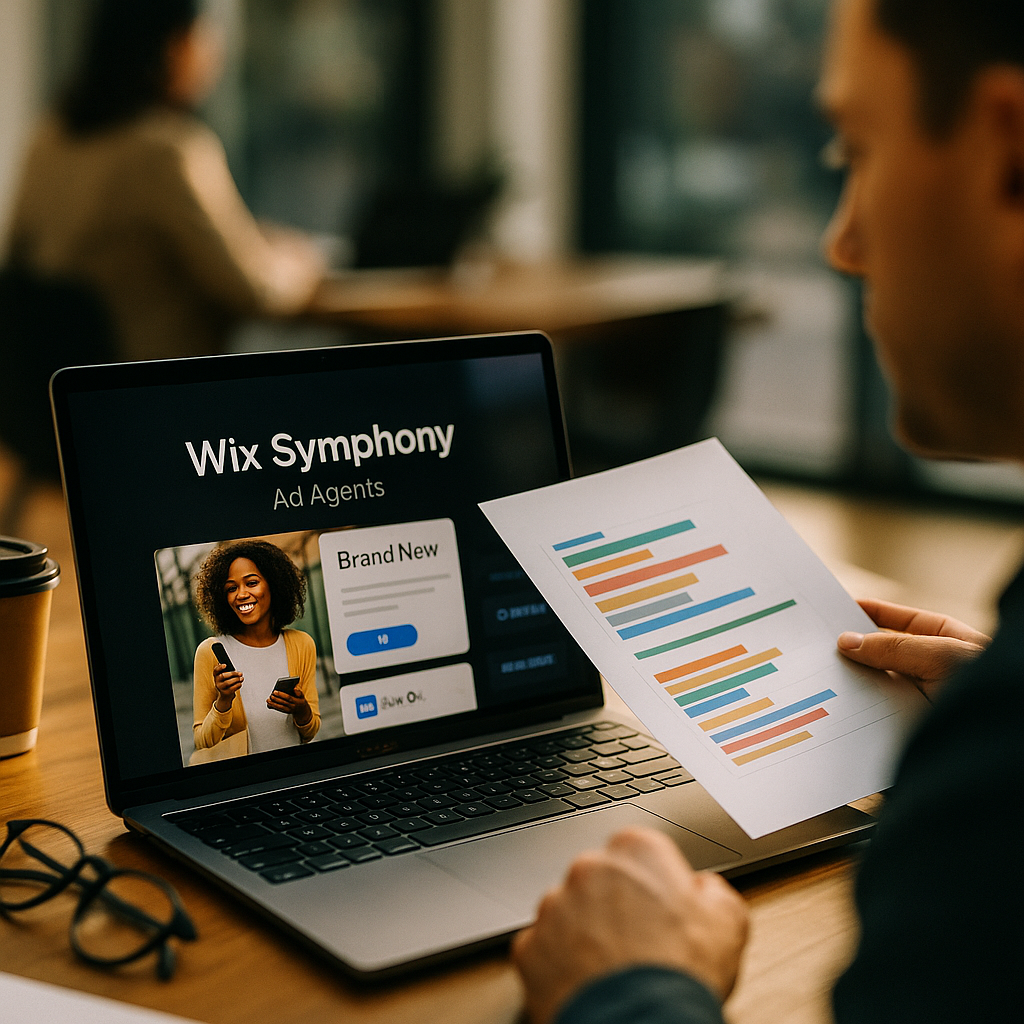
Seventy-three percent of marketers say they’ll use AI agents for campaign execution within the next year, according to recent eMarketer survey data. Wix Symphony just gave that stat a face. Its multi-agent distribution model promises to plan, place, and optimize ads across platforms without a human touching a single bid. That’s the pitch, anyway. Here’s what’s actually happening under the hood — and where brands should be nervous.
What Symphony Actually Is
Wix Symphony isn’t a single AI model wearing a marketing costume. It’s an orchestration layer, a set of specialized agents that each own a narrow slice of the ad workflow: creative generation, audience targeting, budget allocation, platform bidding, and performance reporting. They pass tasks to one another like relay runners handing off a baton, except the baton is a JSON payload full of campaign parameters.
This matters because most “AI ad automation” tools on the market today are single-model wrappers. They take one large language model, bolt on a few API connectors to Meta and Google, and call it autonomous marketing. Symphony’s architecture is different in kind, not just degree. Each agent is purpose-built and independently tunable, which means a brand can, in theory, audit and override one function (say, budget pacing) without disrupting creative testing running in parallel.
The core promise of multi-agent architecture isn’t smarter AI — it’s smarter division of labor, with each agent accountable for a narrower, auditable slice of the campaign.
How the Agents Actually Talk to Each Other
This is where it gets technical, and where most vendor decks get vague on purpose. Symphony’s agents communicate through a coordination protocol that resembles the emerging standards discussed in agent-to-agent contract frameworks now circulating in martech procurement circles. In practice, that means:
- A planning agent ingests campaign goals, budget ceilings, and brand guidelines, then decomposes them into platform-specific sub-tasks.
- Creative agents generate or adapt assets per platform spec — a 9:16 Reels cut, a square Meta carousel, a horizontal YouTube pre-roll — pulling from a shared brand asset library.
- Bidding agents negotiate placement and spend in near real-time, reacting to auction dynamics on each ad exchange.
- A reconciliation agent pulls performance data back into a shared state, so the planning agent can rebalance budget across channels mid-flight.
None of this happens instantly or magically. There’s latency between agent handoffs, and Wix has been candid (more candid than most) that full-loop reoptimization currently runs on roughly 4-6 hour cycles, not millisecond decisioning. If your team expects Symphony to shift $10,000 from TikTok to Meta the second a CPA spikes, temper that expectation. It’s fast. It’s not instant.
Where This Beats Manual Cross-Platform Buying
The honest case for Symphony isn’t “it’s smarter than your media buyer.” It’s that it removes the coordination tax. Anyone who has run a five-platform campaign knows the real cost isn’t strategy — it’s the operational drag of exporting creative specs, re-uploading to six ad managers, and manually reconciling spend across dashboards that don’t talk to each other.
Symphony collapses that into one control plane. A mid-market DTC brand running Meta, TikTok, Pinterest, and YouTube simultaneously can, in principle, launch from a single brief and let the agents handle platform-native formatting and bid strategy. That’s a real efficiency gain, especially for lean teams without a dedicated programmatic specialist.
It also plays nicely with the broader shift toward autonomous next-best-action systems that brands are already piloting elsewhere in the stack. If your CDP is already feeding decisioning models, plugging Symphony into that same signal layer isn’t a huge leap.
The Attribution Problem Nobody’s Solved Yet
Here’s the uncomfortable part. Multi-agent systems that reallocate budget across platforms in real time create an attribution nightmare if your measurement stack isn’t equally sophisticated. If Symphony shifts spend from TikTok to YouTube three times in a week based on its own read of conversion signals, can your finance team actually trace which platform drove which sale?
Most brands still rely on platform-reported conversions or basic GA4 channel groupings, both of which have known blind spots for cross-device, cross-platform journeys. That’s a real gap, and it’s the same gap explored in GA4 attribution comparisons — the tooling for measuring what an AI agent is doing hasn’t caught up to the tooling for letting it do it.
If you’re evaluating Symphony or any comparable multi-agent buying tool, the diligence checklist should mirror what serious attribution vendors already get put through. Look at the attribution vendor due-diligence framework and ask the same questions of your ad automation stack: What’s the source of truth? How is cross-platform double-counting handled? What’s the data freshness SLA?
An agent that reallocates budget faster than your attribution model can validate causality isn’t optimization — it’s noise dressed up as intelligence.
Governance: Who’s Actually Accountable When an Agent Overspends?
This is the question every CFO should be asking before signing off on budget for agentic ad platforms. Symphony’s bidding agent operates within guardrails you set — daily caps, target CPA thresholds, category exclusions — but guardrails are only as good as who’s monitoring the exceptions.
Consider a scenario that’s already happened with comparable tools: a bidding agent, chasing a CPA target during a low-conversion window, keeps increasing bids because it’s “learning” that higher bids marginally improve win rate, without factoring in that the audience pool has degraded. You wake up to a 40% overspend and a mediocre ROAS. Whose fault is that? Contractually, probably yours, unless your MSA with Wix specifies liability for autonomous decisioning errors.
This is precisely the terrain covered in recent breakdowns of what to demand in martech contracts for agent-to-agent systems. Before rolling Symphony out past a pilot budget, get explicit answers on:
- Spend ceiling enforcement — is it hard-capped or advisory?
- Audit logs — can you see every agent decision and its rationale, or just the outcome?
- Rollback speed — how fast can a human override an agent mid-campaign?
- Data residency — where is your creative and audience data processed, and does it touch third-party model training?
Comparing the Field: Symphony vs. Single-Model Competitors
Wix isn’t alone in this race, and brands evaluating multi-agent ad tools should benchmark against what’s already shipping elsewhere. Viral Nation’s agent stack, for instance, has drawn scrutiny over whether it genuinely reduces headcount needs or just shifts labor into prompt engineering and QA — a debate covered in depth in Viral Nation’s headcount claims. Similar skepticism applies to Symphony: automation doesn’t eliminate oversight, it relocates it.
Meanwhile, tools like Kinetik for Teams and Okara AI CMO v2 take a more centralized, single-brain approach rather than Symphony’s distributed agent model. The trade-off comparison in Kinetik vs Okara AI CMO is instructive: centralized systems are easier to audit but slower to adapt; distributed agent systems adapt faster but are harder to fully explain after the fact.
That trade-off — explainability versus adaptiveness — is the real decision brands are making when they choose Symphony over a simpler automation layer. There’s no free lunch here. You’re buying speed and coordination at the cost of some interpretability.
Practical Rollout: Don’t Start With Your Whole Budget
The brands getting the best early results with Symphony aren’t the ones going all-in. They’re running it on a defined slice — one product line, one region, 15-20% of total paid budget — and comparing performance against a manually managed control group over a full quarter. That’s not overly cautious; it’s basic testing discipline that too many teams skip because the demo looked impressive.
Set clear KPIs before you start: blended CPA, incrementality (not just platform-reported conversions), and time saved on manual campaign ops. Track that last one carefully. The efficiency gain is often the most defensible ROI case even before performance gains show up, and it’s the metric finance actually cares about.
Also worth checking: how Symphony’s creative agent handles brand safety and platform policy compliance, particularly around disclosure requirements. The FTC’s endorsement guidelines still apply regardless of who — or what — generated the ad copy. An autonomous agent that auto-generates influencer-style creative without proper disclosure language is a compliance exposure, not a feature.
The Bottom Line for Brands Evaluating This Now
Run a bounded pilot, demand full audit logs and hard spend caps in your contract, and don’t let Symphony touch your attribution model until your measurement stack can actually validate its decisions. Automation without accountability isn’t efficiency — it’s just faster risk.
Frequently Asked Questions
What makes Wix Symphony’s multi-agent model different from standard AI ad tools?
Most AI ad tools use a single model connected to platform APIs. Symphony uses multiple specialized agents — for planning, creative, bidding, and reconciliation — that hand off tasks to each other, allowing narrower auditing and independent tuning of each function.
How fast does Symphony reallocate budget across platforms?
Current reoptimization cycles run roughly every 4-6 hours, not in real time. Brands expecting instant, millisecond-level budget shifts should recalibrate expectations before deploying at scale.
Can Symphony overspend without human approval?
It operates within brand-set guardrails like daily caps and CPA targets, but enforcement mechanisms vary. Brands should confirm contractually whether spend limits are hard-capped or merely advisory before granting budget access.
Does using Symphony create attribution problems?
Yes, potentially. Rapid cross-platform reallocation can outpace standard attribution tools like platform-reported conversions or basic GA4 grouping, making it harder to validate which channel actually drove results.
What should brands negotiate in a Symphony contract?
Key items include hard spend ceilings, full audit logs of agent decisions, fast human override/rollback capability, and clarity on data residency and whether campaign data is used for third-party model training.
Top Influencer Marketing Agencies
The leading agencies shaping influencer marketing in 2026
Agencies ranked by campaign performance, client diversity, platform expertise, proven ROI, industry recognition, and client satisfaction. Assessed through verified case studies, reviews, and industry consultations.
Moburst

-
2

The Shelf
Boutique Beauty & Lifestyle Influencer AgencyA data-driven boutique agency specializing exclusively in beauty, wellness, and lifestyle influencer campaigns on Instagram and TikTok. Best for brands already focused on the beauty/personal care space that need curated, aesthetic-driven content.Clients: Pepsi, The Honest Company, Hims, Elf Cosmetics, Pure LeafVisit The Shelf → -
3

Audiencly
Niche Gaming & Esports Influencer AgencyA specialized agency focused exclusively on gaming and esports creators on YouTube, Twitch, and TikTok. Ideal if your campaign is 100% gaming-focused — from game launches to hardware and esports events.Clients: Epic Games, NordVPN, Ubisoft, Wargaming, Tencent GamesVisit Audiencly → -
4

Viral Nation
Global Influencer Marketing & Talent AgencyA dual talent management and marketing agency with proprietary brand safety tools and a global creator network spanning nano-influencers to celebrities across all major platforms.Clients: Meta, Activision Blizzard, Energizer, Aston Martin, WalmartVisit Viral Nation → -
5

The Influencer Marketing Factory
TikTok, Instagram & YouTube CampaignsA full-service agency with strong TikTok expertise, offering end-to-end campaign management from influencer discovery through performance reporting with a focus on platform-native content.Clients: Google, Snapchat, Universal Music, Bumble, YelpVisit TIMF → -
6

NeoReach
Enterprise Analytics & Influencer CampaignsAn enterprise-focused agency combining managed campaigns with a powerful self-service data platform for influencer search, audience analytics, and attribution modeling.Clients: Amazon, Airbnb, Netflix, Honda, The New York TimesVisit NeoReach → -
7

Ubiquitous
Creator-First Marketing PlatformA tech-driven platform combining self-service tools with managed campaign options, emphasizing speed and scalability for brands managing multiple influencer relationships.Clients: Lyft, Disney, Target, American Eagle, NetflixVisit Ubiquitous → -
8

Obviously
Scalable Enterprise Influencer CampaignsA tech-enabled agency built for high-volume campaigns, coordinating hundreds of creators simultaneously with end-to-end logistics, content rights management, and product seeding.Clients: Google, Ulta Beauty, Converse, AmazonVisit Obviously →