


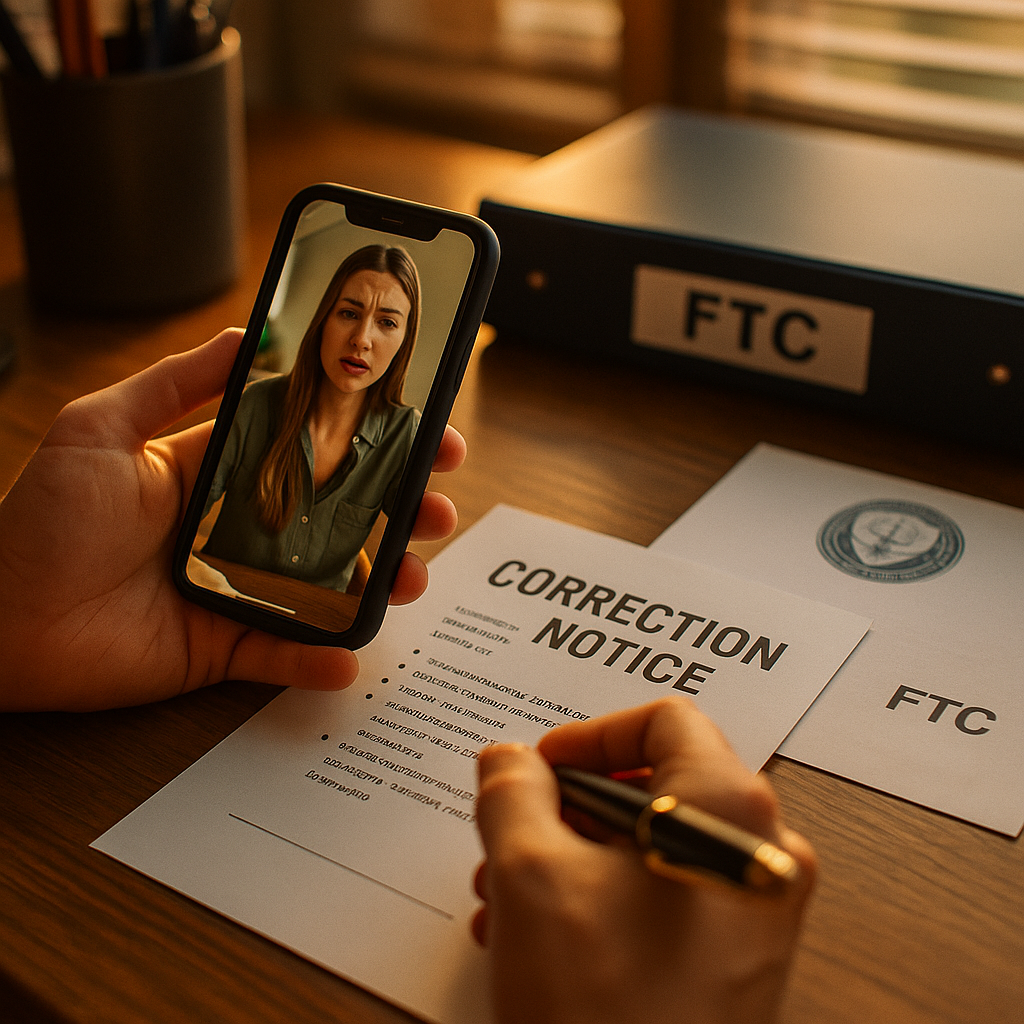
One FTC complaint. One viral “well, actually” comment thread. One creator who got the dosage wrong on a supplement claim. That’s all it takes to turn a six-figure campaign into a liability event. Yet most brands still don’t have a creator correction protocol, a documented, repeatable process for what happens the moment a sponsored claim goes wrong. They improvise instead. Improvising in front of regulators is a bad strategy.
Why “Just Delete It” Isn’t a Compliance Strategy
The instinct when a sponsored post makes a false or unsupportable claim is to quietly ask the creator to take it down and move on. That instinct is understandable. It’s also exactly the kind of response that makes things worse if the FTC or a state attorney general ever looks at your program.
Deleting a post doesn’t delete the record. Screenshots circulate. The FTC’s endorsement guidelines care less about whether a claim is still live and more about whether the brand acted with reasonable diligence once it knew, or should have known, the claim was false. Silent deletion with no documentation looks like concealment, not correction.
Regulators don’t punish brands for having a bad post. They punish brands for having no process to catch and fix it.
A correction protocol gives you something a deleted post never can: a paper trail showing you took the claim seriously, assessed the harm, and acted within a defined window. That paper trail is your defense if this ever escalates.
What Counts as a “Claim Gone Wrong”
Not every awkward sponsored post needs a formal response. Compliance teams need a clear trigger list, otherwise every typo turns into a fire drill or, worse, every real problem gets waved off as “not a big deal.” Build your protocol around these categories:
- Unsubstantiated performance claims: “This cleared my skin in three days” with zero clinical backing.
- Financial or health claims that trigger regulatory thresholds: APR promises, weight loss guarantees, disease-cure language.
- Disclosure failures: missing #ad, buried hashtags, or disclosure that’s technically present but not “clear and conspicuous.”
- Factual inaccuracy: wrong pricing, wrong availability, wrong ingredient list, misattributed data.
- AI generated or synthetic content misrepresented as authentic: a claim delivered by an avatar or voice clone without disclosure.
That last category is growing fast. If your creator vetting doesn’t already screen for AI disclosure gaps, read our breakdown of AI generated UGC disclosure risk before your next brief goes out.
The Four Phase Correction Protocol
Think of this less as a crisis plan and more as a workflow that lives next to your approval process. Four phases, each with an owner and a clock.
Phase 1: Detection and Triage (0 to 24 hours)
Someone has to find the claim before a regulator or a competitor does. That means active monitoring, not waiting for a comment to go viral. Social listening tools, a legal review queue, or even a simple weekly audit of live sponsored content all work. Once flagged, triage against severity: regulatory risk, reputational risk, and reach. A nano creator’s typo gets a different response than a mega creator’s medical claim.
Assign an owner within the first few hours. Compliance or legal should make the severity call, not the social team alone. This is the same discipline we outline in our piece on compliance sign off workflows, the faster the routing, the smaller the exposure window.
Phase 2: Containment
Containment isn’t deletion. It’s limiting active harm while you build the actual fix. Depending on severity, that might mean pausing paid amplification on the post, pausing the creator’s other live content pending review, or issuing a temporary platform level takedown request if the claim violates platform ad policy outright.
Document every containment action with a timestamp. “We paused paid spend on the post at 2:14 PM, 90 minutes after detection” is the kind of line that looks very good in a regulatory response and very bad if it’s missing.
Phase 3: Correction
This is where most brands get lazy. A correction has to actually correct the record, not just remove it. Best practice, informed by FTC guidance on corrective disclosures, includes:
- A follow up post or story from the creator explicitly stating what was inaccurate and what the correct information is.
- Equal or greater visibility compared to the original claim (a correction buried in a story highlight doesn’t undo a feed post with 2 million views).
- No vague language. “Update on my last post” doesn’t meet the bar. “My earlier post overstated this product’s results, here’s the accurate information” does.
- A record of creator acknowledgment that they issued the correction as instructed.
If the original claim involved AI generated content or a synthetic likeness, the correction needs to address that specifically. Our analysis of AI synthetic endorser disclosure walks through how regulators are starting to treat these cases differently from standard human endorsement errors.
Phase 4: Internal Remediation
Once the public facing fix is live, turn inward. Who approved the original claim? Was there a gap in the brief, the vetting process, or the sign off chain? This phase produces the actual compliance value: a root cause finding that updates your process so the same mistake doesn’t repeat with the next creator.
Log the incident in a central register. Regulators and insurers both respond well to brands that can show a pattern of detection, correction, and process improvement rather than one-off scrambling.
Who Owns the Clock?
A protocol without a named owner is a document, not a process. Map roles explicitly:
- Legal/Compliance: severity classification, correction language approval, regulatory exposure assessment.
- Creator/Influencer Marketing team: creator communication, relationship management, enforcement of correction within contract terms.
- Agency or talent partner (if applicable): coordination with creator, timeline enforcement.
- Risk/Insurance: assessment of whether the incident triggers a claim under errors and omissions coverage.
If you work with talent agencies, your protocol needs to be baked into the master services agreement, not negotiated after something’s already gone wrong. See our coverage of talent agency licensing gaps for how liability often gets quietly shifted (or not shifted) in these contracts.
Build Correction Clauses Into the Contract, Not the Crisis
The best time to define correction obligations is before you ever need them. Brands that bake specific language into creator contracts, defining response time windows, correction format requirements, and consequences for non-compliance, move faster when something actually breaks.
A correction clause with a 24 hour response requirement is worth more than a 40 page crisis playbook nobody reads until it’s too late.
Pair this with clear termination clause language so repeat offenses or refusal to correct have a defined exit path that protects remaining budget. And if liability for a bad claim ever gets disputed between brand, agency, and creator, you want the attribution question settled contractually in advance. Our deep dive on who pays when claims go wrong is a useful companion read here.
Where AI Makes This Harder
AI generated content complicates correction protocols in a specific way: it’s harder to prove who approved what, and the original “claim” may have been generated by a tool, not written by the creator directly. According to eMarketer research on brand use of generative AI in creator content, adoption is climbing fast across mid-market brands, often faster than internal review processes can keep up.
That gap matters. If an AI tool auto generated a claim that a creator posted without fully reviewing it, your correction protocol needs to account for a different root cause investigation, one that includes the AI vetting tool or platform, not just the creator. For brands using automated matching or content generation platforms, it’s worth revisiting the liability language in your AI matching platform terms to see who’s actually on the hook when the tool, not the human, is the source of the error.
Measuring Whether Your Protocol Actually Works
A correction protocol isn’t a document you file away. Track it like any other operational process:
- Average time from detection to containment.
- Average time from containment to published correction.
- Percentage of flagged claims that required escalation to legal.
- Repeat incident rate per creator or per campaign vertical.
If your detection-to-correction window is measured in days rather than hours, that’s a signal your approval chain is too slow, not that the incidents are too rare to systematize. Tools like Sprout Social or HubSpot can help automate the detection layer, but the response workflow still has to be built and owned internally.
Next Step
Don’t wait for a bad claim to find out your brand has no correction process. Draft the four phase protocol, name the owners, write the response time windows into your next creator contract, and run one tabletop drill before your next major campaign launches.
FAQs
What is a creator correction protocol?
It’s a documented, repeatable process a brand follows when a sponsored claim made by a creator is found to be false, unsubstantiated, or non-compliant. It typically covers detection, containment, public correction, and internal remediation.
How fast does a brand need to respond to a false sponsored claim?
There’s no fixed legal deadline, but regulators evaluate whether a brand acted with reasonable diligence once aware of the issue. Best practice is containment within 24 hours of detection and a published correction within 48 to 72 hours, depending on severity and reach.
Is deleting a sponsored post enough to fix a false claim?
No. Deletion removes the live post but doesn’t correct the record, and screenshots or cached versions often persist. Regulators generally expect an affirmative, visible correction, not silent removal.
Who is legally responsible when a creator makes a false claim in sponsored content?
Both the brand and the creator can be held responsible under FTC endorsement guidelines. Liability often depends on contract terms, the brand’s review process, and whether the brand exercised adequate oversight before and after publication.
Should correction protocols be written into creator contracts?
Yes. Contracts should specify response time windows, correction format requirements, and consequences for failure to comply. Defining this before a dispute arises avoids slow, ad hoc negotiations during an active compliance issue.
How does AI generated content change the correction process?
AI generated claims complicate root cause investigation because the error may originate from a tool or platform rather than the creator’s own judgment. Correction protocols should include a review of AI vetting and generation tools as part of the remediation phase.
Top Influencer Marketing Agencies
The leading agencies shaping influencer marketing in 2026
Agencies ranked by campaign performance, client diversity, platform expertise, proven ROI, industry recognition, and client satisfaction. Assessed through verified case studies, reviews, and industry consultations.
Moburst

-
2

The Shelf
Boutique Beauty & Lifestyle Influencer AgencyA data-driven boutique agency specializing exclusively in beauty, wellness, and lifestyle influencer campaigns on Instagram and TikTok. Best for brands already focused on the beauty/personal care space that need curated, aesthetic-driven content.Clients: Pepsi, The Honest Company, Hims, Elf Cosmetics, Pure LeafVisit The Shelf → -
3

Audiencly
Niche Gaming & Esports Influencer AgencyA specialized agency focused exclusively on gaming and esports creators on YouTube, Twitch, and TikTok. Ideal if your campaign is 100% gaming-focused — from game launches to hardware and esports events.Clients: Epic Games, NordVPN, Ubisoft, Wargaming, Tencent GamesVisit Audiencly → -
4

Viral Nation
Global Influencer Marketing & Talent AgencyA dual talent management and marketing agency with proprietary brand safety tools and a global creator network spanning nano-influencers to celebrities across all major platforms.Clients: Meta, Activision Blizzard, Energizer, Aston Martin, WalmartVisit Viral Nation → -
5

The Influencer Marketing Factory
TikTok, Instagram & YouTube CampaignsA full-service agency with strong TikTok expertise, offering end-to-end campaign management from influencer discovery through performance reporting with a focus on platform-native content.Clients: Google, Snapchat, Universal Music, Bumble, YelpVisit TIMF → -
6

NeoReach
Enterprise Analytics & Influencer CampaignsAn enterprise-focused agency combining managed campaigns with a powerful self-service data platform for influencer search, audience analytics, and attribution modeling.Clients: Amazon, Airbnb, Netflix, Honda, The New York TimesVisit NeoReach → -
7

Ubiquitous
Creator-First Marketing PlatformA tech-driven platform combining self-service tools with managed campaign options, emphasizing speed and scalability for brands managing multiple influencer relationships.Clients: Lyft, Disney, Target, American Eagle, NetflixVisit Ubiquitous → -
8

Obviously
Scalable Enterprise Influencer CampaignsA tech-enabled agency built for high-volume campaigns, coordinating hundreds of creators simultaneously with end-to-end logistics, content rights management, and product seeding.Clients: Google, Ulta Beauty, Converse, AmazonVisit Obviously →