


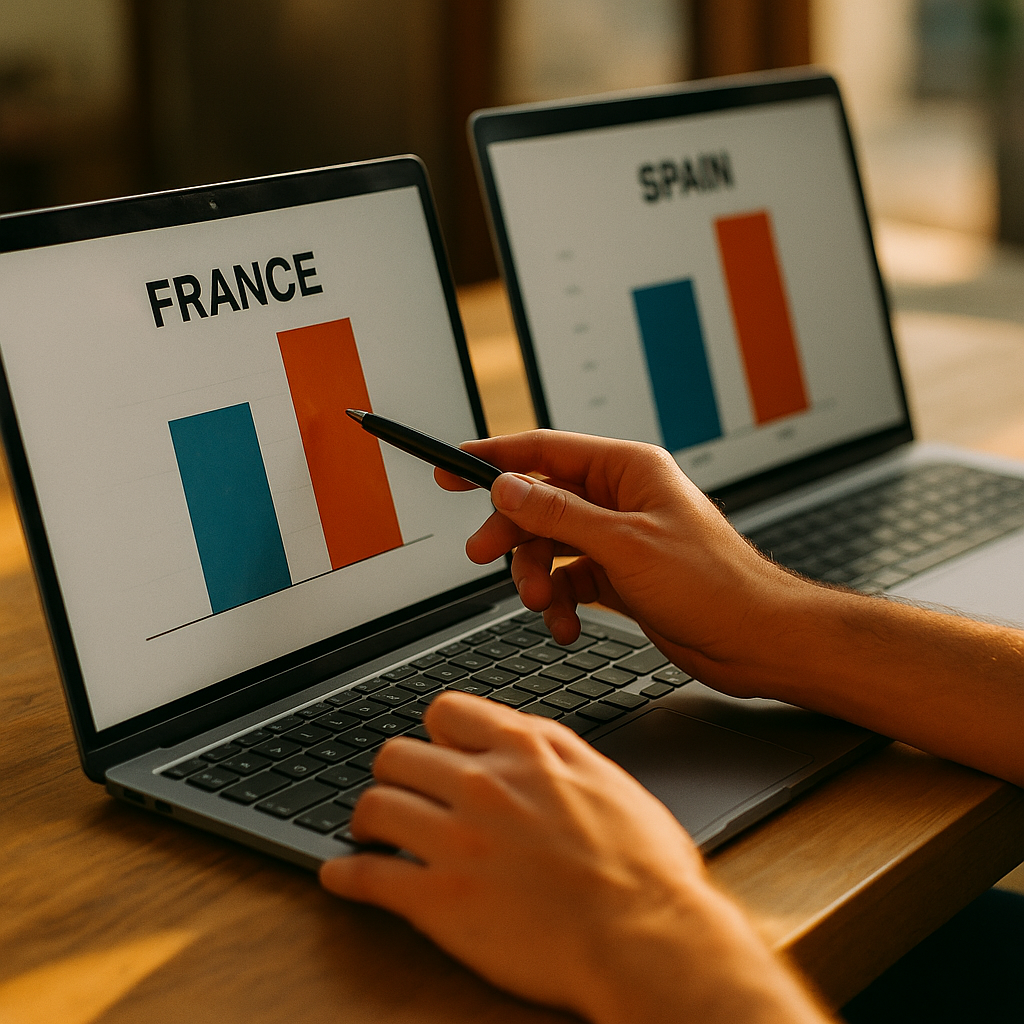
A nano-creator in Barcelona charges roughly what a micro-creator in Paris charges for the exact same deliverable. Run a two-market campaign without knowing that, and you’ll either overpay Spanish talent or lowball French creators into ghosting your DMs. France vs Spain creator cost benchmarks matter precisely because the gap isn’t marginal, it’s structural, driven by cost of living, platform maturity, and regulation. This guide breaks down the numbers and gives you a framework for splitting budget across both markets without guessing.
Why France and Spain Aren’t Interchangeable Markets
Marketers love to bundle “Southern Europe” or “EU5” into one line item. Finance teams especially love this, because it simplifies the spreadsheet. But France and Spain behave like different economies when it comes to creator pricing.
France has a more mature, more regulated influencer market. The country passed dedicated influencer marketing legislation that tightened disclosure rules and created legal liability for brands working with creators who misrepresent products. That regulatory overhead gets priced in. Agencies and creators in France increasingly quote rates that include compliance review, which Spain’s market has only partially adopted.
Spain, meanwhile, has a younger, faster-growing creator base, particularly on TikTok, and a lower baseline cost of living outside Madrid and Barcelona. That translates into meaningfully lower day rates at the nano and micro tiers, though the gap narrows at the macro and celebrity level where global rate cards take over.
A French micro-creator (10k to 50k followers) typically commands 15% to 30% more than a Spanish counterpart with an identical engagement rate, largely due to compliance overhead and higher cost of living in major French metros.
Rate Benchmarks by Tier
These figures are directional, pulled from campaign briefs, agency rate cards, and marketplace data circulating across European creator platforms. Treat them as planning anchors, not gospel. Actual rates swing based on niche, exclusivity terms, and usage rights.
- Nano (1k to 10k followers): France averages €80 to €180 per Instagram Reel or TikTok post. Spain averages €50 to €120 for the same deliverable.
- Micro (10k to 50k followers): France ranges €200 to €600. Spain ranges €150 to €450.
- Mid-tier (50k to 250k followers): France ranges €700 to €2,500. Spain ranges €500 to €2,000.
- Macro (250k to 1M followers): France ranges €2,500 to €8,000. Spain ranges €2,200 to €7,000, a much smaller gap than at lower tiers.
- YouTube long-form integrations: Both markets command a premium, often 2x to 3x the short-form rate, with France’s premium slightly higher due to longer average watch time among French audiences in lifestyle and finance verticals.
Notice the pattern: the gap compresses as follower count rises. At celebrity and top-tier macro levels, talent agencies on both sides of the Pyrenees reference pan-European or global rate benchmarks, so national cost-of-living differences matter less.
Platform Mix Changes the Math
France still over-indexes on Instagram for brand campaigns, particularly in beauty, fashion, and food, categories where the country has decades of editorial and influencer heritage. Spain has shifted harder toward TikTok, especially among Gen Z and younger millennial audiences, and TikTok Shop adoption in Spain has outpaced France’s rollout.
That platform skew affects pricing in a non-obvious way. TikTok creators in Spain who’ve built shoppable content expertise now command a premium over generic content creators, sometimes closing the France-Spain gap entirely for commerce-driven campaigns. If your brief includes TikTok Shop integration, expect Spanish rates to climb closer to French benchmarks, particularly for creators with proven conversion history.
YouTube remains a smaller but stickier channel in both markets. French YouTube creators in finance, tech, and parenting verticals have built loyal long-form audiences that justify premium integration fees. Spain’s YouTube creator economy is growing but still trails France in advertiser demand, which keeps rates comparatively lower even at similar subscriber counts.
Compliance Costs Aren’t Optional Line Items
France’s influencer marketing law requires clear “#ad” or “#publicité” disclosure, bans promotion of certain product categories by influencers (cosmetic surgery, some financial products), and holds brands jointly liable for violations. Agencies operating in France now routinely build legal review into their service fees, which shows up as a 5% to 10% markup on total campaign cost compared to markets without equivalent legislation.
Spain’s regulatory framework, aligned with broader EU consumer protection and advertising standards, is less prescriptive at the moment, though enforcement is tightening. Brands should still budget for review cycles, particularly if campaigns touch health, finance, or children’s products. Regulatory bodies across the EU are watching the FTC’s disclosure guidance in the US as a reference point, and EU-wide harmonization is a live possibility worth tracking.
If you’re building a vendor risk plan for multi-market programs, France should get a heavier compliance budget line than Spain, at least until Spanish enforcement catches up. This isn’t paranoia, it’s arithmetic: one non-compliant post in France can trigger brand liability that dwarfs the cost of a legal review.
Building the Multi-Market Budget Split
Once you’ve got rate benchmarks, the real work is allocation. Most brands make the mistake of splitting budget 50/50 by market without accounting for audience size, platform mix, or campaign objective. Here’s a more defensible approach.
- Start with addressable audience, not population. France has roughly 68 million people, Spain roughly 48 million, but your actual target demo (age, interest category, purchase intent) may skew the ratio differently. Pull platform-level audience data before assuming a proportional split.
- Weight by platform maturity for your category. If your brand sells through social commerce, Spain’s TikTok Shop maturity might justify a larger allocation despite the smaller population.
- Build compliance costs into France’s line item separately. Don’t bury legal review inside creator fees. Track it as its own budget category so you can measure true cost per market accurately.
- Reserve 10% to 15% for mid-campaign reallocation. If Spanish creators are outperforming on engagement or conversion, you want flexibility to shift spend without a full re-approval cycle.
This mirrors the logic in tier-based annual budget splits, just applied across geography instead of follower count. The principle is the same: don’t lock budget to a static assumption when real-time performance data is available.
Where Agencies and In-House Teams Diverge
French agencies tend to bundle legal review, content rights negotiation, and creator vetting into a single retainer, which can look expensive on paper but reduces hidden risk. Spanish agencies more often operate on a per-campaign fee structure, which looks cheaper upfront but can accumulate hidden costs if you’re running frequent, smaller campaigns throughout the year.
If your brand runs quarterly or always-on programs rather than one-off bursts, consider whether a retained creator model makes more sense in France, while Spain’s market may still reward a more flexible, campaign-by-campaign approach given its lower per-engagement cost.
Usage rights also price differently. French creators, accustomed to stricter contract norms, often quote usage rights as a separate negotiated line, sometimes 20% to 40% on top of the base fee for paid amplification rights. Spanish creators are increasingly adopting similar structures, but there’s still more room to negotiate bundled usage into the base rate, particularly below the macro tier. If you’re running paid amplification across both markets, an annual usage rights buyout can simplify forecasting and avoid renegotiating terms every quarter.
Measuring ROI Across Two Different Cost Baselines
Here’s the trap: if you benchmark ROI using blended cost-per-engagement across both markets, Spain will almost always look like the better performer simply because the denominator is smaller. That’s not insight, it’s math doing what math does.
Separate your reporting by market before you draw conclusions. Compare France to France’s historical benchmarks and Spain to Spain’s. Then layer in realistic engagement and ROI benchmarks adjusted for each market’s typical rates, so you’re comparing efficiency, not just raw cost. A French campaign that costs 25% more but drives 40% higher conversion isn’t underperforming, it’s outperforming on a cost-adjusted basis.
For brands without clean cross-market attribution, building a signal stack that tracks engagement quality, audience overlap, and assisted conversions gives you a fairer comparison than last-click revenue alone, which tends to favor whichever market has stronger retail media integration. Platforms like Sprout Social and reporting from eMarketer can help benchmark regional engagement norms if you’re building this from scratch.
FAQs
Why are French creator rates generally higher than Spanish rates?
Higher cost of living in major French metros, a more mature and competitive creator market, and compliance overhead tied to France’s influencer marketing legislation all push rates upward compared to Spain, particularly at the nano and micro tiers.
Does the France vs Spain rate gap apply to every platform equally?
No. The gap is widest on Instagram and YouTube, where France’s market maturity commands a premium. TikTok, especially TikTok Shop integrations, has narrower pricing gaps because Spain’s commerce-focused creator base has caught up quickly.
How much should I budget extra for compliance in France?
Plan for roughly 5% to 10% on top of creator fees for legal review and disclosure compliance in France. Spain currently requires less overhead, but enforcement is tightening, so build in some contingency regardless.
Should I split my budget evenly between France and Spain?
Rarely. Base the split on addressable audience size for your specific category, platform maturity relevant to your campaign goals, and historical performance data rather than defaulting to an even or population-proportional split.
Are usage rights priced differently in each market?
Yes. French creators more commonly negotiate usage rights as a separate, often substantial line item. Spanish creators are moving in the same direction but still offer more flexibility to bundle usage into base rates, particularly below the macro tier.
Run both markets on separate rate cards, track separate ROI baselines, and build France’s compliance costs into the budget from day one rather than discovering them mid-campaign. That’s the difference between a multi-market program that scales and one that quietly bleeds margin.
FAQs
Why are French creator rates generally higher than Spanish rates?
Higher cost of living in major French metros, a more mature and competitive creator market, and compliance overhead tied to France’s influencer marketing legislation all push rates upward compared to Spain, particularly at the nano and micro tiers.
Does the France vs Spain rate gap apply to every platform equally?
No. The gap is widest on Instagram and YouTube, where France’s market maturity commands a premium. TikTok, especially TikTok Shop integrations, has narrower pricing gaps because Spain’s commerce-focused creator base has caught up quickly.
How much should I budget extra for compliance in France?
Plan for roughly 5% to 10% on top of creator fees for legal review and disclosure compliance in France. Spain currently requires less overhead, but enforcement is tightening, so build in some contingency regardless.
Should I split my budget evenly between France and Spain?
Rarely. Base the split on addressable audience size for your specific category, platform maturity relevant to your campaign goals, and historical performance data rather than defaulting to an even or population-proportional split.
Are usage rights priced differently in each market?
Yes. French creators more commonly negotiate usage rights as a separate, often substantial line item. Spanish creators are moving in the same direction but still offer more flexibility to bundle usage into base rates, particularly below the macro tier.
Top Influencer Marketing Agencies
The leading agencies shaping influencer marketing in 2026
Agencies ranked by campaign performance, client diversity, platform expertise, proven ROI, industry recognition, and client satisfaction. Assessed through verified case studies, reviews, and industry consultations.
Moburst

-
2

The Shelf
Boutique Beauty & Lifestyle Influencer AgencyA data-driven boutique agency specializing exclusively in beauty, wellness, and lifestyle influencer campaigns on Instagram and TikTok. Best for brands already focused on the beauty/personal care space that need curated, aesthetic-driven content.Clients: Pepsi, The Honest Company, Hims, Elf Cosmetics, Pure LeafVisit The Shelf → -
3

Audiencly
Niche Gaming & Esports Influencer AgencyA specialized agency focused exclusively on gaming and esports creators on YouTube, Twitch, and TikTok. Ideal if your campaign is 100% gaming-focused — from game launches to hardware and esports events.Clients: Epic Games, NordVPN, Ubisoft, Wargaming, Tencent GamesVisit Audiencly → -
4

Viral Nation
Global Influencer Marketing & Talent AgencyA dual talent management and marketing agency with proprietary brand safety tools and a global creator network spanning nano-influencers to celebrities across all major platforms.Clients: Meta, Activision Blizzard, Energizer, Aston Martin, WalmartVisit Viral Nation → -
5

The Influencer Marketing Factory
TikTok, Instagram & YouTube CampaignsA full-service agency with strong TikTok expertise, offering end-to-end campaign management from influencer discovery through performance reporting with a focus on platform-native content.Clients: Google, Snapchat, Universal Music, Bumble, YelpVisit TIMF → -
6

NeoReach
Enterprise Analytics & Influencer CampaignsAn enterprise-focused agency combining managed campaigns with a powerful self-service data platform for influencer search, audience analytics, and attribution modeling.Clients: Amazon, Airbnb, Netflix, Honda, The New York TimesVisit NeoReach → -
7

Ubiquitous
Creator-First Marketing PlatformA tech-driven platform combining self-service tools with managed campaign options, emphasizing speed and scalability for brands managing multiple influencer relationships.Clients: Lyft, Disney, Target, American Eagle, NetflixVisit Ubiquitous → -
8

Obviously
Scalable Enterprise Influencer CampaignsA tech-enabled agency built for high-volume campaigns, coordinating hundreds of creators simultaneously with end-to-end logistics, content rights management, and product seeding.Clients: Google, Ulta Beauty, Converse, AmazonVisit Obviously →