


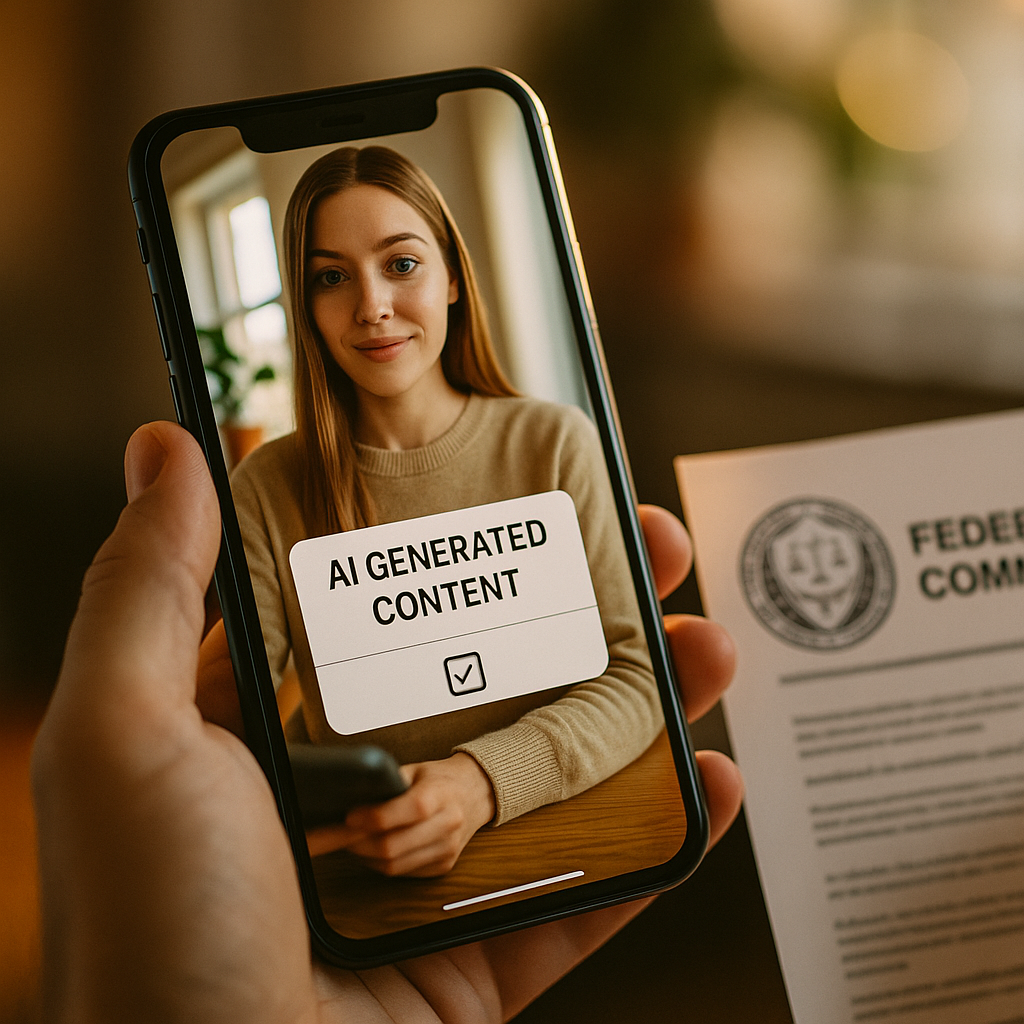
Would you know if that glowing “customer review” was never filmed by a customer at all? A growing share of branded UGC now comes from AI generators like Synthesia, Arcads, and Captions, and most of it carries no disclosure whatsoever. AI generated UGC disclosure is quickly becoming the compliance question that catches marketing teams flat footed, because the old labeling playbook assumed a human was always on camera.
That assumption is dead. And the FTC isn’t waiting for brands to catch up.
The Problem: Synthetic Faces, Real Legal Exposure
UGC style ads work because they look unscripted. A person talks to their phone camera, shares a genuine reaction, and the audience trusts it precisely because it doesn’t look like an ad. Brands have leaned hard into this format, spending aggressively on “testimonial style” creative that outperforms polished studio spots on conversion.
Now swap the human for an AI avatar. The format looks identical, the persuasion mechanics are identical, but the person doesn’t exist. No one actually used the product. No one actually had the reaction shown on screen. That’s not a style choice anymore, it’s a potential misrepresentation, and it sits squarely inside the FTC’s definition of deceptive advertising when the synthetic nature isn’t disclosed.
If an ad format’s entire credibility rests on looking like a real person’s unscripted opinion, using a synthetic actor without disclosure isn’t a gray area. It’s the exact deception the format was designed to avoid.
Brand legal teams have started treating this as its own risk category, distinct from traditional influencer disclosure failures. Our earlier look at AI synthetic endorsers covered the baseline FTC exposure. Synthetic UGC raises the stakes further because the format itself is built to disguise the fact that it’s an advertisement at all.
What Counts as “Synthetic” for Disclosure Purposes?
Marketing teams keep asking where the line sits. Is a voice over lightly cleaned up with AI tools synthetic? What about a real creator whose video was edited with AI to swap backgrounds? Here’s a working framework that holds up under scrutiny:
- Fully AI generated avatar or voice: no real person involved in the performance. Disclosure required, full stop.
- Real creator, AI generated script or voice clone: the face is real but the words or voice weren’t theirs. Requires disclosure of AI involvement plus material connection disclosure.
- Real creator, AI editing only (color grading, background removal, noise reduction): generally not a disclosure trigger, since the underlying endorsement and performance are genuine.
- AI generated “customer reactions” or composite testimonials: high risk. These mimic real review formats and courts have historically treated fabricated testimonials harshly.
The test the FTC applies isn’t “did you use software,” it’s “would a reasonable consumer be misled about whether this is a real person’s genuine experience.” That standard hasn’t changed with AI, it’s just being applied to a new production method. For a deeper breakdown of where brand liability starts, see our piece on AI generated brand mentions and the endorsement liability gap they create.
Why Brands Keep Getting This Wrong
Three recurring mistakes show up across the campaigns that have drawn regulator attention or public backlash.
First, teams treat AI UGC as a production shortcut, not a legal category. The creative brief focuses on cost savings and turnaround time, not disclosure requirements. Legal review gets skipped because “it’s not an influencer, it’s just a video asset.”
Second, labels get buried or made illegible. A tiny “AI generated” watermark in the corner of a nine second TikTok clip doesn’t meet the FTC’s “clear and conspicuous” bar. Platforms are starting to build native AI labeling tools (Meta and TikTok both rolled out AI content tags), but relying solely on a platform level tag without a verbal or on screen disclosure is risky if the platform tag gets stripped on download and reshare.
Third, agencies and freelance AI studios don’t flag synthetic content to the brand. A performance marketing vendor delivers a batch of “UGC style ads” without specifying which were filmed and which were generated. The brand runs them without knowing the difference, and the compliance gap becomes the brand’s problem, not the vendor’s, the moment a complaint lands.
A 2024 Edelman trust study found consumers are over three times more likely to distrust a brand after discovering undisclosed AI content than after discovering a paid but disclosed partnership. Disclosure isn’t just compliance, it’s the cheaper outcome.
Building a Disclosure Standard That Actually Scales
Here’s what a workable internal policy looks like for brands running AI generated UGC at volume.
- Tag content at the production stage, not the publishing stage. Every asset gets a metadata flag the moment it’s generated: human-filmed, AI-generated, or hybrid. This should live in your asset management system, not in someone’s memory.
- Standardize the disclosure language across formats. “This video features an AI generated spokesperson” or “Avatar created with AI, not an actual customer” placed in the first three seconds of video and in the caption. Don’t bury it in a hashtag block.
- Apply platform native AI labels in addition to, not instead of, your own disclosure. Use both. Redundancy here is a feature, not inefficiency.
- Contractually require AI UGC vendors to disclose synthetic content status. Build this into vendor agreements the same way you’d require usage rights documentation. If you work with AI matching platforms or UGC marketplaces, check their terms against the standard set in our AI matching platform terms review.
- Route all synthetic content through the same compliance sign off as influencer content. Many brands already have a fast lane for this; see how finance and regulated verticals handle it in our guide to compliance sign off workflows.
Notice none of this requires you to stop using AI UGC. It requires you to stop pretending it’s the same thing as footage of a real customer.
Regional Variation: One Label Doesn’t Fit All Markets
US brands often assume an FTC compliant disclosure travels internationally. It doesn’t. The UK’s Advertising Standards Authority and the EU’s Digital Services Act both impose their own transparency expectations around synthetic and AI generated commercial content, and some EU member states are moving toward explicit AI labeling mandates independent of influencer disclosure rules.
If your AI UGC campaign runs across multiple markets, you need a market specific disclosure matrix, not a single global label. This mirrors the complexity brands already manage with the global disclosure template library approach used for human influencer campaigns. The same logic extends to synthetic content: localize the label, don’t just translate it.
It’s also worth tracking how quickly guidance from bodies like the ICO and the FTC is evolving here. Neither has published AI UGC specific rules as a separate category yet, both regulators have signaled that existing endorsement and deception frameworks apply fully to synthetic content, which means waiting for a dedicated rule is a losing strategy.
What This Means for Creative and Media Teams
There’s a tactical wrinkle worth flagging: disclosed AI UGC still converts. Several performance marketers running paid social have reported that clearly labeled “AI spokesperson” ads retain most of their conversion lift versus unlabeled versions, as long as the hook and message quality stay strong. The deception, not the AI itself, was driving the risk. Consumers tolerate synthetic content. They don’t tolerate being fooled by it.
That’s a useful reframe for creative teams resistant to adding labels because they fear it’ll “break the illusion.” The illusion was never the asset’s real value, the message was. Platforms like Meta Business and TikTok Ads now surface performance data by creative type, so you can A/B test disclosed versus undisclosed framing directly and settle the internal debate with numbers instead of opinions.
For benchmarking how AI content is reshaping paid and organic strategy more broadly, eMarketer and Sprout Social both track adoption and consumer sentiment data worth referencing in internal briefs when you’re making the case for a formal disclosure policy.
FAQs
Does AI generated UGC always need an ad disclosure label?
Yes, if the content is used for advertising purposes and features a synthetic person, voice, or fabricated testimonial. The FTC’s deception standard applies regardless of production method; what matters is whether a reasonable consumer would be misled about the content’s authenticity.
Is a platform’s built in AI label enough to satisfy disclosure requirements?
Not on its own. Platform tags can be stripped when content is downloaded or reposted, and they may not meet the “clear and conspicuous” standard the FTC applies. Brands should pair platform labels with their own on screen or verbal disclosure.
What’s the difference between AI edited content and AI generated content for disclosure purposes?
AI editing (color correction, background cleanup) on footage of a real person generally doesn’t require disclosure. AI generated avatars, voices, or scripted “reactions” that replace a real person’s genuine performance do require disclosure.
Who is liable if an AI UGC vendor fails to flag synthetic content?
The brand typically carries the regulatory and reputational exposure once the content is published, even if a vendor or agency produced it. Contracts should explicitly require vendors to disclose synthetic content status before delivery.
Does disclosed AI content hurt ad performance?
Data from brands running side by side tests suggests disclosed AI UGC retains most of its conversion performance compared to undisclosed versions, as long as the core message and hook remain strong. The deception, not the AI itself, is what damages trust.
Visible FAQ (HTML)
If you only take one thing from this: audit your current AI UGC library this quarter, flag every synthetic asset, and get a standardized disclosure template into your creative brief before your next production cycle starts. The brands that build this habit now will avoid the retroactive scramble everyone else is heading toward.
Top Influencer Marketing Agencies
The leading agencies shaping influencer marketing in 2026
Agencies ranked by campaign performance, client diversity, platform expertise, proven ROI, industry recognition, and client satisfaction. Assessed through verified case studies, reviews, and industry consultations.
Moburst

-
2

The Shelf
Boutique Beauty & Lifestyle Influencer AgencyA data-driven boutique agency specializing exclusively in beauty, wellness, and lifestyle influencer campaigns on Instagram and TikTok. Best for brands already focused on the beauty/personal care space that need curated, aesthetic-driven content.Clients: Pepsi, The Honest Company, Hims, Elf Cosmetics, Pure LeafVisit The Shelf → -
3

Audiencly
Niche Gaming & Esports Influencer AgencyA specialized agency focused exclusively on gaming and esports creators on YouTube, Twitch, and TikTok. Ideal if your campaign is 100% gaming-focused — from game launches to hardware and esports events.Clients: Epic Games, NordVPN, Ubisoft, Wargaming, Tencent GamesVisit Audiencly → -
4

Viral Nation
Global Influencer Marketing & Talent AgencyA dual talent management and marketing agency with proprietary brand safety tools and a global creator network spanning nano-influencers to celebrities across all major platforms.Clients: Meta, Activision Blizzard, Energizer, Aston Martin, WalmartVisit Viral Nation → -
5

The Influencer Marketing Factory
TikTok, Instagram & YouTube CampaignsA full-service agency with strong TikTok expertise, offering end-to-end campaign management from influencer discovery through performance reporting with a focus on platform-native content.Clients: Google, Snapchat, Universal Music, Bumble, YelpVisit TIMF → -
6

NeoReach
Enterprise Analytics & Influencer CampaignsAn enterprise-focused agency combining managed campaigns with a powerful self-service data platform for influencer search, audience analytics, and attribution modeling.Clients: Amazon, Airbnb, Netflix, Honda, The New York TimesVisit NeoReach → -
7

Ubiquitous
Creator-First Marketing PlatformA tech-driven platform combining self-service tools with managed campaign options, emphasizing speed and scalability for brands managing multiple influencer relationships.Clients: Lyft, Disney, Target, American Eagle, NetflixVisit Ubiquitous → -
8

Obviously
Scalable Enterprise Influencer CampaignsA tech-enabled agency built for high-volume campaigns, coordinating hundreds of creators simultaneously with end-to-end logistics, content rights management, and product seeding.Clients: Google, Ulta Beauty, Converse, AmazonVisit Obviously →