


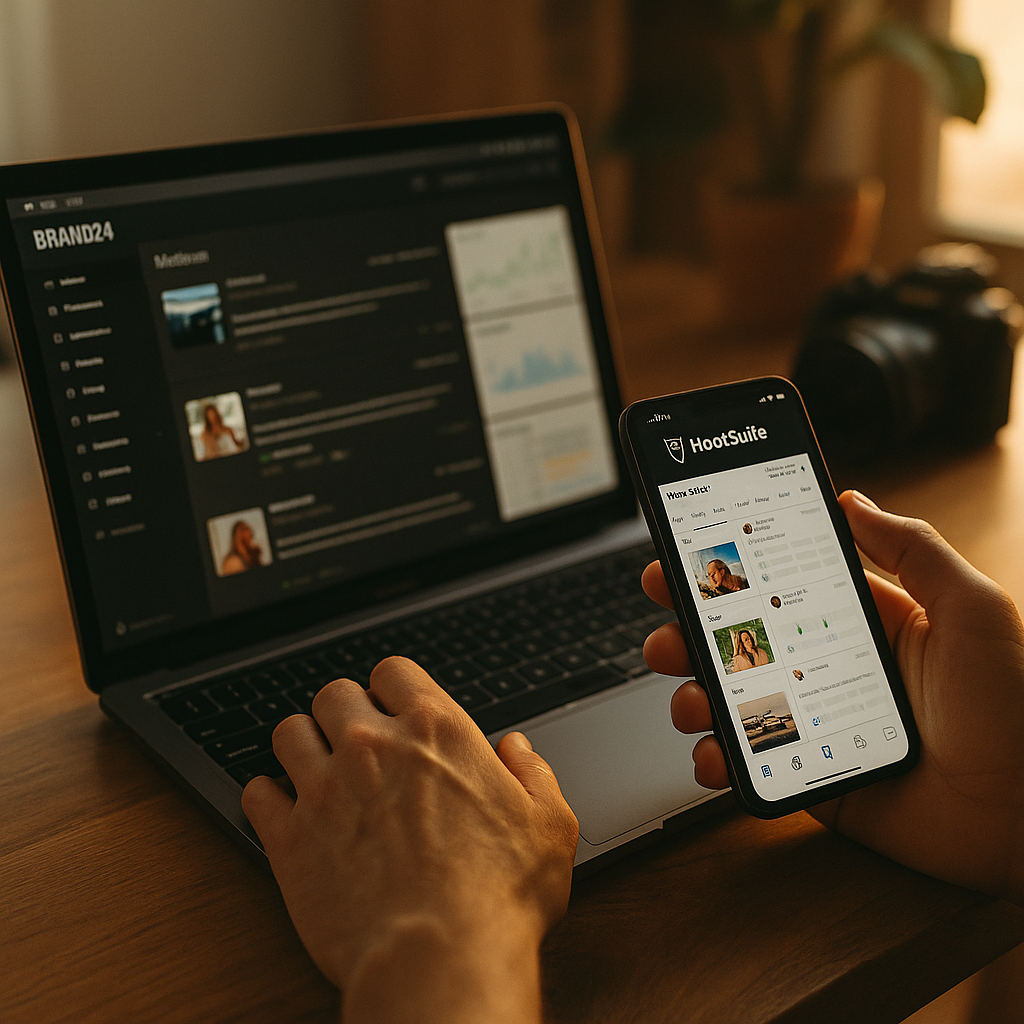
Marketing teams waste an average of six hours a week just hunting for usable user-generated content, according to internal benchmarks from several agency ops teams we’ve spoken with. That’s not a listening problem. That’s a workflow problem. And it’s why the Brand24 vs Hootsuite comparison keeps surfacing in Slack channels where social and content teams argue about which tool actually gets UGC into a campaign faster, not just which tool finds it first.
Both platforms claim real-time monitoring. Both have dashboards, sentiment scores, and export buttons. But “real-time” is doing a lot of marketing lifting in both product pages, and the gap between finding a mention and turning it into a usable asset is where most repurposing workflows actually die.
The Real Bottleneck Isn’t Detection Speed
Every social listening vendor wants you to believe the hard part is catching a mention the second it posts. It isn’t. Both Brand24 and Hootsuite index public mentions within minutes on most networks. The real bottleneck is what happens after detection: rights clearance, asset tagging, handoff to design or paid media, and getting the content into a usable format before the moment passes.
Think about it from a brand strategist’s chair. A UGC clip blows up at 9am. By noon, your competitor has already boosted a paid version of a similar creator moment. If your team is still manually screenshotting posts and pasting links into a shared doc, you’ve lost the window. The tool that wins isn’t the one with the fastest alert. It’s the one that shortens the distance between alert and action.
Speed to detection is a vanity metric if your team still needs 40 minutes of manual work before a mention becomes a usable asset.
Brand24: Built for Narrow, Fast Loops
Brand24 positions itself as a lean listening tool, and that positioning shows up in how it handles UGC. Its strength is speed of surfacing combined with sentiment and influence scoring that’s easy to skim without a training session. For teams running small, focused campaigns, especially around a single hashtag, product launch, or creator partnership, Brand24’s project-based structure makes it fast to isolate the mentions that matter.
Where it genuinely helps repurposing workflows: the “Influencer Score” and reach metrics let a social manager triage which UGC is worth escalating without waiting on an analyst. You can filter by engagement, sort by reach, and export a shortlist in a few clicks. That shortlist becomes the seed for a repurposing brief, whether that’s a paid social ad, a landing page testimonial, or a TikTok Spark Ads submission.
The tradeoff is integration depth. Brand24 doesn’t have the same native publishing or asset-management ecosystem as Hootsuite. If your workflow requires pushing surfaced UGC directly into a content calendar or approval chain, you’re likely exporting to a spreadsheet or a third-party tool like a DAM platform, then manually re-entering data. That extra hop adds friction that smaller teams can absorb but larger, multi-brand organizations often can’t.
Hootsuite: More Muscle, More Steps
Hootsuite’s social listening (through its Talkwalker-powered module in most enterprise tiers) is built for scale. It handles multi-brand monitoring, deeper historical search, and more granular audience segmentation than Brand24. If you’re running listening across a dozen regional accounts or need to track sentiment shifts over quarters rather than days, Hootsuite’s infrastructure is the stronger foundation.
But scale comes with overhead. Hootsuite’s interface, built originally as a publishing and scheduling tool, wasn’t designed around a “find UGC, clear rights, repurpose fast” loop. Surfacing a strong mention often means jumping between the listening module, the streams dashboard, and a separate approval workflow (if your org has one built in Hootsuite Amplify or a connected DAM). Each jump is a place where a fast-moving UGC moment can stall.
That said, Hootsuite’s advantage shows up downstream. Once UGC is approved, its native scheduling and cross-platform publishing means repurposed content can go live without switching tools. For teams that value one platform for listening through publishing, that consolidation has real value, even if the listening-to-clearance step is slower than Brand24’s.
What “Repurposing Speed” Actually Means in Practice
When brand teams say they want faster repurposing, they usually mean one of three things: faster identification of high-performing UGC, faster rights clearance and creator outreach, or faster handoff to whoever builds the final asset. These are different problems, and neither tool solves all three equally well.
- Identification speed: Brand24 tends to win here for smaller, campaign-specific monitoring due to its cleaner filtering and lighter interface.
- Clearance and outreach: Neither tool has strong native creator-rights workflows. Most teams still handle usage rights outside the platform, often through email or a separate contract management tool.
- Handoff to production: Hootsuite edges ahead if your team already publishes through it, since surfaced content can move into a draft post without leaving the ecosystem.
If your team is mid-sized and campaign-driven, Brand24’s simplicity often wins on raw speed. If you’re an enterprise brand running listening across regions and need publishing consolidation, Hootsuite’s broader toolset may offset its slower UGC-to-brief pipeline.
Pricing and the Hidden Cost of Switching Tools Mid-Campaign
Brand24’s entry tiers start noticeably lower than Hootsuite’s listening add-ons, which matter for teams testing UGC-driven campaigns before committing budget. Hootsuite’s enterprise listening tier, bundled with its publishing suite, often requires a larger annual commitment, which can be hard to justify if your team hasn’t yet proven a repeatable UGC repurposing motion.
There’s a real risk in choosing based on price alone, though. Teams that start on Brand24 for its speed and simplicity sometimes hit a wall when campaigns scale across multiple markets or brands, forcing a migration to a more robust tool mid-year. That migration cost, retraining teams, rebuilding saved searches, re-establishing alert thresholds, is rarely factored into the initial tool selection. It’s worth mapping your 12-month campaign roadmap before locking into either platform’s annual contract.
This is the same due-diligence discipline brands should apply to any martech renewal decision, not just listening tools. The vendor renewal audit scorecard approach works just as well here: score the tool against your actual workflow steps, not just its feature list.
Where AI Is Actually Changing the Comparison
Both vendors have leaned into AI-assisted summarization and sentiment classification, but the practical impact on repurposing speed is still uneven. Brand24’s AI-generated summaries help a social manager skim hundreds of mentions in minutes rather than hours. Hootsuite’s AI features lean more toward content suggestions and caption generation, useful once you’ve already decided to repurpose something, but less helpful for the initial triage step.
Neither platform yet offers a mature agentic workflow, where AI not only surfaces UGC but drafts the rights-clearance request, tags the asset, and routes it to the right team automatically. That’s the next frontier for social listening tools, and it echoes what’s happening across martech more broadly, where autonomous next-best-action platforms are starting to close the gap between signal and execution. Brands evaluating listening tools today should ask vendors directly about their agentic roadmap, because the tool you pick now will need to support that shift within a budget cycle or two.
It’s also worth remembering that any AI layer touching creator content raises the same governance questions brands are already wrestling with elsewhere in the stack. If your listening tool’s AI features summarize, tag, or auto-suggest repurposing actions on third-party content, that’s a contractual and compliance conversation, not just a product feature. The same scrutiny applied to AI agent contracts should extend to how listening vendors handle creator content ownership and data retention.
Compliance and Rights: The Part Both Tools Underserve
Surfacing UGC quickly is only valuable if you can legally use it. Neither Brand24 nor Hootsuite handles creator usage rights natively with any real sophistication. Both will show you the mention; neither will confirm you have permission to repost it commercially.
This gap matters more than most teams initially realize. The FTC’s endorsement guidelines and platform-specific rules from networks like Meta and TikTok still require documented consent before brands repurpose creator content in paid media. Speed without a rights-clearance step just means you’re moving faster toward a takedown request or a compliance headache.
Build a lightweight rights-request template into your workflow regardless of which listening tool you choose. A one-line DM or comment asking permission, logged in a shared tracker, closes the gap neither platform fills on its own.
So Which Tool Actually Wins?
If your organization runs lean, campaign-specific UGC pushes and needs a low-friction way to spot and shortlist strong creator content fast, Brand24 is the better fit for repurposing speed. Its interface removes steps rather than adding them.
If you’re managing listening across multiple brands or regions and already publish through Hootsuite, the consolidation benefit likely outweighs its slower initial triage. You’re trading a few extra clicks at the top of the funnel for a smoother path once content is cleared.
Neither tool is a complete repurposing engine. Both require a rights-clearance layer and a clear internal handoff process to actually turn speed-to-detection into speed-to-publish. According to Sprout Social’s industry research, brands that formalize UGC workflows see measurably faster campaign turnaround than those relying on ad hoc processes, regardless of which listening tool sits underneath.
The tool matters less than the workflow wrapped around it. Pick the platform that fits your team’s existing publishing habits, then fix the rights-clearance gap yourself.
Run a two-week side-by-side pilot on your next campaign: track actual hours from mention detection to published repurposed asset in both tools, not just alert speed. The tool that shortens that full cycle, not the one with the flashier dashboard, is the one worth the contract.
FAQs
Is Brand24 or Hootsuite better for real-time UGC monitoring?
Brand24 generally offers faster, simpler triage for real-time UGC monitoring on focused campaigns, while Hootsuite offers deeper scale and multi-brand monitoring at the cost of a more complex interface.
Do either of these tools handle creator usage rights?
No. Neither Brand24 nor Hootsuite natively manages usage rights or consent documentation. Brands need a separate process, even a simple tracked template, to request and log permission before repurposing UGC commercially.
Which tool is cheaper for small marketing teams?
Brand24’s entry-level pricing tiers are typically lower than Hootsuite’s listening add-ons, making it a more accessible starting point for smaller teams testing UGC-driven repurposing workflows.
Can these tools automatically push UGC into a content calendar?
Hootsuite has an advantage here since its listening module connects to its native publishing and scheduling tools. Brand24 typically requires exporting surfaced content into a separate calendar or DAM tool.
What should brands prioritize when comparing social listening tools for repurposing?
Prioritize the full cycle time from mention detection to published asset, not just alert speed. Also evaluate how each tool supports rights clearance, team handoffs, and integration with existing publishing workflows.
FAQs
Top Influencer Marketing Agencies
The leading agencies shaping influencer marketing in 2026
Agencies ranked by campaign performance, client diversity, platform expertise, proven ROI, industry recognition, and client satisfaction. Assessed through verified case studies, reviews, and industry consultations.
Moburst

-
2

The Shelf
Boutique Beauty & Lifestyle Influencer AgencyA data-driven boutique agency specializing exclusively in beauty, wellness, and lifestyle influencer campaigns on Instagram and TikTok. Best for brands already focused on the beauty/personal care space that need curated, aesthetic-driven content.Clients: Pepsi, The Honest Company, Hims, Elf Cosmetics, Pure LeafVisit The Shelf → -
3

Audiencly
Niche Gaming & Esports Influencer AgencyA specialized agency focused exclusively on gaming and esports creators on YouTube, Twitch, and TikTok. Ideal if your campaign is 100% gaming-focused — from game launches to hardware and esports events.Clients: Epic Games, NordVPN, Ubisoft, Wargaming, Tencent GamesVisit Audiencly → -
4

Viral Nation
Global Influencer Marketing & Talent AgencyA dual talent management and marketing agency with proprietary brand safety tools and a global creator network spanning nano-influencers to celebrities across all major platforms.Clients: Meta, Activision Blizzard, Energizer, Aston Martin, WalmartVisit Viral Nation → -
5

The Influencer Marketing Factory
TikTok, Instagram & YouTube CampaignsA full-service agency with strong TikTok expertise, offering end-to-end campaign management from influencer discovery through performance reporting with a focus on platform-native content.Clients: Google, Snapchat, Universal Music, Bumble, YelpVisit TIMF → -
6

NeoReach
Enterprise Analytics & Influencer CampaignsAn enterprise-focused agency combining managed campaigns with a powerful self-service data platform for influencer search, audience analytics, and attribution modeling.Clients: Amazon, Airbnb, Netflix, Honda, The New York TimesVisit NeoReach → -
7

Ubiquitous
Creator-First Marketing PlatformA tech-driven platform combining self-service tools with managed campaign options, emphasizing speed and scalability for brands managing multiple influencer relationships.Clients: Lyft, Disney, Target, American Eagle, NetflixVisit Ubiquitous → -
8

Obviously
Scalable Enterprise Influencer CampaignsA tech-enabled agency built for high-volume campaigns, coordinating hundreds of creators simultaneously with end-to-end logistics, content rights management, and product seeding.Clients: Google, Ulta Beauty, Converse, AmazonVisit Obviously →