


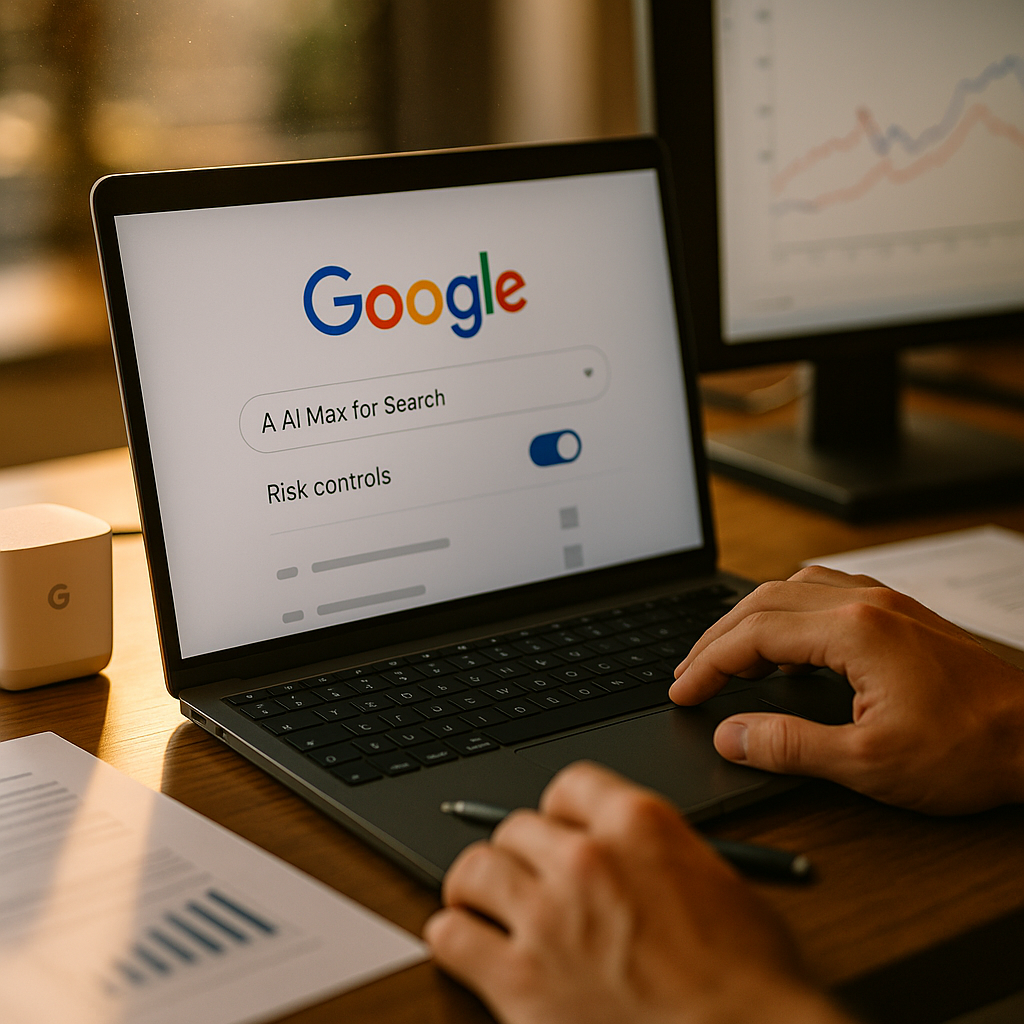
Seventy-six percent of Google Search queries now trigger some form of AI-generated overlay, according to internal Google disclosures shared with advertisers this year. Google AI Max for Search is the company’s answer to a question brands have been asking nervously: how do we still show up when the answer box eats the click? Ten clicks get you live. Understanding what those clicks actually change takes a little longer.
What Google AI Max for Search Actually Is
Google AI Max for Search isn’t a new campaign type. It’s a bundle of AI-driven expansions — broader match logic, automatically generated assets, and URL expansion — layered onto existing Search campaigns. Think of it as Google’s way of pushing Performance Max-style automation into the search query itself, rather than just across placements.
For brand marketers, that distinction matters. Performance Max blends search, display, YouTube, and Discovery into one automated pool. AI Max stays inside Search, but loosens the reins on match types and creative generation so campaigns can respond to the long, conversational queries that now dominate AI Overviews and Gemini-assisted search sessions.
The core shift: you’re no longer bidding on keywords you wrote. You’re bidding on intent clusters Google’s models infer from your landing pages, existing ads, and site content.
The 10-Click Setup, Step by Step
Here’s the walkthrough, stripped of Google’s usual help-center padding.
- Click 1: Open an existing Search campaign (or create new) in Google Ads.
- Click 2: Navigate to campaign settings, scroll to “AI Max for Search.”
- Click 3: Toggle it on. This unlocks the sub-settings panel.
- Click 4: Enable “Search term matching” (broadens beyond your set match types).
- Click 5: Enable “Final URL expansion” if you want Google to route clicks to any page on your domain, not just what you specified.
- Click 6: Set brand exclusions (critical — more on this below).
- Click 7: Turn on AI-generated assets (auto headlines and descriptions pulled from your site copy).
- Click 8: Review the asset preview panel and remove anything off-brand or legally risky.
- Click 9: Confirm reporting labels so AI Max traffic is segmented, not blended, in your dashboards.
- Click 10: Save and publish.
Ten clicks, maybe four minutes. That speed is exactly why it deserves more scrutiny than a typical settings toggle. You’re handing Google discretion over match expansion, creative generation, and landing page selection in a single motion.
The Setting Everyone Skips (Click 6)
Brand exclusions get glossed over because they feel optional. They’re not. Without them, AI Max’s expanded matching can pull in competitor comparison queries, unrelated product categories, or — in regulated industries — search terms that trip compliance filters. Agencies running multi-client accounts should treat this click as mandatory, not a nice-to-have. Set negative keyword lists and brand-safety exclusions before you ever hit publish, not after the first anomaly report.
Why This Changes Campaign Structure, Not Just Settings
The old model of campaign structure was tidy: tight ad groups, single-intent keyword clusters, granular bid control. AI Max quietly breaks that model. When Google is matching against inferred intent rather than exact strings, the value of hyper-segmented ad groups drops. What replaces it is thematic structuring — grouping by business objective or landing page cluster instead of keyword granularity.
Practically, that means fewer, broader campaigns with stronger asset libraries feeding them. Agencies used to building 40-ad-group accounts for a single client will find that structure fights against how AI Max actually optimizes. It wants signal density, not segmentation purity.
This is the same pattern we’ve tracked across the broader AI-native martech shift — automation rewards consolidated signal over manual precision. The same logic is playing out in suite consolidation trends where fragmented best-of-breed stacks are losing ground to unified data pools that AI systems can actually learn from.
The ROI Question Nobody Wants to Answer Yet
Early adopters are reporting mixed results, which is normal for any Google automation rollout in its first cycle. Some brands see conversion volume up 15-20% with stable CPA. Others see volume climb while lead quality craters, because expanded matching pulled in adjacent-but-irrelevant intent.
The honest answer: it depends heavily on how clean your existing conversion tracking and audience signals already are. AI Max amplifies whatever signal quality you’re feeding it. Feed it noisy data, get noisy expansion.
This is where attribution hygiene stops being a nice-to-have and becomes the gating factor for whether AI Max is even worth testing. If your GA4 setup and Google Ads conversion actions aren’t already aligned, you’ll misread AI Max’s performance entirely, crediting or blaming automation for what’s actually a tracking gap. It’s worth reviewing how AI-driven channel grouping compares against third-party attribution before drawing conclusions from AI Max reporting alone.
If you can’t already trust your last-click and assisted-conversion data, AI Max won’t fix that. It will scale it.
Compliance and Brand Safety: The Part Google’s Docs Underplay
AI-generated ad copy pulled from your site content sounds efficient until legal asks who approved the claims in it. Auto-generated headlines can inadvertently surface pricing, promotional language, or comparative claims that never went through review. For regulated categories — finance, health, insurance — this is not a theoretical risk.
Build a review cadence: check the AI Max asset panel weekly, not just at launch. Google updates generated assets dynamically as it learns what performs, which means copy that passed review in week one can drift by week four.
This mirrors a broader governance problem the industry is only now taking seriously. As more ad platforms let AI agents generate and place creative with minimal human sign-off, the contractual and audit expectations brands set with vendors need to catch up. The same due-diligence logic outlined in martech contract standards for AI agents applies directly here — you need audit logs, rollback controls, and clear ownership of generated claims before you scale spend through automated systems.
For teams running multi-market campaigns, the URL expansion setting deserves particular caution. Letting Google route traffic to any page on your domain is efficient for a single-market English site. It gets messier fast when you have localized pages with region-specific claims, pricing, or legal disclaimers that shouldn’t cross borders.
How This Fits the Bigger AI Ad Platform Shift
Google isn’t moving alone here. Meta’s Advantage+ campaigns, TikTok’s Smart+ tools, and even X’s advertiser-facing AI agents are all converging on the same idea: fewer manual levers, more automated inference, faster iteration cycles. Brands comparing platform investments should look at this holistically rather than platform by platform. We’ve broken down how these approaches diverge in AI ad activation comparisons across major platforms, and the pattern holds: whoever has the cleanest first-party data wins the automation dividend, regardless of which platform they’re running it on.
For teams weighing whether AI Max deserves a full budget shift or a cautious test bucket, that data-readiness question should come before the platform question. Google’s own Search advertiser support resources outline the mechanics well; they say far less about the organizational readiness required to use them safely.
Industry data from eMarketer shows AI-assisted search ad spend climbing sharply as a share of total search budgets, a trend echoed in survey data from Statista on marketer adoption of automated bidding and creative tools. The direction is clear. The execution risk is where most teams are underprepared.
A Note on Attribution and Reporting Segmentation
Click 9 in the setup — labeling AI Max traffic separately — is easy to skip but essential for honest measurement. Blend it into your standard Search reporting and you lose the ability to isolate whether performance shifts are coming from broader matching, new creative, or URL expansion. Segment it, and you can actually run a controlled comparison against your legacy Search campaigns for at least one full reporting cycle before reallocating budget. Teams already wrestling with attribution fragmentation across channels should treat this the same way they’d treat any new data source entering a clean room evaluation: verify before you trust.
Getting Started Without Getting Burned
Run AI Max on a secondary or lower-stakes campaign first. Set brand exclusions before publishing, not after. Segment reporting from day one. Review generated assets weekly for the first month, then biweekly once patterns stabilize. And don’t let the ten-click simplicity fool you into treating this as a minor settings change — it’s a structural shift in how Google decides who sees your ads, which means your campaign architecture, review processes, and attribution setup all need to catch up before budget follows.
Frequently Asked Questions
What is Google AI Max for Search?
It’s an automation layer added to standard Google Search campaigns that expands keyword matching, generates ad assets automatically, and can route clicks to any page on your site through final URL expansion.
How long does it take to set up Google AI Max for Search?
The core toggle-and-configure process takes about ten clicks and a few minutes inside Google Ads. The harder part is configuring brand exclusions and reporting segmentation properly before launch.
Does AI Max replace Performance Max campaigns?
No. Performance Max spans multiple placements including YouTube and Display. AI Max stays within Search but applies similar AI-driven matching and asset generation logic specifically to search query intent.
Is Google AI Max for Search safe for regulated industries?
It can be, but only with active oversight. Auto-generated ad copy needs regular legal and compliance review since Google can update generated assets dynamically without additional approval.
Will AI Max hurt my campaign’s keyword-level reporting?
It reduces the value of granular keyword-level structure since matching shifts toward inferred intent. Reporting should be segmented by campaign objective and landing page cluster rather than individual keywords.
Should agencies test AI Max across all client accounts immediately?
No. Test on a secondary campaign first, verify signal quality and conversion tracking accuracy, then expand once you have at least one full reporting cycle of segmented data to evaluate.
Top Influencer Marketing Agencies
The leading agencies shaping influencer marketing in 2026
Agencies ranked by campaign performance, client diversity, platform expertise, proven ROI, industry recognition, and client satisfaction. Assessed through verified case studies, reviews, and industry consultations.
Moburst

-
2

The Shelf
Boutique Beauty & Lifestyle Influencer AgencyA data-driven boutique agency specializing exclusively in beauty, wellness, and lifestyle influencer campaigns on Instagram and TikTok. Best for brands already focused on the beauty/personal care space that need curated, aesthetic-driven content.Clients: Pepsi, The Honest Company, Hims, Elf Cosmetics, Pure LeafVisit The Shelf → -
3

Audiencly
Niche Gaming & Esports Influencer AgencyA specialized agency focused exclusively on gaming and esports creators on YouTube, Twitch, and TikTok. Ideal if your campaign is 100% gaming-focused — from game launches to hardware and esports events.Clients: Epic Games, NordVPN, Ubisoft, Wargaming, Tencent GamesVisit Audiencly → -
4

Viral Nation
Global Influencer Marketing & Talent AgencyA dual talent management and marketing agency with proprietary brand safety tools and a global creator network spanning nano-influencers to celebrities across all major platforms.Clients: Meta, Activision Blizzard, Energizer, Aston Martin, WalmartVisit Viral Nation → -
5

The Influencer Marketing Factory
TikTok, Instagram & YouTube CampaignsA full-service agency with strong TikTok expertise, offering end-to-end campaign management from influencer discovery through performance reporting with a focus on platform-native content.Clients: Google, Snapchat, Universal Music, Bumble, YelpVisit TIMF → -
6

NeoReach
Enterprise Analytics & Influencer CampaignsAn enterprise-focused agency combining managed campaigns with a powerful self-service data platform for influencer search, audience analytics, and attribution modeling.Clients: Amazon, Airbnb, Netflix, Honda, The New York TimesVisit NeoReach → -
7

Ubiquitous
Creator-First Marketing PlatformA tech-driven platform combining self-service tools with managed campaign options, emphasizing speed and scalability for brands managing multiple influencer relationships.Clients: Lyft, Disney, Target, American Eagle, NetflixVisit Ubiquitous → -
8

Obviously
Scalable Enterprise Influencer CampaignsA tech-enabled agency built for high-volume campaigns, coordinating hundreds of creators simultaneously with end-to-end logistics, content rights management, and product seeding.Clients: Google, Ulta Beauty, Converse, AmazonVisit Obviously →