


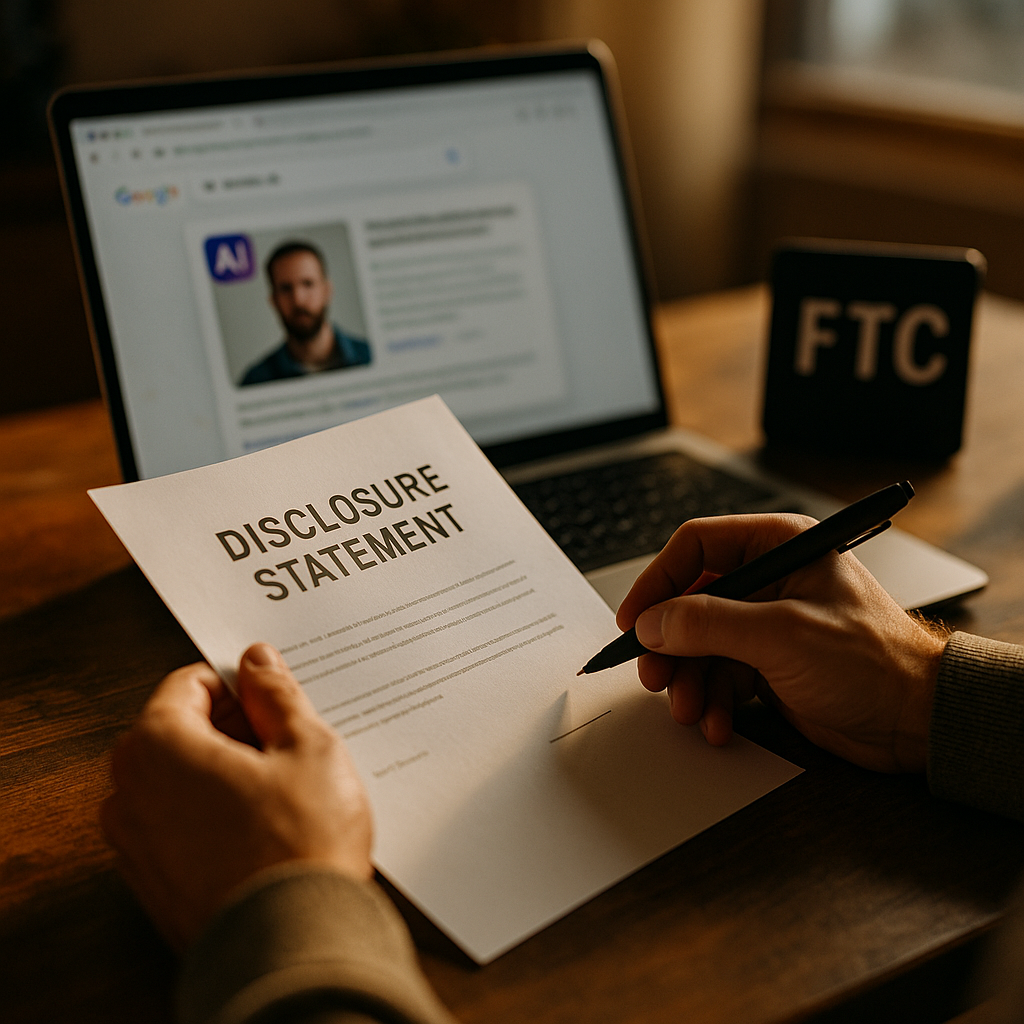
Zero-click citations from AI search engines now surface creator content without a single visitor ever landing on the original post. No click, no view, no context — just a snippet and a name. So who’s liable when that snippet omits a paid partnership disclosure? If you answered “the creator,” you’re only half right, and that half-right answer is exactly why FTC disclosure language for AI search-cited creator content needs a rewrite.
The Problem Nobody Budgeted For
Traditional influencer disclosure was built for a linear journey: creator posts, consumer sees post, consumer clicks or scrolls past. The FTC’s Endorsement Guides assume the audience actually encounters the content in its native environment, hashtags and all.
AI search changes that entirely. Tools like Google’s AI Overviews, Perplexity, and ChatGPT’s browsing mode now pull excerpts, paraphrase claims, and cite creator content as a source — often stripping away the exact disclosure language brands worked so hard to embed. A creator’s “#ad” tag at the bottom of a caption doesn’t survive the summarization process. The consumer sees a confident, seemingly neutral answer, generated by an AI, that happens to be sourced from paid content. They never click through. They never see the disclosure. They never know it was sponsored at all.
If an AI engine cites your creator’s sponsored review and strips the disclosure in the process, the FTC doesn’t care that a human never wrote the summary — the material connection still needed to be clear “at all times,” regardless of the format that reaches the consumer.
Does the FTC’s Rule Actually Cover This?
Short answer: yes, functionally. The FTC’s Endorsement Guides require that a material connection be “clearly and conspicuously disclosed” and that disclosure be unavoidable regardless of how the endorsement is republished, screenshotted, or excerpted. The Commission has never carved out an exception for AI intermediaries. Our earlier analysis on undisclosed AI citations creating Section 5 risk covers the enforcement theory in depth — the short version is that “I didn’t control how the AI summarized it” is not a defense the FTC has ever accepted for any other redistribution channel, and there’s no reason to expect it will accept it here.
Think about it from a risk perspective. A brand’s job isn’t just to make sure disclosure exists somewhere in the original post. It’s to make sure the likelihood of exposure without disclosure is minimized wherever that content might travel. AI search is now one of those travel paths, and arguably the fastest-growing one. eMarketer has tracked accelerating adoption of AI-powered search interfaces among younger consumers, precisely the demographic most likely to encounter creator content through a zero-click AI answer instead of a native app scroll.
Why “Put It in the Caption” No Longer Works
Every legacy disclosure strategy relies on placement: front-load the hashtag, keep it above the “more” fold, verbally disclose in the first eight seconds of video. All of that logic assumes a human eyeball on the original post.
AI citation engines don’t respect fold placement. They extract based on relevance and semantic weight, not brand-friendly formatting. A disclosure buried at the bottom of a 400-word caption might get cut entirely from a 40-word AI summary. Worse, some AI tools synthesize claims across multiple sources, blending a disclosed creator post with an undisclosed competitor review into a single generated answer — at which point the disclosure doesn’t just get lost, it becomes actively misleading because the AI presents unified, seemingly independent information.
This is structurally similar to a problem we’ve flagged before with automated ad approval: when a machine handles distribution decisions, someone still has to own the liability question. See our breakdown of AI auto-approving creative without human review for the parallel logic — the technology doesn’t remove the compliance obligation, it just obscures who’s supposed to be watching.
A Structural Fix: Disclosure That Survives Extraction
If AI engines extract based on semantic relevance, then disclosure language has to become semantically inseparable from the claim itself. That’s the core strategic shift brands need to make. Instead of treating disclosure as a bolt-on element (hashtag, caption footer, verbal aside), treat it as part of the sentence structure the AI is most likely to lift.
- Embed disclosure in the claim sentence itself. Instead of “This serum changed my skin. #ad” write “As a paid partner with [Brand], I tested this serum for 30 days.” The disclosure and the claim are now one extractable unit.
- Repeat the disclosure in multiple structural locations. Caption open, mid-content, and metadata/alt-text where platforms allow it. Redundancy increases the odds at least one instance survives summarization.
- Use plain declarative language, not stylized hashtags. AI summarization models are trained on natural language patterns. “#sponsored” is more likely to be filtered out as noise than “This is a sponsored post from [Brand].”
- Avoid relying on video-only disclosure. Many AI search tools transcribe audio or index video captions unevenly. A disclosure spoken once at second three of a 60-second clip may never make it into a transcript-based citation.
None of this guarantees an AI engine will preserve the disclosure. But it dramatically improves the odds, and it builds a defensible compliance record showing the brand took reasonable steps — which is exactly the kind of documentation the FTC weighs in enforcement actions.
Contract Language Brands Need to Add Now
Creator agreements written even eighteen months ago almost certainly don’t account for AI citation risk. That’s a gap legal and brand teams need to close in the next contract cycle, not the next renewal cycle.
Specific clauses worth adding:
- Requirements that disclosure language appear in a structurally redundant format (caption open, mid-content restatement, alt-text where supported).
- A warranty that the creator won’t edit or shorten disclosure language in ways that reduce AI-extraction survivability.
- An audit right allowing the brand to periodically check how content is being surfaced in major AI search tools, not just how it appears on the native platform.
- Indemnification language addressing scenarios where third-party AI summarization strips disclosure despite compliant original posting.
This isn’t dramatically different from the material-connection risk brands already manage when creators or editors alter scripts post-approval. Our piece on script editing and material connection risk covers a closely related failure mode: content that looked compliant at approval time but drifted before publication. AI citation is the same drift risk, just introduced after publication instead of before it.
What Legal and Marketing Teams Keep Getting Wrong
The most common mistake? Treating this as a legal-only problem. Compliance teams write a policy, hand it to creators, and consider the box checked. But AI-extraction survivability is fundamentally a content design problem — it requires marketing, creative, and legal working from the same brief.
The second most common mistake is assuming platform-level fixes will solve this. They won’t, at least not soon. Google, OpenAI, and Perplexity have no commercial incentive to preserve brand disclosure formatting; their incentive is concise, readable answers. Waiting for platforms to “fix” citation-stripping is a bet against the platforms’ own product goals.
Brands that wait for AI platforms to solve disclosure preservation are outsourcing a compliance obligation to companies with zero regulatory exposure of their own.
There’s also a documentation gap. If the FTC ever investigates a specific citation instance, brands need to show what disclosure language existed at time of publication, and what reasonable steps were taken to maximize its survivability. That’s an evidentiary trail, not a one-time policy memo. Compare this to the audit disciplines already emerging around data provenance in attribution models — the same rigor about tracing where information came from and how it was transformed applies directly to disclosure survivability in AI citations.
Practical Rollout: What to Change This Quarter
Start with an audit, not a policy rewrite. Pull your top 20 highest-performing creator posts from the last two quarters and run them through Perplexity, ChatGPT search, and Google’s AI Overview. See what gets cited, what gets paraphrased, and whether disclosure survives. This single exercise will tell you more about your actual exposure than any legal memo.
From there:
- Update your creator brief template to require embedded, sentence-level disclosure — not hashtag-dependent disclosure.
- Add AI-citation audit rights to new and renewing creator contracts.
- Set a quarterly cadence for re-testing top content against major AI search tools, since model behavior shifts with every update.
- Loop legal into content review for high-spend campaigns specifically to flag AI-extraction risk, not just platform-compliance risk.
None of this requires a massive budget increase. It requires reallocating existing compliance review time toward a channel most teams haven’t been checking at all. Given how fast AI search adoption is climbing according to Statista’s search behavior tracking, this isn’t a someday problem — it’s a this-quarter problem.
Take the Next Step
Run the citation audit before your next campaign brief goes out, not after a compliance complaint forces the question. Structuring disclosure for extraction survivability is cheap now and expensive to retrofit once the FTC starts asking why a sponsored claim showed up in an AI answer with no disclosure attached.
Frequently Asked Questions
Does the FTC’s Endorsement Guide apply when a consumer never clicks through to the original creator post?
Yes. The FTC’s enforcement theory focuses on whether the material connection was clearly and conspicuously disclosed wherever the endorsement reaches consumers, not whether the consumer visited the original posting environment. A zero-click AI citation is still a place the endorsement “reaches” someone.
Who is liable if an AI search tool strips disclosure language from a compliant creator post?
Liability analysis typically starts with the brand and creator who made the original material connection, since they control the underlying content and contract terms. Third-party AI platforms are a distribution layer, but their behavior doesn’t automatically shift legal responsibility away from the brand.
Can hashtag-only disclosure like #ad survive AI summarization?
Not reliably. AI summarization tools tend to filter stylized hashtags as low-value noise during extraction. Plain declarative disclosure embedded in the sentence structure survives summarization far more consistently.
Should brands add AI-citation clauses to creator contracts?
Yes. Contracts should require structurally redundant disclosure placement, restrict edits that reduce extraction survivability, and grant the brand audit rights to check how content appears across major AI search tools over time.
How often should brands audit creator content against AI search tools?
Quarterly at minimum, given how frequently AI models update their summarization and citation behavior. High-spend campaigns or evergreen content with long shelf lives warrant more frequent checks.
Frequently Asked Questions
Does the FTC’s Endorsement Guide apply when a consumer never clicks through to the original creator post?
Yes. The FTC’s enforcement theory focuses on whether the material connection was clearly and conspicuously disclosed wherever the endorsement reaches consumers, not whether the consumer visited the original posting environment. A zero-click AI citation is still a place the endorsement “reaches” someone.
Who is liable if an AI search tool strips disclosure language from a compliant creator post?
Liability analysis typically starts with the brand and creator who made the original material connection, since they control the underlying content and contract terms. Third-party AI platforms are a distribution layer, but their behavior doesn’t automatically shift legal responsibility away from the brand.
Can hashtag-only disclosure like #ad survive AI summarization?
Not reliably. AI summarization tools tend to filter stylized hashtags as low-value noise during extraction. Plain declarative disclosure embedded in the sentence structure survives summarization far more consistently.
Should brands add AI-citation clauses to creator contracts?
Yes. Contracts should require structurally redundant disclosure placement, restrict edits that reduce extraction survivability, and grant the brand audit rights to check how content appears across major AI search tools over time.
How often should brands audit creator content against AI search tools?
Quarterly at minimum, given how frequently AI models update their summarization and citation behavior. High-spend campaigns or evergreen content with long shelf lives warrant more frequent checks.
Top Influencer Marketing Agencies
The leading agencies shaping influencer marketing in 2026
Agencies ranked by campaign performance, client diversity, platform expertise, proven ROI, industry recognition, and client satisfaction. Assessed through verified case studies, reviews, and industry consultations.
Moburst

-
2

The Shelf
Boutique Beauty & Lifestyle Influencer AgencyA data-driven boutique agency specializing exclusively in beauty, wellness, and lifestyle influencer campaigns on Instagram and TikTok. Best for brands already focused on the beauty/personal care space that need curated, aesthetic-driven content.Clients: Pepsi, The Honest Company, Hims, Elf Cosmetics, Pure LeafVisit The Shelf → -
3

Audiencly
Niche Gaming & Esports Influencer AgencyA specialized agency focused exclusively on gaming and esports creators on YouTube, Twitch, and TikTok. Ideal if your campaign is 100% gaming-focused — from game launches to hardware and esports events.Clients: Epic Games, NordVPN, Ubisoft, Wargaming, Tencent GamesVisit Audiencly → -
4

Viral Nation
Global Influencer Marketing & Talent AgencyA dual talent management and marketing agency with proprietary brand safety tools and a global creator network spanning nano-influencers to celebrities across all major platforms.Clients: Meta, Activision Blizzard, Energizer, Aston Martin, WalmartVisit Viral Nation → -
5

The Influencer Marketing Factory
TikTok, Instagram & YouTube CampaignsA full-service agency with strong TikTok expertise, offering end-to-end campaign management from influencer discovery through performance reporting with a focus on platform-native content.Clients: Google, Snapchat, Universal Music, Bumble, YelpVisit TIMF → -
6

NeoReach
Enterprise Analytics & Influencer CampaignsAn enterprise-focused agency combining managed campaigns with a powerful self-service data platform for influencer search, audience analytics, and attribution modeling.Clients: Amazon, Airbnb, Netflix, Honda, The New York TimesVisit NeoReach → -
7

Ubiquitous
Creator-First Marketing PlatformA tech-driven platform combining self-service tools with managed campaign options, emphasizing speed and scalability for brands managing multiple influencer relationships.Clients: Lyft, Disney, Target, American Eagle, NetflixVisit Ubiquitous → -
8

Obviously
Scalable Enterprise Influencer CampaignsA tech-enabled agency built for high-volume campaigns, coordinating hundreds of creators simultaneously with end-to-end logistics, content rights management, and product seeding.Clients: Google, Ulta Beauty, Converse, AmazonVisit Obviously →